MPEP § 1879
Preparation of the International Preliminary Examination Report
Published Aug 1, 2012United States Patent and Trademark Office
Viewing an earlier, undated versionView current
35
The International Preliminary Examination Report
- (1) The international preliminary examination report shall be established within the prescribed time limit and in the prescribed form.
- (2) The international preliminary examination report shall not contain any statement on the question whether the claimed invention is or seems to be patentable or unpatentable according to any national law. It shall state, subject to the provisions of paragraph (3), in relation to each claim, whether the claim appears to satisfy the criteria of novelty, inventive step (non-obviousness), and industrial applicability, as defined for the purposes of the international preliminary examination in Article 33 (1) to (4). The statement shall be accompanied by the citation of the documents believed to support the stated conclusion with such explanations as the circumstances of the case may require. The statement shall also be accompanied by such other observation as the Regulations provide for.
- (3)
- (a) If, at the time of establishing the international preliminary examination report, the International Preliminary Examining Authority considers that any of the situations referred to in Article 34 (4)(a) exists, that report shall state this opinion and the reasons therefor. It shall not contain any statement as provided in paragraph (2).
- (b) If a situation under Article 34 (4)(b) is found to exist, the international preliminary examination report shall, in relation to the claims in question, contain the statement as provided in subparagraph (a), whereas, in relation to the other claims, it shall contain the statement as provided in paragraph (2).
604
Guidelines for Explanations Contained in the International Preliminary Examination Report
- (a) Explanations under Rule 70.8 shall clearly point out to which of the three criteria of novelty, inventive step (non-obviousness) and industrial applicability referred to in Article 35 (2), taken separately, any cited document is applicable and shall clearly describe, with reference to the cited documents, the reasons supporting the conclusion that any of the said criteria is or is not satisfied.
- (b) Explanations under Article 35 (2) shall be concise and preferably in the form of short sentences.
The international preliminary examination report is established on Form PCT/IPEA/409.
The international preliminary examination report must be established within:
For applications having an international filing date on or after January 1, 2004:
- (A) 28 months from the priority date; or
- (B) 6 months from the time provided under PCT Rule 69.1 for the start of international preliminary examination; or
- (C) 6 months from the date of receipt by the IPEA of the translation furnished under PCT Rule 55.2 whichever expires last, as provided in PCT Rule 69.2 .
For applications having an international filing date before January 1, 2004:
- (A) 28 months from the priority date; or
- (B) 8 months from the date of payment of the fees referred to in PCT Rules 57.1 and 58.1(a) ; or
- (C) 8 months from the date of receipt by the International Preliminary Examining Authority of the translation furnished under PCT Rule 55.2 , whichever expires last, as provided in PCT Rule 69.2 .
To meet the 28-month date for establishing the report, Office practice is to complete internal processing by 27 months from the priority date in order to provide adequate time for reviewing, final processing and mailing. Thus, under normal circumstances, the applicant receives the report, at the latest, 2 months before national processing at the elected Offices may start. This ensures that he/she has time to consider whether, and in which elected Offices, he/she wants to enter the national stage and to take the necessary action.
The international preliminary examination report contains, among other things, a statement (in the form of simple "yes" or "no"), in relation to each claim which has been examined, on whether the claim appears to satisfy the criteria of novelty, inventive step (non-obviousness) and industrial applicability. The statement is, where appropriate, accompanied by the citation of relevant documents together with concise explanations pointing out the criteria to which the cited documents are applicable and giving reasons for the International Preliminary Examining Authority’s conclusions. Where applicable, the report also includes remarks relating to the question of unity of invention.
The international preliminary examination report identifies the basis on which it is established, that is, whether, and if so, which amendments have been taken into account. Replacement sheets containing amendments under PCT Article 19 and/or Article 34 which have been taken into account are attached as "annexes" to the international preliminary examination report. Amendments under PCT Article 19 which have been considered as reversed by an amendment under PCT Article 34 are not annexed to the report; neither are the letters which accompany replacement sheets.
Superseded amendments are not normally included. However, if a first replacement sheet is acceptable and a second replacement sheet for the same numbered sheet contains subject matter that goes beyond the original disclosure of the application as filed, the second replacement sheet supersedes the first replacement sheet, but both the first and second replacement sheets shall be attached to the international preliminary examination report. In this case, the superseded replacement sheets are to be marked as provided in Administrative Instructions Section 602. The international preliminary examination report may not express a view on the patentability of the invention. PCT Article 35(2) expressly states that "the international preliminary examination report shall not contain any statement on the question whether the claimed invention is or seems to be patentable or unpatentable according to any national law."
I. CLASSIFICATION OF SUBJECT MATTER
The classification of the subject matter shall be either (1) that given by the International Searching Authority under PCT Rule 43.3 , if the examiner agrees with such classification, or (2) shall be that which the examiner considers to be correct, if the examiner does not agree with that classification. Both the International Patent Classification (IPC) and the U.S. classification should be given. This classification is placed on the cover sheet of the report.
II. BOX NO. I. BASIS OF REPORT
When completing Box No. I, item 1, of Form PCT/IPEA/409, the examiner must indicate whether or not the report has been established on the basis of the international application in the language in which it was filed. If a translation was furnished for the purpose of the search, the publication or the examination, this must be indicated. The international preliminary examination report will be established on the basis of any amendments, rectifications, priority and/or unity of invention holdings and shall answer the questions concerning novelty, inventive step, and industrial applicability for each of the claims under examination.
In completing Form PCT/IPEA/409, the examiner should first indicate any amendments and/or rectifications of obvious mistakes taken into account in establishing the international preliminary examination report. The amendments and/or rectifications should be indicated by references to the dates on which the amendments and/or rectifications were filed.
For the purpose of completing Box No. I, item 2, sheets of the description and drawings filed during Chapter I proceedings and stamped "SUBSTITUTE SHEET (RULE 26)", "RECTIFIED SHEET (RULE 91)", and "INCORPORATED BY REFERENCE (RULE 20.6)" are considered to be originally filed pages/sheets and should be listed as originally filed pages/sheets. Only those amendments or rectifications to the description and drawings filed on the date of Demand or after the filing of a Demand should be listed as later filed pages/sheets.
Sheets of claims filed during the Chapter I proceedings and stamped "SUBSTITUTE SHEET (RULE 26)", "RECTIFIED SHEET (RULE 91)", and "INCORPORATED BY REFERENCE (RULE 20.6)" are also considered to be originally filed claims and should be listed as originally filed claims. However, amended sheets of claims filed under Article 19 in response to the international search report are to be indicated as claims as amended under Article 19 . Applicant’s submission of a timely amendment to the claims alleged to be under Article 19 is accepted under Article 34 (not Article 19 ) unless the International Bureau has indicated the amendments were accepted under Article 19 . Only those amendments, or rectifications to the claims filed on the date of Demand or after the filing of a Demand should be listed as later filed claims.
Further, if the report has been based on a nucleotide and/or amino acid sequence disclosed and necessary to the claimed invention, the examiner must indicate the type of material (i.e., a sequence listing and/or tables related thereto), the format of the material (i.e., on paper or in electronic form) and the time of filing/furnishing (i.e., contained in the international application as filed, filed together with the international application in electronic form, or furnished subsequently to the IPEA). If more than one version or copy of the sequence listing and/or tables relating thereto is filed, the examiner must indicate whether the applicant has provided the required statement indicating that the information in the subsequent or additional copies are identical to that in the application as filed or does not go beyond the application as filed.
Amendments and/or rectifications filed but not taken into account in the establishment of the report (e.g., an amendment not taken into account because the amendment went beyond the disclosure of the international application as filed or a rectification that is not considered to be merely a correction of an obvious mistake) are then indicated separately. The replacement sheets (but not replacement sheets superseded by later replacement sheets) or letters cancelling sheets under PCT Rule 66.8(a) are included as an annex to the report.
With respect to Box No. I, item 3, the examiner must indicate whether any amendments have resulted in the cancellation of pages of the description, claims, drawings, sequence listings or any tables related to sequence listings.
With respect to Box No. I, item 4, the examiner must indicate whether any amendments to the description, claims, drawings, sequence listings or any tables related to sequence listing that are annexed to the report, have been treated as if they had not been made because they go beyond the disclosure as filed.
With respect to Box No. I, item 5, the examiner must indicate whether the report is established taking into account the rectification of an obvious mistake under PCT Rule 91 .
The final report package when sent to the International Application Processing Division for mailing must include copies of all amendments and rectifications entered and any cover letters to those amendments.
III. BOX NO. II. PRIORITY
Box No. II of Form PCT/IPEA/409 is to inform applicant of the establishment of the report as if the priority claim made in the international application had not been made. This may occur where:
- (A) the IPEA requested, but was not furnished, a copy of the earlier application whose priority is claimed (PCT Rule 66.7 (a)), or
- (B) applicant failed to timely comply with an invitation to furnish a translation of the earlier app lication (PCT Rule 66.7 (b)), or
- (C) the priority claim is found invalid or all claims are directed to inventions which were not described and enabled by the earlier application (PCT Rule 64.1 ), or
- (D) the priority claim has been withdrawn.
IV. BOX NO. III. NON-ESTABLISHMENT OF OPINION WITH REGARD TO NOVELTY, INVENTIVE STEP OR INDUSTRIAL APPLICABILITY
Indications that a report has not been established on the questions of novelty, inventive step or industrial applicability, either as to some claims or as to all claims, are given in Box No. III on the Report. The examiner must specify that the report has not been established because:
- (A) the application relates to subject matter which does not require international preliminary examination;
- (B) the description, claims or drawings are so unclear that no meaningful opinion could be formed;
- (C) the claims are so inadequately supported by the description that no meaningful opinion could be formed.
Where the report has not been established in relation to certain claims only, the claims affected must be specified.
If the nucleotide and/or amino acid sequence listing, and/or tables related thereto, do not comply with the standard in Annex C of the Administrative Instructions, the examiner must indicate the reason for non-compliance.
V. BOX NO. IV. LACK OF UNITY OF INVENTION
If the applicant has paid additional fees or has restricted the claims in response to an invitation to do so or if the applicant has failed to respond to the invitation to pay additional fees or restrict the claims, the international preliminary examination report shall so indicate. The examiner should indicate whether:
- (A) the claims have been restricted;
- (B) additional fees have been paid without protest;
- (C) additional fees have been paid by the applicant under protest;
- (D) the applicant has neither restricted the claims nor paid additional fees;
- (E) the examiner was of the opinion that the international application did not comply with the requirement of unity of invention but decided not to issue an invitation to restrict the claims or pay additional fees.
In addition, if the examiner is examining less than all the claims, the examiner must indicate which parts of the international application were, and which parts were not, the subject of international preliminary examination.
In the case where additional fees were paid under protest, the text of the protest, together with the decision thereon, must be annexed to the report by International Application Processing Division IPEA personnel if the applicant has so requested.
Where an indication has been given under item (E) above, the examiner must also specify the reasons for which the international application was not considered as complying with the requirement of unity of invention.
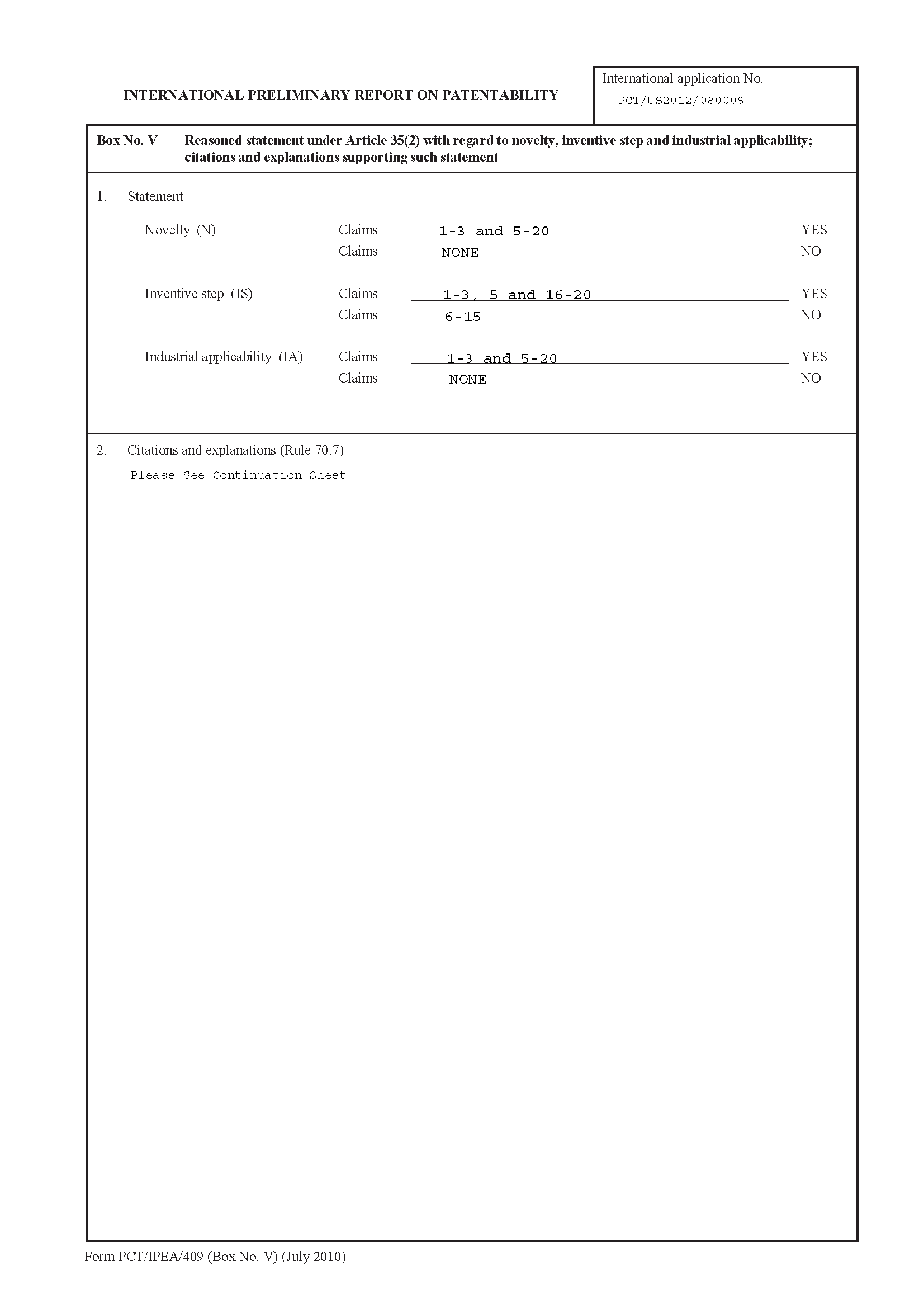
VI. BOX NO. V. REASONED STATEMENT UNDER ARTICLE 35(2) WITH REGARD TO NOVELTY, INVENTIVE STEP, AND INDUSTRIAL APPLICABILITY; AND CITATIONS AND EXPLANATIONS SUPPORTING SUCH STATEMENT
The examiner must indicate whether each claim appears to satisfy the criteria of novelty, inventive step (nonobviousness), and industrial applicability. The determination or statement should be made on each of the three criteria taken separately. The determination as to any criteria should be negative if the criteria as to the particular claim is not satisfied. The examiner should always cite documents believed to support any negative determination as to novelty and inventive step. Any negative holding as to lack of industrial applicability must be fully explained. See the further discussion in MPEP § 1845.01 relating to Box No. V of Form PCT/ISA/237. The citation of documents should be in accordance with Administrative Instructions Sections 503 and 611 . The procedure is the same as the procedure for search report citations. Explanations should clearly indicate, with reference to the cited documents, the reasons supporting the conclusions that any of the said criteria is or is not satisfied, unless the statement is positive and the reason for citing any document is easy to understand when consulting the document. If only certain passages of the cited documents are relevant, the examiner should identify them, for example, by indicating the page, column, or the lines where such passages appear. Preferably, a reasoned statement should be provided in all instances.
VII. BOX NO. VI. CERTAIN DOCUMENTS CITED
If the examiner has discovered, or the international search report has cited, a relevant document which refers to a nonwritten disclosure, and the document was only published on or after the relevant date of the international application, the examiner must indicate on the international preliminary examination report:
- (A) the date on which the document was made available to the public;
- (B) the date on which the non-written public disclosure occurred.
The examiner should also identify any published application or patent which would constitute prior art for purposes of PCT Article 33 (2) and (3) had it been published prior to the relevant date (PCT Rule 64.1) but was filed prior to, or claims the priority of an earlier application which had been filed prior to, the relevant date (PCT Rule 64.3 ). For each such published application or patent the following indications should be provided:
- (A) its date of publication;
- (B) its filing date, and its claimed priority date (if any).
The Report may also indicate that, in the opinion of the International Preliminary Examining Authority, the priority date of the document cited has not been validly claimed ( PCT Rule 70.10 ).
Guidelines explaining to the examiner the manner of indicating certain special categories of documents as well as the manner of indicating the claims to which the documents cited in such report are relevant are set forth in Administrative Instructions Sections 507 (c), (d), and (e) and 508 .
VIII. BOX NO. VII. CERTAIN DEFECTS IN THE INTERNATIONAL APPLICATION
If, in the opinion of the examiner, defects existing in the form or contents of the international application have not been suitably solved at the prescribed time limit for establishing the international preliminary examination report, the examiner may include this opinion in the report, and if included, must also indicate the reasons therefor. See the further discussion in MPEP § 1845.01 relating to Box No. VII of Form PCT/ISA/237.
IX. BOX NO. VIII. CERTAIN OBSERVATIONS ON THE INTERNATIONAL APPLICATION
If, in the opinion of the examiner, the clarity of claims, the description, and the drawings, or the question as to whether the claims are fully supported by the description have not been suitably solved at the prescribed time limit for establishing the international preliminary examination report, the examiner may include this opinion in the report, and if included, must also indicate the reasons therefor. See the further discussion in MPEP § 1845.01 relating to Box No. VIII of Form PCT/ISA/237.
X. FINALIZATION OF THE INTERNATIONAL PRELIMINARY EXAMINATION REPORT
The date on which the report was completed and the name and mailing address of the International Preliminary Examining Authority are indicated on the cover sheet (Form PCT/IPEA/416) of the international preliminary examination report. This information is generated automatically by the OACS software when preparing the report. In addition, the date on which the demand for international preliminary examination was submitted and the name of the authorized officer responsible for the report must be indicated. Pursuant to Administrative Instructions Section 612 , an "authorized officer" is the person who actually performed the examination work and prepared the international preliminary examination report or another person who was responsible for supervising the examination. Thus, an examiner need not have signatory authority in order to be named as an authorized officer on the examination report. However, the "file copy" of the international preliminary examination report must be signed by a primary examiner.




[Note: The regulations under the PCT were changed effective January 1, 2004 and corresponding changes were made to Title 37 of the Code of Federal Regulations. See January 2004 Revision of Patent Cooperation Treaty Application Procedure , 68 FR 59881 (Oct. 20, 2003), 1276 O.G. 6 (Nov. 11, 2003). The discussion of the procedures in effect for applications filed prior to January 1, 2004 has been moved from this section to MPEP § 1879.01(a) .]
69
Start of and Time Limit for International Preliminary Examination
- (a) Subject to paragraphs (b) to (e), the International Preliminary Examining Authority shall start the international preliminary examination when it is in possession of all of the following:
- (i) the demand;
- (ii) the amount due (in full) for the handling fee and the preliminary examination fee, including where applicable, the late payment fee under Rule 58 bis .2 ; and
- (iii) either the international search report or the declaration by the International Searching Authority under Article 17 (2)(a) that no international search report will be established, and the written opinion established under Rule 43 bis .1;
provided that the International Preliminary Examining Authority shall not start the international preliminary examination before the expiration of the applicable time limit under Rule 54 bis .1(a) unless the applicant expressly requests an earlier start.
- (b) If the national Office or intergovernmental organization that acts as International Searching Authority also acts as International Preliminary Examining Authority, the international preliminary examination may, if that national Office or intergovernmental organization so wishes and subject to paragraphs (d) and (e), start at the same time as the international search.
(b- bis ) Where, in accordance with paragraph (b), the national Office or intergovernmental organization that acts as both International Searching Authority and International Preliminary Examining Authority wishes to start the international preliminary examination at the same time as the international search and considers that all of the conditions referred to in Article 34(2)(c)(i) to (iii) are fulfilled, that national Office or intergovernmental organization need not, in its capacity as International Searching Authority, establish a written opinion under Rule 43 bis .1
- (c) Where the statement concerning amendments contains an indication that amendments under Article 19 are to be taken into account ( Rule 53.9 (a)(i)), the International Preliminary Examining Authority shall not start the international preliminary examination before it has received a copy of the amendments concerned.
- (d) Where the statement concerning amendments contains an indication that the start of the international preliminary examination is to be postponed ( Rule 53.9(b) ), the International Preliminary Examining Authority shall not start the international preliminary examination before whichever of the following occurs first:
- (i) it has received a copy of any amendments made under Article 19 ;
- (ii) it has received a notice from the applicant that he does not wish to make amendments under Article 19 ; or
- (iii) the expiration of the applicable time limit under Rule 46.1 .
- (e) Where the statement concerning amendments contains an indication that amendments under Article 34 are submitted with the demand ( Rule 53.9 (c)) but no such amendments are, in fact, submitted, the International Preliminary Examining Authority shall not start the international preliminary examination before it has received the amendments or before the time limit fixed in the invitation referred to in Rule 60.1 (g) has expired, whichever occurs first.
The time limit for establishing the international preliminary examination report shall be whichever of the following periods expires last:
- (i) 28 months from the priority date; or
- (ii) six months from the time provided under Rule 69.1 for the start of the international preliminary examination; or
- (iii) six months from the date of receipt by the International Preliminary Examining Authority of the translation furnished under Rule 55.2 .
PCT Rule 69.2 was amended as reproduced above for applications having an international filing date on or after January 1, 2004. The time limit for preparing the international preliminary examination report is 28 months from the priority date, or 6 months from the time provided under PCT Rule 69.1 for the start of the international preliminary examination, or 6 months from the date of receipt by the International Preliminary Examining Authority of the translation furnished under PCT Rule 55.2 , whichever expires first. This time limit is 27 months internally to ensure sufficient time to process, review and mail the report in sufficient time to reach the International Bureau by 28 months from the earliest priority date.
[Note: For international applications filed on or after January 1, 2004, see MPEP § 1879.01 .]
Former
69
Start of and Time Limit for International Preliminary Examination (as amended July 1, 1998)
- (a) Subject to paragraphs (b) to (e), the International Preliminary Examining Authority shall start the international preliminary examination when it is in possession both of the demand and of either the international search report or a notice of the declaration by the International Searching Authority under Article 17 (2)(a) that no international search report will be established.
- (b) If the competent International Preliminary Examining Authority is part of the same national Office or intergovernmental organization as the competent International Searching Authority, the international preliminary examination may, if the International Preliminary Examining Authority so wishes and subject to paragraph (d), start at the same time as the international search.
- (c) Where the statement concerning amendments contains an indication that amendments under Article 19 are to be taken into account ( Rule 53.9 (a)(i)), the International Preliminary Examining Authority shall not start the international preliminary examination before it has received a copy of the amendments concerned
- (d) Where the statement concerning amendments contains an indication that the start of the international preliminary examination is to be postponed ( Rule 53.9 (b)), the International Preliminary Examining Authority shall not start the international preliminary examination before
- (i) it has received a copy of any amendments made under Article 19 ,
- (ii) it has received a notice from the applicant that he does not wish to make amendments under Article 19 , or
- (iii) the expiration of 20 months from the priority date, whichever occurs first.
- (e) Where the statement concerning amendments contains an indication that amendments under Article 34 are submitted with the demand ( Rule 53.9 (c)) but no such amendments are, in fact, submitted, the International Preliminary Examining Authority shall not start the international preliminary examination before it has received the amendments or before the time limit fixed in the invitation referred to in Rule 60.1 (g) has expired, whichever occurs first.
The time limit for establishing the international preliminary examination report shall be:
- (i) 28 months from the priority date, or
- (ii) eight months from the date of payment of the fees referred to in Rules 57.1 and 58.1(a) , or
- (iii) eight months from the date of receipt by the International Preliminary Examining Authority of the translation furnished under Rule 55.2 , whichever expires last.
For international applications having an international filing date before January 1, 2004, the period for preparing the IPER is set forth in former PCT Rule 69.2 (as amended July 1, 1998) . The time limit for preparing the international preliminary examination report is 28 months from the priority date, or 8 months from the date of payment of the fees referred to in PCT Rules 57.1 and 58.1(a) , or 8 months from the date of receipt by the International Preliminary Examining Authority of the translation furnished under PCT Rule 55.2 , whichever expires first. This time limit is 27 months internally to ensure sufficient time to process, review and mail the report in sufficient time to reach the International Bureau by 28 months from the earliest priority date.
36
Transmittal, Translation, and Communication of the International Preliminary Examination Report
- (1) The international preliminary examination report, together with the prescribed annexes, shall be transmitted to the applicant and to the International Bureau.
*****
71
Transmittal of the International Preliminary Examination Report
The International Preliminary Examining Authority shall, on the same day, transmit one copy of the international preliminary examination report and its annexes, if any, to the International Bureau, and one copy to the applicant.
- (a) The request under Article 36 (4) may be presented any time during seven years from the international filing date of the international application to which the report relates.
- (b) The International Preliminary Examining Authority may require that the party (applicant or elected Office) presenting the request pay to it the cost of preparing and mailing the copies. The level of the cost of preparing copies shall be provided for in the agreements referred to in Article 32 (2) between the International Preliminary Examining Authorities and the International Bureau.
- (c) [Deleted ]
- (d) Any International Preliminary Examining Authority may perform the obligations referred to in paragraphs (a) and (b) through another agency responsible to it.
The international preliminary examination report is transmitted to the International Bureau using a transmittal Form PCT/IPEA/416. Every effort is made to ensure that the transmittal is effected in sufficient time to reach the International Bureau before the expiration of the time limit set in PCT Rule 69.2 .
AUTHORIZED OFFICER
Form PCT/IPEA/416 must be signed by a primary examiner.
36
Transmittal, Translation, and Communication of the International Preliminary Examination Report
*****
- (2)
- (a) The international preliminary examination report and its annexes shall be translated into the prescribed languages.
- (b) Any translation of the said report shall be prepared by or under the responsibility of the International Bureau, whereas any translation of the said annexes shall be prepared by the applicant.
*****
70
International Preliminary Report on Patentability by the International Preliminary Examining Authority (International Preliminary Examination Report)
*****
The report and any annex shall be in the language in which the international application to which they relate is published, or, if the international preliminary examination is carried out, pursuant to Rule 55.2 , on the basis of a translation of the international application, in the language of that translation.
72
Translation of the International Preliminary Examination Report and of the Written Opinion of the International Searching Authority
- (a) Any elected State may require that the international preliminary examination report, established in any language other than the official language, or one of the official languages, of its national Office, be translated into English.
- (b) Any such requirement shall be notified to the International Bureau, which shall promptly publish it in the Gazette.
The International Bureau shall transmit a copy of the translation referred to in Rule 72.1 (a) of the international preliminary examination report to the applicant at the same time as it communicates such translation to the interested elected Office or Offices.
In the case referred to in Rule 73.2(b)(ii) , the written opinion established by the International Searching Authority under Rule 43 bis .1 shall, upon request of the elected Office concerned, be translated into English by or under the responsibility of the International Bureau. The International Bureau shall transmit a copy of the translation to the elected Office concerned within two months from the date of receipt of the request for translation, and shall at the same time transmit a copy to the applicant.
The applicant may make written observations as to the correctness of the translation of the international preliminary examination report or of the written opinion established by the International Searching Authority under Rule 43 bis .1 and shall send a copy of the observations to each of the interested elected Offices and to the International Bureau.
The written opinion established by the International Searching Authority and the international preliminary examination report and any annexes are established in Chinese, English, French, German, Japanese, Russian or Spanish, if the international application was filed in one of those languages or translated into one of those languages. See PCT Rules 48.3 (b), 55.2 and 70.17 . Each elected State may require that the written opinion and/or the report, if it is not in (one of) the official language(s) of its national Office, be translated into English. See PCT Rule 72.1 (a). In that case, the translation of the body of the written opinion and/or report is prepared by the International Bureau, which transmits copies to the applicant and to each interested elected Office. If any elected Office requires a translation of annexes to the report, the preparation and furnishing of that translation is the responsibility of the applicant. See PCT Article 36 (2)(b).
The U.S. requires the final report and the annexes thereto to be in English. Translation of the annexes for national stage purposes is required pursuant to 35 U.S.C. 371(c) (5) and 37 CFR 1.495(e) . Failure to timely provide such translation results in cancellation of the annexes.
38
Confidential Nature of the International Preliminary Examination
- (1) Neither the International Bureau nor the International Preliminary Examining Authority shall, unless requested or authorized by the applicant, allow access within the meaning, and with the proviso, of Article 30 (4) to the file of the international preliminary examination by any person or authority at any time, except by the elected Offices once the international preliminary examination report has been established.
- (2) Subject to the provisions of paragraph (1) and Articles 36(1) and (3) and 37(3)(b) , neither the International Bureau nor the International Preliminary Examining Authority shall, unless requested or authorized by the applicant, give information on the issuance or non-issuance of an international preliminary examination report and on the withdrawal or non-withdrawal of the demand or of any election.
44 ter
Confidential Nature of Written Opinion, Report, Translation and Observations
- (a) The International Bureau and the International Searching Authority shall not, unless requested or authorized by the applicant, allow access by any person or authority before the expiration of 30 months from the priority date:
- (i) to the written opinion established under Rule 43 bis .1 , to any translation thereof prepared under Rule 44 bis .3(d) or to any written observations on such translation sent by the applicant under Rule 44 bis .4 ;
- (ii) if a report is issued under Rule 44 bis .1 , to that report, to any translation of it prepared under Rule 44 bis .3(b) or to any written observations on that translation sent by the applicant under Rule 44 bis .4 .
- (b) For the purposes of paragraph (a), the term "access" covers any means by which third parties may acquire cognizance, including individual communication and general publication.
37 C.F.R. 1.11 Files open to the public.
- (a) The specification, drawings, and all papers relating to the file of an abandoned published application, except if a redacted copy of the application was used for the patent application publication, a patent, or a statutory invention registration are open to inspection by the public, and copies may be obtained upon the payment of the fee set forth in § 1.19(b)(2) . See § 2.27 for trademark files.
*****
37 C.F.R. 1.14 Patent applications preserved in confidence.
*****
- (g) International applications . (1) Copies of international application files for international applications which designate the U.S. and which have been published in accordance with PCT Article 21(2) , or copies of a document in such application files, will be furnished in accordance with PCT Articles 30 and 38 and PCT Rules 94.2 and 94.3 , upon written request including a showing that the publication of the application has occurred and that the U.S. was designated, and upon payment of the appropriate fee (see § 1.19(b) ), if:
- ""
- (i) With respect to the Home Copy (the copy of the international application kept by the Office in its capacity as the Receiving Office, see PCT Article 12(1) ), the international application was filed with the U.S. Receiving Office;
- (ii) With respect to the Search Copy (the copy of an international application kept by the Office in its capacity as the International Searching Authority, see PCT Article 12 (1)), the U.S. acted as the International Searching Authority, except for the written opinion of the International Searching Authority which shall not be available until the expiration of thirty months from the priority date; or
- (iii) With respect to the Examination Copy (the copy of an international application kept by the Office in its capacity as the International Preliminary Examining Authority), the United States acted as the International Preliminary Examining Authority, an International Preliminary Examination Report has issued, and the United States was elected.
- (2) A copy of an English language translation of a publication of an international application which has been filed in the United States Patent and Trademark Office pursuant to 35 U.S.C. 154 (d)(4) will be furnished upon written request including a showing that the publication of the application in accordance with PCT Article 21 (2) has occurred and that the U.S. was designated, and upon payment of the appropriate fee (§ 1.19 (b)(4)).
- (3) Access to international application files for international applications which designate the U.S. and which have been published in accordance with PCT Article 21 (2), or copies of a document in such application files, will be permitted in accordance with PCT Articles 30 and 38 and PCT Rules 44 ter .1 , 94.2 and 94.3 , upon written request including a showing that the publication of the application has occurred and that the U.S. was designated.
- (4) In accordance with PCT Article 30 , copies of an international application-as-filed under paragraph (a) of this section will not be provided prior to the international publication of the application pursuant to PCT Article 21(2) .
- (5) Access to international application files under paragraphs (a)(1)(i) through (a)(1)(vi) and (g)(3) of this section will not be permitted with respect to the Examination Copy in accordance with PCT Article 38 .
- ""
*****
- (i) Access or copies in other circumstances . The Office, either sua sponte or on petition, may also provide access or copies of all or part of an application if necessary to carry out an Act of Congress or if warranted by other special circumstances. Any petition by a member of the public seeking access to, or copies of, all or part of any pending or abandoned application preserved in confidence pursuant to paragraph (a) of this section, or any related papers, must include:
- (1) The fee set forth in § 1.17(g) ; and
- (2) A showing that access to the application is necessary to carry out an Act of Congress or that special circumstances exist which warrant petitioner being granted access to all or part of the application.
For a discussion of the availability of copies of documents from international application files and/or access to international application files, see MPEP § 110 .