MPEP § 1823
The Description
United States Patent and Trademark Office
Viewing an earlier, undated versionView current
5
The description shall disclose the invention in a manner sufficiently clear and complete for the invention to be carried out by a person skilled in the art.
5
The Description
- (a) The description shall first state the title of the invention as appearing in the request and shall:
- (i) specify the technical field to which the invention relates;
- (ii) indicate the background art which, as far as known to the applicant, can be regarded as useful for the understanding, searching and examination of the invention, and, preferably, cite the documents reflecting such art;
- (iii) disclose the invention, as claimed, in such terms that the technical problem (even if not expressly stated as such) and its solution can be understood, and state the advantageous effects, if any, of the invention with reference to the background art;
- (iv) briefly describe the figures in the drawings, if any;
- (v) set forth at least the best mode contemplated by the applicant for carrying out the invention claimed; this shall be done in terms of examples, where appropriate, and with reference to the drawings, if any; where the national law of the designated State does not require the description of the best mode but is satisfied with the description of any mode (whether it is the best contemplated or not), failure to describe the best mode contemplated shall have no effect in that State;
- (vi) indicate explicitly, when it is not obvious from the description or nature of the invention, the way in which the invention is capable of exploitation in industry and the way in which it can be made and used, or, if it can only be used, the way in which it can be used; the term "industry" is to be understood in its broadest sense as in the Paris Convention for the Protection of Industrial Property.
- (b) The manner and order specified in paragraph (a) shall be followed except when, because of the nature of the invention, a different manner or a different order would result in a better understanding and a more economic presentation.
- (c) Subject to the provisions of paragraph (b), each of the parts referred to in paragraph (a) shall preferably be preceded by an appropriate heading as suggested in the Administrative Instructions.
204
Headings of the Parts of the Description
The headings of the parts of the description should be as follows:
- (i) for matter referred to in Rule 5.1 (a)(i), "Technical Field";
- (ii) for matter referred to in Rule 5.1 (a)(ii), "Background Art";
- (iii) for matter referred to in Rule 5.1 (a)(iii), "Disclosure of Invention";
- (iv) for matter referred to in Rule 5.1 (a)(iv), "Brief Description of Drawings";
- (v) for matter referred to in Rule 5.1 (a)(v), "Best Mode for Carrying Out the Invention," or, where appropriate, "Mode(s) for Carrying Out the Invention";
- (vi) for matter referred to in Rule 5.1 (a)(vi), "Industrial Applicability";
- (vii) for matter referred to in Rule 5.2 (a), "Sequence Listing";
- (viii) for matter referred to in Rule 5.2 (b), "Sequence Listing Free Text."
209
Indications as to Deposited Biological Material on a Separate Sheet
- (a) To the extent that any indication with respect to deposited biological material is not contained in the description, it may be given on a separate sheet. Where any such indication is so given, it shall preferably be on Form PCT/RO/134 and, if furnished at the time of filing, the said Form shall, subject to paragraph (b), preferably be attached to the request and referred to in the check list referred to in Rule 3.3 (a)(ii).
- (b) For the purposes of designated Offices, which have so notified the International Bureau under Rule 13 bis .7 (a), paragraph (a) applies only if the said Form or sheet is included as one of the sheets of the description of the international application at the time of filing.
37 C.F.R. 1.435 The description.
- (a) The application must meet the requirements as to the content and form of the description set forth in PCT Rules 5 , 9 , 10 , and 11 and sections 204 and 208 of the Administrative Instructions .
- (b) In international applications designating the United States the description must contain upon filing an indication of the best mode contemplated by the inventor for carrying out the claimed invention.
The description must disclose the invention in a manner sufficiently clear and complete for it to be carried out by a person skilled in the art. It must start with the title of the invention as appearing in Box No. I of the request. PCT Rule 5 contains detailed requirements as to the manner and order of the description, which, generally, should be in six parts. Those parts should have the following headings: "Technical Field," "Background Art," "Disclosure of Invention," "Brief Description of Drawings," "Best Mode for Carrying Out the Invention" or, where appropriate, "Mode(s) for Carrying Out the Invention," "Industrial Applicability," "Sequence Listing," and "Sequence Listing Free Text," where applicable.
The details required for the disclosure of the invention so that it can be carried out by a person skilled in the art depend on the practice of the national Offices. It is therefore recommended that due account be taken of national practice in the United States of America when the description is drafted.
The need to amend the description during the national phase may thus be avoided.
This applies likewise to the need to indicate the "best mode for carrying out the invention." If at least one of the designated Offices requires the indication of the best mode (for instance, the United States Patent and Trademark Office), that best mode must be indicated in the description.
A description drafted with due regard to what is said in these provisions will be accepted by all the designated Offices. It might require more care than the drafting of a national patent application, but certainly much less effort than the drafting of multiple applications, which is necessary where the PCT route is not used for filing in several countries.
13 bis
Inventions Relating to Biological Material
For the purposes of this Rule, "reference to deposited biological material" means particulars given in an international application with respect to the deposit of a biological material with a depositary institution or to the biological material so deposited.
Any reference to deposited biological material shall be made in accordance with this Rule and, if so made, shall be considered as satisfying the requirements of the national law of each designated State.
- (a) A reference to deposited biological material shall indicate:
- (i) the name and address of the depositary institution with which the deposit was made;
- (ii) the date of deposit of the biological material with that institution;
- (iii) the accession number given to the deposit by that institution; and
- (iv) any additional matter of which the International Bureau has been notified pursuant to Rule 13 bis .7 (a)(i), provided that the requirement to indicate that matter was published in the Gazette in accordance with Rule 13 bis .7 (c) at least two months before the filing of the international application.
- (b) Failure to include a reference to deposited biological material or failure to include, in a reference to deposited biological material, an indication in accordance with paragraph (a), shall have no consequence in any designated State whose national law does not require such reference or such indication in a national application.
- (a) Subject to paragraphs (b) and (c), if any of the indications referred to in Rule 13 bis .3 (a) is not included in a reference to deposited biological material in the international application as filed but is furnished to the International Bureau:
- (i) within 16 months from the priority date, the indication shall be considered by any designated Office to have been furnished in time;
- (ii) after the expiration of 16 months from the priority date, the indication shall be considered by any designated Office to have been furnished on the last day of that time limit if it reaches the International Bureau before the technical preparations for international publication have been completed.
- (b) If the national law applicable by a designated Office so requires in respect of national applications, that Office may require that any of the indications referred to in Rule 13 bis .3 (a) be furnished earlier than 16 months from the priority date, provided that the International Bureau has been notified of such requirement pursuant to Rule 13 bis .7 (a)(ii) and has published such requirement in the Gazette in accordance with Rule 13 bis .7 (c) at least two months before the filing of the international application.
- (c) Where the applicant makes a request for early publication under Article 21 (2)(b), any designated Office may consider any indication not furnished before the technical preparations for international publication have been completed as not having been furnished in time.
- (d) The International Bureau shall notify the applicant of the date on which it received any indication furnished under paragraph (a), and:
- (i) if the indication was received before the technical preparations for international publication have been completed, publish the indication furnished under paragraph (a), and an indication of the date of receipt, together with the international application;
- (ii) if the indication was received after the technical preparations for international publication have been completed, notify that date and the relevant data from the indication to the designated Offices.
- (a) A reference to deposited biological material shall be considered to be made for the purposes of all designated States, unless it is expressly made for the purposes of certain of the designated States only; the same applies to the indications included in the reference.
- (b) References to different deposits of the biological material may be made for different designated States.
- (c) Any designated Office may disregard a deposit made with a depositary institution other than one notified by it under Rule 13 bis .7(b).
Pursuant to Articles 23 and 40 , no furnishing of samples of the deposited biological material to which a reference is made in an international application shall, except with the authorization of the applicant, take place before the expiration of the applicable time limits after which national processing may start under the said Articles. However, where the applicant performs the acts referred to in Articles 22 or 39 after international publication but before the expiration of the said time limits, the furnishing of samples of the deposited biological material may take place, once the said acts have been performed. Notwithstanding the previous provision, the furnishing of samples of the deposited biological material may take place under the national law applicable by any designated Office as soon as, under that law, the international publication has the effects of the compulsory national publication of an unexamined national application.
- (a) Any national Office may notify the International Bureau of any requirement of the national law:
- (i) that any matter specified in the notification, in addition to those referred to in Rule 13 bis .3 (a)(i), (ii) and (iii), is required to be included in a reference to deposited biological material in a national application;
- (ii) that one or more of the indications referred to in Rule 13 bis .3 (a) are required to be included in a national application as filed or are required to be furnished at a time specified in the notification which is earlier than 16 months after the priority date.
- (b) Each national Office shall notify the International Bureau of the depositary institutions with which the national law permits deposits of biological materials to be made for the purposes of patent procedure before that Office or, if the national law does not provide for or permit such deposits, of that fact.
- (c) The International Bureau shall promptly publish in the Gazette requirements notified to it under paragraph (a) and information notified to it under paragraph (b).
209
Indications as to Deposited Biological Material on a Separate Sheet
- (a) To the extent that any indication with respect to deposited biological material is not contained in the description, it may be given on a separate sheet. Where any such indication is so given, it shall preferably be on Form PCT/RO/134 and, if furnished at the time of filing, the said Form shall, subject to paragraph (b), preferably be attached to the request and referred to in the check list referred to in Rule 3.3 (a)(ii).
- (b) For the purposes of designated Offices, which have so notified the International Bureau under Rule 13 bis .7 (a), paragraph (a) applies only if the said Form or sheet is included as one of the sheets of the description of the international application at the time of filing.
REFERENCES TO DEPOSITED BIOLOGICAL MATERIAL IN THE CASE OF MICROBIOLOGICAL INVENTIONS
The PCT does not require the inclusion of a reference to a biological material and/or to its deposit with a depositary institution in an international application; it merely prescribes the contents of any "reference to deposited biological material" (defined as "particulars given... with respect to the deposit of biological material... or to the biological material so deposited") which is included in an international application, and when such a reference must be furnished. It follows that the applicant may see a need to make such a reference only when it is required for the purpose of disclosing the invention claimed in the international application in a manner sufficient for the invention to be carried out by a person skilled in the art that is, when the law of at least one of the designated States provides for the making, for this purpose, of a reference to a deposited biological material if the invention involves the use of a biological material that is not available to the public. Any reference to a deposited biological material furnished separately from the description will be included in the publication of the international application.
A reference to a deposited biological material made in accordance with the requirements of the PCT must be regarded by each of the designated Offices as satisfying the requirements of the national law applicable in that Office with regard to the contents of such references and the time for furnishing them.
A reference may be made for the purposes of all designated States or for one or only some of the designated States. A reference is considered to be made for the purpose of all designated States unless it is expressly made for certain designated States only. References to different deposits may be made for the purposes of different designated States.
There are two kinds of indication which may have to be given with regard to the deposit of the biological material, namely:
- (A) indications specified in the PCT Regulations themselves; and
- (B) additional indications by the national (or regional) Office of (or acting for) a State designated in the international application and which have been published in the PCT Gazette ; these additional indications may relate not only to the deposit of the biological material but also to the biological material itself.
The indications in the first category are:
(1) the name and address of the depositary institution with which the deposit was made;
(2) the date of the deposit with that institution; and
(3) the accession number given to the deposit by that institution.
U.S. requirements include the name and address of the depository institution at the time of filing, the date of the deposit or a statement that the deposit was made on or before the priority date of the international application and, to the extent possible, a taxonomic description of the biological material. See Annex L of the PCT Applicant’s Guide.
The national laws of some of the national (or regional) Offices require that, besides indications concerning the deposit of a biological material, an indication be given concerning the biological material itself, such as, for example, a short description of its characteristics, at least to the extent that this information is available to the applicant. These requirements must be met in the case of international applications for which any such Office is a designated Office, provided that the requirements have been published in the PCT Gazette . Annex L of the PCT Applicant’s Guide indicates, for each of the national (or regional) Offices, the requirements (if any) of this kind which have been published.
If any indication is not included in a reference to a deposited biological material contained in the international application as filed, it may be furnished to the International Bureau within 16 months after the priority date unless the International Bureau has been notified (and, at least 2 months prior to the filing of the international application, it has published in the PCT Gazette ) that the national law requires the indication to be furnished earlier. However, if the applicant makes a request for early publication, all indications should be furnished by the time the request is made, since any designated Office may regard any indication not furnished when the request is made as not having been furnished in time.
No check is made in the international phase to determine whether a reference has been furnished within the prescribed time limit. However, the International Bureau notifies the designated Offices of the date(s) on which indications, not included in the international application as filed, were furnished to it. Those dates are also mentioned in the publication of the international application. Failure to include a reference to a deposited biological material (or any indication required in such a reference) in the international application as filed, or failure to furnish it (or the indication) within the prescribed time limit, has no consequence if the national law does not require the reference (or indication) to be furnished in a national application. Where there is a consequence, it is the same as that which applies under the national law.
To the extent that indications relating to the deposit of a biological material are not given in the description, because they are furnished later, they may be given in the "optional sheet" provided for that purpose. If the sheet is submitted when the international application is filed, a reference to it should be made in the check list contained on the last sheet of the request form. Should certain States be designated, e.g., Israel, Japan, Korea, Mexico, or Turkey , such a sheet must, if used, be included as one of the sheets of the description at the time of filing; otherwise the indications given in it will not be taken into account by the respective patent offices of those designated States in the national phase. Requirements of the various Offices are set forth in Annex L of the PCT Applicant’s Guide, available online at http://www.wipo.int/pct/guide/en/. If the sheet is furnished to the International Bureau later, it must be enclosed with a letter.
Each national (or regional) Office whose national law provides for deposits of biological material for the purposes of patent procedure notifies the International Bureau of the depositary institutions with which the national law permits such deposits to be made. Information on the institutions notified by each of those Offices is published by the International Bureau in the PCT Gazette .
A reference to a deposit cannot be disregarded by a designated Office for reasons pertaining to the institution with which the biological material was deposited if the deposit referred to is one made with a depositary institution notified by that Office. Thus, by consulting the PCT Gazette or Annex L of the PCT Applicant’s Guide, the applicant can be sure that he has deposited the biological material with an institution which will be accepted by the designated Office.
International Searching Authorities and International Preliminary Examining Authorities are not expected to request access to deposited biological material. However, in order to retain the possibility of access to a deposited biological material referred to in an international application which is being searched or examined by such an Authority, the PCT provides that the Authorities may, if they fulfill certain conditions, ask for samples. Thus, an Authority may only ask for samples if it has notified the International Bureau (in a general notification) that it may require samples and the International Bureau has published the notification in the PCT Gazette . The only Authority which has made such a notification (and thus the only Authority which may request samples) is the Japan Patent Office. If a sample is asked for, the request is directed to the applicant, who then becomes responsible for making the necessary arrangements for the sample to be provided.
The furnishing of samples of a deposit of a biological material to third persons is governed by the national laws applicable in the designated Offices. PCT Rule 13 bis .6(b), however, provides for the delaying of any furnishing of samples under the national law applicable in each of the designated (or elected) Offices until the start of the national phase, subject to the ending of this "delaying effect" brought about by the occurrence of either of the following two events:
- (A) the applicant has, after international publication of the international application, taken the steps necessary to enter the national phase before the designated Office.
- (B) international publication of the international application has been effected, and that publication has the same effects, under the national law applicable in the designated Office, as the compulsory national publication of an unexamined national application (in other words, the international application has qualified for the grant of "provisional protection").
5
The Description
*****
- (a) Where the international application contains disclosure of one or more nucleotide and/or amino acid sequences, the description shall contain a sequence listing complying with the standard prescribed by the Administrative Instructions and presented as a separate part of the description in accordance with that standard.
- (b) Where the sequence listing part of the description contains any free text as defined in the standard provided for in the Administrative Instructions, that free text shall also appear in the main part of the description in the language thereof.
13 ter
Nucleotide and/or Amino Acid Sequence Listings
- (a) Where the international application contains disclosure of one or more nucleotide and/or amino acid sequences, the International Searching Authority may invite the applicant to furnish to it, for the purposes of the international search, a sequence listing in electronic form complying with the standard provided for in the Administrative Instructions, unless such listing in electronic form is already available to it in a form and manner acceptable to it, and to pay to it, where applicable, the late furnishing fee referred to paragraph (c), within a time limit fixed in the invitation:
- (b) Where at least part of the international application is filed on paper and the International Searching Authority finds that the description does not comply with Rule 5.2 (a), it may invite the applicant to furnish, for the purposes of the international search, a sequence listing in paper form complying with the standard provided for in the Administrative Instructions, unless such listing in paper form is already available to it in a form and manner acceptable to it, whether or not the furnishing of a sequence listing in electronic form is invited under paragraph (a), and to pay, where applicable, the late furnishing fee referred to in paragraph (c), within a time limit fixed in the invitation.
- (c) The furnishing of a sequence listing in response to an invitation under paragraph (a) or (b) may be subjected by the International Searching Authority to the payment to it, for its own benefit, of a late furnishing fee whose amount shall be determined by the International Searching Authority but shall not exceed 25% of the international filing fee referred to in item 1 of the Schedule of Fees, not taking into account any fee for each sheet of the international application in excess of 30 sheets, provided that a late furnishing fee may be required under either paragraph (a) or (b) but not both.
- (d) If the applicant does not, within the time limit fixed in the invitation under paragraph (a) or (b), furnish the required sequence listing and pay any required late furnishing fee, the International Searching Authority shall only be required to search the international application to the extent that a meaningful search can be carried out without the sequence listing.
- (e) Any sequence listing not contained in the international application as filed, whether furnished in response to an invitation under paragraph (a) or (b) or otherwise, shall not form part of the international application, but this paragraph shall not prevent the applicant from amending the description in relation to a sequence listing pursuant to Article 34 (2)(b).
- (f) Where the International Searching Authority finds that the description does not comply with Rule 5.2 (b), it shall invite the applicant to submit the required correction. Rule 26.4 shall apply mutatis mutandis to any correction offered by the applicant. The International Searching Authority shall transmit the correction to the receiving Office and to the International Bureau.
Rule 13 ter .1 shall apply mutatis mutandis to the procedure before the International Preliminary Examining Authority.
No designated Office shall require the applicant to furnish to it a sequence listing other than a sequence listing complying with the standard provided for in the Administrative Instructions.
208
Sequence Listings
Any nucleotide and/or amino acid sequence listing ("sequence listing"), whether on paper or in electronic form, filed as part of the international application, or furnished together with the international application or subsequently, shall comply with Annex C.
I. REQUIREMENTS FOR SEQUENCE LISTINGS
Where an international application discloses one or more nucleotide and/or amino acid sequences, the description must contain a sequence listing complying with the standard specified in the Administrative Instructions. The standard is set forth in detail in Annex C - Standard for the Presentation of Nucleotide and Amino Acid Sequence Listings in International Patent Applications Under the PCT. The standard allows the applicant to draw up a single sequence listing which is acceptable to all receiving Offices, International Searching and Preliminary Examining Authorities for the purposes of the international phase, and to all designated and elected Offices for the purposes of the national phase. The International Searching Authority and the International Preliminary Examining Authority may, in some cases, invite the applicant to furnish a listing complying with that standard. The applicant may also be invited to furnish a listing in an electronic form provided for in the PCT Administrative Instructions. It is advisable for the applicant to submit a listing of the sequence in electronic form, if such a listing is required by the competent International Searching Authority or International Preliminary Examining Authority, together with the international application rather than to wait for an invitation by the International Searching Authority or International Preliminary Examining Authority.
The electronic form is not mandatory in international applications to be searched by the United States International Searching Authority or examined by the United States International Preliminary Examining Authority. However, if an electronic form of a sequence listing is not provided, a search or examination will be performed only to the extent possible in the absence of the electronic form. The U.S. sequence rules ( 37 CFR 1.821 - 1.825 ) and the PCT sequence requirements are substantively consistent. In this regard, full compliance with the requirements of the U.S. rules will ensure compliance with the applicable PCT requirements. For a detailed discussion of the U.S. sequence rules, see MPEP § 2420 - § 2421.04 .
II. QUALIFYING FOR POTENTIALLY REDUCED BASIC FEE BY FILING SEQUENCE LISTING AND/OR TABLES ON COMPACT DISC RATHER THAN ON PAPER
801
Filing of International Applications Containing Sequence Listings and/or Tables
- (a) Pursuant to Rules 89 bis and 89 ter , where an international application contains disclosure of one or more nucleotide and/or amino acid sequence listings ("sequence listings"), the receiving Office may, if it is prepared to do so, accept that the sequence listing part of the description, as referred to in Rule 5.2 (a) and/or any table related to the sequence listing(s) ("sequence listings and/or tables"), be filed, at the option of the applicant:
- (i) only on an electronic medium in electronic form in accordance with Section 802 ; or
- (ii) both on an electronic medium in electronic form and on paper in accordance with Section 802 ;
provided that the other elements of the international application are filed as otherwise provided for under the Regulations and these Instructions.
- (b) Any receiving Office which is prepared to accept the filing in electronic form of the sequence listings and/or tables under paragraph (a) shall notify the International Bureau accordingly. The notification shall specify the electronic media on which the receiving Office will accept such filings. The International Bureau shall promptly publish any such information in the Gazette.
- (c) A receiving Office which has not made a notification under paragraph (b) may nevertheless decide in a particular case to accept an international application the sequence listings and/or tables of which are filed with it under paragraph (a).
- (d) Where the sequence listings and/or tables are filed in electronic form under paragraph (a) but not on an electronic medium specified by the receiving Office under paragraph (b), that Office shall, under Article 14 (1)(a)(v), invite the applicant to furnish to it replacement sequence listings and/or tables on an electronic medium specified under paragraph (b).
- (e) Where an international application containing sequence listings and/or tables in electronic form is filed under paragraph (a) with a receiving Office which is not prepared, under paragraph (b) or (c), to accept such filings, Section 333 (b) and (c) shall apply.
Part 8 of the Administrative Instructions became effective January 11, 2001. Under Administrative Instructions Section 801(a) , applicants may file the nucleotide and/or amino acid sequence listing part of the description of an international application on an electronic medium in electronic form with certain receiving Offices. As of September 6, 2002, Part 8 of the Administrative Instructions was expanded to include tables related to sequence listings. At the present time, the United States Receiving Office (RO/US) has not notified the International Bureau (IB) under Administrative Instructions Section 801(b) that it will be generally accepting the filing of international applications under Administrative Instructions Section 801(a) . The RO/US will, however, accept such applications in a particular case pursuant to Administrative Instructions Section 801(c) , provided that applicant follows the Guidelines set forth below in subsection II. A.
803
Calculation of International Filing Fee for International Applications Containing Sequence Listings and/or Tables
Where sequence listings and/or tables are filed in electronic form under Section 801 (a), the international filing fee payable in respect of that application shall include the following two components:
- (i) a basic component calculated as provided in the Schedule of Fees in respect of all pages filed on paper (that is, all pages of the request, description (excluding sequence listings and/or tables if also filed on paper), claims, abstract and drawings), and
- (ii) an additional component, in respect of sequence listings and/or tables, equal to 400 times the fee per sheet as referred to in item 1 of the Schedule of Fees, regardless of the actual length of the sequence listings and/or tables filed in electronic form and regardless of the fact that sequence listings and/or tables may have been filed both on paper and in electronic form.
Applicants will usually achieve a significant fee savings by filing international applications under Administrative Instructions Section 801 (a) in situations where the sequence listings and/or tables consume over four hundred (400) combined pages. The potentially reduced international filing fee described in Administrative Instructions Section 803 is available to applications filed pursuant to the Guidelines below. Applicants who do not wish to file under Administrative Instructions Section 801(a) may submit the sequence listing part and any related tables under conventional filing procedures but will not be eligible for the potentially reduced international filing fee described in Administrative Instructions Section 803 .
When filing an international application under Administrative Instructions Section 801(a) in the RO/US, applicant should not submit a paper copy of the Sequence Listing part and/or tables. If both a sequence listing part and a tables part are filed under Administrative Instructions Section 801 (a), the sequence listing part and the tables part must not be filed on the same electronic medium. With specific regard to tables, only tables which are related to sequence listings, as referred to in PCT Rule 5.2 (a), are covered under Part 8 of the Administrative Instructions. Currently, other types of table data may not be filed on electronic media.
A. Guidelines on Qualifying for Potentially Reduced International Filing Fee Under PCT Administrative Instructions Section 803
1. What To Submit
The applicant is required to submit a complete copy of the international application, wherein the sequence listing part and/or tables part of the application is submitted on electronic media rather than on paper. The application is to be accompanied by a transmittal letter entitled "Compact Disc Transmittal Sheet For Submission Of Sequence Listing and/or Tables To the United States Receiving Office Under PCT Administrative Instructions - Part 8."
(a) Complete International Application With Sequence Listing Part and/or Tables Part on Electronic Media
Applicant shall submit a paper copy of the complete international application, with the exception that the sequence listing part and/or tables part is provided on electronic media rather than on paper. Four (4) copies of the sequence listing part and/or three (3) copies of the tables part are to be included with the application, each copy on an electronic medium or set of electronic media if additional capacity is needed. One copy of the sequence listing part, called the "computer readable form" (CRF) copy required by the Administrative Instructions (see Annex C of the Administrative Instructions, paragraphs 39-46), may be submitted on any acceptable medium under 37 CFR 1.824(c) , although compact disc (CD) media is preferred. All other copies must be submitted only on CD media as specified below:
(1) CD-R
Type: 120mm Compact Disc Recordable
Specification: ISO 9660, 650MB; or
(2) CD-ROM
Type: ISO/IEC 10149:1995, 120mm Compact Disc Read Only Memory
Specification: ISO 9660, 650MB
Each electronic medium shall be enclosed in a hard protective case within a padded envelope. If a sequence listing file is included, the four (4) sequence listing part copies shall be labeled as follows:
- (1) "COPY 1 – SEQUENCE LISTING PART"
- (2) "COPY 2 – SEQUENCE LISTING PART"
- (3) "COPY 3 – SEQUENCE LISTING PART"
- (4) "CRF"
If tables file(s) are included, the three (3) tables part copies shall be labeled as follows:
(1) "COPY 1 – TABLES PART"
(2) "COPY 2 – TABLES PART"
(3) "COPY 3 – TABLES PART"
Additionally, the labeling shall contain the following information:
- (1) Name of Applicant
- (2) Title of Invention
- (3) Applicant’s or Agent’s File Reference Number
- (4) Date of Recording
- (5) Computer Operating System Used
- (6) Name of the Competent Authority (i.e. the RO/US)
- (7) Indication that the sequence listing part and/or tables part is being filed under Administrative Instructions Section 801(a)
- (8) If the sequence listing file and/or tables file(s) consumes more than one CD, an indication such as "DISK 1/3", "DISK 2/3", and "DISK 3/3"
- (9) For a CD containing tables, an indication such as "TABLES 1 to 450"
Examples of properly labeled electronic media appear below.
Example of properly labeled electronic medium 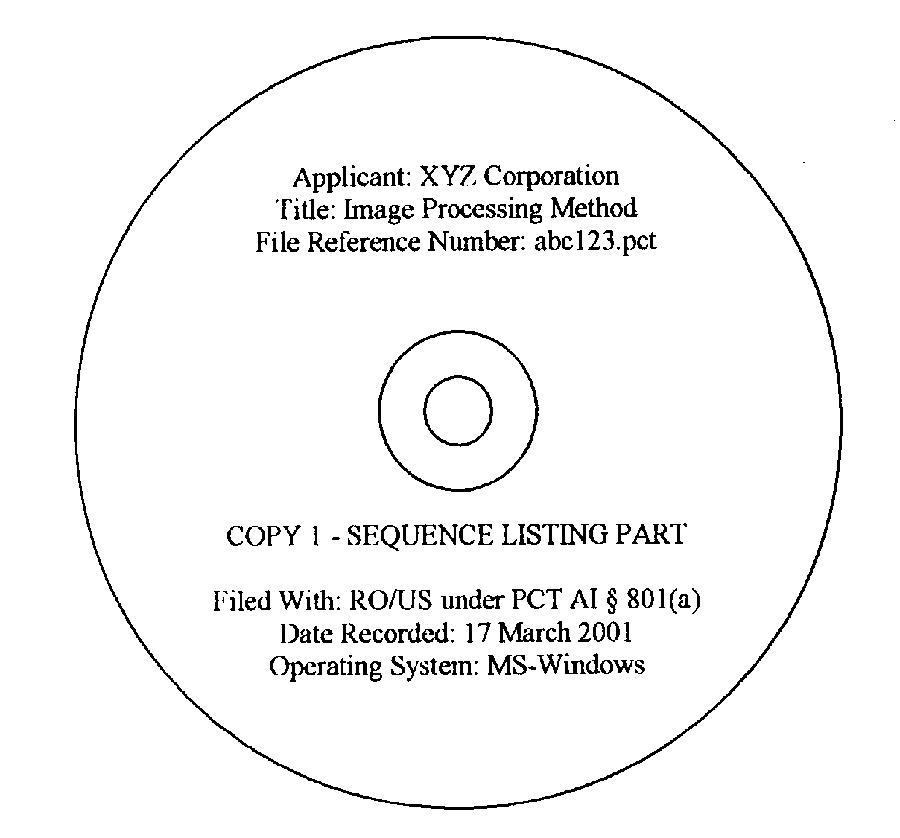

Important Notes :
The electronic medium itself must be neatly labeled with the required information. Labeling of the protective case is recommended, but not required. Sequence listings or tables submitted for correction, rectification, or amendment must satisfy the additional labeling requirements of Administrative Instructions Section 802(d) .
Each CD shall contain either: (1) only a sequence listing part or (2) only a tables part. A sequence listing part and a tables part must not reside together on the same CD. Furthermore, each file in the tables part must have a file name which indicates the name of the table contained therein, e.g., "table-1.txt", "table-2.txt", etc. In addition, no programs or any explanatory files shall appear on any CD.
The sequence listing file and/or tables file(s) must be in compliance with the American Standard Code for Information Interchange (ASCII) and formatted in accordance with Administrative Instructions Annex C, paragraph 41 and Administrative Instructions Annex C- bis . No copy protection or encryption techniques are permitted. File compression is acceptable for the sequence listing part, so long as the compressed file is in a self-extracting format and uses the compression method described in Administrative Instructions Part 7, Annex F, Section 4.1.1. File Compression is not permitted for the tables part.
(b) Compact Disc Transmittal Sheet for Submission of Sequence Listing and/or Tables to the United States Receiving Office Under PCT Administrative Instructions - Part 8.
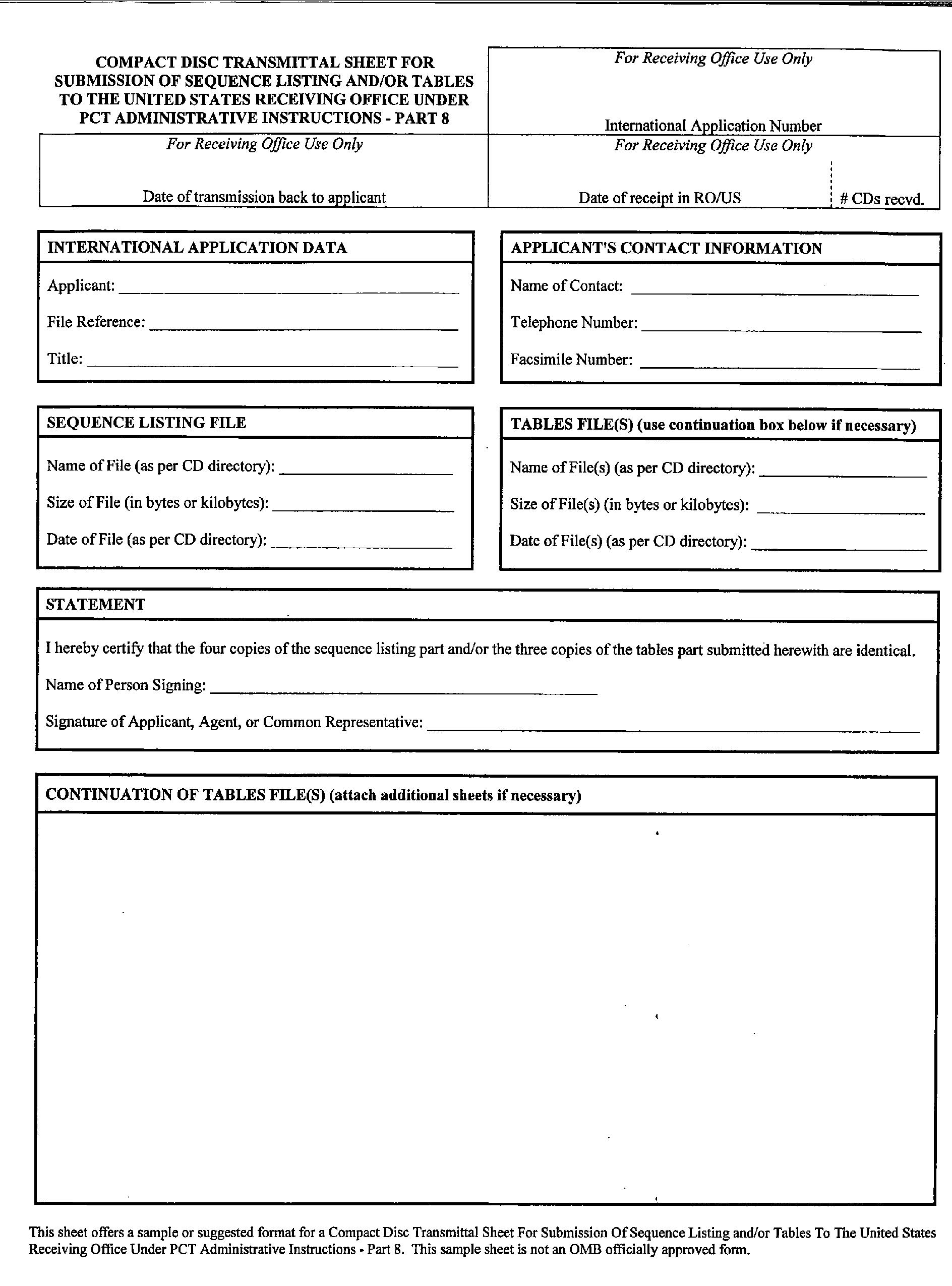
If applicant desires for an application to be accepted pursuant to Administrative Instructions Section 801(c) , the application must be submitted with a document entitled "Compact Disc Transmittal Sheet For Submission Of Sequence Listing and/or Tables To The United States Receiving Office Under PCT Administrative Instructions - Part 8." This document is available as a PDF sheet that may be downloaded from http://www.uspto.gov/web/offices/pac/dapps/pct/part8translett.pdf. The PDF sheet includes the following information:
- (1) Name of Applicant
- (2) Applicant’s or Agent’s File Reference Number
- (3) Title of Invention
- (4) Name of Sequence Listing File and/or Tables File(s) (as per CD directory)
- (5) Size of Sequence Listing File and/or Tables Files(s) (in bytes or kilobytes as per CD directory)
- (6) Date of Sequence Listing File and/or Tables File(s) (as per CD directory)
- (7) Statement that the four (4) submitted copies of the Sequence Listing Part and/or three (3) submitted copies of the Tables Part are identical
- (8) Contact information
- (a) Name of Contact
- (b) Telephone Number
- (c) Facsimile Number
- (9) Signature of Applicant, Agent, or Common Representative
Important Note: The "Compact Disc Transmittal Sheet For Submission Of Sequence Listing and/or Tables To The United States Receiving Office Under PCT Administrative Instructions - Part 8" is separate and apart from any other transmittal letter. The Transmittal Sheet requirement cannot be satisfied by incorporating the above information into any other document. A sample copy of a "Compact Disc Transmittal Sheet for Submission of Sequence Listing To the United States Receiving Office Under PCT Administrative Instructions - Part 8" is reproduced on the following page.
2. Where To Submit
(a) United States Postal Service (Express Mail, Priority Mail, First Class Mail, etc.)
If deposited with the United States Postal Service, the entire international application, including all applicable items set forth in MPEP § 1823.02 paragraph II.A.1. above, should be addressed to:
Mail Stop PCT
Commissioner for Patents
P.O. Box 1450
Alexandria, VA 22313-1450
(b) Hand-Carried or by Private Delivery Service
If hand-carried or deposited with a private delivery service, the entire international application, including all applicable items set forth in MPEP § 1823.02 paragraph II.A.1. above, should be delivered to:
U.S. Patent and Trademark Office
Customer Service Window, Mail Stop PCT
Randolph Building
401 Dulany Street
Alexandria, VA 22314