MPEP § 713.01
General Policy, How Conducted
Published Nov 1, 2013United States Patent and Trademark Office
Viewing an earlier, undated versionView current
37 C.F.R. 1.133 Interviews.
- (a)
- (1) Interviews with examiners concerning applications and other matters pending before the Office must be conducted on Office premises and within Office hours, as the respective examiners may designate. Interviews will not be permitted at any other time or place without the authority of the Director.
- (2) An interview for the discussion of the patentability of a pending application will not occur before the first Office action, unless the application is a continuing or substitute application or the examiner determines that such an interview would advance prosecution of the application.
- (3) The examiner may require that an interview be scheduled in advance.
- (b) In every instance where reconsideration is requested in view of an interview with an examiner, a complete written statement of the reasons presented at the interview as warranting favorable action must be filed by the applicant. An interview does not remove the necessity for reply to Office actions as specified in §§ 1.111 and 1.135.
I. WHERE AND WHEN TO CONDUCT INTERVIEWS
- i) Face-to-face interviews may be accomplished via video conferencing or in-person. The physical location of either party participating in an interview should not limit the USPTO’s ability to hold face-to-face interviews. A request for a face-to-face interview will normally be granted. Other times, a telephone interview provides an appropriate level of interaction.
- ii) In-person interviews with the examiner should normally be granted. In-person interviews must be conducted on the Office premises, such as in an examiner’s office, a conference room, an interview room or a video conference center, and should be held during normal business hours of 8:30 AM – 5:00PM Monday through Friday.
- iii) Interviews other than in-person interviews should be held during normal business hours and may also be held during mutually agreed upon non-traditional business hours, such as Saturday and evening hours.
- iv) When an examiner is working remotely from a USPTO campus, there may not be an opportunity to have an in-person interview. The examiner shall accommodate an applicant, attorney, or agent’s preference for an interview via telephone conversation, video conference, electronic mail, or electronic instant message system using USPTO-based collaboration tools, consistent with the special requirements of section II. below. Alternatively, an applicant, attorney, or agent may request to have an interview on a USPTO campus while the examiner is remotely participating via the phone or video conference. In this instance, appropriate arrangements will be made on the USPTO campus for equipment and/or internet access to facilitate the interview. Appropriate USPTO representative may be present with the applicant during the on campus interview.
- v) Any Examiner may, with the applicant’s consent, conduct an interview by using video conferencing and collaboration tools provided by the Office.
- vi) Examiners who normally work remotely should arrange to hold an interview on campus if the timing can be mutually agreed upon with the applicant. In special situations the examiner will be required to travel to campus for an in-person interview. The decision on special situations will be made at the TC Director level or higher as to whether the examiner of record or another USPTO representative will be on campus for the interview. A hoteling examiner within the local commuting area of a satellite office may use that satellite office for in-person or video conference interviews.
- vii) Examiners working on campus may hold interviews in-person, telephonically, or via video conference. Examiners may receive requests from an applicant for an interview using video conferencing. Such requests should normally be granted. See MPEP § 713.01, subsection III below. Telework does not prevent examiners from conducting interviews via video conference or telephonically from their approved alternate worksite.
II. SPECIAL REQUIREMENTS FOR USING INTERNET COMMUNICATIONS
Internet e-mail, instant message system, or video conferencing shall NOT be used to conduct an exchange or communications similar to those exchanged during telephone or personal interviews unless a written authorization from the applicants or an attorney/agent of record has been given to use Internet communications. See MPEP § 502.03. In such cases, a paper copy of the Internet e-mail contents or instant message system transcripts or video conferencing transcripts, if any, MUST be made and placed in the patent application file as required by the Federal Records Act in the same manner as an Examiner Interview Summary Form is entered.
The following is a sample authorization which may be used by applicant:
"Recognizing that Internet communications are not secure, I hereby authorize the USPTO to communicate with any attorney or agent of record concerning any subject matter of this application via video conferencing, instant messaging, or electronic mail. I understand that a written record of these communications will be made of record in the application file when possible."
III. VIDEO CONFERENCING
- i) A video conference is a meeting, usually via the Internet, using USPTO-supplied collaboration tools to visually interact and collaborate with people anywhere in real time.
- ii) All video conferences for interviews MUST originate or be hosted by USPTO personnel. Examiners may not conduct interviews via video conferences hosted by applicants or third parties. The examiner assigned to the subject application should coordinate the video conference using USPTO-supplied collaboration tools.
- iii) When an applicant requests a video conference with an examiner, the request should normally be granted. When applicants request an in-person interview but there is not an opportunity for both parties to be on the same USPTO campus at a mutually agreed upon time, a video conference should be offered. All examiners, regardless of worksite location, should offer and hold interviews via video conferencing when appropriate.
- iv) Video conferencing should be conducted consistent with the special procedure of Section II. above. Written authorization from the applicant should be obtained prior to scheduling and setting up a video conference. See MPEP § 502.03. Without written authorization from the applicant or applicant’s representative, the interview options are limited to telephonic or in-person.
IV. SCHEDULING AND CONDUCTING AN INTERVIEW
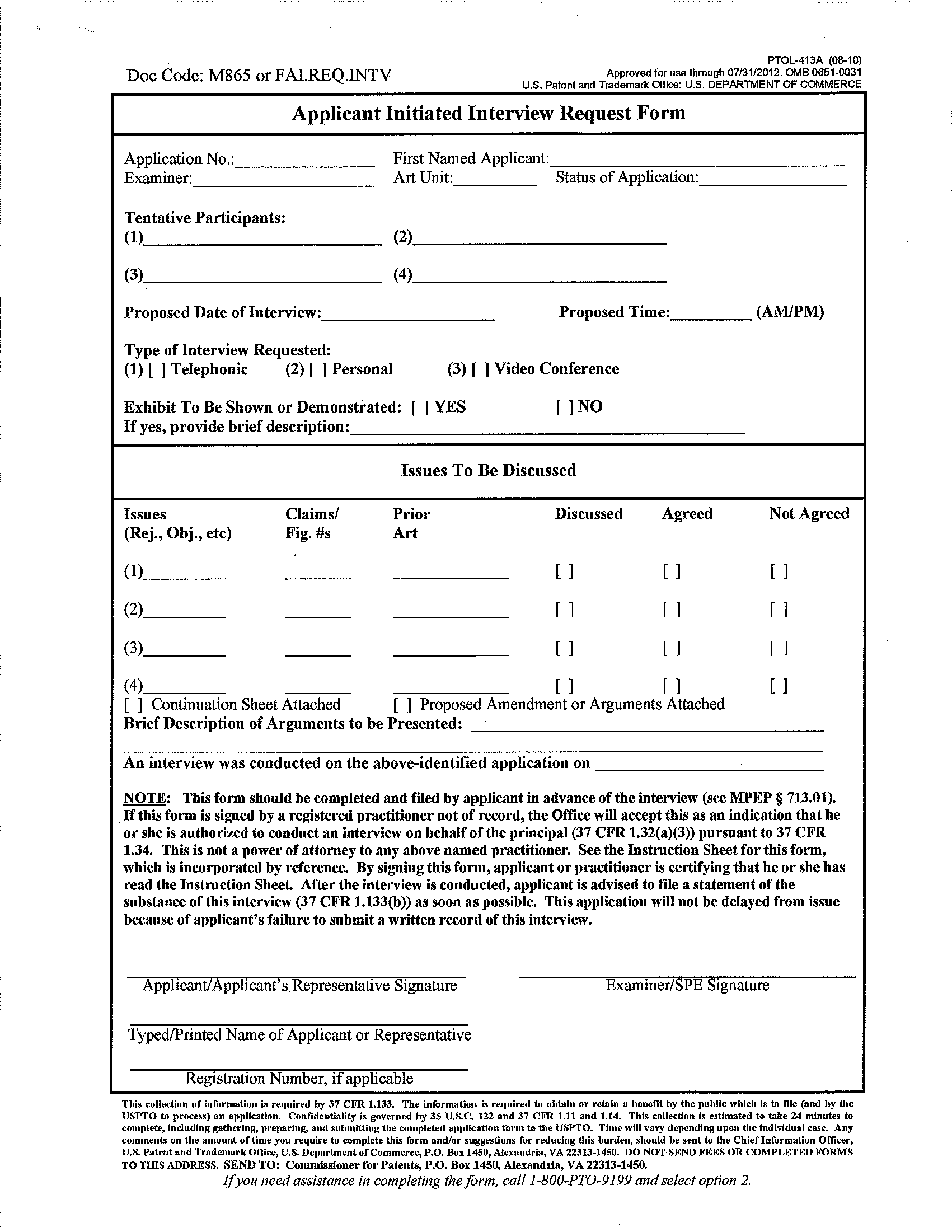
An interview should normally be arranged for in advance, as by letter, facsimile, electronic mail, or telephone call, in order to insure that the primary examiner and/or the examiner in charge of the application will be available. When applicant is initiating a request for an interview, an "Applicant Initiated Interview Request" form (PTOL-413A) should be submitted to the examiner prior to the interview in order to permit the examiner to prepare in advance for the interview and to focus on the issues to be discussed. This form should identify the participants of the interview, the proposed date of the interview, whether the interview will be personal, telephonic, instant message system or video conference, and should include a brief description of the issues to be discussed. A copy of the completed "Applicant Initiated Interview Request" form should be attached to the Interview Summary form, PTOL-413 at the completion of the interview and a copy should be given to applicant or applicant’s representative. Applicants are encouraged to use form PTO-413A, however, the fact that applicant does not submit an "Applicant Initiated Interview Request" form is not, by itself, grounds for the examiner to deny a request for an interview. When a second art unit is involved, such as in the case where approval of a Patentability Report is necessary, the availability of the second examiner should also be checked. See MPEP §§ 705-705.01(f). An appointment for interview once arranged should be kept by examiner and applicant, attorney, or agent. When, after an appointment has been made, circumstances compel the absence of a party necessary to an effective interview (e.g., applicant, applicant’s representative, or examiner), the other party should be notified immediately so that substitute arrangements may be made.
When a telephone call is made to an examiner and it becomes evident that a lengthy discussion will ensue or that the examiner needs time to restudy the situation, the call should be terminated with an agreement that the examiner will call back at a specified time. Such a call and all other calls originated by the examiner should be made through the Office’s telephone system.
An examiner’s suggestion of allowable subject matter may justify indicating the possibility of an interview to accelerate early agreement on allowable claims.
The unexpected appearance of an attorney or applicant requesting an interview without any previous notice may well justify the examiner’s refusal of the interview at that time, particularly in an involved case.
An interview should be had only when the nature of the case is such that the interview could serve to develop and clarify specific issues and lead to a mutual understanding between the examiner and the applicant, and thereby advance the prosecution of the application.
Thus, the attorney when presenting himself or herself for an interview should be fully prepared to discuss the issues raised in the Office action. When it is obvious that the attorney is not so prepared, the interview should be rescheduled. It is desirable that the attorney or applicant indicate in advance what issues he or she desires to discuss at the interview by submitting, in writing, a proposed amendment. This would permit the examiner to prepare in advance for the interview and to focus on the matters set forth in the proposed amendment.
In order to have an effective interview, both parties should avoid unnecessary interruptions. Do not take incoming telephone calls, emails, or text messages unless an emergency. All parties participating in an interview should familiarize themselves with the status and existing issues in an application or reexamination proceeding before an interview.
The examiner should not hesitate to state, when appropriate, that claims presented for discussion at an interview would require further search and consideration. Nor should the examiner hesitate to conclude an interview when it appears that no common ground can be reached or when it becomes apparent that the application requires further amendment or an additional action by the examiner. However, the examiner should attempt to identify issues and resolve differences during the interview as much as possible.
It is the responsibility of all participants to see that the interview is not extended beyond a reasonable period, usually 30 minutes. It is the duty of the primary examiner to see that an interview is not extended beyond a reasonable period.
During an interview with a pro se applicant (i.e., an applicant who is prosecuting his or her own case and is not familiar with Office procedure), the examiner may make suggestions that will advance the prosecution of this case; this lies wholly within the examiner’s discretion. Excessive time, however, should not be allowed for such interviews.
Examiners should inspect all incoming papers. See MPEP § 714.05. Where a complete reply to a first action includes a request for an interview, a telephone consultation to be initiated by the examiner or a video conference, or where an out-of-town attorney under similar circumstances requests that the examiner defer taking any further action on the case until the attorney’s next visit to a USPTO campus (provided such visit is not beyond the date when the Office action would normally be taken up for action), the examiner, as soon as he or she has considered the effect of the reply, should grant such request if it appears that the interview or consultation would result in expediting the case to a final action.
Where agreement is reached as a result of an interview, applicant’s representative should be advised that an amendment pursuant to the agreement should be promptly submitted. If the amendment prepares the case for final action, the examiner should take the case up as special. If not, the case should await its turn.
A duplicate copy of a filed amendment and/or remarks may be sent to the examiner in order to facilitate early consideration.
A duplicate copy is unnecessary when the amendment and/or remarks are filed via the Office’s electronic filing system (EFS-Web) as the examiner will be able to quickly access such documents. See the EFS-Web Guidance and Resources page of the Office Web site (http://www.uspto.gov/patents /process/file/efs/guidance/index. jsp ) for additional information. See also MPEP § 502.05.
The substance of any interview, whether in person, by video conference, by electronic mail, electronic message system or by telephone must be made of record in the application. See MPEP § 502.03 and § 713.04.
Examiners may grant one interview after final rejection. See MPEP § 713.09.
V. VIEWING OF VIDEO DURING INTERVIEWS
The USPTO has compact disc player equipment available for viewing video discs from applicants during interviews with patent examiners.
Attorneys or applicants wishing to show a video during an examiner interview must be able to demonstrate that the content of the video has a bearing on an outstanding issue in the application and its viewing will advance the prosecution of the application. If the video that applicant would like to display during the interview is in a format other than current DVD format, the applicant should also bring to the interview the equipment necessary to display the video. The substance of the interview, including a summary of the content of the video must be made of record in the application. See MPEP § 713.04.
VI. EXAMINATION BY EXAMINER OTHER THAN THE ONE WHO CONDUCTED THE INTERVIEW
Sometimes the examiner who conducted the interview is transferred to another Technology Center or resigns, and the examination is continued by another examiner. If there is an indication that an interview had been held, the second examiner should ascertain if any agreements were reached at the interview. Where conditions permit, as in the absence of a clear error or knowledge of other prior art, the second examiner should take a position consistent with the agreements previously reached. See MPEP § 812.01 for a statement of telephone practice in restriction and election of species situations.
VII. COLLABORATION TOOLS
Collaboration tools include instant messaging, document sharing and whiteboard, virtual meeting tools, and video conferencing equipment and software. All collaboration tools used for interviews must be supplied by the USPTO and hosted by the USPTO network.