§ 601
MPEP § 601
Content of Provisional and Nonprovisional Applications
Published Nov 1, 2013United States Patent and Trademark Office
Viewing an earlier, undated versionView current
35 U.S.C. 111 Application
- (a) IN GENERAL.—
- (1) WRITTEN APPLICATION.—An application for patent shall be made, or authorized to be made, by the inventor, except as otherwise provided in this title, in writing to the Director.
- (2) CONTENTS.—Such application shall include—
- (A) a specification as prescribed by section 112;
- (B) a drawing as prescribed by section 113; and
- (C) an oath or declaration as prescribed by section 115.
- (3) FEE AND OATH OR DECLARATION.—The application must be accompanied by the fee required by law. The fee and oath or declaration may be submitted after the specification and any required drawing are submitted, within such period and under such conditions, including the payment of a surcharge, as may be prescribed by the Director.
- (4) FAILURE TO SUBMIT.—Upon failure to submit the fee and oath or declaration within such prescribed period, the application shall be regarded as abandoned, unless it is shown to the satisfaction of the Director that the delay in submitting the fee and oath or declaration was unavoidable or unintentional. The filing date of an application shall be the date on which the specification and any required drawing are received in the Patent and Trademark Office.
- (b) PROVISIONAL APPLICATION.—
- (1) AUTHORIZATION.—A provisional application for patent shall be made or authorized to be made by the inventor, except as otherwise provided in this title, in writing to the Director. Such application shall include—
- (A) a specification as prescribed by section 112(a); and
- (B) a drawing as prescribed by section 113 .
- (2) CLAIM.—A claim, as required by subsections (b) through (e) of section 112, shall not be required in a provisional application.
- (3) FEE.—
- (A) The application must be accompanied by the fee required by law.
- (B) The fee may be submitted after the specification and any required drawing are submitted, within such period and under such conditions, including the payment of a surcharge, as may be prescribed by the Director.
- (C) Upon failure to submit the fee within such prescribed period, the application shall be regarded as abandoned, unless it is shown to the satisfaction of the Director that the delay in submitting the fee was unavoidable or unintentional.
- (4) FILING DATE.—The filing date of a provisional application shall be the date on which the specification and any required drawing are received in the Patent and Trademark Office.
- (5) ABANDONMENT.—Notwithstanding the absence of a claim, upon timely request and as prescribed by the Director, a provisional application may be treated as an application filed under subsection (a). Subject to section 119(e)(3), if no such request is made, the provisional application shall be regarded as abandoned 12 months after the filing date of such application and shall not be subject to revival after such 12-month period.
- (6) OTHER BASIS FOR PROVISIONAL APPLICATION.—Subject to all the conditions in this subsection and section 119(e), and as prescribed by the Director, an application for patent filed under subsection (a) may be treated as a provisional application for patent.
- (7) NO RIGHT OF PRIORITY OR BENEFIT OF EARLIEST FILING DATE.—A provisional application shall not be entitled to the right of priority of any other application under section 119 or 365(a) or to the benefit of an earlier filing date in the United States under section 120, 121, or 365(c).
- (8) APPLICABLE PROVISIONS.—The provisions of this title relating to applications for patent shall apply to provisional applications for patent, except as otherwise provided, and except that provisional applications for patent shall not be subject to sections 131 and 135.
- (1) AUTHORIZATION.—A provisional application for patent shall be made or authorized to be made by the inventor, except as otherwise provided in this title, in writing to the Director. Such application shall include—
37 C.F.R. 1.51 General requisites of an application.
- (a) Applications for patents must be made to the Director of the United States Patent and Trademark Office.
- (b) A complete application filed under § 1.53(b) or § 1.53(d) comprises:
- (1) A specification as prescribed by 35 U.S.C. 112, including a claim or claims, see §§ 1.71 to1.77;
- (2) The inventor’s oath or declaration, see §§ 1.63 and1.68;
- (3) Drawings, when necessary, see §§ 1.81 to1.85; and
- (4) The prescribed filing fee, search fee, examination fee, and application size fee, see § 1.16.
- (c) A complete provisional application filed under § 1.53(c) comprises:
- (1) A cover sheet identifying:
- (i) The application as a provisional application,
- (ii) The name or names of the inventor or inventors, (see § 1.41(a)(2) ),
- (iii) The residence of each named inventor,
- (iv) The title of the invention,
- (v) The name and registration number of the attorney or agent (if applicable),
- (vi) The docket number used by the person filing the application to identify the application (if applicable),
- (vii) The correspondence address, and
- (viii) The name of the U.S. Government agency and Government contract number (if the invention was made by an agency of the U.S. Government or under a contract with an agency of the U.S. Government);
- (2) A specification as prescribed by the first paragraph of 35 U.S.C. 112, see § 1.71;
- (3) Drawings, when necessary, see §§ 1.81 to 1.85; and
- (4) The prescribed filing fee and application size fee, see § 1.16.
- (1) A cover sheet identifying:
- (d) Applicants are encouraged to file an information disclosure statement in nonprovisional applications. See § 1.97 and § 1.98. No information disclosure statement may be filed in a provisional application.
I. GUIDELINES FOR DRAFTING A NONPROVISIONAL PATENT APPLICATION UNDER 35 U.S.C. 111(a)
The following guidelines illustrate the preferred layout and content of patent applications filed under 35 U.S.C. 111(a). These guidelines are suggested for the applicant’s use. See also 37 CFR 1.77 and MPEP § 608.01(a). If an application data sheet (37 CFR 1.76 ) is used, data supplied in the application data sheet need not be provided elsewhere in the application with one exception for applications filed before September 16, 2012. For such applications, the citizenship of each inventor must be provided in the oath or declaration under pre-AIA 37 CFR 1.63 even if this information is provided in the application data sheet (see pre-AIA 37 CFR 1.76(b) ). If there is a discrepancy between the information submitted in an application data sheet and the information submitted elsewhere in the application, the application data sheet will control except for the naming of the inventors and, for applications filed before September 16, 2012, the citizenship of the inventors. See MPEP § 601.05.
A complete application filed under 35 U.S.C. 111(a) comprises a specification, including claims, as prescribed by 35 U.S.C. 112, drawings as prescribed by 35 U.S.C. 113, an oath or declaration as prescribed by 35 U.S.C. 115, and the prescribed filing fee, search fee, examination fee and application size fee.
Arrangement and Contents of the Specification
The following order of arrangement is preferable in framing the specification. See also MPEP § 608.01(a). Each of the lettered items should appear in upper case, without underlining or bold type, as section headings.
- (A) Title of the invention. (See MPEP § 606).
- (B) Cross-reference to related applications. (See MPEP § 211et seq.).
- (C) Statement regarding federally sponsored research or development. (See MPEP § 310).
- (D) The names of the parties to a joint research agreement (see 37 CFR 1.71(g) ).
- (E) Reference to a "Sequence Listing," a table, or a computer program listing appendix submitted on compact disc and an incorporation-by-reference of the material on the compact disc.
- (F) Statement regarding prior disclosures by an inventor or joint inventor.
- (G) Background of the invention. (See MPEP § 608.01(c)).
- (1) Field of the invention.
- (2) Description of related art including information disclosed under 37 CFR 1.97 and 37 CFR 1.98.
- (H) Brief summary of the invention. (See MPEP § 608.01(d)).
- (I) Brief description of the several views of the drawing. (See MPEP § 608.01(f)).
- (J) Detailed description of the invention. (See MPEP § 608.01(g)).
- (K) Claim(s) (commencing on a separate sheet). (See MPEP § 608.01(i)-(p)).
- (L) Abstract of the Disclosure (commencing on a separate sheet). (See MPEP § 608.01(b)).
- (M) Sequence Listing, if on paper (see 37 CFR 1.821 through 1.825 ).
II. GUIDELINES FOR DRAFTING A PROVISIONAL APPLICATION UNDER 35 U.S.C. 111(b)
A provisional application should preferably conform to the arrangement guidelines for nonprovisional applications. The specification must, however, comply with the first paragraph of 35 U.S.C. 112 and refer to drawings, where necessary for an understanding of the invention. Unlike an application filed under 35 U.S.C. 111(a), a provisional application does not need claims. Furthermore, no oath or declaration is required. See MPEP § 201.04.
A cover sheet providing identifying information is required for a complete provisional application. In accordance with 37 CFR 1.51(c)(1) the cover sheet must state that it is for a provisional application, it must identify and give the residence of the inventor or inventors, and it must give a title of the invention. The cover sheet must also give the name and registration number of the attorney or agent (if applicable), the docket number used by the person filing the application (if applicable) and the correspondence address. If there is a governmental interest, the cover sheet must include a statement as to rights to inventions made under Federally sponsored research and development (See MPEP § 310). 37 CFR 1.51(c)(1)(viii) requires the name of the Government agency and the contract number, if the invention was developed by or while under contract with an agency of the U.S. Government.
Unlike applications filed under 35 U.S.C. 111(a), provisional applications should not include an information disclosure statement. See 37 CFR 1.51(d). Since no substantive examination is made, such statements are unnecessary. The Office will not accept an information disclosure statement in a provisional application. Any such statement received, will be returned or disposed of at the convenience of the Office.
This cover sheet information enables the Office to prepare a proper filing receipt and provides the Office of Patent Application Processing (OPAP) `with most of the information needed to process the provisional application. See MPEP § 201.04 for a sample cover sheet.
III. THE APPLICATION
The parts of the application may be included in a single document.
The paper standard requirements for papers submitted as part of the record of a patent application is covered in MPEP § 608.01, subsection I. Determination of completeness of an application is covered in MPEP § 506 and § 601.01 et seq.
The elements of the application are stored together in an electronic file wrapper, bearing appropriate identifying data including the application number and filing date (MPEP § 719).
See also the following the MPEP sections.
Provisional applications, MPEP § 201.04.
Divisional applications, MPEP § 201.06.
Continuation applications, MPEP § 201.07.
Continued prosecution applications, MPEP § 201.06(d).
Reissue applications, MPEP § 1401.
Design applications, MPEP Chapter 1500.
Plant applications, MPEP Chapter 1600.
Ex Parte Reexamination, MPEP Chapter 2200.
Inter Partes Reexamination, MPEP Chapter 2600.
International applications filed under the Patent Cooperation Treaty (PCT), MPEP Chapter 1800.
A model, exhibit, or specimen is normally not admitted as part of the application, although it may be required in the prosecution of the application (37 CFR 1.91 and 1.93, MPEP § 608.03).
Copies of an application will be provided by the USPTO upon request and payment of the fee set forth in 37 CFR 1.19(b) unless the application has been disposed of (see 37 CFR 1.53(e), (f) and (g)).
37 C.F.R. 1.53 Application number, filing date, and completion of application.
- (a) Application number. Any papers received in the Patent and Trademark Office which purport to be an application for a patent will be assigned an application number for identification purposes.
- (b) Application filing requirements - Nonprovisional application. The filing date of an application for patent filed under this section, except for a provisional application under paragraph (c) of this section or a continued prosecution application under paragraph (d) of this section, is the date on which a specification as prescribed by 35 U.S.C. 112 containing a description pursuant to § 1.71 and at least one claim pursuant to § 1.75, and any drawing required by § 1.81(a) are filed in the Patent and Trademark Office. No new matter may be introduced into an application after its filing date. A continuing application, which may be a continuation, divisional, or continuation-in-part application, may be filed under the conditions specified in 35 U.S.C. 120, 121 or 365(c) and § 1.78(c) adn (d).
- (1) A continuation or divisional application that names as inventors the same or fewer than all of the inventors named in the prior application may be filed under this paragraph or paragraph (d) of this section.
- (2) A continuation-in-part application (which may disclose and claim subject matter not disclosed in the prior application) or a continuation or divisional application naming an inventor not named in the prior application must be filed under this paragraph.
- (c) Application filing requirements - Provisional application. The filing date of a provisional application is the date on which a specification as prescribed by 35 U.S.C. 112(a), and any drawing required by § 1.81(a) are filed in the Patent and Trademark Office. No amendment, other than to make the provisional application comply with the patent statute and all applicable regulations, may be made to the provisional application after the filing date of the provisional application.
- (1) A provisional application must also include the cover sheet required by § 1.51(c)(1), which may be an application data sheet (§ 1.76 ), or a cover letter identifying the application as a provisional application. Otherwise, the application will be treated as an application filed under paragraph (b) of this section.
- (2) An application for patent filed under paragraph (b) of this section may be converted to a provisional application and be accorded the original filing date of the application filed under paragraph (b) of this section. The grant of such a request for conversion will not entitle applicant to a refund of the fees that were properly paid in the application filed under paragraph (b) of this section. Such a request for conversion must be accompanied by the processing fee set forth in § 1.17(q) and be filed prior to the earliest of:
- (i) Abandonment of the application filed under paragraph (b) of this section;
- (ii) Payment of the issue fee on the application filed under paragraph (b) of this section; or
- (iii) Expiration of twelve months after the filing date of the application filed under paragraph (b) of this section.
- (3) A provisional application filed under paragraph (c) of this section may be converted to a nonprovisional application filed under paragraph (b) of this section and accorded the original filing date of the provisional application. The conversion of a provisional application to a nonprovisional application will not result in either the refund of any fee properly paid in the provisional application or the application of any such fee to the filing fee, or any other fee, for the nonprovisional application. Conversion of a provisional application to a nonprovisional application under this paragraph will result in the term of any patent to issue from the application being measured from at least the filing date of the provisional application for which conversion is requested. Thus, applicants should consider avoiding this adverse patent term impact by filing a nonprovisional application claiming the benefit of the provisional application under 35 U.S.C. 119(e) (rather than converting the provisional application into a nonprovisional application pursuant to this paragraph). A request to convert a provisional application to a nonprovisional application must be accompanied by the fee set forth in § 1.17(i) and an amendment including at least one claim as prescribed by 35 U.S.C. 112(b), unless the provisional application under paragraph (c) of this section otherwise contains at least one claim as prescribed by 35 U.S.C.112(b). The nonprovisional application resulting from conversion of a provisional application must also include the filing fee, search fee, and examination fee for a nonprovisional application, the inventor's oath or declaration, and the surcharge required by § 1.16(f) if either the basic filing fee for a nonprovisional application or the inventor's oath or declaration was not present on the filing date accorded the resulting nonprovisional application (i.e., the filing date of the original provisional application). A request to convert a provisional application to a nonprovisional application must also be filed prior to the earliest of:
- (i) Abandonment of the provisional application filed under paragraph (c) of this section; or
- (ii) Expiration of twelve months after the filing date of the provisional application filed under paragraph (c) of this section.
- (4) A provisional application is not entitled to the right of priority under 35 U.S.C. 119 or 365(a) or § 1.55, or to the benefit of an earlier filing date under 35 U.S.C. 120, 121 or 365(c) or § 1.78 of any other application. No claim for priority under 35 U.S.C. 119(e) or § 1.78(a)(4 ) may be made in a design application based on a provisional application. The requirements of §§ 1.821 through 1.825 regarding application disclosures containing nucleotide and/or amino acid sequences are not mandatory for provisional applications.
- (d) Application filing requirements - Continued prosecution (nonprovisional) application.
- (1) A continuation or divisional application (but not a continuation-in-part) of a prior nonprovisional application may be filed as a continued prosecution application under this paragraph, provided that:
- (i) The application is for a design patent;
- (ii) The prior nonprovisional application is a design application that is complete as defined by § 1.51(b); and
- (iii) The application under this paragraph is filed before the earliest of:
- (A) Payment of the issue fee on the prior application, unless a petition under § 1.313(c) is granted in the prior application;
- (B) Abandonment of the prior application; or
- (C) Termination of proceedings on the prior application.
- (2) The filing date of a continued prosecution application is the date on which a request on a separate paper for an application under this paragraph is filed. An application filed under this paragraph:
- (i) Must identify the prior application;
- (ii) Discloses and claims only subject matter disclosed in the prior application;
- (iii) Names as inventors the same inventors named in the prior application on the date the application under this paragraph was filed, except as provided in paragraph (d)(4) of this section;
- (iv) Includes the request for an application under this paragraph, will utilize the file jacket and contents of the prior application, including the specification, drawings and the inventor's oath or declaration from the prior application, to constitute the new application, and will be assigned the application number of the prior application for identification purposes; and
- (v) Is a request to expressly abandon the prior application as of the filing date of the request for an application under this paragraph.
- (3) The filing fee, search fee, and examination fee for a continued prosecution application filed under this paragraph are the basic filing fee as set forth in §1.16(b), the search fee as set forth in §1.16(l), and the examination fee as set forth in §1.16(p).
- (4) An application filed under this paragraph may be filed by fewer than all the inventors named in the prior application, provided that the request for an application under this paragraph when filed is accompanied by a statement requesting deletion of the name or names of the person or persons who are not inventors of the invention being claimed in the new application. No person may be named as an inventor in an application filed under this paragraph who was not named as an inventor in the prior application on the date the application under this paragraph was filed, except by way of correction of inventorship under § 1.48.
- (5) Any new change must be made in the form of an amendment to the prior application as it existed prior to the filing of an application under this paragraph. No amendment in an application under this paragraph (a continued prosecution application) may introduce new matter or matter that would have been new matter in the prior application. Any new specification filed with the request for an application under this paragraph will not be considered part of the original application papers, but will be treated as a substitute specification in accordance with § 1.125.
- (6) The filing of a continued prosecution application under this paragraph will be construed to include a waiver of confidentiality by the applicant under 35 U.S.C. 122 to the extent that any member of the public, who is entitled under the provisions of § 1.14 to access to, copies of, or information concerning either the prior application or any continuing application filed under the provisions of this paragraph, may be given similar access to, copies of, or similar information concerning the other application or applications in the file jacket.
- (7) A request for an application under this paragraph is the specific reference required by 35 U.S.C. 120 to every application assigned the application number identified in such request. No amendment in an application under this paragraph may delete this specific reference to any prior application.
- (8) In addition to identifying the application number of the prior application, applicant should furnish in the request for an application under this paragraph the following information relating to the prior application to the best of his or her ability:
- (i) Title of invention;
- (ii) Name of applicant(s); and
- (iii) Correspondence address.
- (9) See § 1.103(b) for requesting a limited suspension of action in an application filed under this paragraph.
- (1) A continuation or divisional application (but not a continuation-in-part) of a prior nonprovisional application may be filed as a continued prosecution application under this paragraph, provided that:
- (e) Failure to meet filing date requirements.
- (1) If an application deposited under paragraph (b), (c), or (d) of this section does not meet the requirements of such paragraph to be entitled to a filing date, applicant will be so notified, if a correspondence address has been provided, and given a period of time within which to correct the filing error. If, however, a request for an application under paragraph (d) of this section does not meet the requirements of that paragraph because the application in which the request was filed is not a design application, and if the application in which the request was filed was itself filed on or after June 8, 1995, the request for an application under paragraph (d) of this section will be treated as a request for continued examination under § 1.114.
- (2) Any request for review of a notification pursuant to paragraph (e)(1) of this section, or a notification that the original application papers lack a portion of the specification or drawing(s), must be by way of a petition pursuant to this paragraph accompanied by the fee set forth in § 1.17(f). In the absence of a timely (§ 1.181(f) ) petition pursuant to this paragraph, the filing date of an application in which the applicant was notified of a filing error pursuant to paragraph (e)(1) of this section will be the date the filing error is corrected.
- (3) If an applicant is notified of a filing error pursuant to paragraph (e)(1) of this section, but fails to correct the filing error within the given time period or otherwise timely (§ 1.181(f) ) take action pursuant to this paragraph, proceedings in the application will be considered terminated. Where proceedings in an application are terminated pursuant to this paragraph, the application may be disposed of, and any filing fees, less the handling fee set forth in 1.21(n), will be refunded.
- (f) Completion of application subsequent to filing—Nonprovisional (including continued prosecution or reissue) application.
- (1) If an application which has been accorded a filing date pursuant to paragraph (b) or (d) of this section does not include the basic filing fee, the search fee, or the examination fee, or if an application which has been accorded a filing date pursuant to paragraph (b) of this section does not include the inventor's oath or declaration (§ 1.63, § 1.64, § 1.162 or § 1.175 ), and the applicant has provided a correspondence address (§ 1.33(a) ), the applicant will be notified and given a period of time within which to pay the basic filing fee, search fee, and examination fee, and pay the surcharge if required by § 1.16(f) to avoid abandonment.
- (2) If an application which has been accorded a filing date pursuant to paragraph (b) of this section does not include the basic filing fee, the search fee, the examination fee, or the inventor's oath or declaration, and the applicant has not provided a correspondence address (§ 1.33(a) ), the applicant has two months from the filing date of the application within which to pay the basic filing fee, search fee, and examination fee, and pay the surcharge required by § 1.16(f) to avoid abandonment.
- (3) The inventor's oath or declaration in an application under § 1.53(b) must also be filed within the period specified in paragraph (f)(1) or (f)(2) of this section, except that the filing of the inventor's oath or declaration may be postponed until the application is otherwise in condition for allowance under the conditions specified in paragraphs (f)(3)(i) and (f)(3)(ii) of this section.
- (i) The application must be an original (non-reissue) application that contains an application data sheet in accordance with § 1.76 identifying:
- (A) Each inventor by his or her legal name;
- (B) A mailing address where the inventor customarily receives mail, and residence, if an inventor lives at a location which is different from where the inventor customarily receives mail, for each inventor.
- (ii) The applicant must file an oath or declaration in compliance with § 1.63, or a substitute statement in compliance with § 1.64, executed by or with respect to each actual inventor no later than the expiration of the time period set in the "Notice of Allowability" to avoid abandonment, when the applicant is notified in a "Notice of Allowability" that an application is otherwise in condition for allowance. The time period set in a "Notice of Allowability" is not extendable. See § 1.136(c). The Office may dispense with the notice provided for in paragraph (f)(1) of this section if an oath or declaration under § 1.63, or a substitute statement under § 1.64, executed by or with respect to each actual inventor has been filed before the application is in condition for allowance.
- (i) The application must be an original (non-reissue) application that contains an application data sheet in accordance with § 1.76 identifying:
- (4) If the excess claims fees required by § 1.16(h) and (i) and multiple dependent claim fee required by § 1.16(j) are not paid on filing or on later presentation of the claims for which the excess claims or multiple dependent claim fees are due, the fees required by § 1.16(h), (i) and (j) must be paid or the claims canceled by amendment prior to the expiration of the time period set for reply by the Office in any notice of fee deficiency. If the application size fee required by § 1.16(s) (if any) is not paid on filing or on later presentation of the amendment necessitating a fee or additional fee under § 1.16(s), the fee required by § 1.16(s) must be paid prior to the expiration of the time period set for reply by the Office in any notice of fee deficiency in order to avoid abandonment.
- (5) This paragraph applies to continuation or divisional applications under paragraphs (b) or (d) of this section and to continuation-in-part applications under paragraph (b) of this section. See § 1.63(d) concerning the submission of a copy of the inventor's oath or declaration from the prior application for a continuing application under paragraph (b) of this section.
- (6) If applicant does not pay the basic filing fee during the pendency of the application, the Office may dispose of the application.
- (g) Completion of application subsequent to filing—Provisional application.
- (1) If a provisional application which has been accorded a filing date pursuant to paragraph (c) of this section does not include the cover sheet required by § 1.51(c)(1) or the basic filing fee (§ 1.16(d) ), and applicant has provided a correspondence address (§ 1.33(a) ), applicant will be notified and given a period of time within which to pay the basic filing fee, file a cover sheet (§ 1.51(c)(1) ), and pay the surcharge required by § 1.16(g) to avoid abandonment.
- (2) If a provisional application which has been accorded a filing date pursuant to paragraph (c) of this section does not include the cover sheet required by § 1.51(c)(1) or the basic filing fee (§ 1.16(d) ), and applicant has not provided a correspondence address (§ 1.33(a) ), applicant has two months from the filing date of the application within which to pay the basic filing fee, file a cover sheet (§ 1.51(c)(1) ), and pay the surcharge required by § 1.16(g) to avoid abandonment.
- (3) If the application size fee required by § 1.16(s) (if any) is not paid on filing, the fee required by § 1.16(s) must be paid prior to the expiration of the time period set for reply by the Office in any notice of fee deficiency in order to avoid abandonment.
- (4) If applicant does not pay the basic filing fee during the pendency of the application, the Office may dispose of the application.
- (h) Subsequent treatment of application - Nonprovisional (including continued prosecution) application. An application for a patent filed under paragraphs (b) or (d) of this section will not be placed on the files for examination until all its required parts, complying with the rules relating thereto, are received, except that the inventor's oath or declaration may be filed when the application is otherwise in condition for allowance pursuant to paragraph (f)(3) of this section and minor informalities may be waived subject to subsequent correction whenever required.
- (i) Subsequent treatment of application - Provisional application. A provisional application for a patent filed under paragraph (c) of this section will not be placed on the files for examination and will become abandoned no later than twelve months after its filing date pursuant to 35 U.S.C. 111(b)(1).
37 C.F.R. 1.53 (pre-AIA) Application number, filing date, and completion of application.
*****
- (f) Completion of application subsequent to filing—Nonprovisional (including continued prosecution or reissue) application.
- (1) If an application which has been accorded a filing date pursuant to paragraph (b) or (d) of this section does not include the basic filing fee, the search fee, or the examination fee, or if an application which has been accorded a filing date pursuant to paragraph (b) of this section does not include an oath or declaration by the applicant pursuant to §§ 1.63, 1.162 or § 1.175, and applicant has provided a correspondence address (§1.33(a) ), applicant will be notified and given a period of time within which to pay the basic filing fee, search fee, and examination fee, file an oath or declaration in an application under paragraph (b) of this section, and pay the surcharge if required by § 1.16(f) to avoid abandonment.
- (2) If an application which has been accorded a filing date pursuant to paragraph (b) of this section does not include the basic filing fee, the search fee, the examination fee, or an oath or declaration by the applicant pursuant to §§ 1.63, 1.162 or § 1.175, and applicant has not provided a correspondence address (§ 1.33(a) ), applicant has two months from the filing date of the application within which to pay the basic filing fee, search fee, and examination fee, file an oath or declaration, and pay the surcharge required by § 1.16(f) to avoid abandonment.
- (3) If the excess claims fees required by §§ 1.16(h) and (i) and multiple dependent claim fee required by § 1.16(j) are not paid on filing or on later presentation of the claims for which the excess claims or multiple dependent claim fees are due, the fees required by §§ 1.16(h), (i) and (j) must be paid or the claims canceled by amendment prior to the expiration of the time period set for reply by the Office in any notice of fee deficiency. If the application size fee required by § 1.16(s) (if any) is not paid on filing or on later presentation of the amendment necessitating a fee or additional fee under § 1.16(s), the fee required by § 1.16(s) must be paid prior to the expiration of the time period set for reply by the Office in any notice of fee deficiency in order to avoid abandonment.
- (4) This paragraph applies to continuation or divisional applications under paragraphs (b) or (d) of this section and to continuation-in-part applications under paragraph (b) of this section. See § 1.63(d) concerning the submission of a copy of the oath or declaration from the prior application for a continuation or divisional application under paragraph (b) of this section.
- (5) If applicant does not pay the basic filing fee during the pendency of the application, the Office may dispose of the application.
*****
37 CFR 1.53 relates to application numbers, filing dates, and completion of applications. Note that the substantive requirements under 37 CFR 1.53 for applications filed on or after September 16, 2012 as compared to those filed prior to September 16, 2012 (pre-AIA) are the same with the exception of 37 CFR 1.53(f), pertaining to completion of a nonprovisional application subsequent to filing. See MPEP § 601.01(a) for additional information. 37 CFR 1.53(a) indicates that an application number is assigned for identification purposes to any paper which purports to be an application for a patent, even if the application is incomplete or informal. The remaining sections of 37 CFR 1.53 treat nonprovisional applications filed under 35 U.S.C. 111(a) separately from provisional applications filed under 35 U.S.C. 111(b).
37 CFR 1.53(d) sets forth the filing date requirements for a continued prosecution application (CPA). A CPA is a nonprovisional application which must be filed on or after December 1, 1997. Only a continuation or divisional application (but not a continuation-in-part) may be filed as a CPA. See MPEP § 201.06(d). Effective July 14, 2003, CPA practice under 37 CFR 1.53(d) does not apply to utility and plant applications. CPAs can only be filed in design applications.
I. APPLICATION FILING REQUIREMENTS
The procedure for filing a nonprovisional application under 35 U.S.C. 111(a) is set forth in 37 CFR 1.53(b) and 37 CFR 1.53(d). 37 CFR 1.53(b) may be used to file any original, reissue, or substitute nonprovisional application and any continuing application, i.e., continuation, divisional, or continuation-in-part. Under 37 CFR 1.53(b), a filing date is assigned to a nonprovisional application as of the date a specification containing a description and claim and any necessary drawings are filed in the U.S. Patent and Trademark Office (USPTO). Failure to meet any of the requirements in 37 CFR 1.53(b) will result in the application being denied a filing date. The filing date to be accorded such an application is the date on which all of the requirements of 37 CFR 1.53(b) are met.
37 CFR 1.53(d) may be used to file either a continuation or a divisional application (but not a continuation-in-part) of a design application. The prior nonprovisional application must be a design application that is complete as defined by 37 CFR 1.51(b). Any application filed under 37 CFR 1.53(d) must disclose and claim only subject matter disclosed in the prior nonprovisional application and must name as inventors the same or less than all of the inventors named in the prior nonprovisional application. Under 37 CFR 1.53(d), the filing date assigned is the date on which a request, on a separate paper, for an application under 37 CFR 1.53(d) is filed. An application filed under 37 CFR 1.53(d) must be filed before the earliest of:
- (A) payment of the issue fee on the prior application, unless a petition under 37 CFR 1.313(c) is granted in the prior application;
- (B) abandonment of the prior application; or
- (C) termination of proceedings on the prior application.
The filing fee , search fee and examination fee for an application filed under 37 CFR 1.53(b) or 37 CFR 1.53(d) and the oath or declaration for an application filed under 37 CFR 1.53(b) can be submitted after the filing date. However, no amendment may introduce new matter into the disclosure of an application after its filing date.
If the required basic filing fee is not paid during the pendency of the application, the application will be disposed of.
The basic filing fee must be paid within the pendency of a nonprovisional application in order to permit benefit of the application to be claimed under 35 U.S.C. 120, 121, or 365(c) in a subsequent nonprovisional or international application.
See 37 CFR 1.78. Copies of an application will be provided by the USPTO upon request and payment of the fee set forth in 37 CFR 1.19(b) unless the application has been disposed of (see 37 CFR 1.53(e) and (f)).
37 CFR 1.53(h) indicates that a patent application will not be forwarded for examination on the merits until all required parts have been received.
II. COMPLETION OF NONPROVISIONAL APPLICATION SUBSEQUENT TO FILING
In accordance with the provisions of 35 U.S.C. 111(a) and 37 CFR 1.53(b), a filing date is granted to a nonprovisional application for patent that includes at least a specification as prescribed by 35 U.S.C. 112 containing a description pursuant to 37 CFR 1.71 and at least one claim pursuant to 37 CFR 1.75, and any drawing referred to in the specification or required by 37 CFR 1.81(a), which is filed in the U.S. Patent and Trademark Office.
A. Completion of Nonprovisional Application Filed On or After September 16, 2012
[Editor Note: See subsection B., below, for applications filed before September 16, 2012.]
If an application which has been accorded a filing date does not include the appropriate filing fee, search fee, examination fee, or inventor's oath or declaration, applicant will be so notified in accordance with 37 CFR 1.53(f).
For applications filed before September 16, 2012, the Office issued a Notice to File Missing Parts if an application under 37 CFR 1.53(b) did not contain the basic filing fee, the search fee, or the examination fee, or the inventor's oath or declaration, and the applicant was given a time period (usually two months) within which to file the missing basic filing fee, the search fee, the examination fee, or the inventor's oath or declaration and pay the surcharge required by 37 CFR 1.16(f) to avoid abandonment. See subsection II.B below for additional information regarding completion of a nonprovisional application filed before September 16, 2012.
For applications filed on or after September 16, 2012, 37 CFR 1.53(f) revises the former missing parts practice to allow applicants to postpone filing the inventor's oath or declaration until the application is otherwise in condition for allowance.
37 CFR 1.53(f)(1) provides for a notice (if the applicant has provided a correspondence address) if the application does not contain the basic filing fee, the search fee, or the examination fee, or if the application under 37 CFR 1.53(b) does not contain the inventor's oath or declaration. 37 CFR 1.53(f)(1) provides that applicant must pay the basic filing fee, search fee, and examination fee, and pay the surcharge if required by 37 CFR 1.16(f) within the time period set in the notice to avoid abandonment.
Section 1.53(f)(3) (discussed subsequently) sets forth the time period for filing the inventor's oath or declaration in an application under 37 CFR 1.53(b) (an application under 37 CFR 1.53(d) uses the inventor's oath or declaration from the prior application) and provides the conditions under which an applicant may postpone filing the inventor's oath or declaration until the application is otherwise in condition for allowance.
37 CFR 1.53(f)(2) provides for the situation where applicant has not provided a correspondence address in an application under 37 CFR 1.53(b), and the application does not contain the basic filing fee, the search fee, or the examination fee, or does not contain the inventor's oath or declaration.37 CFR 1.53(f)(2) provides that if the applicant has not provided a correspondence address, the applicant must pay the basic filing fee, search fee, and examination fee, and pay the surcharge if required by 37 CFR 1.16(f), within two months from the filing date of the application to avoid abandonment.
37 CFR 1.53(f)(3) sets forth the time period for filing the inventor's oath or declaration in an application under 37 CFR 1.53(b) and provides the conditions under which an applicant may postpone filing the inventor's oath or declaration until the application is otherwise in condition for allowance. Section 1.53(f)(3) specifically provides that the inventor's oath or declaration in an application under 37 CFR 1.53(b) must also be filed within the period specified in 37 CFR 1.53(f)(1) or (f)(2), except that the filing of the inventor's oath or declaration may be postponed until the application is otherwise in condition for allowance under the conditions specified in 37 CFR 1.53(f)(3)(i) through (f)(3)(ii). This requires payment of the surcharge under 37 CFR 1.16(f) if the inventor’s oath or declaration (executed by or with respect to each inventor) is not submitted on filing of the application. If the surcharge is not paid at the time the application is filed, the Office will send a Notice to File Missing Parts requiring the surcharge. If, however, a general authorization to charge any required fees to a deposit account (that covers fees under 37 CFR 1.16 ) is submitted on filing of the application, the Office will charge the surcharge in accordance with the deposit account authorization. Payment of the surcharge cannot be postponed until a Notice of Allowability issues.
37 CFR 1.53(f)(3)(i) provides that the application must be an original (non-reissue) application that contains an application data sheet in accordance with 37 CFR 1.76 identifying: (1) each inventor by his or her legal name; and (2) a mailing address where the inventor customarily receives mail, and residence, if an inventor lives at a location which is different from where the inventor customarily receives mail, for each inventor. The applicant must file an oath or declaration in compliance with 37 CFR 1.63, or substitute statement in compliance with 37 CFR 1.64, executed by or with respect to each actual inventor no later than the date on which the issue fee is paid. See 35 U.S.C. 115(f).
If an application under 37 CFR 1.53(b) does not include the inventor's oath or declaration but does contains the applicable filing fees (basic filing fee, search fee, the examination fee, any applicable excess claims fee, and any applicable application size fee), the surcharge required by 37 CFR 1.16(f) (for filing the oath or declaration later than the filing date), and a signed application data sheet providing the information required by 37 CFR 1.53(f)(3)(i), the Office will not issue a Notice to File Missing Parts requiring the applicant to file the inventor's oath or declaration.
If an application under 37 CFR 1.53(b) that does not contain the inventor's oath or declaration also does not contain the applicable filing fees, or the surcharge required by 37 CFR 1.16(f), or a signed application data sheet providing the information required by 37 CFR 1.53(f)(3)(i), the Office will issue a Notice to File Missing Parts giving the applicant a time period (usually two months) within which to file the missing parts. While the inventor's oath or declaration will not be required within the period for reply to the Notice to File Missing Parts if the applicant provides a signed application data sheet providing the information required by 37 CFR 1.53(f)(3)(i), any required filing fees and surcharge required by 37 CFR 1.16(f) must be filed within the period for reply to the Notice to File Missing Parts to avoid abandonment.
If an application is in condition for allowance but does not include an oath or declaration in compliance with 37 CFR 1.63, or a substitute statement in compliance with 37 CFR 1.64, executed by or with respect to each actual inventor, the Office will issue a ``Notice of Allowability'' (PTOL-37) including a Notice Requiring Inventor’s Oath or Declaration requiring the applicant to file an oath or declaration in compliance with 37 CFR 1.63, or substitute statement in compliance with 37 CFR 1.64, executed by or with respect to each actual inventor, no later than the date of payment of the issue fee to avoid abandonment.
B. Completion of Nonprovisional Application Filed Before September 16, 2012.
[Editor Note: See subsection A., above, for applications filed on or after September 16, 2012.]
If an application which has been accorded a filing date does not include the appropriate filing fee, search fee, examination fee, or oath or declaration, applicant will be so notified in accordance with pre-AIA 37 CFR 1.53(f) and given a period of time within which to file the missing parts to complete the application and to pay the surcharge as set forth in 37 CFR 1.16(f) in order to prevent abandonment of the application
Applicants should submit a copy of any notice to file missing parts or notice of incomplete application with the reply submitted to the U.S. Patent and Trademark Office, unless the reply is being submitted via EFS-Web. Applicants should also include the application number on all correspondence to the Office. These measures will aid the Office in matching papers to applications, thereby expediting the processing of applications.
In order for the Office to so notify the applicant, a correspondence address must also be provided in the application. The correspondence address may be different from the mailing (post office) address of the applicant. For example, the address of applicant’s registered attorney or agent may be used as the correspondence address. If applicant fails to provide the Office with a correspondence address, the Office will be unable to provide applicant with notification to complete the application and to pay the surcharge as set forth in 37 CFR 1.16(f). In such a case, applicant will be considered to have constructive notice as of the filing date that the application must be completed within 2 months from the filing date before abandonment occurs per 37 CFR 1.53(f). This time period may be extended pursuant to 37 CFR 1.136.
The oath or declaration filed in reply to such a notice under 37 CFR 1.53(f) must be executed by the inventors and must identify the specification and any amendment filed with the specification which includes subject matter not otherwise included in the specification (including claims) or drawings of the application as filed. See MPEP § 602. If an amendment is filed with the oath or declaration filed after the filing date of the application, it may be identified in the oath or declaration but may not include new matter. No new matter may be included after the filing date of the application. See MPEP § 608.04(b). If the oath or declaration improperly refers to an amendment filed after the filing date of the application which contains new matter, a supplemental oath or declaration will be required pursuant to 37 CFR 1.67, deleting the reference to the amendment containing new matter. If an amendment is filed on the same day that the application filed under 37 CFR 1.53(b) is filed it is a part of the original application papers and the question of new matter is not considered. Similarly, if the application papers are altered prior to execution of the oath or declaration and the filing of the application, new matter is not a consideration since the alteration is considered as part of the original disclosure.
A provisional application will be given a filing date in accordance with 37 CFR 1.53(c) as of the date the written description and any necessary drawings are filed in the Office. The filing date requirements for a provisional application set forth in 37 CFR 1.53(c) parallel the requirements for a nonprovisional application set forth in 37 CFR 1.53(b), except that no claim is required. Amendments, other than those required to make the provisional application comply with applicable regulations, are not permitted after the filing date of the provisional application.
When the specification or drawing are omitted, 37 CFR 1.53(e) requires that the applicant be notified and given a time period in which to submit the missing element to complete the filing. See MPEP § 601.01(f) and § 601.01(g) for treatment of applications filed without drawings, or filed without all figures of drawings, respectively.
37 CFR 1.53(c)(1) requires all provisional applications be filed with a cover sheet, which may be an application data sheet (37 CFR 1.76 ) or a cover letter identifying the application as a provisional application. The Office will treat an application as having been filed under paragraph (b), unless the application is clearly identified as a provisional application. A provisional application, which is identified as such, but which does not have a complete cover sheet as required by 37 CFR 1.51(c)(1) will be treated as a provisional application. However, the complete cover sheet and a surcharge will be required to be submitted at a later date in conformance with 37 CFR 1.53(g).
When the provisional application does not have a complete cover sheet or the appropriate fee, the applicant will be notified pursuant to 37 CFR 1.53(g) and given a time period in which to provide the necessary fee or cover sheet and to pay the surcharge as set forth in 37 CFR 1.16(g) in order to avoid abandonment of the application. The time period will usually be set at 2 months from the date of notification. This time period may be extended under 37 CFR 1.136(a). If the filing fee is not timely paid, the Office may dispose of the provisional application. If no correspondence address has been provided, applicant has 2 months from the filing date to file the basic filing fee, cover sheet, and to pay the surcharge as set forth in 37 CFR 1.16(g) in order to avoid abandonment of the provisional application. Copies of a provisional application will be provided by the USPTO upon request and payment of the fee set forth in 37 CFR 1.19(b) unless the provisional application has been disposed of (see 37 CFR 1.53(e) and (g)).
The basic filing fee must be paid in a provisional application on filing or within the time period set forth in 37 CFR 1.53(g), and the provisional application must be entitled to a filing date under 37 CFR 1.53(c), if any claim for benefits under 35 U.S.C. 119(e) based on that application is made in a subsequently filed nonprovisional application 37 CFR 1.78.
37 CFR 1.53(e)(2) requires that any request for review of a refusal to accord an application a filing date be made by way of a petition accompanied by the fee set forth in 37 CFR 1.17(f) (see MPEP § 506.02).
I. CONVERSION FROM A NONPROVISIONAL APPLICATION TO A PROVISIONAL APPLICATION
37 C.F.R. 1.53 Application number, filing date, and completion of application.
*****
- (c)(2) An application for patent filed under paragraph (b) of this section may be converted to a provisional application and be accorded the original filing date of the application filed under paragraph (b) of this section. The grant of such a request for conversion will not entitle applicant to a refund of the fees that were properly paid in the application filed under paragraph (b) of this section. Such a request for conversion must be accompanied by the processing fee set forth in § 1.17(q) and be filed prior to the earliest of:
- (i) Abandonment of the application filed under paragraph (b) of this section;
- (ii) Payment of the issue fee on the application filed under paragraph (b) of this section; or
- (iii) Expiration of twelve months after the filing date of the application filed under paragraph (b) of this section;
*****
An application filed under 37 CFR 1.53(b) may be converted to a provisional application in accordance with the procedure described in 37 CFR 1.53(c)(2). The procedure requires the filing of a request for conversion and the processing fee set forth in 37 CFR 1.17(q). The provisional application filing fee (37 CFR 1.16(d) ) and the surcharge set forth in 37 CFR 1.16(g) are also required, although these fees do not need to be paid with the request for conversion. If the provisional application filing fee and the surcharge are not paid at the time of filing of the request for conversion, the Office will send a Notice to File Missing Parts in the provisional application requiring these fees. Filing of the request in the nonprovisional application is required prior to the abandonment of the 37 CFR 1.53(b) application, the payment of the issue fee, or the expiration of 12 months after the filing date of the 37 CFR 1.53(b) application, whichever event is earlier. The grant of any such request does not entitle applicant to a refund of the fees properly paid in the application filed under 37 CFR 1.53(b).
Converting a nonprovisional application to a provisional application will not avoid the publication of the nonprovisional application unless the request to convert is recognized in sufficient time to permit the appropriate officials to remove the nonprovisional application from the publication process. The Office cannot ensure that it can remove an application from publication or avoid publication of application information any time after the publication process for the application has been initiated. For information on procedures for removing an application from publication, see MPEP § 1120.
A provisional application is not entitled to claim priority to or benefit of a prior-filed application under 35 U.S.C. 119, 120, 121, or 365. See MPEP § 201.04. After the nonprovisonal application has been converted to a provisional application, any priority or benefit claims submitted in the nonprovisional application will be disregarded.
Applicants who wish to file a request for conversion under 37 CFR 1.53(c)(2) by mail should designate "Mail Stop Conversion" as part of the U. S. Patent and Trademark Office address.
II. CONVERSION FROM A PROVISIONAL APPLICATION TO A NONPROVISIONAL APPLICATION
37 C.F.R. 1.53 Application number, filing date, and completion of application.
*****
- (c)
- (3) A provisional application filed under paragraph (c) of this section may be converted to a nonprovisional application filed under paragraph (b) of this section and accorded the original filing date of the provisional application. The conversion of a provisional application to a nonprovisional application will not result in either the refund of any fee properly paid in the provisional application or the application of any such fee to the filing fee, or any other fee, for the nonprovisional application. Conversion of a provisional application to a nonprovisional application under this paragraph will result in the term of any patent to issue from the application being measured from at least the filing date of the provisional application for which conversion is requested. Thus, applicants should consider avoiding this adverse patent term impact by filing a nonprovisional application claiming the benefit of the provisional application under 35 U.S.C. 119(e) (rather than converting the provisional application into a nonprovisional application pursuant to this paragraph). A request to convert a provisional application to a nonprovisional application must be accompanied by the fee set forth in § 1.17(i) and an amendment including at least one claim as prescribed by 35 U.S.C. 112(b), unless the provisional application under paragraph (c) of this section otherwise contains at least one claim as prescribed by 35 U.S.C. 112(b). The nonprovisional application resulting from conversion of a provisional application must also include the filing fee, search fee, and examination fee for a nonprovisional application, the inventor’s oath or declaration , and the surcharge required by § 1.16(f) if either the basic filing fee for a nonprovisional application or the inventor's oath or declaration was not present on the filing date accorded the resulting nonprovisional application (i.e., the filing date of the original provisional application). A request to convert a provisional application to a nonprovisional application must also be filed prior to the earliest of:
- (i) Abandonment of the provisional application filed under paragraph (c) of this section; or
- (ii) Expiration of twelve months after the filing date of the provisional application filed under paragraph (c) of this section.
- (3) A provisional application filed under paragraph (c) of this section may be converted to a nonprovisional application filed under paragraph (b) of this section and accorded the original filing date of the provisional application. The conversion of a provisional application to a nonprovisional application will not result in either the refund of any fee properly paid in the provisional application or the application of any such fee to the filing fee, or any other fee, for the nonprovisional application. Conversion of a provisional application to a nonprovisional application under this paragraph will result in the term of any patent to issue from the application being measured from at least the filing date of the provisional application for which conversion is requested. Thus, applicants should consider avoiding this adverse patent term impact by filing a nonprovisional application claiming the benefit of the provisional application under 35 U.S.C. 119(e) (rather than converting the provisional application into a nonprovisional application pursuant to this paragraph). A request to convert a provisional application to a nonprovisional application must be accompanied by the fee set forth in § 1.17(i) and an amendment including at least one claim as prescribed by 35 U.S.C. 112(b), unless the provisional application under paragraph (c) of this section otherwise contains at least one claim as prescribed by 35 U.S.C. 112(b). The nonprovisional application resulting from conversion of a provisional application must also include the filing fee, search fee, and examination fee for a nonprovisional application, the inventor’s oath or declaration , and the surcharge required by § 1.16(f) if either the basic filing fee for a nonprovisional application or the inventor's oath or declaration was not present on the filing date accorded the resulting nonprovisional application (i.e., the filing date of the original provisional application). A request to convert a provisional application to a nonprovisional application must also be filed prior to the earliest of:
*****
An application filed under 37 CFR 1.53(c) may be converted to a nonprovisional application in accordance with the procedure described in 37 CFR 1.53(c)(3). Applicants should carefully consider the patent term consequences of requesting conversion rather than simply filing a nonprovisional application claiming the benefit of the filing date of the provisional application under 35 U.S.C. 119(e). Claiming the benefit of the provisional application under 35 U.S.C. 119(e) is less expensive and will result in a longer patent term. The procedure requires the filing of a request for the conversion of the provisional application to a nonprovisional application and the fee set forth in 37 CFR 1.17(i) as well as the basic filing fee, search fee, and examination fee for the nonprovisional application. In addition, if the provisional application was not filed with an executed oath or declaration and the appropriate fees for a nonprovisional application, the surcharge set forth in 37 CFR 1.16(f) is required. See MPEP § 601.01(a). Filing of the request for conversion in the provisional application is required prior to the abandonment of the provisional application or the expiration of 12 months after the filing date of the 37 CFR 1.53(c) application, whichever event is earlier. The grant of any such request does not entitle applicant to a refund of the fees properly paid in the application filed under 37 CFR 1.53(c).
Applicants who wish to file a request for conversion under 37 CFR 1.53(c)(3) by mail should designate "Mail Stop Conversion" as part of the U. S. Patent and Trademark Office address.
The Office of Patent Application Processing (OPAP) reviews application papers to determine whether all of the pages of specification are present in the application. If the application is filed without all of the page(s) of the specification, but containing something that can be construed as a written description, at least one drawing figure, if necessary under 35 U.S.C. 113 (first sentence), and, in a nonprovisional application, at least one claim, an OPAP notice (e.g., a "Notice of Omitted Items") will be sent indicating that the application papers so deposited have been accorded a filing date, but are lacking some page(s) of the specification.
If the application does not contain anything that can be construed as a written description, OPAP will mail a Notice of Incomplete Application indicating that the application lacks the specification required by 35 U.S.C. 112 and no filing date is granted.
I. APPLICATION ENTITLED TO FILING DATE
The procedure for handling nonprovisional application papers having omitted items was revised in 2007. See "Change in Procedure for Handling Nonprovisional Applications Having Omitted Items," 1315 O.G. 103 (February 20, 2007). Under the revised procedure, the mailing of an OPAP notice regarding a missing page(s) of specification in a nonprovisional application will permit the applicant to:
- (A) promptly establish prior receipt in the USPTO of the page(s) at issue. An applicant asserting that the page(s) was in fact received by the USPTO with the application papers must, within 2 months from the date of the OPAP notice, file a petition under 37 CFR 1.53(e) with the petition fee set forth in 37 CFR 1.17(f), along with evidence of such deposit. The petition fee will be refunded if it is determined that the page(s) was in fact received by the USPTO with the application papers deposited on filing. The 2-month period is extendable under 37 CFR 1.136;
- (B) promptly submit the omitted page(s) in a nonprovisional application and accept the date of such submission as the application filing date. An applicant desiring to submit the omitted page(s) in a nonprovisional application and accept the date of such submission as the application filing date must, within 2 months from the date of the OPAP notice, file any omitted page(s) and a petition under 37 CFR 1.182 with the petition fee set forth in 37 CFR 1.17(f), requesting the later filing date. The 2-month period is extendable under 37 CFR 1.136. For applications filed before September 16, 2012, an oath or declaration in compliance with pre-AIA 37 CFR 1.63 and pre-AIA 37 CFR 1.64 must be filed with the omitted page(s) and refer to such page(s); or
- (C) accept the application as deposited in the USPTO by filing an appropriate amendment. Applicant may accept the application as deposited in the USPTO by either:
- (1) filing a substitute specification (including claims) that amends the specification to renumber the pages consecutively and cancels any incomplete sentences, in compliance with 37 CFR 1.121(b)(3) and 1.125, without adding the subject matter that was in the omitted page(s) and without adding any new matter (see 35 U.S.C. 132(a) ). For a missing page of the claim listing only, applicant is required to submit a replacement claim listing with the claims renumbered consecutively, or, if amendment to the claims is also necessary, then a complete claim listing in compliance with 37 CFR 1.121(c). The application will maintain the filing date as of the date of deposit of the application papers in the USPTO, and the original application papers (i.e., the original disclosure of the invention) will include only those application papers present in the USPTO on the date of deposit , or
- (2) filing a substitute specification (excluding claims), in compliance with 37 CFR 1.121(b)(3) and 1.125, to add the subject matter in the omitted page(s) by relying on an incorporation by reference under 37 CFR 1.57(a) or other portions of the original disclosure, without any adding new matter (see 35 U.S.C. 132(a) ). For a missing page of the claim listing, applicant is required to submit a complete claim listing in compliance with 37 CFR 1.121(c). If an application was filed on or after September 21, 2004, and contains a claim under 37 CFR 1.55 for priority of a prior-filed foreign application, or a claim under 37 CFR 1.78 for the benefit of a prior-filed provisional, nonprovisional, or international application that was present on the filing date of the application, and the omitted portion of the specification was inadvertently omitted from the application and is completely contained in the prior-filed application, applicant may submit an amendment to include the inadvertently omitted portion of the specification pursuant to 37 CFR 1.57(a). The amendment should be identified as an amendment pursuant to 37 CFR 1.57(a) and must comply with the requirements of 37 CFR 1.57(a) and 37 CFR 1.121. See MPEP § 217. The application will maintain the filing date as of the date of deposit of the original application papers in the USPTO. The original application papers (i.e., the original disclosure of the invention) will include only those application papers present in the USPTO on the original date of deposit. The 2-month period is extendable under 37 CFR 1.136.
The submission of omitted page(s) in a nonprovisional application and acceptance of the date of such submission as the application filing date is tantamount to simply filing a new application. Thus, applicants should consider filing a new application as an alternative to submitting a petition under 37 CFR 1.182 (with the petition fee under 37 CFR 1.17(f) ) with any omitted page(s), which is a cost effective alternative in instances in which a nonprovisional application is deposited without filing fees. Likewise, in view of the relatively low filing fee for provisional applications, and the USPTO’s desire to minimize the processing of provisional applications, the USPTO will not grant petitions under 37 CFR 1.182 to accept omitted page(s) and accord an application filing date as of the date of such submission in provisional applications. The applicant should simply file a new completed provisional application. The mailing of an OPAP notice regarding omitted page(s) in a provisional application will permit the applicant to either: (1) promptly establish prior receipt of the page(s) at issue by filing of a petition under 37 CFR 1.53(e) with the petition fee set forth in 37 CFR 1.17(f), along with evidence of such deposit; or (2) accept the application as deposited by failing to file a petition within a 2-month non-extendable time period. Applications in which an OPAP notice regarding omitted items has been mailed will be retained in OPAP to await a reply to the notice. Failure to timely reply to the OPAP notice in a nonprovisional application will result in abandonment of the application. Nonprovisional applications that are timely completed will then be forwarded to the appropriate Technology Center for examination of the application. For provisional applications in which applicant accepts the application as deposited by failing to timely file a petition in response to an OPAP notice regarding omitted items, if the provisional application is complete under 37 CFR 1.51(c), it will be forwarded to the Files Repository after expiration of the 2-month non-extendable time period set in the OPAP notice. See MPEP § 601.01(a) for treatment of nonprovisional applications that are not complete under 37 CFR 1.51(b) and § 601.01(b) for treatment of provisional applications that are not complete under 37 CFR 1.51(c) ).
II. APPLICATION NOT ENTITLED TO FILING DATE
If the application does not contain anything that can be construed as a written description, OPAP will mail a Notice of Incomplete Application indicating that the application lacks the specification required by 35 U.S.C. 112. Applicant may:
- (A) file a petition under 37 CFR 1.53(e) with the petition fee set forth in 37 CFR 1.17(f), asserting that (1) the missing specification was submitted, or (2) the application papers as deposited contain an adequate written description under 35 U.S.C. 112. The petition under 37 CFR 1.53(e) must be accompanied by sufficient evidence (37 CFR 1.181(b) ) to establish applicant’s entitlement to the requested filing date (e.g., a date-stamped postcard receipt (MPEP § 503) to establish prior receipt in the USPTO of the missing specification);
- (B) submit the omitted specification, including at least one claim in a nonprovisional application and accept the date of such submission as the application filing date. For applications filed before September 16, 2012, the omitted specification should be accompanied by an oath or declaration in compliance with with pre-AIA 37 CFR 1.63 and pre-AIA 37 CFR 1.64 referring to the specification being submitted; or
- (C) submit an amendment under 37 CFR 1.57(a) in a nonprovisional application. If a nonprovisional application was filed on or after September 21, 2004, and contains a claim under 37 CFR 1.55 for priority of a prior-filed foreign application, or a claim under 37 CFR 1.78 for the benefit of a prior-filed provisional, nonprovisional, or international application that was present on the filing date of the application, and the specification was inadvertently omitted from the application and is completely contained in the prior-filed application, applicant may submit an amendment to include the inadvertently omitted specification pursuant to 37 CFR 1.57(a). The amendment must be accompanied by a petition under 37 CFR 1.57(a)(3) along with the petition fee set forth in 37 CFR 1.17(f). See MPEP § 217. The amendment should be identified as an amendment pursuant to 37 CFR 1.57(a) and must comply with the requirements of 37 CFR 1.57(a) and 37 CFR 1.121. The 2-month period is extendable under 37 CFR 1.136.
Applications in which a "Notice of Incomplete Application" has been mailed will be retained in OPAP to await action by the applicant since further action by the applicant is necessary for the application to be accorded a filing date. Unless applicant completes the application, or files a petition under 37 CFR 1.53(e) with the petition fee set forth in 37 CFR 1.17(f), or files a petition under 37 CFR 1.57(a)(3) with the petition fee set forth in 37 CFR 1.17(f), within the period set in the "Notice of Incomplete Application," the application will be processed as an incomplete application under 37 CFR 1.53(e).
III. APPLICATION LOCATED IN A TECHNOLOGY CENTER
If it is discovered that an application, located in a Technology Center (TC), was filed without all of the page(s) of the specification, and a Notice of Omitted Items has not been mailed by OPAP, the examiner should review the application to determine whether the application is entitled to a filing date. An application is entitled to a filing date if the application contains something that can be construed as a written description, at least one drawing figure (if necessary under 35 U.S.C. 113, first sentence), and at least one claim.
A. Application Entitled to a Filing Date
If the application is entitled to a filing date, the examiner should notify applicant of the omission in the next Office action and require applicant to do one of the following:
- (A) accept the application, as filed, without all of the page(s) of the specification;
- (B) file any omitted page(s) and a petition under 37 CFR 1.182 with the petition fee set forth in 37 CFR 1.17(f), requesting the date of submission of the omitted page(s) as the application filing date. For applications filed before September 16, 2012, the omitted pages must be accompanied by an oath or declaration in compliance with pre-AIA 37 CFR 1.63 and pre-AIA 37 CFR 1.64 referring to the omitted page(s); or
- (C) file a petition under 37 CFR 1.53(e) with the petition fee set forth in 37 CFR 1.17(f) alleging that the page(s) indicated as omitted was in fact deposited with the USPTO with the application papers, including any and all evidence supporting the allegation. See MPEP § 503. The petition fee will be refunded if it is determined that the page(s) was in fact received by the USPTO with the application papers deposited on filing.
If applicant is willing to accept the application, as filed, without all of the page(s) of the application (item A above), an amendment of the specification is required to renumber the pages of the application consecutively and to cancel any incomplete sentences caused by the absence of the omitted page(s). The amendment should be submitted in response to the Office action.
If an application was filed on or after September 21, 2004, and contains a claim under 37 CFR 1.55 for priority of a prior-filed foreign application, or a claim under 37 CFR 1.78 for the benefit of a prior-filed provisional, nonprovisional, or international application that was present on the filing date of the application, and the omitted portion of the specification was inadvertently omitted from the application and is completely contained in the prior-filed application, applicant may submit an amendment to include the inadvertently omitted portion of the specification pursuant to 37 CFR 1.57(a). The amendment should be submitted in response to the Office action and must comply with 37 CFR 1.57(a) and 37 CFR 1.121. See MPEP § 217.
Any petition filed in accordance with item B or C above will be forwarded to the Office of Petitions.
B. Application NOT Entitled to a Filing Date
If upon review of the application, the examiner determines that the application is NOT entitled to a filing date, the examiner should forward the application to OPAP for mailing of a "Notice of Incomplete Application."
35 U.S.C. 111(a)(2) requires that an application for patent include, inter alia, "a specification as prescribed by section 112," and 35 U.S.C. 111(a)(4) provides that the "filing date of an application shall be the date on which the specification and any required drawing are received in the Patent and Trademark Office." 35 U.S.C. 112 provides, in part, that "[t]he specification shall contain a written description of the invention," and 35 U.S.C. 112(b), provides that "[t]he specification shall conclude with one or more claims particularly pointing out and distinctly claiming the subject matter which the applicant regards as his invention." Also, the Court of Appeals for the Federal Circuit stated in Litton Systems, Inc. v. Whirlpool Corp.:
Both statute, 35 U.S.C. 111[(a)], and federal regulations, 37 CFR 1.51[(b)], make clear the requirement that an application for a patent must include. . . a specification and claims. . . . The omission of any one of these component parts makes a patent application incomplete and thus not entitled to a filing date.
728 F.2d 1423, 1437, 221 USPQ 97, 105 (Fed. Cir. 1984)(citing Gearon v. United States, 121 F. Supp 652, 654, 101 USPQ 460, 461 (Ct. Cl. 1954), cert. denied, 348 U.S. 942, 104 USPQ 409 (1955))(emphasis in the original).
Therefore, in an application filed under 35 U.S.C. 111(a), a claim is a statutory requirement for according a filing date to the application. 35 U.S.C. 162 and 35 U.S.C. 171 make 35 U.S.C. 112 applicable to plant and design applications, and 35 U.S.C. 162 specifically requires the specification in a plant patent application to contain a claim. 35 U.S.C. 111(b)(2), however, provides that "[a] claim, as required subsections (b) through (e) of section 112, shall not be required in a provisional application." Thus, with the exception of provisional applications filed under 35 U.S.C. 111(b), any application filed without at least one claim is incomplete and not entitled to a filing date.
If a nonprovisional application does not contain at least one claim, a "Notice of Incomplete Application" will be mailed to the applicant(s) indicating that no filing date has been granted and setting a period for submitting a claim. The filing date will be the date of receipt of at least one claim. See In re Mattson, 208 USPQ 168 (Comm’r Pat. 1980). In applications filed before September 16, 2012, an oath or declaration in compliance with pre-AIA 37 CFR 1.63 and pre-AIA 37 CFR 1.64 referring to the claim being submitted is also required.
If a nonprovisional application is accompanied by a preliminary amendment which cancels all claims without presenting any new or substitute claims, the Office will disapprove such an amendment. See 37 CFR 1.115(b)(1) andExxon Corp. v. Phillips Petroleum Co., 265 F.3d 1249, 60 USPQ2d 1368 (Fed. Cir. 2001). Thus, the application will not be denied a filing date merely because such a preliminary amendment was submitted on filing. For fee calculation purposes, the Office will treat such an application as containing only a single claim.
As 37 CFR 1.53(c)(2) permits the conversion of an application filed under 35 U.S.C. 111(a) to an application under 35 U.S.C. 111(b), an applicant in an application, other than for a design patent, filed under 35 U.S.C. 111(a) on or after June 8, 1995, without at least one claim has the alternative of filing a petition under 37 CFR 1.53(c)(2) to convert such application into an application under 35 U.S.C. 111(b), which does not require a claim to be entitled to its date of deposit as a filing date. Such a petition, however, must be filed prior to the expiration of 12 months after the date of deposit of the application under 35 U.S.C. 111(a), and comply with the other requirements of 37 CFR 1.53(c) (2). See MPEP § 601.01(c).
The treatment of an application subsequent to the mailing of a "Notice of Incomplete Application" is discussed in MPEP § 601.01(d).
35 U.S.C. 111(a)(2)(B) and 35 U.S.C. 111(b)(1)(B) each provide, in part, that an "application shall include . . . a drawing as prescribed by section 113" and 35 U.S.C. 111(a)(4) and 35 U.S.C. 111(b)(4) each provide, in part, that the "filing date. . . shall be the date on which . . . any required drawing are received in the Patent and Trademark Office." 35 U.S.C. 113 (first sentence) in turn provides that an "applicant shall furnish a drawing where necessary for the understanding of the subject matter sought to be patented."
Applications filed without drawings are initially inspected to determine whether a drawing is referred to in the specification, and if not, whether a drawing is necessary for the understanding of the invention. 35 U.S.C. 113 (first sentence).
It has been USPTO practice to treat an application that contains at least one process or method claim as an application for which a drawing is not necessary for an understanding of the invention under 35 U.S.C. 113 (first sentence). The same practice has been followed in composition applications. Other situations in which drawings are usually not considered necessary for the understanding of the invention under 35 U.S.C. 113 (first sentence) are:
- (A) Coated articles or products: where the invention resides solely in coating or impregnating a conventional sheet (e.g., paper or cloth, or an article of known and conventional character with a particular composition), unless significant details of structure or arrangement are involved in the article claims;
- (B) Articles made from a particular material or composition: where the invention consists in making an article of a particular material or composition, unless significant details of structure or arrangement are involved in the article claims;
- (C) Laminated structures: where the claimed invention involves only laminations of sheets (and coatings) of specified material unless significant details of structure or arrangement (other than the mere order of the layers) are involved in the article claims; or
- (D) Articles, apparatus, or systems where sole distinguishing feature is presence of a particular material: where the invention resides solely in the use of a particular material in an otherwise old article, apparatus or system recited broadly in the claims, for example:
- (1) A hydraulic system distinguished solely by the use therein of a particular hydraulic fluid;
- (2) Packaged sutures wherein the structure and arrangement of the package are conventional and the only distinguishing feature is the use of a particular material.
A nonprovisional application having at least one claim, or a provisional application having at least some disclosure, directed to the subject matter discussed above for which a drawing is usually not considered essential for a filing date, not describing drawing figures in the specification, and filed without drawings will simply be processed, so long as the application contains something that can be construed as a written description. A nonprovisional application having at least one claim, or a provisional application having at least some disclosure, directed to the subject matter discussed above for which a drawing is usually not considered essential for a filing date, describing drawing figure(s) in the specification, but filed without drawings will be treated as an application filed without all of the drawing figures referred to in the specification as discussed in MPEP § 601.01(g), so long as the application contains something that can be construed as a written description. In a situation in which the appropriate Technology Center (TC) determines that drawings are necessary under 35 U.S.C. 113 (first sentence) the filing date issue will be reconsidered by the USPTO. The application will be returned to the Office of Patent Application Processing (OPAP) for mailing of a "Notice of Incomplete Application."
If a nonprovisional application does not have at least one claim directed to the subject matter discussed above for which a drawing is usually not considered essential for a filing date, or a provisional application does not have at least some disclosure directed to the subject matter discussed above for which a drawing is usually not considered essential for a filing date, and is filed without drawings, OPAP will mail a "Notice of Incomplete Application" indicating that the application lacks drawings and that 35 U.S.C. 113 (first sentence) requires a drawing where necessary for the understanding of the subject matter sought to be patented.
Applicant may file a petition under 37 CFR 1.53(e) with the petition fee set forth in 37 CFR 1.17 (f), asserting that (A) the drawing(s) at issue was submitted, or (B) the drawing(s) is not necessary under 35 U.S.C. 113 (first sentence) for a filing date. The petition must be accompanied by sufficient evidence to establish applicant’s entitlement to the requested filing date (e.g., a date-stamped postcard receipt (MPEP § 503) to establish prior receipt in the USPTO of the drawing(s) at issue). Alternatively, applicant in a nonprovisional application may submit drawing(s) and accept the date of such submission as the application filing date. For applications filed before September 16, 2012, such drawings must be accompanied by an oath or declaration in compliance with pre-AIA 37 CFR 1.63 and pre-AIA 1.64 referring to the drawing(s) being submitted.
As an alternative to a petition under 37 CFR 1.53(e), if the drawing(s) was inadvertently omitted from a nonprovisional application filed on or after September 21, 2004, and the application contains a claim under 37 CFR 1.55 for priority of a prior-filed foreign application, or a claim under 37 CFR 1.78 for the benefit of a prior-filed provisional, nonprovisional, or international application, that was present on the filing date of the application, and the inadvertently omitted drawing(s) is completely contained in the prior-filed application, the applicant may submit the omitted drawing(s) by way of an amendment in compliance with 37 CFR 1.57(a). The amendment must be by way of a petition under 37 CFR1.57(a)(3) accompanied by the petition fee set forth in 37 CFR 1.17(f). See MPEP § 217
In design applications, OPAP will mail a "Notice of Incomplete Application" indicating that the application lacks the drawings required under 35 U.S.C. 113 (first sentence). The applicant may: (A) promptly file a petition under 37 CFR 1.53(e) with the petition fee set forth in 37 CFR 1.17(f), asserting that the missing drawing(s) was submitted; or (B) promptly submit drawing(s) and accept the date of such submission as the application filing date. For applications filed before September 16, 2012, such drawing(s) must be accompanied by an oath or declaration in compliance with pre-AIA 37 CFR 1.63 and pre-AIA 37 CFR 1.64. Applicant may also be able to file an amendment by way of a petition under 37 CFR 1.57(a)(3) as discussed above. 37 CFR 1.153(a) provides that the claim in a design application "shall be in formal terms to the ornamental design for the article (specifying name) as shown, or as shown and described." As such, petitions under 37 CFR 1.53(e) asserting that drawings are unnecessary under 35 U.S.C. 113 (first sentence) for a filing date in a design application will not be found persuasive.
The treatment of an application subsequent to the mailing of a "Notice of Incomplete Application" is discussed in MPEP § 601.01(d).
I. REVIEW BY THE OFFICE OF PATENT APPLICATION PROCESSING
The Office of Patent Application Processing (OPAP) reviews application papers to determine whether all of the figures of the drawings that are mentioned in the specification are present in the application. If the application is filed without all of the drawing figure(s) referred to in the specification, and the application contains something that can be construed as a written description, at least one drawing, if necessary under 35 U.S.C. 113 (first sentence), and, in a nonprovisional application, at least one claim, an OPAP notice (e.g., a "Notice of Omitted Item(s)") will be sent indicating that the application papers so deposited have been accorded a filing date, but are lacking some of the figures of drawings described in the specification.
The procedure for handling nonprovisional applications having omitted items was revised in 2007. See "Change in Procedure for Handling Nonprovisional Applications Having Omitted Items," 1315 O.G. 103 (February 20, 2007).
Under the revised procedure, the mailing of an OPAP notice regarding a missing drawing figure(s) in a nonprovisional application will permit the applicant to:
- (A) promptly establish prior receipt in the USPTO of the drawing(s) at issue. An applicant asserting that the drawing(s) was in fact received by the USPTO with the application papers must, within 2 months from the date of the OPAP notice, file a petition under 37 CFR 1.53(e) with the petition fee set forth in 37 CFR1.17(f), along with evidence of such deposit. The petition fee will be refunded if it is determined that the drawing(s) was in fact received by the USPTO with the application papers deposited on filing. The 2-month period is extendable under 37 CFR 1.136;
- (B) promptly submit the omitted drawing(s) in a nonprovisional application and accept the date of such submission as the application filing date. An applicant desiring to submit the omitted drawing(s) in a nonprovisional application and accept the date of such submission as the application filing date must, within 2 months from the date of the OPAP notice, file any omitted drawing(s) and a petition under 37 CFR 1.182 with the petition fee set forth in 37 CFR 1.17(f), requesting the later filing date. For applications filed before September 16, 2012, the omitted drawings must be filed with an oath or declaration in compliance with pre-AIA 37 CFR 1.63 and pre-AIA 37 CFR 1.64 referring to such drawing(s). The 2-month period is extendable under 37 CFR 1.136; or
- (C) accept the application as deposited in the USPTO by filing an appropriate amendment. Applicant may accept the application as deposited in the USPTO by either:
- (1) filing an amendment including replacement drawing sheets in compliance with 37 CFR 1.121(d) to renumber the drawing figures consecutively (if necessary), and a substitute specification (excluding claims) that amends the specification to cancel any references to any omitted drawing(s) and corrects the references in the specification to the drawing figures to correspond with any relabeled drawing figures, in compliance with 37 CFR 1.121(b)(3) and 1.125, without adding the subject matter that was in the omitted drawing(s) and without adding any new matter (see 35 U.S.C. 132(a) ). The application will maintain the filing date as of the date of deposit of the original application papers in the USPTO. The original application papers (i.e., the original disclosure of the invention) will include only those application papers present in the USPTO on the original date of deposit. Amendment of the specification is required in a nonprovisional application to cancel all references to the omitted drawing, both in the brief and detailed descriptions of the drawings and including any reference numerals shown only in the omitted drawings. In addition, an amendment with replacement sheets of drawings in compliance with 37 CFR 1.121(d) is required in a nonprovisional application to renumber the drawing figures consecutively, if necessary, and amendment of the specification is required to correct the references to the drawing figures to correspond with any relabeled drawing figures, both in the brief and detailed descriptions of the drawings, or
- (2) filing an amendment to add the missing figure(s) by relying on an incorporation by reference under 37 CFR 1.57(a) or other portions of the original disclosure, without adding any new matter (see 35 U.S.C. 132(a) ). Applicant is required to submit new and replacement drawing sheets in compliance with 37 CFR 1.121(d) to add the missing figure(s). If an application was filed on or after September 21, 2004, and contains a claim under 37 CFR 1.55 for priority of a prior-filed foreign application, or a claim under 37 CFR 1.78 for the benefit of a prior-filed provisional, nonprovisional, or international application that was present on the filing date of the application, and the omitted portion of the drawings was inadvertently omitted from the application and is completely contained in the prior-filed application, applicant may submit an amendment to include the inadvertently omitted portion of the drawings pursuant to 37 CFR 1.57(a). The amendment should be identified as an amendment pursuant to 37 CFR 1.57(a) and must comply with the requirements of 37 CFR 1.57(a) and 37 CFR 1.121. See MPEP § 217. The application will maintain the filing date as of the date of deposit of the original application papers in the USPTO. The original application papers (i.e., the original disclosure of the invention) will include only those application papers present in the USPTO on the original date of deposit.
The submission of omitted drawing(s) in a nonprovisional application and acceptance of the date of such submission as the application filing date is tantamount to simply filing a new application. Thus, applicants should consider filing a new application as an alternative to submitting a petition under 37 CFR 1.182 (with the petition fee under 37 CFR 1.17(f) ) with any omitted drawing(s), which is a cost effective alternative in instances in which a nonprovisional application is deposited without filing fees. Likewise, in view of the relatively low filing fee for provisional applications, and the USPTO’s desire to minimize the processing of provisional applications, the USPTO will not grant petitions under 37 CFR 1.182 to accept omitted drawing(s) and accord an application filing date as of the date of such submission in provisional applications. The applicant should simply file a new completed provisional application.The mailing of an OPAP notice regarding missing drawing figure(s) in a provisional application will permit the applicant to either: (1) promptly establish prior receipt of the drawing(s) at issue by filing a petition under 37 CFR 1.53(e) with the petition fee set forth in 37 CFR 1.17(f), along with evidence of such deposit; or (2) accept the application as deposited by failing to file a petition within a 2-month non-extendable time period.
Applications in which an OPAP notice regarding omitted items has been mailed will be retained in OPAP to await a reply to the notice. Failure to timely reply to the OPAP notice in a nonprovisional application will result in abandonment of the application. Nonprovisional applications that are timely completed will then be forwarded to the appropriate Technology Center for examination of the application. For provisional applications in which applicant accepts the application as deposited by failing to timely file a petition in response to an OPAP notice regarding omitted items, if the provisional application is complete under 37 CFR 1.51(c), it will be forwarded to the Files Repository after expiration of the 2-month non-extendable time period set in the OPAP notice. See MPEP § 601.01(a) for treatment of nonprovisional applications that are not complete under 37 CFR 1.51(b) and MPEP § 601.01(b) for treatment of provisional applications that are not complete under 37 CFR 1.51(c).
The treatment of an application subsequent to the mailing of a "Notice of Omitted Item(s)" is discussed in MPEP § 601.01(d).
Applications are often filed with drawings with several views of the invention where the views are labeled using a number-letter combination, e.g., Fig. 1A, Fig. 1B, and Fig. 1C. OPAP will not send an OPAP notice regarding omitted items if a figure which is referred to in the specification by a particular number cannot be located among the drawings, if the drawings include at least one figure labeled with that particular number in combination with a letter. For example, if the drawings show Figures 1A, 1B, and 1C and the brief description of the drawings refers only to Figure 1, this is an error in the specification which must be corrected, rather than an application filed without all figures of drawings.
II. REVIEW BY EXAMINER
If it is discovered that an application that was forwarded for examination was filed without all of the drawing figure(s) referred to in the specification, and a Notice of Omitted Items or other OPAP notice regarding omitted items has not been mailed by OPAP, the examiner should review the application to determine whether the application is entitled to a filing date. An application is entitled to a filing date if the application contains something that can be construed as a written description, at least one drawing figure (if necessary under 35 U.S.C. 113, first sentence), and at least one claim.
A. Application Entitled to a Filing Date
If the application is entitled to a filing date, the examiner should notify applicant of the omission in the next Office action and require applicant to do one of the following:
- (A) accept the application, as filed, without all of the drawing figure(s) referred to in the specification;
- (B) file any omitted drawing figure(s) and a petition under 37 CFR 1.182 with the petition fee set forth in 37 CFR 1.17(f), requesting the date of submission of the omitted drawing figure(s) as the application filing date. For applications filed before September 16, 2012, the omitted drawing(s) must be filed with an oath or declaration in compliance with pre-AIA 37 CFR 1.63 and pre-AIA 37 CFR 1.64 referring to the omitted drawing figure(s); or
- (C) file a petition under 37 CFR 1.53(e) with the petition fee set forth in 37 CFR 1.17(f) alleging that the drawing figure(s) indicated as omitted was in fact deposited with the USPTO with the application papers, including any and all evidence supporting the allegation. See MPEP § 503. The petition fee will be refunded if it is determined that the drawing figure(s) was in fact received by the USPTO with the application papers deposited on filing.
If applicant is willing to accept the application, as filed, without all of the drawing figure(s) referred to in the application (item A above), applicant is required to submit (1) an amendment to the specification canceling all references to the omitted drawing figure(s) including any reference numerals shown only in the omitted drawing figure(s), (2) an amendment with replacement sheets of drawings in compliance with 37 CFR 1.121(d) renumbering the drawing figure(s) submitted on filing consecutively, and (3) a further amendment to the specification correcting references to drawing figure(s) to correspond with the relabeled drawing figure(s), both in the brief and detailed descriptions of the drawings. The amendment should be submitted in response to the Office action.
If an application contains a claim under 37 CFR 1.55 for priority of a prior-filed foreign application, or a claim under 37 CFR 1.78 for the benefit of a prior-filed provisional, nonprovisional, or international application that was present on the filing date of the application, and the omitted portion of the drawing(s) was inadvertently omitted from the application and is completely contained in the prior-filed application, applicant may submit an amendment to include the inadvertently omitted portion of the drawing(s) pursuant to 37 CFR 1.57(a). The amendment should be submitted in response to the Office action and must comply with 37 CFR 1.57(a) and 37 CFR 1.121. See MPEP § 217.
Any petition filed in accordance with item (B) or (C) above will be forwarded to the Office of Petitions.
B. Application NOT Entitled to a Filing Date
If upon review of the application, the examiner determines that the application is NOT entitled to a filing date because the application does not contain any drawing figure, and at least one drawing figure is necessary under 35 U.S.C 113, first sentence, the examiner should forward the application to OPAP for mailing of a "Notice of Incomplete Application."
The attorney’s or agent’s full mailing address (including ZIP Code) must be given in every power of attorney. The telephone and fax numbers of the attorney or agent should also be included in the power. The prompt delivery of communications will thereby be facilitated.
See MPEP § 402.02(a) for detailed information and relevant forms pertaining to appointment of a power of attorney in applications filed on or after September 16, 2012. See MPEP § 402.02(b) for detailed information and relevant forms pertaining to appointment of a power of attorney in applications filed before September 16, 2012.
An application must specify a correspondence address to which the Office will send notices, letters, and other communications relating to an application. The Office should be promptly notified of any change in correspondence address. The required notification of change of correspondence address need take no particular form. However, it should be provided in a manner calling attention to the fact that a change of address is being made. Thus, the mere inclusion, in a paper being filed for another purpose, of an address which is different from the previously provided correspondence address, without mention of the fact that an address change is being made would not ordinarily be recognized or deemed as instructions to change the correspondence address on the file record.
See MPEP § 601.03(a) for information specific to correspondence address changes in an application filed on or after September 16, 2012. See MPEP § 601.03(b) for information specific to correspondence address changes in an application filed before September 16, 2012.
See MPEP § 711.03(c) for treatment of petitions to revive applications abandoned as a consequence of failure to timely receive an Office action at the correspondence address of record (e.g., because the Office action was mailed to the incorrect correspondence address).
Note that the obligation (see 37 CFR 11.11 ) of a registered attorney or agent to notify the Director of the Office of Enrollment and Discipline of any change of his or her address is separate from the obligation to file a notice of change of address in individual applications. Unless the correspondence address is designated as the address associated with a Customer Number, a separate notification must be filed in each application for which a person is intended to receive communications from the Office. See MPEP § 403 for Customer Number Practice. In those instances where a change in the correspondence address of a registered attorney or agent is necessary in a plurality of applications, the notification filed in each application may be a reproduction of a properly executed, original notification. The original notice may either be sent to the Office of Enrollment and Discipline as notification of the change of address (37 CFR 11.11 ), or may be retained by applicant.
[Editor Note: See MPEP § 601.03(b) for change of correspondence address in applications filed before September 16, 2012.]
37 C.F.R. 1.33 Correspondence respecting patent applications, reexamination proceedings, and other proceedings.
*****
- (a) Correspondence address and daytime telephone number. When filing an application, a correspondence address must be set forth in either an application data sheet (§ 1.76 ), or elsewhere, in a clearly identifiable manner, in any paper submitted with an application filing. If no correspondence address is specified, the Office may treat the mailing address of the first named inventor (if provided, see §§ 1.76(b)(1) and 37 CFR 1.63(b)(2) ) as the correspondence address. The Office will direct, or otherwise make available, all notices, official letters, and other communications relating to the application to the person associated with the correspondence address. For correspondence submitted via the Office's electronic filing system, however, an electronic acknowledgment receipt will be sent to the submitter. The Office will generally not engage in double correspondence with an applicant and a patent practitioner, or with more than one patent practitioner except as deemed necessary by the Director. If more than one correspondence address is specified, the Office will select one of the specified addresses for use as the correspondence address and, if given, may select the address associated with a Customer Number over a typed correspondence address. For the party to whom correspondence is to be addressed, a daytime telephone number should be supplied in a clearly identifiable manner and may be changed by any party who may change the correspondence address. The correspondence address may be changed by the parties set forth in paragraph (b)(1) or (b)(3) of this section. Prior to the appointment of any power of attorney under § 1.32(b), the correspondence address may also be changed by any patent practitioner named in the application transmittal papers who acts in a representative capacity under the provisions of § 1.34.
- (b) Amendments and other papers. Amendments and other papers, except for written assertions pursuant to § 1.27(c)(2)(iii) or (c)(2)(iv), filed in the application must be signed by:
*****
- (e) A change of address filed in a patent application or patent does not change the address for a patent practitioner in the roster of patent attorneys and agents. See § 11.11 of this title.
- (f) Where application papers from a prior application are used in a continuing application and the correspondence address was changed during the prosecution of the prior application, an application data sheet or separate paper identifying the correspondence address to be used for the continuing application must be submitted. Otherwise, the Office may not recognize the change of correspondence address effected during the prosecution of the prior application.
- (g) A patent practitioner acting in a representative capacity whose correspondence address is the correspondence address of record in an application may change the correspondence address after the patent has issued, provided that the change of correspondence address is accompanied by a statement that notice has been given to the patentee or owner.
37 CFR 1.33(a) provides that the application must specify a correspondence address to which the Office will send notice, letters, and other communications relating to an application. The correspondence address must either be in an application data sheet (37 CFR 1.76 ) or in a clearly identifiable manner elsewhere in any papers submitted with the application filing.
Applicants should provide clear instructions regarding the correspondence address. If more than one correspondence address is specified, whether in a single paper or in multiple papers, the Office will select one of the specified addresses for use as the correspondence address and, if given, may select the address associated with a Customer Number over a typed correspondence address. If an applicant provides multiple correspondence addresses in a single paper (e.g., providing both a typed correspondence address and a Customer Number in a single paper) or multiple papers (e.g., an oath or declaration, a transmittal letter, and a preliminary amendment that each includes a different correspondence address), and the Office does not select the correspondence address actually desired by applicant, the Office will not re-mail papers to the desired address. Note however that the hierarchy provided in 37 CFR 1.76(d) for inconsistencies between an application data sheet and other documents governs. Accordingly, if the ADS includes a typed correspondence address, and the declaration submitted at the same time gives a different address (e.g., the address associated with a Customer Number) as the correspondence address, the Office will use the typed correspondence address as included on the ADS. After the correspondence address has been entered according to the above procedure, it will only be changed pursuant to 37 CFR 1.33(a).
For applications submitted via the Office’s electronic filing system, although an electronic acknowledgment receipt will be sent to the submitter, a correspondence address must still set be forth in either an application data sheet (37 CFR 1.76 ) or in a clearly identifiable manner elsewhere in any papers submitted with the application filing.
The submission of a daytime telephone number of the party to whom correspondence is to be addressed is requested pursuant to 37 CFR 1.33(a). While business is to be conducted on the written record (37 CFR 1.2 ), a daytime telephone number would be useful in initiating contact that could later be reduced to writing. Any party who may change the correspondence address may also change the telephone number.
37 CFR 1.33(a) specifies that the correspondence address may be changed by the parties set forth in 37 CFR 1.33(b)(1) (a patent practitioner of record) or 37 CFR 1.33(b)(3) (the applicant under 37 CFR 1.42 ). 37 CFR 1.33(a) also provides that prior to the appointment of any power of attorney under 37 CFR 1.32(b), the correspondence address may be changed by any patent practitioner named in the application transmittal papers who acts in a representative capacity under the provisions of 37 CFR 1.34.
Prior to the appointment of any power of attorney, if a patent practitioner (i.e., registered attorney or agent) filed the application, any other patent practitioners named in the transmittal papers may also change the correspondence address. A patent practitioner named in a letterhead would not be considered as being named in the transmittal papers for purposes of changing the correspondence address. A clear identification of the individual as a representative is required. If an application is filed by a company to whom the invention has been assigned or to whom there is an obligation to assign the invention, a person (other than a patent practitioner) who has the authority to act on behalf of the company may not change the correspondence address, as all papers signed on behalf of a juristic entity must be signed by a patent practitioner.
The correspondence address will not be changed by filing a paper (such as an application data sheet) which includes a correspondence address which is different from the correspondence address of record if the paper does not clearly identify that an address change is being made.
37 CFR 1.33(e) provides that a change of address filed in a patent application or patent does not change the address for a patent practitioner in the roster of patent attorneys and agents. See 37 CFR 11.11.
37 CFR 1.33(f) provides that where application papers (e.g., the inventor’s oath or declaration) from a prior application are used in a continuing application and the correspondence address was changed during the prosecution of the prior application, an application data sheet or separate paper identifying the correspondence address to be used for the continuing application must be submitted. If not submitted, the Office may not recognize the change of correspondence address effected during the prosecution of the prior application and correspondence may be mailed to a previously designated correspondence address.
37 CFR 1.33(g) provides that a practitioner acting in a representative capacity whose correspondence address is the correspondence address of record in an application may change the correspondence address after the patent has issued, provided that the change of correspondence address is accompanied by a statement that notice has been given to the patentee or owner. 37 CFR 1.33(g) provides a means for practitioners acting in a representative capacity in an application to effect a change in correspondence address after the patent has granted but does not provide authority to a practitioner acting under 37 CFR 1.34 to change the correspondence address in an application. See 37 CFR 1.33(a).


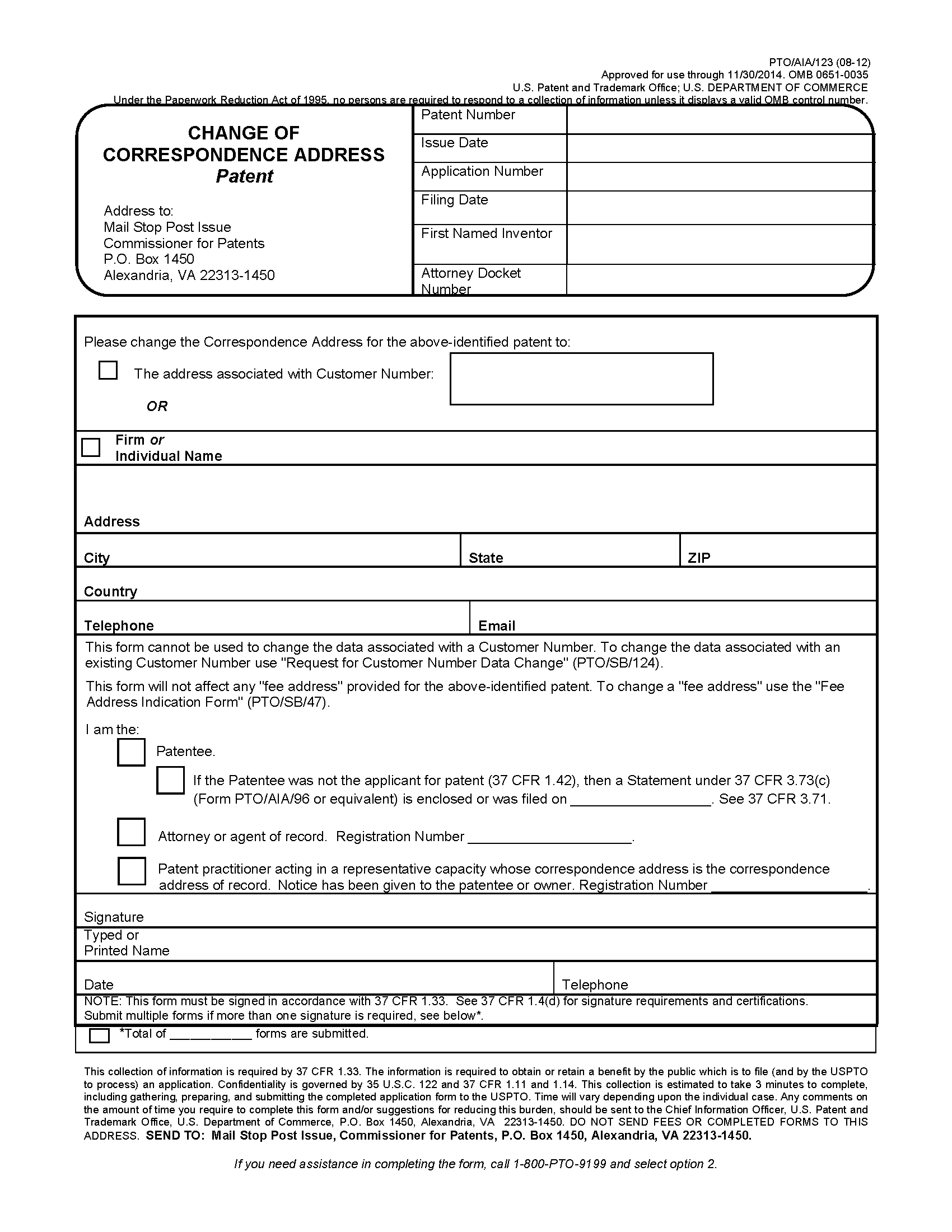

[Editor Note: See MPEP § 601.03(a) for change of correspondence address in applications filed on or after September 16, 2012.]
37 C.F.R. 1.33 (pre-AIA) Correspondence respecting patent applications, reexamination proceedings, and other proceedings.
- (a) Correspondence address and daytime telephone number. When filing an application, a correspondence address must be set forth in either an application data sheet (§ 1.76 ), or elsewhere, in a clearly identifiable manner, in any paper submitted with an application filing. If no correspondence address is specified, the Office may treat the mailing address of the first named inventor (if provided, see §§ 1.76(b)(1) and 1.63(c)(2) ) as the correspondence address. The Office will direct, or otherwise make available, all notices, official letters, and other communications relating to the application to the person associated with the correspondence address. For correspondence submitted via the Office’s electronic filing system, however, an electronic acknowledgment receipt will be sent to the submitter. The Office will generally not engage in double correspondence with an applicant and a patent practitioner, or with more than one patent practitioner except as deemed necessary by the Director. If more than one correspondence address is specified in a single document, the Office will select one of the specified addresses for use as the correspondence address and, if given, will select the address associated with a Customer Number over a typed correspondence address. For the party to whom correspondence is to be addressed, a daytime telephone number should be supplied in a clearly identifiable manner and may be changed by any party who may change the correspondence address. The correspondence address may be changed as follows:
- (1) Prior to filing of § 1.63 oath or declaration by any of the inventors. If a § 1.63 oath or declaration has not been filed by any of the inventors, the correspondence address may be changed by the party who filed the application. If the application was filed by a patent practitioner, any other patent practitioner named in the transmittal papers may also change the correspondence address. Thus, the inventor(s), any patent practitioner named in the transmittal papers accompanying the original application, or a party that will be the assignee who filed the application, may change the correspondence address in that application under this paragraph.
- (2) Where a § 1.63 oath or declaration has been filed by any of the inventors. If a § 1.63 oath or declaration has been filed, or is filed concurrent with the filing of an application, by any of the inventors, the correspondence address may be changed by the parties set forth in paragraph (b) of this section, except for paragraph (b)(2).
*****
Pre-AIA 37 CFR 1.33(a) provides that the application must specify a correspondence address to which the Office will send notice, letters, and other communications relating to an application. The correspondence address must either be in an application data sheet (pre-AIA 37 CFR 1.76 ) or in a clearly identifiable manner elsewhere in any papers submitted with the application filing. If more than one correspondence address is specified in a single document, the Office will select one of the specified addresses for use as the correspondence address and, if given, will select the address associated with a Customer Number over a typed correspondence address. Additionally, applicants will often specify the correspondence address in more than one paper that is filed with an application, and the address given in the different places sometimes conflicts. Where the applicant specifically directs the Office to use non-matching correspondence addresses in more than one paper, priority will be accorded to the correspondence address specified in the following order: (A) Application data sheet (ADS); (B) application transmittal; (C) oath or declaration (unless power of attorney is more current); and (D) power of attorney. Accordingly, if the ADS includes a typed correspondence address, and the declaration gives a different address (i.e., the address associated with a Customer Number) as the correspondence address, the Office will use the typed correspondence address as included on the ADS. In the experience of the Office, the ADS is the most recently created document and tends to have the most current address. After the correspondence address has been entered according to the above procedure, it will only be changed pursuant to pre-AIA 37 CFR 1.33(a)(1).
The submission of a daytime telephone number of the party to whom correspondence is to be addressed is requested pursuant to pre-AIA 37 CFR 1.33(a). While business is to be conducted on the written record (37 CFR 1.2 ), a daytime telephone number would be useful in initiating contact that could later be reduced to writing. Any party who may change the correspondence address may also change the telephone number.
pre-AIA 37 CFR 1.33(a)(1) provides that the party filing the application and setting forth a correspondence address may later change the correspondence address provided that an executed oath or declaration under pre-AIA 37 CFR 1.63 by any of the inventors has not been filed. If a patent practitioner (i.e., registered attorney or agent) filed the application, any other patent practitioners named in the transmittal papers may also change the correspondence address. A patent practitioner named in a letterhead would not be considered as being named in the transmittal papers for purposes of changing the correspondence address. A clear identification of the individual as a representative is be required. If an application is filed by a company to whom the invention has been assigned or to whom there is an obligation to assign the invention, a person who has the authority to act on behalf of the company may change the correspondence address. Thus, the inventor(s), any patent practitioner named in the transmittal papers accompanying the original application, or a party that will be the assignee who filed the application, may change the correspondence address pursuant to pre-AIA 37 CFR 1.33(a)(1). The filing of an executed oath or declaration that does not include a correspondence address does not affect any correspondence address previously established on filing of the application, or changed pursuant to pre-AIA 37 CFR 1.33(a)(1).
Where a correspondence address has been established on filing of the application or changed pursuant to pre-AIA 37 CFR 1.33(a)(1) (prior to the filing of an executed oath or declaration under pre-AIA 37 CFR 1.63 by any of the inventors), that correspondence address remains in effect upon filing of an executed oath or declaration under pre-AIA 37 CFR 1.63 and can only be subsequently changed pursuant to pre-AIA 37 CFR 1.33(a)(2). Under pre-AIA 37 CFR 1.33(a)(2), where an executed oath or declaration under pre-AIA 37 CFR 1.63 has been filed by any of the inventors, the correspondence address may be changed by (A) a patent practitioner of record, (B) an assignee as provided for under pre-AIA 37 CFR 3.71(b), or (C) all of the applicants (pre-AIA 37 CFR 1.41(b) ) for patent, unless there is an assignee of the entire interest and such assignee has taken action in the application in accordance with pre-AIA 37 CFR 3.71. See pre-AIA 37 CFR 1.33(a)(2).
Special care should be taken in continuation or divisional applications to ensure that any change of correspondence address in a prior application is reflected in the continuation or divisional application. For example, where a copy of the oath or declaration from the prior application is submitted for a continuation or divisional application filed under pre-AIA 37 CFR 1.53(b) and the copy of the oath or declaration from the prior application designates an old correspondence address, the Office may not recognize, in the continuation or divisional application, the change of correspondence address made during the prosecution of the prior application. Applicant is required to identify the change of correspondence address in the continuation or divisional application to ensure that communications from the Office are mailed to the current correspondence address. pre-AIA 37 CFR 1.63(d)(4).


See MPEP Chapter 1800, especially MPEP § 1893.01 for requirements for entry into the national stage before the Designated Office or Elected Office under the Patent Cooperation Treaty (PCT).
An application data sheet (ADS) is a sheet or set of sheets containing bibliographic data, which is arranged in a format specified by the Office. An ADS must comply with the requirements of 37 CFR 1.76, and may be submitted in a provisional application under 35 U.S.C. 111(b), a nonprovisional application under 35 U.S.C. 111(a), or a national stage application under 35 U.S.C. 371. See MPEP § 601.05(a) for requirements for an ADS that are specific to applications filed on or after September 16, 2012. See MPEP § 601.05(b) for requirements for an ADS that are specific to applications filed prior to September 16, 2012.
When an application data sheet is provided in a patent application, the application data sheet becomes part of the application and must comply with 37 CFR 1.52. While the use of an application data sheet is not always required (see MPEP §§ 601.05(a) and 601.05(b)), the Office prefers its use in all applications to help facilitate the electronic capturing of important data. When an ADS is optional, the data that is suggested to be supplied by way of an application data sheet can also be provided elsewhere in the application papers, but it is to applicant’s advantage to submit the data via an application data sheet. To help ensure that the Office efficiently captures the data, the Office specifies a particular format to be used. The Office also provides a fillable form (PTO/AIA/14 for applications filed or after September 16, 2012 and PTO/SB/14 for applications filed prior to September 16, 2012) on the Office’s Web site, which contains the bibliographic data arranged in the specified format. The Office’s fillable form is designed to be completed electronically and then filed via EFS-Web or in paper. However, the data will only load directly into the Office’s electronic systems when the PTO/AIA/14 or PTO/SB/14 is submitted as an EFS-Web Fillable Form, rather than a scanned portable document format (PDF) image submitted electronically via EFS-Web or in paper.
[Editor Note: See MPEP § 601.05(b) for a discussion of the requirements of an ADS for applications filed before September 16, 2012.]
37 C.F.R. 1.76 Application data sheet.
- (a) Application data sheet: An application data sheet is a sheet or sheets, that may be submitted in a provisional application under 35 U.S.C. 111(b), a nonprovisional application under 35 U.S.C. 111(a), or a national stage application under 35 U.S.C. 371, and must be submitted when required by § 1.55 or 1.78 to claim priority to or the benefit of a prior-filed application under 35 U.S.C. 119, 120, 121, or 365. An application data sheet must be titled "Application Data Sheet." An application data sheet must contain all of the section headings listed in paragraph (b) of this section, except as provided in paragraph (c)(2) of this section, with any appropriate data for each section heading. If an application data sheet is provided, the application data sheet is part of the application for which it has been submitted.
- (b) Bibliographic data. Bibliographic data as used in paragraph (a) of this section includes:
- (1) Inventor information. This information includes the legal name, residence, and mailing address of the inventor or each joint inventor.
- (2) Correspondence information. This information includes the correspondence address, which may be indicated by reference to a customer number, to which correspondence is to be directed (see § 1.33(a)).
- (3) Application information. This information includes the title of the invention, the total number of drawing sheets, a suggested drawing figure for publication (in a nonprovisional application), any docket number assigned to the application, the type of application (e.g., utility, plant, design, reissue, provisional), whether the application discloses any significant part of the subject matter of an application under a secrecy order pursuant to § 5.2 of this chapter (see § 5.2(c)), and, for plant applications, the Latin name of the genus and species of the plant claimed, as well as the variety denomination
- (4) Representative information. This information includes the registration number of each practitioner having a power of attorney in the application (preferably by reference to a customer number). Providing this information in the application data sheet does not constitute a power of attorney in the application (see § 1.32).
- (5) Domestic benefit information. This information includes the application number, the filing date, the status (including patent number if available), and relationship of each application for which a benefit is claimed under 35 U.S.C. 119(e), 120, 121, or 365(c). Providing this information in the application data sheet constitutes the specific reference required by 35 U.S.C. 119(e) or 120, and § 1.78.
- (6) Foreign priority information. This information includes the application number, country, and filing date of each foreign application for which priority is claimed. Providing this information in the application data sheet constitutes the claim for priority as required by 35 U.S.C. 119(b) and § 1.55.
- (7) Applicant information: This information includes the name (either natural person or juristic entity) and address of the legal representative, assignee, person to whom the inventor is under an obligation to assign the invention, or person who otherwise shows sufficient proprietary interest in the matter who is the applicant under § 1.43 or § 1.46. Providing assignment information in the application data sheet does not substitute for compliance with any requirement of part 3 of this chapter to have an assignment recorded by the Office.
- (c) Correcting and updating an application data sheet.
- (1) Information in a previously submitted application data sheet, inventor's oath or declaration under § 1.63, § 1.64 or § 1.67, or otherwise of record, may be corrected or updated until payment of the issue fee by a new application data sheet providing corrected or updated information, except that inventorship changes must comply with the requirements of § 1.48, foreign priority and domestic benefit information changes must comply with §§ 1.55 and 1.78, and correspondence address changes are governed by § 1.33(a).
- (2) An application data sheet providing corrected or updated information may include all of the sections listed in paragraph (b) of this section or only those sections containing changed or updated information. The application data sheet must include the section headings listed in paragraph (b) of this section for each section included in the application data sheet, and must identify the information that is being changed, with underlining for insertions, and strike-through or brackets for text removed, except that identification of information being changed is not required for an application data sheet included with an initial submission under 35 U.S.C. 371.
- (d) Inconsistencies between application data sheet and other documents. For inconsistencies between information that is supplied by both an application data sheet under this section and other documents:
- (1) The most recent submission will govern with respect to inconsistencies as between the information provided in an application data sheet, a designation of a correspondence address, or by the inventor's oath or declaration, except that:
- (i) The most recent application data sheet will govern with respect to foreign priority (§ 1.55) or domestic benefit (§ 1.78) claims; and
- (ii) The naming of the inventorship is governed by § 1.41 and changes to inventorship or the names of the inventors is governed by § 1.48.
- (2) The information in the application data sheet will govern when the inconsistent information is supplied at the same time by a designation of correspondence address or the inventor's oath or declaration.
- (3) The Office will capture bibliographic information from the application data sheet. The Office will generally not review the inventor's oath or declaration to determine if the bibliographic information contained therein is consistent with the bibliographic information provided in an application data sheet. Incorrect bibliographic information contained in an application data sheet may be corrected as provided in paragraph (c)(1) of this section.
- (1) The most recent submission will govern with respect to inconsistencies as between the information provided in an application data sheet, a designation of a correspondence address, or by the inventor's oath or declaration, except that:
- (e) Signature requirement. An application data sheet must be signed in compliance with § 1.33(b). An unsigned application data sheet will be treated only as a transmittal letter.
37 CFR 1.76(a) provides that an application data sheet may be submitted in a provisional application under 35 U.S.C. 111(b), a nonprovisional application under 35 U.S.C. 111(a), or a national stage application under 35 U.S.C. 371. However, 37 CFR 1.76(a) also provides that an application data sheet must be submitted when required by 37 CFR 1.55 and 1.78 to claim priority to, or the benefit of, a prior-filed application under 35 U.S.C. 119, 120, 121, or 365 in accordance with 37 CFR 1.55 and 1.78. An application data sheet must also be submitted in accordance with 37 CFR 1.46 when an application is filed by an assignee, a person to whom the inventor is under an obligation to assign the invention, or a person who otherwise shows a sufficient proprietary interest in the matter under 35 U.S.C. 118.
I. BIBLIOGRAPHIC INFORMATION
37 CFR 1.76(a) requires that any ADS contain the seven headings listed in 37 CFR 1.76(b) with any appropriate data for each section heading (except as provided in 37 CFR 1.76(c)(2) for an ADS providing corrected or updated information). The ADS must be titled "Application Data Sheet" and any heading that does not contain any corresponding data will be interpreted by the Office to mean that there is no corresponding data for that heading anywhere in the application. Bibliographic data under 37 CFR 1.76(b) includes: (1) inventor information; (2) correspondence information; (3) application information; (4) representative information; (5) domestic benefit information; (6) foreign priority information; and (7) applicant information.
Inventor information includes the legal name, residence, and mailing address of each inventor (37 CFR 1.41(b). Whether or not the inventor is the applicant, the Office will to continue to use the inventor’s name for application and patent identification purposes. Inventor names tend to provide a more distinct identification than assignee name, for example. The "mailing address" is the address where the inventor customarily receives mail.
Correspondence information includes the correspondence address, which may be indicated by reference to a customer number, to which correspondence is to be directed (see 37 CFR 1.33(a) ).
As set forth in 37 CFR 1.76(b)(3), application information includes the title of the invention, the total number of drawing sheets, a suggested drawing figure for publication (in a nonprovisional application), any docket number assigned to the application, and the type of application (e.g., utility, plant, design, reissue, provisional). Note that the Office is not bound to print the suggested drawing figure, as the Office may decide to print another figure on the front page of any patent application publication or patent issuing from the application.
Application information includes whether the application discloses any significant part of the subject matter of an application under a secrecy order pursuant to 37 CFR 5.2(c). 37 CFR 1.76(b)(3) also requests that the plant patent applicant state the Latin name and the variety denomination for the plant claimed. The Latin name of the genus and species and the variety denomination of the claimed plant are usually included in the specification of the plant patent application, and will be included in any plant patent or plant patent application publication if included in an application data sheet or patent application. The Office, pursuant to the "International Convention for the Protection of New Varieties of Plants" (generally known by its French acronym as the UPOV convention), has been asked to compile a database of the plants patented and the database must include the Latin name and the variety denomination of each patented plant. Having this information in an ADS will make the process of compiling this database more efficient.
Representative information includes the registration number of each practitioner appointed with a power of attorney in the application (preferably by reference to a customer number). 37 CFR 1.76(b)(4) states that providing this information in the application data sheet does not constitute a power of attorney in the application (see 37 CFR 1.32 ). This is because the Office does not expect the application data sheet to be executed by the party (applicant or assignee) who may appoint a power of attorney in the application.
Domestic benefit information includes the application number (series code and serial number), the filing date, the status (including patent number if available), and relationship of each application for which a benefit is claimed under 35 U.S.C. 119(e), 120, 121, or 365(c). The application data sheet, if provided, is considered part of the application. 37 CFR 1.76(b)(5) states that providing this information in the application data sheet constitutes the specific reference required by 35 U.S.C. 119(e) or 120, and 37 CFR 1.78. A specific reference to the earlier application(s) is no longer required to be made in the specification, such as in the first sentence(s) thereof. The continuity data for the patent front page will be taken from the application data sheet. No continuity data will be included in the first sentence(s) of the specification, unless applicant separately provides it there. 37 CFR 1.76(b)(5) does not apply to provisional applications.
Foreign priority information includes the application number, country, and filing date of each foreign application for which priority is claimed. 37 CFR 1.76(b)(6) states that providing this information in the application data sheet constitutes the claim for priority as required by 35 U.S.C. 119(b) and 37 CFR 1.55. 37 CFR 1.76(b)(6) does not apply to provisional applications.
37 CFR 1.76(b)(7) provides that applicant information includes the name (either natural person or juristic entity) and address of the applicant under 37 CFR 1.43 or 1.46. Thus, 37 CFR 1.76(b)(7) provides for the situation in which the applicant is a person other than the inventor under 37 CFR 1.43 (legal representative) or 37 CFR 1.46 (assignee, person to whom the inventor is under an obligation to assign the invention, or person who otherwise shows sufficient proprietary interest in the matter). This heading should be left blank if the applicant is the inventor or is the remaining joint inventor or inventors (37 CFR 1.45).
37 CFR 1.46(b) provides that if an application is filed by the assignee, a person to whom the inventor is under an obligation to assign the invention, or a person who otherwise shows sufficient proprietary interest in the matter, the application must contain an application data sheet under 37 CFR 1.76 specifying the assignee, person to whom the inventor is under an obligation to assign the invention, or person who otherwise shows sufficient proprietary interest in the matter in the applicant information section. 37 CFR 1.46(c) provides that any request to correct or update the name of the applicant must include an application data sheet under 37 CFR 1.76 specifying the applicant in the applicant information section. 37 CFR 1.46(c) also provides that any request to change the applicant must include an application data sheet under 37 CFR 1.76 specifying the applicant in the applicant information section and comply with 37 CFR 3.71 and 3.73. The application data sheet must comply with the provisions for correcting and updating an application data sheet set forth in 37 CFR 1.76(c). 37 CFR 1.76(b)(7) explains that providing assignment information in the application data sheet does not substitute for compliance with any requirement of 37 CFR part 3 to have an assignment recorded by the Office. Assignment information must be recorded to have legal effect.
II. CORRECTING AND UPDATING AN ADS
37 CFR 1.76(c) provides that an application data sheet provided on filing and an application data sheet submitted after the filing date of the application are both considered an application data sheet. Application data sheets may be subsequently supplied prior to payment of the issue fee to either correct or update information in a previously submitted application data sheet, or in an oath or declaration under 37 CFR 1.63 or 1.67. See 37 CFR 1.76(c)(1). An application data sheet submitted after filing the application may contain all of the seven section headings listed in 37 CFR 1.76(b) with all appropriate data for each heading or only those sections containing changed or updated information. An application data sheet submitted after the filing of the application must identify the information that is being changed (added, deleted, or modified) in the application data sheet. If no ADS was originally filed, but applicant wants to submit an ADS to correct, modify, or augment the original application data, the ADS must identify the information that is being changed (added, deleted, or modified) in the application.
An ADS that is being used to correct data shown in an oath or declaration, such as residence information for an inventor, would show the original incorrect information with strike-through or brackets, and the new information with underlining, as if an ADS had originally been used to submit the information. For example, if the original ADS included a foreign priority claim, in order to delete the foreign priority claim, applicant must provide an ADS showing the foreign priority claim with strike-through or brackets to ensure that the patent will reflect such change.
37 CFR 1.76(c)(1) provides that information in a previously submitted application data sheet, the inventor’s oath or declaration under § 1.63, § 1.64, or § 1.67, or otherwise of record, may be corrected or updated until payment of the issue fee by a new application data sheet providing corrected or updated information, except that inventorship changes must comply with the requirements of § 1.48, foreign priority and domestic benefit information changes must comply with §§ 1.55 and 1.78, and correspondence address changes must comply with § 1.33(a). Note also that any request to correct or update the name of the applicant, or change the applicant, must comply with 37 CFR 1.46(c).
37 CFR 1.76(c)(2) provides that an application data sheet providing corrected or updated information may include all of the sections listed in § 1.76(b) or only those sections containing changed or updated information. 37 CFR 1.76(c)(2) further provides that the application data sheet must include the section headings listed in § 1.76(b) for each section included in the application data sheet, and must identify the information that is being changed, with underlining for insertions, and strike-through or brackets for text removed, except that identification of information being changed is not required for an application data sheet included with an initial submission under 35 U.S.C. 371.
III. TREATMENT OF INCONSISTENT INFORMATION
Resolution of inconsistent information supplied by both an application data sheet and other documents (e.g., the oath or declaration under 37 CFR 1.63, or 37 CFR 1.67) are addressed in 37 CFR 1.76(d).
37 CFR 1.76(d)(1) provides that the most recent submission will govern (control) with respect to inconsistencies as between the information provided in an application data sheet, a designation of a correspondence address, or by the inventor’s oath or declaration, except that: (1) the most recent application data sheet will govern with respect to foreign priority (37 CFR 1.55) or domestic benefit (37 CFR 1.78) claims; and (2) the naming of the inventorship is governed by 37 CFR 1.41 and changes to inventorship or the names of the inventors is governed by 37 CFR 1.48.
37 CFR 1.76(d)(2) provides that the information in the application data sheet will govern when the inconsistent information is supplied at the same time by a designation of correspondence address or the inventor’s oath or declaration.
If an ADS is inconsistent with the information provided in another document that was submitted at the same time or prior to the ADS submission, the ADS will control. This is because the application data sheet is intended to be the means by which applicant provides complete bibliographic information. In the small number of instances where another document has more accurate information than a concurrently supplied application data sheet (37 CFR 1.76(d)(2)), a corrected application data sheet should be submitted to conform the information in the ADS to the correct information as provided in the other document(s).
37 CFR 1.76(d)(3) provides that the Office will capture bibliographic information from the application data sheet. 37 CFR 1.76(d)(3) further provides that the Office will generally not review the inventor’s oath or declaration to determine if the bibliographic information contained therein is consistent with the bibliographic information provided in an application data sheet. 37 CFR 1.76(d)(3) further provides that incorrect bibliographic information contained in an application data sheet may be corrected as provided in § 1.76(c)(1).
Examples:
If an application naming inventors A and B is filed with an application data sheet that improperly identifies the residence of inventor B and an executed 37 CFR 1.63 declaration that properly identifies the residence of inventor B, the Office will capture the residence information of inventor B as identified in the application data sheet, and include that information in the filing receipt. Applicant may correct the residence information by submitting an application data sheet under 37 CFR 1.76(c) with the name of inventor B and the corrected residence for inventor B.
If an application is filed with an application data sheet improperly identifying inventors A, B and C and an executed 37 CFR 1.63 declaration correctly setting forth the inventorship as A and B, the Office will capture the inventorship as inventors A, B and C based on the information in the application data sheet, and include that information in the filing receipt. To correct the inventorship, applicant must submit a request to correct the inventorship pursuant to 37 CFR 1.48.
If an application is filed with an application data sheet, the Office will capture the applicant information as identified in the application data sheet. To change the name of the applicant, a request in accordance with 37 CFR 1.46(c), and compliance with 37 CFR 3.71 and 3.73, is required.
IV. ADDITIONAL INFORMATION
The application data sheet form PTO/AIA/14 provides a section where applicants can make request not to publish the application or a request for early publication.
The application data sheet form PTO/AIA/14 provides a section where applicants can provide an Authorization to Permit Access to the Instant Application by Participating Offices. If the box in this section of the form is checked, the Office has the authority to provide access to the instant patent application to the participating offices in which a foreign application claiming priority to the instant patent application is filed.
The application data sheet form PTO/AIA/14 provides an assignee information section, which includes the name (either person or juristic entity) and address of the assignee of the entire right, title, and interest in an application. The inclusion of this information in the application data sheet does not substitute for compliance with any requirement of 37 CFR part 3 to have an assignment recorded by the Office. Providing assignee information in the application data sheet is considered a request to include such information on the patent application publication, since there is no other reason for including such information in the application data sheet. Assignment information must be recorded to have legal effect. Assignees who are the applicant will appear on the patent application publication as the applicant and only need to separately provide assignee information in the assignee information section if identification as an assignee is also desired on the patent application publication.
37 CFR 1.76(e) provides that an application data sheet must be signed in compliance with 37 CFR 1.33(b). The rule further provides that an unsigned application data sheet will be treated only as a transmittal letter. Thus, an unsigned application data sheet will not be effective to provide the name of the inventor for any invention claimed in the application (37 CFR 1.41(b) ), name as the applicant an assignee, obligated assignee, or a person who otherwise shows sufficient propriety interest in the application (37 CFR 1.46), make a claim to priority of a foreign application (37 CFR 1.55), or make a claim to the benefit of a prior-filed domestic application (37 CFR 1.78).
[Editor Note: See MPEP § 601.05(a) for a discussion of the requirements of an ADS for applications filed on or after September 16, 2012.]
37 C.F.R. 1.76 (pre-AIA) Application data sheet.
- (a) Application data sheet. An application data sheet is a sheet or sheets, that may be voluntarily submitted in either provisional or nonprovisional applications, which contains bibliographic data, arranged in a format specified by the Office. An application data sheet must be titled "Application Data Sheet" and must contain all of the section headings listed in paragraph (b) of this section, with any appropriate data for each section heading. If an application data sheet is provided, the application data sheet is part of the provisional or nonprovisional application for which it has been submitted.
- (b) Bibliographic data. Bibliographic data as used in paragraph (a) of this section includes:
- (1) Applicant information. This information includes the name, residence, mailing address, and citizenship of each applicant (§ 1.41(b)). The name of each applicant must include the family name, and at least one given name without abbreviation together with any other given name or initial. If the applicant is not an inventor, this information also includes the applicant’s authority (§§ 1.42, 1.43, and 1.47) to apply for the patent on behalf of the inventor.
- (2) Correspondence information. This information includes the correspondence address, which may be indicated by reference to a customer number, to which correspondence is to be directed (see § 1.33(a)).
- (3) Application information. This information includes the title of the invention, a suggested classification, by class and subclass, the Technology Center to which the subject matter of the invention is assigned, the total number of drawing sheets, a suggested drawing figure for publication (in a nonprovisional application), any docket number assigned to the application, the type of application (e.g., utility, plant, design, reissue, provisional), whether the application discloses any significant part of the subject matter of an application under a secrecy order pursuant to § 5.2 of this chapter (see § 5.2(c)), and, for plant applications, the Latin name of the genus and species of the plant claimed, as well as the variety denomination. The suggested classification and Technology Center information should be supplied for provisional applications whether or not claims are present. If claims are not present in a provisional application, the suggested classification and Technology Center should be based upon the disclosure.
- (4) Representative information. This information includes the registration number of each practitioner having a power of attorney in the application (preferably by reference to a customer number). Providing this information in the application data sheet does not constitute a power of attorney in the application (see § 1.32).
- (5) Domestic priority information. This information includes the application number, the filing date, the status (including patent number if available), and relationship of each application for which a benefit is claimed under 35 U.S.C. 119(e), 120, 121, or 365(c). Providing this information in the application data sheet constitutes the specific reference required by 35 U.S.C. 119(e) or 120, and § 1.78(a)(2) or § 1.78(a)(5), and need not otherwise be made part of the specification.
- (6) Foreign priority information. This information includes the application number, country, and filing date of each foreign application for which priority is claimed, as well as any foreign application having a filing date before that of the application for which priority is claimed. Providing this information in the application data sheet constitutes the claim for priority as required by 35 U.S.C. 119(b) and § 1.55(a).
- (7) Assignee information. This information includes the name (either person or juristic entity) and address of the assignee of the entire right, title, and interest in an application. Providing this information in the application data sheet does not substitute for compliance with any requirement of part 3 of this chapter to have an assignment recorded by the Office.
- (c) Supplemental application data sheets. Supplemental application data sheets:
- (1) May be subsequently supplied prior to payment of the issue fee either to correct or update information in a previously submitted application data sheet, or an oath or declaration under § 1.63 or § 1.67, except that inventorship changes are governed by § 1.48, correspondence changes are governed by § 1.33(a), and citizenship changes are governed by § 1.63 or § 1.67; and
- (2) Must be titled "Supplemental Application Data Sheet," include all of the section headings listed in paragraph (b) of this section, include all appropriate data for each section heading, and must identify the information that is being changed, preferably with underlining for insertions, and strike-through or brackets for text removed.
- (d) Inconsistencies between application data sheet and other documents . For inconsistencies between information that is supplied by both an application data sheet under this section and other documents.
- (1) The latest submitted information will govern notwithstanding whether supplied by an application data sheet, an amendment to the specification, a designation of a correspondence address, or by a § 1.63 or § 1.67 oath or declaration, except as provided by paragraph (d)(3) of this section;
- (2) The information in the application data sheet will govern when the inconsistent information is supplied at the same time by an amendment to the specification, a designation of correspondence address, or a § 1.63 or § 1.67 oath or declaration, except as provided by paragraph (d)(3) of this section;
- (3) The oath or declaration under § 1.63 or § 1.67 governs inconsistencies with the application data sheet in the naming of inventors (§ 1.41(a)(1)) and setting forth their citizenship (35 U.S.C. 115);
- (4) The Office will capture bibliographic information from the application data sheet (notwithstanding whether an oath or declaration governs the information). Thus, the Office shall generally, for example, not look to an oath or declaration under § 1.63 to see if the bibliographic information contained therein is consistent with the bibliographic information captured from an application data sheet (whether the oath or declaration is submitted prior to or subsequent to the application data sheet). Captured bibliographic information derived from an application data sheet containing errors may be corrected if applicant submits a request therefor and a supplemental application data sheet.
I. BIBLIOGRAPHIC INFORMATION
The naming of the inventors and the setting forth of the citizenship of each inventor must be provided in the oath or declaration under pre-AIA 37 CFR 1.63 (as required by pre-AIA 35 U.S.C. 115 ) even if this information is provided in the application data sheet.
Applicant information includes the name, residence, mailing address, and citizenship of each applicant ( pre-AIA 37 CFR 1.41(b) ). The name of each applicant must include the family name, and at least one given name without abbreviation together with any other given name or initial. (If the applicant is not an inventor, this information also includes the applicant’s authority (pre-AIA 37 CFR 1.42, 1.43, and 1.47) to apply for the patent on behalf of the inventor. The "mailing address" is the address where applicant customarily receives mail.
Correspondence information includes the correspondence address, which may be indicated by reference to a customer number, to which correspondence is to be directed (see pre-AIA 37 CFR 1.33(a) ).
Application information includes the title of the invention, a suggested classification by class and subclass, the Technology Center (TC) to which the subject matter of the invention is assigned, the total number of drawing sheets, a suggested drawing figure for publication (in a nonprovisional application), any docket number assigned to the application, and the type of application (e.g., utility, plant, design, reissue, provisional). Application information also includes whether the application discloses any significant part of the subject matter of an application under a secrecy order pursuant to 37 CFR 5.2(c).
Although the submission of the information related to a suggested classification and TC is desired for both provisional and nonprovisional applications, the Office will not be bound to follow such information if submitted, as the Office will continue to follow its present procedures for classifying and assigning new applications. Similarly for the suggested drawing figure, the Office may decide to print another figure on the front page of any patent application publication or any patent issuing from the application.
Application information also includes information about provisional applications, particularly their class and subclass, and the TC. Provisional applications are not examined or even processed (e.g., having a class and subclass assigned or being forwarded to a TC). Even though provisional applications are not examined, the TC and the class and subclass, if known to applicants, would be of benefit to the Office in giving an indication of where nonprovisional applications may be eventually received in the Office and their technologies so that the Office will be better able to plan for future workloads.
Pre-AIA 37 CFR 1.76(b)(3) also requests that the plant patent applicant state the Latin name and the variety denomination for the plant claimed. The Latin name and the variety denomination of the claimed plant are usually included in the specification of the plant patent application, and will be included in any plant patent or plant patent application publication if included in an application data sheet or patent application. The Office, pursuant to the "International Convention for the Protection of New Varieties of Plants" (generally known by its French acronym as the UPOV convention), has been asked to compile a database of the plants patented and the database must include the Latin name and the variety denomination of each patented plant. Having this information in an ADS will make the process of compiling this database more efficient.
Representative information includes the registration number appointed with a power of attorney in the application (preferably by reference to a customer number). Pre-AIA 37 CFR 1.76(b)(4) states that providing this information in the application data sheet does not constitute a power of attorney in the application (see pre-AIA 37 CFR 1.32 ). This is because the Office does not expect the application data sheet to be executed by the party (applicant or assignee) who may appoint a power of attorney in the application.
Domestic priority information includes the application number (series code and serial number), the filing date, the status (including patent number if available), and relationship of each application for which a benefit is claimed under 35 U.S.C. 119(e), 120, 121, or 365(c). Pre-AIA 37 CFR 1.76(b)(5) states that providing this information in the application data sheet constitutes the specific reference required by 35 U.S.C.119(e) or 120. Since the application data sheet, if provided, is considered part of the application, the specific reference to an earlier filed provisional or nonprovisional application in the application data sheet satisfies the "specific reference" requirement of 35 U.S.C.119(e)(1) or 120, and it also complies with pre-AIA 37 CFR 1.78(a)(2) (iii) or (a)(5)(iii). Thus, a specific reference does not otherwise have to be made in the specification, such as in the first sentence(s) of the specification. If continuity data is included in an application data sheet, but not in the first sentence(s) of the specification, the continuity data for the patent front page will be taken from the application data sheet. No continuity data will be included in the first sentence(s) of the specification if applicant does not provide it there. Pre-AIA 37 CFR 1.76(b)(5) does not apply to provisional applications.
Foreign priority information includes the application number, country, and filing date of each foreign application for which priority is claimed, as well as any foreign application having a filing date before that of the application for which priority is claimed. Pre-AIA 37 CFR 1.76(b)(6) states that providing this information in the application data sheet constitutes the claim for priority as required by 35 U.S.C. 119(b) and pre-AIA 37 CFR 1.55(a). The patent statute, 35 U.S.C. 119(b), does not require that a claim to the benefit of a prior foreign application take any particular form. Pre-AIA 37 CFR 1.76(b)(6) does not apply to provisional applications.
Pre-AIA 37 CFR 1.76(b)(7) provides that the assignee information includes the name (either person or juristic entity) and address of the assignee of the entire right, title, and interest in an application. The inclusion of this information in the application data sheet does not substitute for compliance with any requirement of 37 CFR part 3 to have an assignment recorded by the Office. Providing assignee information in the application data sheet is considered a request to include such information on the patent application publication, since there is no other reason for including such information in the application data sheet. Assignment information must be recorded to have legal effect.
Supplemental application data sheets may be subsequently supplied prior to payment of the issue fee to either correct or update information in a previously submitted application data sheet, or an oath or declaration under pre-AIA 37 CFR 1.63 or 1.67. See pre-AIA 37 CFR 1.76(c)(1). A supplemental data sheet cannot be used to correct the following: (1) inventorship changes (37 CFR 1.48 ); (2) correspondence changes (pre-AIA 37 CFR 1.33(a) ); and (3) citizenship changes (pre-AIA 37 CFR 1.63 or pre-AIA 37 CFR 1.67 ). Supplemental application data sheets must be titled "Supplemental Application Data Sheet" and also contain all of the seven section headings listed in 37 CFR 1.76(b) with all appropriate data for each heading. Supplemental application data sheets identifying only the information that is being changed (added, deleted, or modified) in the supplemental ADS are not acceptable. A supplemental ADS containing only new or changed information is likely to confuse the record, create unnecessary work for the Office, and does not comply with pre-AIA 37 CFR 1.76. If no ADS was originally filed, but applicant wants to submit an ADS to correct, modify, or augment the original application data, the ADS, even though it is the first-filed ADS, must be titled "Supplemental Application Data Sheet."
II. SUPPLEMENTAL ADS SUBMISSIONS
For applications filed before September 16, 2012, when submitting an application data sheet after the initial filing of the application to correct, modify, or augment the application data sheet that was submitted with the application papers on filing, the following applies:
- (A) the supplemental application data sheet must be titled "Supplemental Application Data Sheet" (while the title "Supplemental Application Data Sheet" is preferred, "Supp. ADS" , "Supplemental ADS" or other variations thereof will be accepted);
- (B) the supplemental application data sheet must be a full replacement copy of the original ADS, if any, with each of the seven section headings listed in pre-AIA 37 CFR 1.76(b), and with all appropriate data for the section heading;
- (C) the supplemental application data sheet must be submitted with all changes indicated, preferably with insertions or additions indicated by underlining, and deletions, with or without replacement data, indicated by strike-through or brackets; and
- (D) the supplemental application data sheet must be signed as it is a paper and/or amendment filed in the application (see pre-AIA 37 CFR 1.33(b) and 37 CFR 11.18 ).
Any ADS submitted after the filing date of the application is a supplemental ADS, regardless of whether an original ADS was submitted with the application papers on filing. A supplemental ADS that is being used to correct data shown in an oath or declaration, such as foreign priority or residence information for an inventor, would show the original incorrect information with strike-through or brackets, and the new information with underlining, as if an ADS had originally been used to submit the information. For example, if the original oath or declaration included a foreign priority claim, in order to delete the foreign priority claim, applicant should provide a supplemental ADS showing the foreign priority claim with strike-through or brackets to ensure that the patent will reflect such change.
III. TREATMENT OF INCONSISTENT INFORMATION
Resolution of inconsistent information supplied by both an application data sheet and other documents (e.g., the oath or declaration under pre-AIA 37 CFR 1.63 , or pre-AIA 37 CFR 1.67) are addressed in pre-AIA 37 CFR 1.76 (d). If an ADS is inconsistent with the information provided in another document that was submitted at the same time or previous to the ADS submission, the ADS will control. Pre-AIA 37 CFR 1.76(d)(1) provides that the latest submitted information will govern notwithstanding whether supplied by an application data sheet, an amendment to the specification, a designation of a correspondence address, or by an oath or declaration under pre-AIA 37 CFR 1.63 or pre-AIA 37 CFR 1.67, except as provided by pre-AIA 37 CFR 1.76(d)(3). This is because the application data sheet is intended as the means by which applicants will provide most information to the Office. In the small number of instances where another document has more accurate information than a concurrently supplied application data sheet (37 CFR 1.76(d)(2) ), a supplemental application data sheet should be submitted to conform the information presented by the supplemental application data sheet with the correct information in the other document(s) (pre-AIA 37 CFR 1.76(d)(1) ).
If an application is filed with an application data sheet improperly identifying the residence of one of the inventors, inventor B, and an executed pre-AIA 37 CFR 1.63 declaration setting forth the correct but different residence of inventor B, the Office will capture the residence of inventor B found in the application data sheet as the residence of B, and include that information in the filing receipt. If applicant desires correction of the residence, applicant should submit a supplemental application data sheet under pre-AIA 37 CFR 1.76(c), with the name of inventor B and the corrected residence for inventor B.
Pursuant to pre-AIA 37 CFR 1.76(d)(3), the oath or declaration under pre-AIA 37 CFR 1.63 or pre-AIA 37 CFR 1.67 governs inconsistencies with the application data sheet in the naming of inventors and setting forth their citizenship. If different inventors are listed in the application data sheet than are named in the oath or declaration for the application, the inventors named in the oath or declaration are considered to be the inventors named in the patent application. See pre-AIA 37 CFR 1.76(d)(3). Any change in the inventorship set forth in the oath or declaration under pre-AIA 37 CFR 1.63 must be by way of a request under pre-AIA 37 CFR 1.48(a) notwithstanding identification of the correct inventive entity in an application data sheet or supplemental application data sheet. Similarly, if the oath or declaration under pre-AIA 37 CFR 1.63 incorrectly sets forth the citizenship of one of the inventors, that inventor must submit a supplemental oath or declaration under pre-AIA 37 CFR 1.67 with the correct citizenship notwithstanding the correct identification of the citizenship in an application data sheet or supplemental application data sheet. If the spelling of the inventor’s name is incorrect, however, only a supplemental application data sheet is required. See MPEP § 602.08(b).
The Office will rely upon information supplied in the application data sheet over an oath or declaration to capture the data even where the type of information supplied (citizenship, inventorship) is governed by the oath or declaration according to statute (pre-AIA 35 U.S.C. 115 ) or other rule (pre-AIA 37 CFR 1.41(a)(1) ). Where the oath or declaration under 37 CFR 1.63 or pre-AIA 37 CFR 1.67 contains the correct information regarding inventors or their citizenship and the application data sheet does not, even though the oath or declaration governs pursuant to pre-AIA 37 CFR 1.76(d)(3), the information in the application data sheet must be corrected by submission of a request for correction and a supplemental application data sheet. If the spelling of the inventor’s name is incorrect, however, only a supplemental application data sheet is required. See MPEP § 602.08(b).
If an application is filed with an application data sheet correctly setting forth the citizenship of inventor B, and an executed pre-AIA 37 CFR 1.63 declaration setting forth a different incorrect citizenship of inventor B, the Office will capture the citizenship of inventor B found in the application data sheet. Applicant, however, must submit a supplemental oath or declaration under pre-AIA 37 CFR 1.67 by inventor B setting forth the correct citizenship even though it appears correctly in the application data sheet. A supplemental application data sheet cannot be used to correct the citizenship error in the oath or declaration. If, however, the error is one of residence, no change would be required (pre-AIA 37 CFR 1.76(d)(2) ).
Although pre-AIA 37 CFR 1.76 does not change the practice in MPEP § 602.01(c) and MPEP § 602.08(b) regarding correction of a typographical or transliteration error in the spelling of an inventor’s name whereby all that is required is notification of the error to the Office, the Office strongly encourages the filing of an application data sheet or a supplemental application data sheet to correct a typographical or transliteration error in the spelling of an inventor’s name. A supplemental oath or declaration is not required.
If applicant merely files a statement notifying the Office of the typographical or transliteration error in the spelling of an inventor’s name without submitting an application data sheet or a supplemental application data sheet, any patent to issue is less likely to reflect the correct spelling since the spelling of the inventor’s name is taken from the oath or declaration, or any subsequently filed application data sheet.
As to the submission of class/subclass information in the application data sheet, the Office notes that there is a distinction between permitting applicants to aid in the identification of the appropriate Art Unit to examine the application and requiring the Office to always honor such identification/request, which could lead to misuse by some applicants of forum shopping. Even when an applicant’s identification of an Art Unit is appropriate, internal staffing/workload requirements may dictate that the application be handled by another Art Unit qualified to do so, particularly when the art or claims encompass the areas of expertise of more than one Art Unit.
If the applicant is not an inventor, the applicant information should also include the applicant’s authority to apply for the patent on behalf of the inventor (see pre-AIA 37 CFR 1.42, 1.43 and 1.47 ). For example, if the inventor is deceased or legally incapacitated, the applicant should include "Legal Representative" as the authority. Similarly, if a petition under pre-AIA 37 CFR 1.47(b) is filed, the applicant’s authority would be "Party in Interest under 35 U.S.C. 118." If the application is filed by the Administrator of NASA, the applicant’s authority would be "Government Property Interest."
The correspondence information may be indicated by reference to a Customer Number to which correspondence is to be directed.