MPEP § 402
Power of Attorney; Naming Representative
United States Patent and Trademark Office
Viewing an earlier, undated versionView current
37 C.F.R. 1.32 Power of attorney.
- (a) Definitions.
- (1) Patent practitioner means a registered patent attorney or registered patent agent under § 11.6.
- (2) Power of attorney means a written document by which a principal authorizes one or more patent practitioners or joint inventors to act on his or her behalf.
- (3) Principal means either an applicant for patent (§ 1.41 (b)) or an assignee of entire interest of the applicant for patent or in a reexamination proceeding, the assignee of the entirety of ownership of a patent. The principal executes a power of attorney designating one or more patent practitioners or joint inventors to act on his or her behalf.
- (4) Revocation means the cancellation by the principal of the authority previously given to a patent practitioner or joint inventor to act on his or her behalf.
- (5) Customer Number means a number that may be used to:
- (i) Designate the correspondence address of a patent application or patent such that the correspondence address for the patent application, patent or other patent proceeding would be the address associated with the Customer Number;
- (ii) Designate the fee address (§ 1.363 ) of a patent such that the fee address for the patent would be the address associated with the Customer Number; and
- (iii) Submit a list of patent practitioners such that those patent practitioners associated with the Customer Number would have power of attorney.
- (b) A power of attorney must:
- (1) Be in writing;
- (2) Name one or more representatives in compliance with (c) of this section;
- (3) Give the representative power to act on behalf of the principal; and
- (4) Be signed by the applicant for patent (§ 1.41 (b)) or the assignee of the entire interest of the applicant.
- (c) A power of attorney may only name as representative:
- (1) One or more joint inventors (§ 1.45 );
- (2) Those registered patent practitioners associated with a Customer Number;
- (3) Ten or fewer patent practitioners, stating the name and registration number of each patent practitioner. Except as provided in paragraph (c)(1) or (c)(2) of this section, the Office will not recognize more than ten patent practitioners as being of record in an application or patent. If a power of attorney names more than ten patent practitioners, such power of attorney must be accompanied by a separate paper indicating which ten patent practitioners named in the power of attorney are to be recognized by the Office as being of record in the application or patent to which the power of attorney is directed.
An applicant may give a power of attorney to one or more patent practitioners or joint inventors (37 CFR 1.31 ). Powers of attorney naming firms of attorneys or agents filed in patent applications will not be recognized. Furthermore, a power of attorney that names more than ten patent practitioners will only be entered if Customer Number practice is used or if such power of attorney is accompanied by a separate paper indicating which ten patent practitioners named in the power of attorney are to be recognized by the Office as being of record in the application or patent to which the power of attorney is directed. If a power of attorney is not entered because more than ten patent practitioners were named, a copy of the power of attorney should be refiled with the separate paper as set forth in 37 CFR 1.32 (c)(3).
Powers of attorney under 37 CFR 1.32(b) naming joint inventors, one or more registered individuals, or all registered practitioners associated with a Customer Number, may be made. See MPEP § 403 for Customer Number practice. Where a power of attorney is given to ten or fewer patent practitioners, 37 CFR 1.32 (c)(3) requires the name and registration number of each patent practitioner to be stated in the power of attorney. If the name submitted on the power of attorney does not match the name associated with the registration number provided in the Office of Enrollment and Discipline records for patent practitioners, the person that the Office will recognize as being of record will be the person associated with the registration number provided, because the Office enters the registration number, not the name, when making the practitioner of record. Accordingly, if the wrong registration number is provided, a new power of attorney will be required to correct the error.
For a power of attorney to be valid, the attorney or agent appointed must be registered to practice before the U.S. Patent and Trademark Office in accordance with 37 CFR 11.6. Any power of attorney given to a practitioner who has been suspended or disbarred by the Office is ineffective, and does not authorize the person to practice before the Office or to represent applicants or patentees in patent matters. Form PTO/SB/81 may be used to appoint a registered patent practitioner.
Form PTO/SB/81 Power of Attorney and Correspondence Address Indication Form 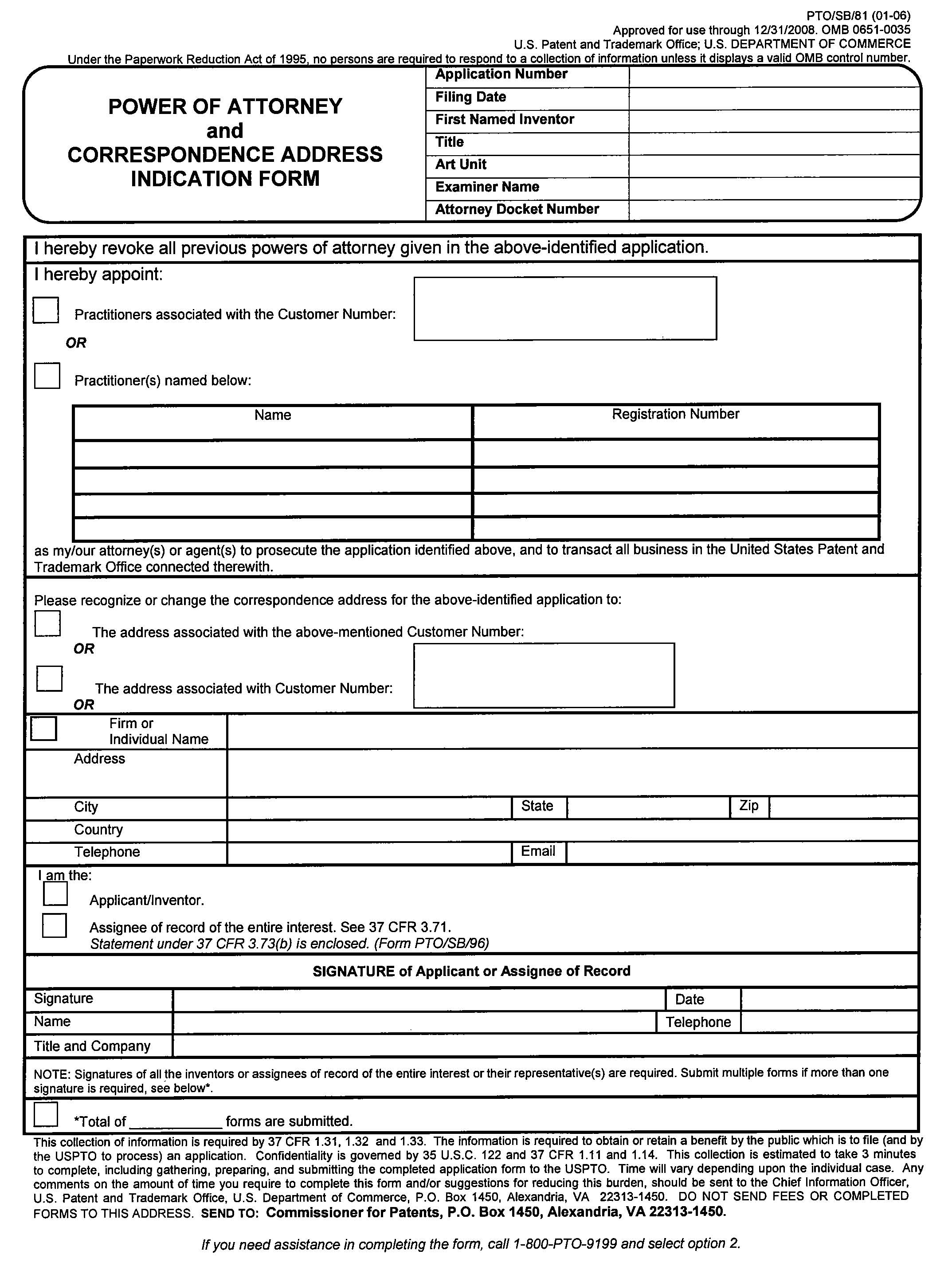
Privacy Act Statement 
37 C.F.R. 1.34 Acting in a representative capacity.
When a patent practitioner acting in a representative capacity appears in person or signs a paper in practice before the United States Patent and Trademark Office in a patent case, his or her personal appearance or signature shall constitute a representation to the United States Patent and Trademark Office that under the provisions of this subchapter and the law, he or she is authorized to represent the particular party on whose behalf he or she acts. In filing such a paper, the patent practitioner must set forth his or her registration number, his or her name and signature. Further proof of authority to act in a representative capacity may be required.
In accordance with 37 CFR 1.34, a paper filed by a registered patent attorney or agent in an application in which he or she is not of record must include his or her name and registration number with his or her signature. Acceptance of papers filed in patent applications and reexamination proceedings by registered attorneys and agents upon a representation that the attorney or agent is authorized to act in a representative capacity is for the purpose of facilitating replies on behalf of applicants in patent applications and, further, to obviate the need for filing powers of attorney in individual applications or patents when there has been a change in composition of law firms or corporate patent staffs. Interviews with a registered attorney or agent not of record will, in view of 35 U.S.C. 122, be conducted only on the basis of information and files supplied by the attorney or agent. A person acting in a representative capacity may not sign (A) a power of attorney (37 CFR 1.32(b)(4) ), (B) a document granting access to an application (except where an executed oath or declaration has not been filed, and the patent practitioner was named in the papers accompanying the application papers - 37 CFR 1.14 (c)), (C) a change of correspondence address (except where an executed oath or declaration has not been filed, and the patent practitioner filed the application - 37 CFR 1.33 (a)), (D) a terminal disclaimer (37 CFR 1.321(b)(1)(iv) ), or (E) a request for an express abandonment without filing a continuing application (37 CFR 1.138 (b)).
A power of attorney or authorization given to a registered Canadian patent agent, to be valid, must be given by the applicants, all of whom are located in Canada. See 37 CFR 11.6(c).
When an application for patent is filed accompanied by a power of attorney to a person who is neither registered to practice before the United States Patent and Trademark Office nor named as an inventor in the application, the Office of Initial Patent Examination will send the official filing receipt directly to the first named inventor, together with an explanatory letter. A copy of the letter will be sent to the person named in the power and a copy placed in the file without being given a paper number. The name of the unregistered person will not be added to the list of patent practitioners of record for the application in the Office’s electronic records and the examiner will communicate only with the applicant directly unless and until the applicant appoints a recognized practitioner.
Form paragraph 4.09 may be used to notify applicant that the attorney or agent is not registered.
An examination of this application reveals that applicant has attempted to appoint an attorney or agent who is neither registered to practice before the U.S. Patent and Trademark Office in patent matters nor named as an inventor in the application, contrary to the Code of Federal Regulations, 37 CFR 1.31 and 1.32. Therefore, the appointment is void, ab initio. We will not recognize the appointment and all correspondence concerning this application must be signed by: 1) all named applicants (inventors), 2) all the owners of the rights to the invention, or 3) a registered attorney or agent duly appointed by the inventor(s) or the owner(s). Furthermore, all communications from the Office will be addressed to the first named inventor, unless specific instructions to the contrary are supplied by the applicant(s) for patent or owner(s).
While an applicant may prosecute the application, lack of skill in this field usually acts as a liability in affording the maximum protection for the invention disclosed. Applicant is, therefore, encouraged to secure the services of a registered patent attorney or agent (i.e., registered to practice before the U.S. Patent and Trademark Office) to prosecute the application, since the value of a patent is largely dependent upon skillful preparation and prosecution.
The Office cannot aid you in selecting a registered attorney or agent, however, a list of attorneys and agents registered to practice before the U.S. Patent and Trademark Office is available from the USPTO web site, http://www.uspto.gov. For assistance locating this information, contact the Office of Enrollment and Discipline at (571) 272-4097 or call the Inventors Assistance Center toll-free number, 1(800)786-9199.
Examiner Note:
This form paragraph is to be used ONLY after ensuring that the named representative is not registered with the Office. A PALM inquiry should be first made and if no listing is given, the Office of Enrollment and Discipline should be contacted to determine the current "recognition" status of the individual named by the applicant in a "power of attorney." If the named individual is NOT registered or otherwise recognized by the Office, the correspondence address on the face of the file should be promptly changed to that of the first named inventor unless applicant specifically provides a different "correspondence address." A copy of the Office communication incorporating this form paragraph should also be mailed to the unregistered individual named by the applicant in the "power of attorney." If desired, you may include with your communication, a list of the registered practitioners from applicant’s Zip Code copied from the Registered Attorney/Agent Roster posted on the USPTO Internet web site http://www.uspto.gov.
See MPEP § 601.03 for change of correspondence address. See MPEP § 201.06(c) for change in the power of attorney in continuation or divisional applications filed under 37 CFR 1.53(b). See MPEP § 403 for the addition and/or deletion of a practitioner from the list of practitioners associated with a Customer Number. For a representative of a requester of reexamination, see MPEP § 2213.
37 C.F.R. 10.18 Signature and certificate for correspondence filed in the Patent and Trademark Office.
- (a) For all documents filed in the Office in patent, trademark, and other non-patent matters, except for correspondence that is required to be signed by the applicant or party, each piece of correspondence filed by a practitioner in the Patent and Trademark Office must bear a signature by such practitioner complying with the provisions of §1.4 (d), § 1.4 (e), or § 2.193(c)(1) of this chapter.
- (b) By presenting to the Office (whether by signing, filing, submitting, or later advocating) any paper, the party presenting such paper, whether a practitioner or non-practitioner, is certifying that—
- (1) All statements made therein of the party’s own knowledge are true, all statements made therein on information and belief are believed to be true, and all statements made therein are made with the knowledge that whoever, in any matter within the jurisdiction of the Patent and Trademark Office, knowingly and willfully falsifies, conceals, or covers up by any trick, scheme, or device a material fact, or makes any false, fictitious or fraudulent statements or representations, or makes or uses any false writing or document knowing the same to contain any false, fictitious or fraudulent statement or entry, shall be subject to the penalties set forth under 18 U.S.C. 1001, and that violations of this paragraph may jeopardize the validity of the application or document, or the validity or enforceability of any patent, trademark registration, or certificate resulting therefrom; and
- (2) To the best of the party’s knowledge, information and belief, formed after an inquiry reasonable under the circumstances, that —
- (i) The paper is not being presented for any improper purpose, such as to harass someone or to cause unnecessary delay or needless increase in the cost of prosecution before the Office;
- (ii) The claims and other legal contentions therein are warranted by existing law or by a nonfrivolous argument for the extension, modification, or reversal of existing law or the establishment of new law;
- (iii) The allegations and other factual contentions have evidentiary support or, if specifically so identified, are likely to have evidentiary support after a reasonable opportunity for further investigation or discovery; and
- (iv) The denials of factual contentions are warranted on the evidence, or if specifically so identified, are reasonably based on a lack of information or belief.
- (c) Violations of paragraph (b)(1) of this section by a practitioner or non-practitioner may jeopardize the validity of the application or document, or the validity or enforceability of any patent, trademark registration, or certificate resulting therefrom. Violations of any of paragraphs (b)(2)(i) through (iv) of this section are, after notice and reasonable opportunity to respond, subject to such sanctions as deemed appropriate by the Commissioner, or the Commissioner's designee, which may include, but are not limited to, any combination of —
- (1) Holding certain facts to have been established;
- (2) Returning papers;
- (3) Precluding a party from filing a paper, or presenting or contesting an issue;
- (4) Imposing a monetary sanction;
- (5) Requiring a terminal disclaimer for the period of the delay; or
- (6) Terminating the proceedings in the Patent and Trademark Office.
- (d) Any practitioner violating the provisions of this section may also be subject to disciplinary action. See § 10.23(c)(15).
emphasizes that every paper filed by a practitioner must be personally signed by the practitioner, except those required to be signed by the applicant or party. 37 CFR 10.18(b) provides that, by presenting any paper to the Office, the party presenting such paper (whether a practitioner or nonpractitioner) is: (1) certifying that the statements made therein are subject to the declaration clause of 37 CFR 1.68; and (2) making the certifications required for papers filed in a federal court under Rule 11(b) of the Federal Rules of Civil Procedure. See MPEP § 410. 37 CFR 10.18(d) provides that any practitioner violating the provisions of 37 CFR 10.18 may also be subject to disciplinary action (see 37 CFR 10.23(c) (15)), thus clarifying that a practitioner may be subject to disciplinary action in lieu of, or in addition to, the sanctions set forth in 37 CFR 10.18(c) for violations of 37 CFR 10.18. See also 37 CFR 1.4(d) (4).
The certifications in 37 CFR 10.18(b) apply to all papers filed in the Office, including allegations of improper conduct made by a registered practitioner in any Office proceeding.
37 C.F.R. 10.11 Removing names from the register.
A letter may be addressed to any individual on the register, at the address of which separate notice was last received by the Director, for the purpose of ascertaining whether such individual desires to remain on the register. The name of any individual failing to reply and give any information requested by the Director within a time limit specified will be removed from the register and the names of individuals so removed will be published in the Official Gazette. The name of any individual so removed may be reinstated on the register as may be appropriate and upon payment of the fee set forth in § 1.21 (a)(3) of this subchapter.
See also MPEP § 1702.
37 C.F.R. 11.9 Limited recognition in patent matters.
- (a) Any individual not registered under §11.6 may, upon a showing of circumstances which render it necessary or justifiable, and that the individual is of good moral character and reputation, be given limited recognition by the OED Director to prosecute as attorney or agent a specified patent application or specified patent applications. Limited recognition under this paragraph shall not extend further than the application or applications specified. Limited recognition shall not be granted while individuals who have passed the examination or for whom the examination has been waived are awaiting registration to practice before the Office in patent matters.
- (b) A nonimmigrant alien residing in the United States and fulfilling the provisions of §11.7 (a) and (b) may be granted limited recognition if the nonimmigrant alien is authorized by the Bureau of Citizenship and Immigration Services to be employed or trained in the United States in the capacity of representing a patent applicant by presenting or prosecuting a patent application. Limited recognition shall be granted for a period consistent with the terms of authorized employment or training. Limited recognition shall not be granted or extended to a non-United States citizen residing abroad. If granted, limited recognition shall automatically expire upon the nonimmigrant alien’s departure from the United States.
- (c) An individual not registered under §11.6 may, if appointed by an applicant, prosecute an international patent application only before the United States International Searching Authority and the United States International Preliminary Examining Authority, provided that the individual has the right to practice before the national office with which the international application is filed as provided in PCT Art. 49, Rule 90 and § 1.455 of this subchapter, or before the International Bureau when the USPTO is acting as Receiving Office pursuant to PCT Rules 83.1bis and 90.1.
Sometimes in an application naming joint inventors, one or more of the joint inventors gives to the other joint inventor(s) the power of attorney in the application. Such power will be recognized even though the one to whom it is given is not registered. See 37 CFR 1.31 and1.32 (c)(1).
If a request for special recognition accompanies the application, the Office of Initial Patent Examination will forward the file to the Director of the Office of Enrollment and Discipline.
Effective June 25, 2004, the associate power of attorney practice has been eliminated. The Office no longer accepts a power of attorney signed by a principal to name an associate power of attorney. An appointment of an associate power of attorney filed on or after June 25, 2004 will not be accepted. See also MPEP § 406.
37 C.F.R. 1.36 Revocation of power of attorney; withdrawal of patent attorney or agent.
- (a) A power of attorney, pursuant to § 1.32 (b), may be revoked at any stage in the proceedings of a case by an applicant for patent (§ 1.41 (b)) or an assignee of the entire interest of the applicant, or the owner of the entire interest of a patent. A power of attorney to the patent practitioners associated with a Customer Number will be treated as a request to revoke any powers of attorney previously given. Fewer than all of the applicants (or fewer than all of the assignees of the entire interest of the applicant or, in a reexamination proceeding, fewer than all the owners of the entire interest of a patent) may revoke the power of attorney only upon a showing of sufficient cause, and payment of the petition fee set forth in § 1.17 (f). A patent practitioner will be notified of the revocation of the power of attorney. Where power of attorney is given to the patent practitioners associated with a Customer Number (§ 1.32 (c)(2)), the practitioners so appointed will also be notified of the revocation of the power of attorney when the power of attorney to all of the practitioners associated with the Customer Number is revoked. The notice of revocation will be mailed to the correspondence address for the application (§ 1.33 ) in effect before the revocation. An assignment will not of itself operate as a revocation of a power previously given, but the assignee of the entire interest of the applicant may revoke previous powers of attorney and give another power of attorney of the assignee’s own selection as provided in § 1.32 (b).
- (b) A registered patent attorney or patent agent who has been given a power of attorney pursuant to § 1.32 (b) may withdraw as attorney or agent of record upon application to and approval by the Director. The applicant or patent owner will be notified of the withdrawal of the registered patent attorney or patent agent. Where power of attorney is given to the patent practitioners associated with a Customer Number, a request to delete all of the patent practitioners associated with the Customer Number may not be granted if an applicant has given power of attorney to the patent practitioners associated with the Customer Number in an application that has an Office action to which a reply is due, but insufficient time remains for the applicant to file a reply. See § 41.5 of this title for withdrawal during proceedings before the Board of Patent Appeals and Interferences.
Upon revocation of the power of attorney, appropriate notification is sent by the technical support staff of the Technology Center.
Revocation of the power of the principal attorney revokes any associate powers granted by him or her to other attorneys.
Revocation of the power of attorney becomes effective on the date that the revocation is RECEIVED in the Office (not on the date of ACCEPTANCE).
Form PTO/SB/82 may be used to revoke a power of attorney.
Form PTO/SB/82 Revocation of Power of Attorney With New Power of Attorney and Change of Correspondence Address 
Privacy Act Statement 
37 C.F.R. 1.36 Revocation of power of attorney; withdrawal of patent attorney or agent.
*****
- (b) A registered patent attorney or patent agent who has been given a power of attorney pursuant to § 1.32 (b) may withdraw as attorney or agent of record upon application to and approval by the Director. The applicant or patent owner will be notified of the withdrawal of the registered patent attorney or patent agent. Where power of attorney is given to the patent practitioners associated with a Customer Number, a request to delete all of the patent practitioners associated with the Customer Number may not be granted if an applicant has given power of attorney to the patent practitioners associated with the Customer Number in an application that has an Office action to which a reply is due, but insufficient time remains for the applicant to file a reply. See § 41.5 of this title for withdrawal during proceedings before the Board of Patent Appeals and Interferences.
See 37 CFR 1.36(a) in MPEP § 402.05 for revocation. See 37 CFR 10.40 for information regarding permissive and mandatory withdrawal. When filing a request to withdraw as attorney or agent of record, the patent attorney or agent should briefly state the reason(s) for which he or she is withdrawing so that the Office can determine whether to grant the request. Note that disciplinary rule, 37 CFR 10.40 (a) provides that a "practitioner shall not withdraw from employment until the practitioner has taken reasonable steps to avoid foreseeable prejudice to the rights of the client." Among several scenarios addressed in 37 CFR 10.40(c), subsections (iv) and (vi) permit withdrawal when the client fails to compensate the practitioner, or when "other conduct on the part of the client has rendered the representation unreasonably difficult." When preparing a request for withdrawal for such reasons, the practitioner should also be mindful of 37 CFR 10.57 (b)(2), which prohibits the use of a confidence or secret of a client to the disadvantage of a client. Where withdrawal is predicated upon such reasons, the practitioner, rather than divulging confidential or secret information about the client, should identify the reason(s) for requesting to withdraw as being based on "irreconcilable differences." An explanation of and the evidence supporting "irreconcilable differences" should be submitted as proprietary material in accordance with MPEP § 724.02 to ensure that the client’s confidences are maintained.
In the event that a notice of withdrawal is filed by the attorney or agent of record, the file will be forwarded to the appropriate official for decision on the request. The withdrawal is effective when approved rather than when received.
To expedite the handling of requests for permission to withdraw as attorney or agent, under 37 CFR 1.36(b), Form PTO/SB/83 may be used. Because the Office does not recognize law firms, each attorney of record must sign the notice of withdrawal, or the notice of withdrawal must contain a clear indication of one attorney signing on behalf of himself or herself and another. A withdrawal of another attorney or agent of record, without also withdrawing the attorney or agent signing the request is a revocation, not a withdrawal.
The Director of the United States Patent and Trademark Office usually requires that there be at least 30 days between approval of withdrawal and the later of the expiration date of a time period for reply or the expiration date of the period which can be obtained by a petition and fee for extension of time under 37 CFR 1.136(a). This is so that the applicant will have sufficient time to obtain other representation or take other action. If a period has been set for reply and the period may be extended without a showing of cause pursuant to 37 CFR 1.136(a) by filing a petition for extension of time and fee, the practitioner will not be required to seek such extension of time for withdrawal to be approved. In such a situation, however, withdrawal will not be approved unless at least 30 days would remain between the date of approval and the last date on which such a petition for extension of time and fee could properly be filed.
For withdrawal during reexamination proceedings, see MPEP § 2223.
Form PTO/SB/83 may be used to request withdrawal of attorney or agent of record.
Form PTO/SB/83 Request for Withdrawal as Attorney or Agent and Change of Correspondence Address 
Privacy Act Statement 
The assignee of record of the entire interest can revoke the power of attorney of the applicant unless an "irrevocable" right to prosecute the application had been given as in some government owned applications.
37 C.F.R. 3.71 Prosecution by assignee.
- (a) Patents — conducting of prosecution. One or more assignees as defined in paragraph (b) of this section may, after becoming of record pursuant to paragraph (c) of this section, conduct prosecution of a national patent application or a reexamination proceeding to the exclusion of either the inventive entity, or the assignee(s) previously entitled to conduct prosecution.
- (b) Patents — assignee(s) who can prosecute. The assignee(s) who may conduct either the prosecution of a national application for patent or a reexamination proceeding are:
- (1) A single assignee. An assignee of the entire right, title and interest in the application or patent being reexamined who is of record, or
- (2) Partial assignee(s) together or with inventor(s). All partial assignees, or all partial assignees and inventors who have not assigned their right, title and interest in the application or patent being reexamined, who together own the entire right, title and interest in the application or patent being reexamined. A partial assignee is any assignee of record having less than the entire right, title and interest in the application or patent being reexamined.
- (c) Patents — Becoming of record. An assignee becomes of record either in a national patent application or a reexamination proceeding by filing a statement in compliance with § 3.73(b) that is signed by a party who is authorized to act on behalf of the assignee.
- (d) Trademarks. The assignee of a trademark application or registration may prosecute a trademark application, submit documents to maintain a trademark registration, or file papers against a third party in reliance on the assignee’s trademark application or registration, to the exclusion of the original applicant or previous assignee. The assignee must establish ownership in compliance with § 3.73(b).
See 37 CFR 1.36 in MPEP § 402.05.
A power of attorney by the assignee of the entire interest revokes all powers given by the applicant and prior assignees if the assignee establishes their right to take action as provided in 37 CFR 3.73(b). See MPEP § 324. Ordinarily, the applicant will still have access to the application (MPEP § 106).
In an application that has been accorded status under 37 CFR 1.47(a), or for which status under 37 CFR 1.47(a) has been requested, a power of attorney given by the inventors who have signed the declaration (available inventors) may be revoked by an assignee of the entire interest of the available inventors (i.e., the applicant). See 37 CFR 1.32 (b)(4). Rights of the assignee to take action may be established as provided in 37 CFR 3.73(b) and MPEP § 324.
Form PTO/SB/80 may be used by an assignee of the entire interest of the applicant to revoke a power of attorney and appoint a new power of attorney. The assignee would sign the power of attorney, and a newly appointed practitioner, having authority to take action on behalf of the assignee would sign a statement under 37 CFR 3.73 (b) for the application in which the general power of attorney is to be used.
Form PTO/SB/80 Power of Attorney To Prosecute Applications Before the USPTO 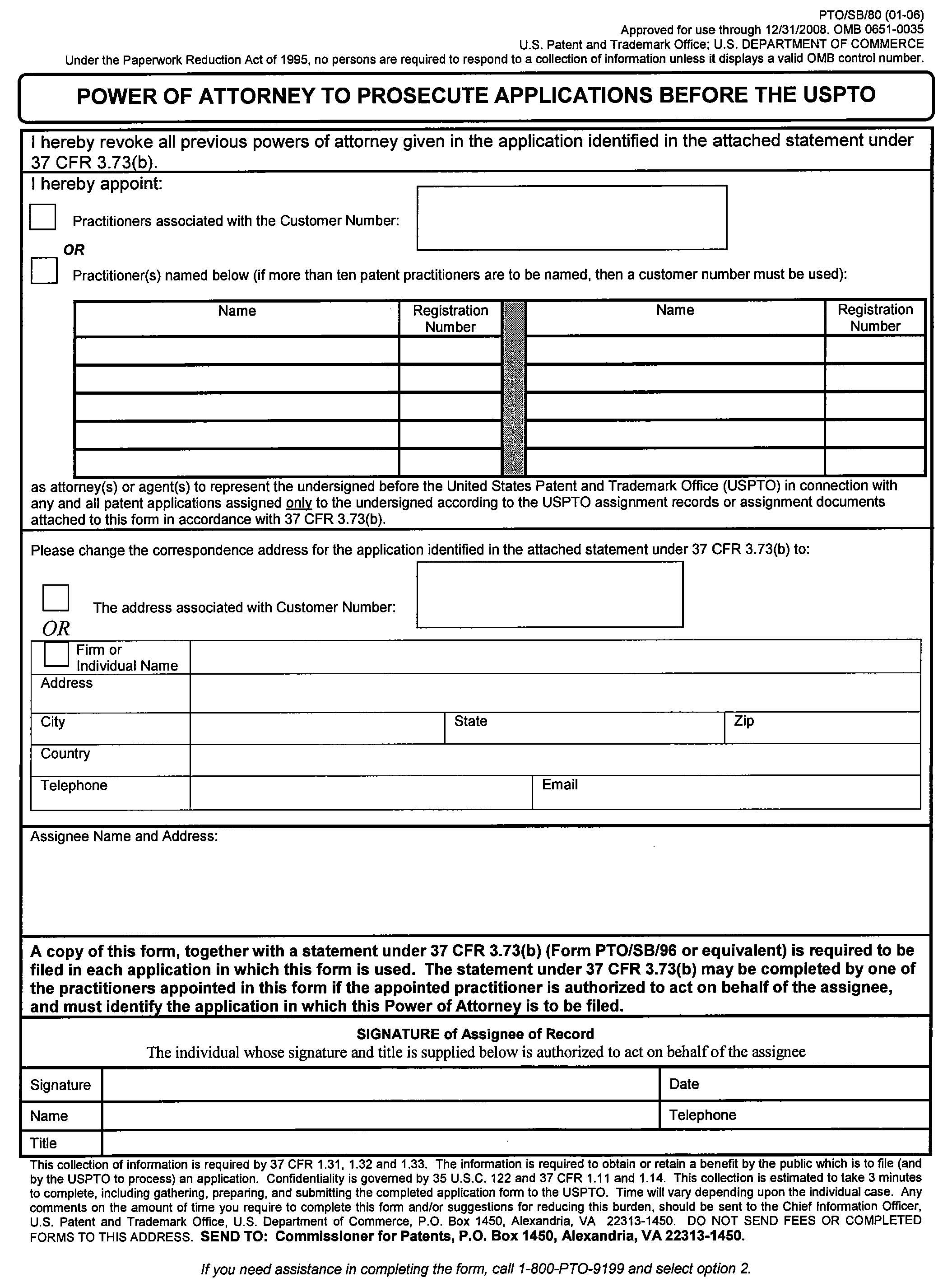
Privacy Act Statement 
While an application is involved in an interference, no power of attorney of any kind should be entered in such application by the technical support staff of the Technology Center.
If a power of attorney or revocation is received for an application which is in interference, it should be forwarded to the Service Branch of the Board of Patent Appeals and Interferences because all parties to the interference must be notified.
37 C.F.R. 11.9 Limited recognition in patent matters
- (a) Any individual not registered under §11.6 may, upon a showing of circumstances which render it necessary or justifiable, and that the individual is of good moral character and reputation, be given limited recognition by the OED Director to prosecute as attorney or agent a specified patent application or specified patent applications. Limited recognition under this paragraph shall not extend further than the application or applications specified. Limited recognition shall not be granted while individuals who have passed the examination or for whom the examination has been waived are awaiting registration to practice before the Office in patent matters.
- (b) A nonimmigrant alien residing in the United States and fulfilling the provisions of §11.7 (a) and (b) may be granted limited recognition if the nonimmigrant alien is authorized by the Bureau of Citizenship and Immigration Services to be employed or trained in the United States in the capacity of representing a patent applicant by presenting or prosecuting a patent application. Limited recognition shall be granted for a period consistent with the terms of authorized employment or training. Limited recognition shall not be granted or extended to a non-United States citizen residing abroad. If granted, limited recognition shall automatically expire upon the nonimmigrant alien’s departure from the United States.
- (c) An individual not registered under §11.6 may, if appointed by an applicant, prosecute an international patent application only before the United States International Searching Authority and the United States International Preliminary Examining Authority, provided that the individual has the right to practice before the national office with which the international application is filed as provided in PCT Art. 49, Rule 90 and § 1.455 of this subchapter, or before the International Bureau when the USPTO is acting as Receiving Office pursuant to PCT Rules 83.1 bis and 90.1.
37 C.F.R. 1.455 Representation in international applications.
- (a) Applicants of international applications may be represented by attorneys or agents registered to practice before the United States Patent and Trademark Office or by an applicant appointed as a common representative (PCT Art. 49,Rules 4.8 and 90 and § 11.9 ). If applicants have not appointed an attorney or agent or one of the applicants to represent them, and there is more than one applicant, the applicant first named in the request and who is entitled to file in the U.S. Receiving Office shall be considered to be the common representative of all the applicants. An attorney or agent having the right to practice before a national office with which an international application is filed and for which the United States is an International Searching Authority or International Preliminary Examining Authority may be appointed to represent the applicants in the international application before that authority. An attorney or agent may appoint an associate attorney or agent who shall also then be of record (PCT Rule 90.1 (d)). The appointment of an attorney or agent, or of a common representative, revokes any earlier appointment unless otherwise indicated (PCT Rule 90.6 (b) and (c)).
- (b) Appointment of an agent, attorney or common representative (PCT Rule 4.8 ) must be effected either in the Request form, signed by applicant, in the Demand form, signed by applicant, or in a separate power of attorney submitted either to the United States Receiving Office or to the International Bureau.
- (c) Powers of attorney and revocations thereof should be submitted to the United States Receiving Office until the issuance of the international search report.
- (d) The addressee for correspondence will be as indicated in section 108 of the Administrative Instructions.
For representation in international applications, see MPEP § 1807.
Papers giving or revoking a power of attorney in an application generally require signature by all the applicants or owners of the application. Papers revoking a power of attorney in an application (or giving a power of attorney) will not be accepted by the Office when signed by less than all of the applicants or owners of the application unless they are accompanied by a petition under 37 CFR 1.36 (a) and fee under 37 CFR 1.17 (f) with a showing of sufficient cause (if revocation), or a petition under 37 CFR 1.183 and fee under 37 CFR 1.17 (f) (if appointment) demonstrating the extraordinary situation where justice requires waiver of the requirement of 37 CFR 1.32 (b)(4) that the applicant, or the assignee of the entire interest of the applicant sign the power of attorney. The petition should be directed to the Office of Petitions. The acceptance of such papers by petition under 37 CFR 1.36 (a) or 1.183 will result in more than one attorney, agent, applicant, or owner prosecuting the application at the same time. Therefore, each of these parties must sign all subsequent replies submitted to the Office. See In re Goldstein, 16 USPQ2d 1963 (Dep. Assist. Comm’r Pat. 1988). In an application filed under 37 CFR 1.47(a), an assignee of the entire interest of the available inventors (i.e., the applicant) who have signed the declaration may appoint or revoke a power of attorney without a petition under 37 CFR 1.36(a) or 1.183. See MPEP § 402.07. However, in applications accepted under 37 CFR 1.47, such a petition under 37 CFR 1.36(a) or 1.183 submitted by a previously nonsigning inventor who has now joined in the application will not be granted. See MPEP § 409.03(i). Upon accepting papers appointing and/or revoking a power of attorney that are signed by less than all of the applicants or owners, the Office will indicate to applicants who must sign subsequent replies. Dual correspondence will still not be permitted. Accordingly, when the acceptance of such papers results in an attorney or agent and at least one applicant or owner prosecuting the application, correspondence will be mailed to the attorney or agent. When the acceptance of such papers results in more than one attorney or agent prosecuting the application, the correspondence address will continue to be that of the attorney or agent first named in the application, unless all parties agree to a different correspondence address. Each attorney or agent signing subsequent papers must indicate whom he or she represents.
The following are examples of who must sign replies when there is more than one person responsible for prosecuting the application:
- (A) If coinventor A has given a power of attorney to a patent practitioner and coinventor B has not, replies must be signed by the patent practitioner of A and by coinventor B.
- (B) If coinventors A and B have each appointed their own patent practitioner, replies must be signed by both patent practitioners.