§ 213
MPEP § 213
Right of Priority of Foreign Application
Published Nov 1, 2013United States Patent and Trademark Office
Viewing an earlier, undated versionView current
Under certain conditions and on fulfilling certain requirements, an application for patent filed in the United States may be entitled to the benefit of the filing date of a prior application filed in a foreign country. The conditions are specified in 35 U.S.C. 119(a)-(d) and (f), and 37 CFR 1.55.
35 U.S.C. 119 Benefit of earlier filing date; right of priority.
- (a) An application for patent for an invention filed in this country by any person who has, or whose legal representatives or assigns have, previously regularly filed an application for a patent for the same invention in a foreign country which affords similar privileges in the case of applications filed in the United States or to citizens of the United States, or in a WTO member country, shall have the same effect as the same application would have if filed in this country on the date on which the application for patent for the same invention was first filed in such foreign country, if the application in this country is filed within twelve months from the earliest date on which such foreign application was filed.
- (b)
- (1) No application for patent shall be entitled to this right of priority unless a claim is filed in the Patent and Trademark Office, identifying the foreign application by specifying the application number on that foreign application, the intellectual property authority or country in or for which the application was filed, and the date of filing the application, at such time during the pendency of the application as required by the Director.
- (2) The Director may consider the failure of the applicant to file a timely claim for priority as a waiver of any such claim. The Director may establish procedures, including the payment of a surcharge, to accept an unintentionally delayed claim under this section.
- (3) The Director may require a certified copy of the original foreign application, specification, and drawings upon which it is based, a translation if not in the English language, and such other information as the Director considers necessary. Any such certification shall be made by the foreign intellectual property authority in which the foreign application was filed and show the date of the application and of the filing of the specification and other papers.
- (c) In like manner and subject to the same conditions and requirements, the right provided in this section may be based upon a subsequent regularly filed application in the same foreign country instead of the first filed foreign application, provided that any foreign application filed prior to such subsequent application has been withdrawn, abandoned, or otherwise disposed of, without having been laid open to public inspection and without leaving any rights outstanding, and has not served, nor thereafter shall serve, as a basis for claiming a right of priority.
- (d) Applications for inventors’ certificates filed in a foreign country in which applicants have a right to apply, at their discretion, either for a patent or for an inventor’s certificate shall be treated in this country in the same manner and have the same effect for purpose of the right of priority under this section as applications for patents, subject to the same conditions and requirements of this section as apply to applications for patents, provided such applicants are entitled to the benefits of the Stockholm Revision of the Paris Convention at the time of such filing.
*****
- (f) Applications for plant breeder’s rights filed in a WTO member country (or in a foreign UPOV Contracting Party) shall have the same effect for the purpose of the right of priority under subsections (a) through (c) of this section as applications for patents, subject to the same conditions and requirements of this section as apply to applications for patents.
*****
37 C.F.R. 1.55 Claim for foreign priority.
- (a) In general. An applicant in a nonprovisional application may claim priority to one or more prior foreign applications under the conditions specified in 35 U.S.C. 119(a) through (d) and (f), 172, and 365(a) and (b) and this section.
- (b) Time for filing subsequent application. The nonprovisional application must be filed not later than twelve months (six months in the case of a design application) after the date on which the foreign application was filed, or be entitled to claim the benefit under 35 U.S.C. 120, 121, or 365(c) of an application that was filed not later than twelve months (six months in the case of a design application) after the date on which the foreign application was filed. The twelve-month period is subject to 35 U.S.C. 21(b) (and § 1.7(a) ) and PCT Rule 80.5, and the six-month period is subject to 35 U.S.C. 21(b) (and § 1.7(a) ).
- (c) Time for filing priority claim and certified copy of foreign application in an application entering the national stage under 35 U.S.C. 371. In an international application entering the national stage under 35 U.S.C. 371, the claim for priority must be made and a certified copy of the foreign application must be filed within the time limit set forth in the PCT and the Regulations under the PCT.
- (d) Time for filing priority claim in an application filed under 35 U.S.C. 111(a). In an original application filed under 35 U.S.C. 111(a), the claim for priority must be filed within the later of four months from the actual filing date of the application or sixteen months from the filing date of the prior foreign application. The claim for priority must be presented in an application data sheet (§ 1.76(b)(6) ), and must identify the foreign application for which priority is claimed, by specifying the application number, country (or intellectual property authority), day, month, and year of its filing. The time period in this paragraph does not apply in a design application.
*****
- (f) Time for filing certified copy of foreign application in an application filed under 35 U.S.C. 111(a). In an original application filed under 35 U.S.C. 111(a), a certified copy of the foreign application must be filed within the later of four months from the actual filing date of the application or sixteen months from the filing date of the prior foreign application, except as provided in paragraphs (h) and (i) of this section. If a certified copy of the foreign application is not filed within the later of four months from the actual filing date of the application or sixteen months from the filing date of the prior foreign application, and the exceptions in paragraphs (h) and (i) of this section are not applicable, the certified copy of the foreign application must be accompanied by a petition including a showing of good and sufficient cause for the delay and the petition fee set forth in § 1.17(g). The time period in this paragraph does not apply in a design application.
- (g) Requirement for filing priority claim, certified copy of foreign application, and translation in any application.
- (1) The claim for priority and the certified copy of the foreign application specified in 35 U.S.C. 119(b) or PCT Rule 17 must, in any event, be filed within the pendency of the application and before the patent is granted. If the claim for priority or the certified copy of the foreign application is filed after the date the issue fee is paid, it must also be accompanied by the processing fee set forth in 37 CFR 1.17(i), but the patent will not include the priority claim unless corrected by a certificate of correction under 35 U.S.C. 255 and § 1.323.
- (2) The Office may require that the claim for priority and the certified copy of the foreign application be filed earlier than otherwise provided in this section:
- (i) When the application is involved in an interference (see § 41.202 of this title) or derivation (see part 42 of this title) proceeding;
- (ii) When necessary to overcome the date of a reference relied upon by the examiner; or
- (iii) When deemed necessary by the examiner.
- (3) An English language translation of a non-English language foreign application is not required except:
- (i) When the application is involved in an interference (see § 41.202 of this title) or derivation (see part 42 of this title) proceeding;
- (ii) When necessary to overcome the date of a reference relied upon by the examiner; or
- (iii) When specifically required by the examiner.
- (4) If an English language translation of a non-English language foreign application is required, it must be filed together with a statement that the translation of the certified copy is accurate.
*****
Pre-March 16, 2013 37 C.F.R. 1.55 Claim for foreign priority
- (a) An applicant in a nonprovisional application may claim the benefit of the filing date of one or more prior foreign applications under the conditions specified in 35 U.S.C. 119(a) through (d) and (f), 172, and 365(a) and (b).
- (1)
- (i) In an original application filed under 35 U.S.C. 111(a), the claim for foreign priority must be presented in an application data sheet (§ 1.76(b)(6)) during the pendency of the application, and within the later of four months from the actual filing date of the application or sixteen months from the filing date of the prior foreign application.
This time period is not extendable. The claim must identify the foreign application for which priority is claimed, as well as any foreign application for the same subject matter and having a filing date before that of the application for which priority is claimed, by specifying the application number, country (or intellectual property authority), day, month, and year of its filing. The time periods in this paragraph do not apply in an application under 35 U.S.C. 111(a) if the application is:
- (A) A design application; or
- (B) An application filed before November 29, 2000.
- (ii) In an application that entered the national stage from an international application after compliance with 35 U.S.C. 371, the claim for priority must be made during the pendency of the application and within the time limit set forth in the PCT and the Regulations under the PCT.
- (i) In an original application filed under 35 U.S.C. 111(a), the claim for foreign priority must be presented in an application data sheet (§ 1.76(b)(6)) during the pendency of the application, and within the later of four months from the actual filing date of the application or sixteen months from the filing date of the prior foreign application.
- (2) The claim for priority and the certified copy of the foreign application specified in 35 U.S.C. 119(b) or PCT Rule 17 must, in any event, be filed before the patent is granted. If the claim for priority or the certified copy of the foreign application is filed after the date the issue fee is paid, it must be accompanied by the processing fee set forth in § 1.17(i), but the patent will not include the priority claim unless corrected by a certificate of correction under 35 U.S.C. 255 and § 1.323
- (3) The Office may require that the claim for priority and the certified copy of the foreign application be filed earlier than provided in paragraphs (a)(1) or (a)(2) of this section:
- (i) When the application becomes involved in an interference (see § 41.202 of this title),
- (ii) When necessary to overcome the date of a reference relied upon by the examiner, or
- (iii) When deemed necessary by the examiner.
- (4)
- (i) An English language translation of a non-English language foreign application is not required except:
- (A) When the application is involved in an interference (see § 41.202 of this title),
- (B) When necessary to overcome the date of a reference relied upon by the examiner, or
- (C) When specifically required by the examiner.
- (i) If an English language translation is required, it must be filed together with a statement that the translation of the certified copy is accurate.
- (i) An English language translation of a non-English language foreign application is not required except:
- (1)
*****
The conditions for claiming priority to a prior application filed in a foreign country may be listed as follows:
- (A) The foreign application must be one filed in "a foreign country which affords similar privileges in the case of applications filed in the United States or to citizens of the United States or in a WTO member country." See MPEP § 213.01.
- (B) The foreign application must have been filed by the same applicant as the applicant in the United States, or by his or her legal representatives or assigns. Consistent with longstanding Office policy, this is interpreted to mean that the U.S. and foreign applications must name the same inventor or have at least one joint inventor in common. See MPEP 213.02.
- (C) The application, or its earliest parent United States application under 35 U.S.C. 120, must have been filed within 12 months from the date of the earliest foreign filing in a "recognized" country (see MPEP § 213.01). However, the period of 12 months specified in this section is 6 months in the case of designs pursuant to 35 U.S.C. 172. See MPEP § 1504.10.
- (D) The foreign application must be for the same invention as the application in the United States.
- (E) For an original application filed under 35 U.S.C. 111(a) (other than a design application), the claim for priority must be presented during the pendency of the application, and within the later of four months from the actual filing date of the application or sixteen months from the filing date of the prior foreign application. This time period is not extendable. See MPEP § 214.01.
- (F) For applications entering the national stage under 35 U.S.C. 371 from an international application, the claim for priority must be made and a certified copy of the foreign application must be filed within the time limit set forth in the PCT Articles and Regulations.
- (G) In the case where the basis of the claim is an application for an inventor's certificate, the requirements of 37 CFR 1.55(k) or pre-March 16, 2013 37 CFR 1.55(b) must also be met. See MPEP § 213.05.
- (H) A certified copy of the foreign application must be filed within the time period set forth in 37 CFR 1.55. See MPEP § 215.02 et seq. for applications filed on or after March 16, 2013, and MPEP § 215.03 for applications filed before March 16, 2013. The claim for priority and the certified copy of the foreign application must, in any event, be filed within the pendency of the application and before the patent is granted. See MPEP § 213.04.
- (I) If a nonprovisional application filed on or after March 16, 2013, claims priority to a foreign application filed prior to March 16, 2013, and also contains, or contained at any time, a claim to a claimed invention that has an effective filing date (as defined in 35 U.S.C. 100(i)) on or after March 16, 2013, the applicant must provide a statement to that effect within a specified time period. See 37 CFR 1.55(j) and MPEP § 210, subsection III.
Applicant may be informed of possible priority rights under 35 U.S.C. 119(a)-(d) and (f) by using the wording of form paragraph 2.18.
Applicant is advised of possible benefits under 35 U.S.C. 119(a) -(d) and (f), wherein an application for patent filed in the United States may be entitled to the benefit of the filing date of a prior claim priority to an application filed in a foreign country.
As a result of recent changes to the applicable laws and rules, the procedural requirements relating to claims for priority to an earlier-filed foreign application may vary based on the filing date of the later-filed nonprovisional application. See MPEP § 214.01 for the time limits for claiming priority to a foreign application and MPEP §§ 215.02 and 215.03 for time limits for submitting a certified copy of the priority document. The Patent Law Treaty that becomes effective on December 18, 2013 revises the procedural requirements and the time relating to claims for priority of an earlier filed foreign application.
The right to rely on a foreign application is known as the right of priority in international patent law and this phrase has been adopted in the U.S. statute. The right of priority originated in a multilateral treaty of 1883, to which the United States adhered in 1887, known as the Paris Convention for the Protection of Industrial Property (Paris Convention). The treaty is administered by the World Intellectual Property Organization (WIPO) at Geneva, Switzerland. This treaty has been revised several times, the latest revision in effect being written in Stockholm in July 1967 (copy at Appendix P of this Manual). Articles 13-30 of the Stockholm Revision became effective on September 5, 1970. Articles 1-12 of the Stockholm Revision became effective on August 25, 1973. One of the many provisions of the treaty requires each of the adhering countries to accord the right of priority to the nationals of the other countries and the first United States statute relating to this subject was enacted to carry out this obligation. There is another treaty between the United States and some Latin American countries which also provides for the right of priority. A foreign country may also provide for this right by reciprocal legislation.
The United States and Taiwan signed an agreement on priority for patent and trademark applications on April 10, 1996, and Taiwan is now a country for which the right of priority is recognized in the United States. Applicants seeking patent protection in the United States may avail themselves of the right of priority based on patent applications filed in Taiwan, on or after April 10, 1996.
An application for patent filed in the United States on or after January 1, 1996, by any person who has, or whose legal representatives or assigns have, previously filed an application for patent in Thailand shall have the benefit of the filing date in Thailand in accordance with 35 U.S.C. 119 and 172.
I. LIST OF RECOGNIZED COUNTRIES
Following is a table of states, i.e., countries, with respect to which the right of priority referred to in 35 U.S.C. 119(a)-(d) has been recognized. The table indicates whether a basis for priority is that the state is party to the Patent Cooperation Treaty (PCT) or the Paris Convention for the Protection of Industrial Property (Paris) (see 613 O.G. 23, 53 Stat. 1748), or a member of the World Trade Organization (WTO). See 35 U.S.C. 119(a). See http://www.wto.org/english/thewto_e /whatis_e/tif_e/org6_e.htm for a current list of WTO member countries along with their dates of membership. Applications for plant breeder’s rights filed in WTO member countries and foreign UPOV contracting parties may be relied upon for priority pursuant to 35 U.S.C. 119(f). See MPEP Chapter 1600.
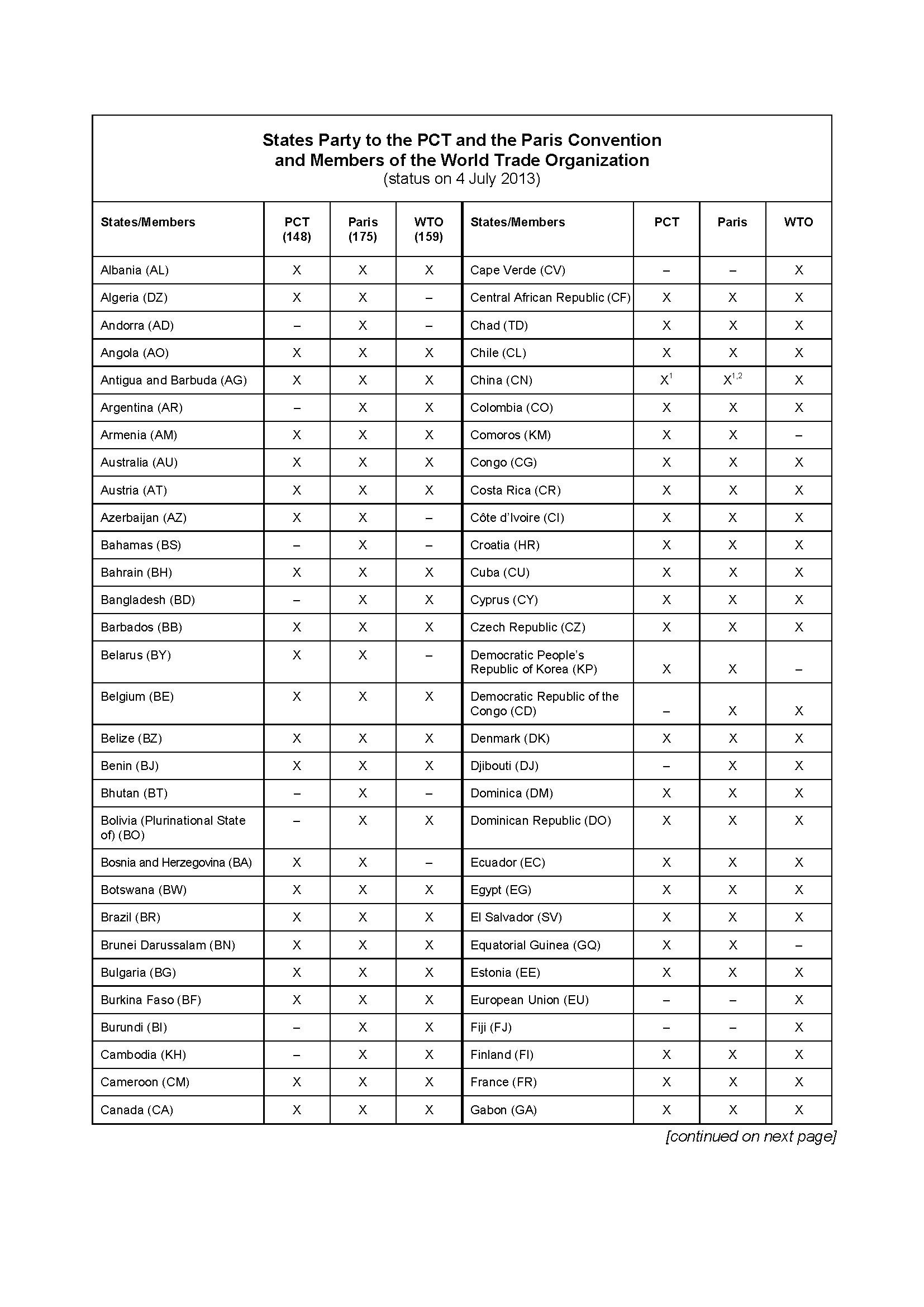
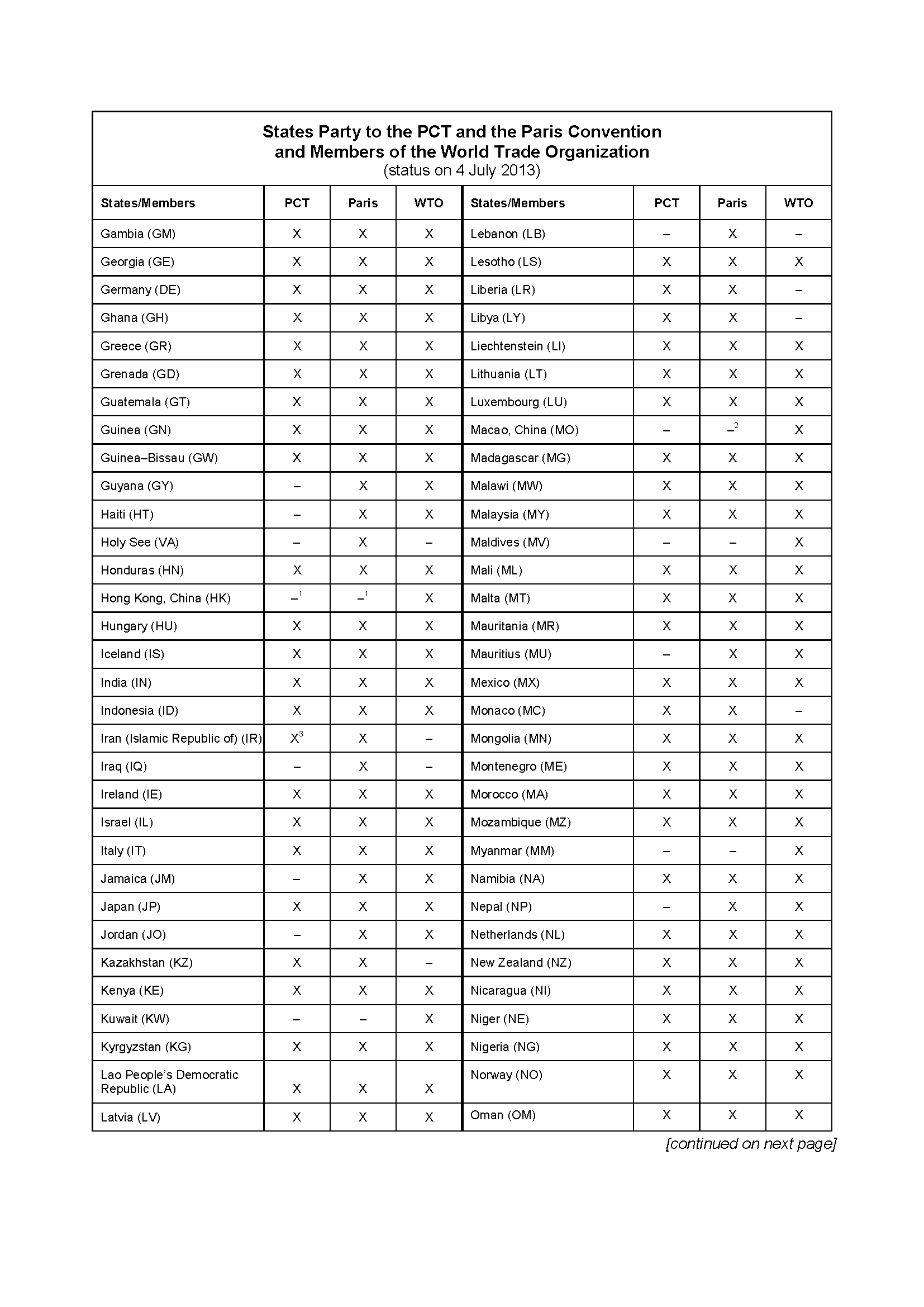

If any applicant asserts the benefit of the filing date of an application filed in a country not on this list, the examiner should contact the Office of Policy and External Affairs to determine if there has been any change in the status of that country. It should be noted that the right is based on the country of the foreign filing and not upon the citizenship of the applicant.
II. RIGHT OF PRIORITY BASED UPON AN INTERNATIONAL APPLICATION FILED UNDER THE PATENT COOPERATION TREATY
35 U.S.C. 365 Right of priority; benefit of the filing date of a prior application.
- (a) In accordance with the conditions and requirements of subsections (a) through (d) of section 119, a national application shall be entitled to the right of priority based on a prior filed international application which designated at least one country other than the United States.
- (b) In accordance with the conditions and requirements of section 119(a) and the treaty and the Regulations, an international application designating the United States shall be entitled to the right of priority based on a prior foreign application, or a prior international application designating at least one country other than the United States.
*****
35 U.S.C. 365(a) provides that a national application shall be entitled to the right of priority based on a prior international application of whatever origin, which designated any country other than, or in addition to, the United States. Of course, the conditions prescribed by 35 U.S.C 119(a)-(d), which deals with the right of priority based on earlier filed foreign applications, must be complied with.
35 U.S.C. 365(b) provides that an international application designating the United States shall be entitled to the right of priority of a prior foreign application which may either be another international application or a regularly filed foreign application. The international application upon which the claim of priority is based can either have been filed in the United States or a foreign country; however, it must contain the designation of at least one country other than, or in addition to, the United States.
As far as the actual place of filing is concerned, for the purpose of 35 U.S.C. 365(a) and (b) and 35 U.S.C. 119(a)-(d) and (f), an international application designating a country is considered to be a national application regularly filed in that country on the international filing date irrespective of whether it was physically filed in that country, in another country, or in an intergovernmental organization acting as Receiving Office for a country.
III. RIGHT OF PRIORITY (35 U.S.C. 119(a)-(d) AND 365(a)-(b)) BASED ON A FOREIGN APPLICATION FILED UNDER A BILATERAL OR MULTILATERAL TREATY
Under Article 4A of the Paris Convention for the Protection of Industrial Property a right of priority may be based either on an application filed under the national law of a foreign country adhering to the Convention or on a foreign application filed under a bilateral or multilateral treaty concluded between two or more such countries. Examples of such treaties pertaining to the protection of designs are The Hague Agreement Concerning the International Deposit of Industrial Designs, the Benelux Designs Convention, and the Office for Harmonization in the Internal Market (OHIM) as created under European Union law. Treaties pertaining to utility and/or plant patents include The Convention on the Grant of European Patents (which established the European Patent Office), the Patent Cooperation Treaty, and the International Convention for the Protection of New Varieties of Plants (UPOV).
In addition to the list of recognized countries set forth in subsection I, above, applicants may claim priority under 35 U.S.C. 119(a)-(d) to applications filed in foreign regional patent offices having member states who are contracting states under the Patent Cooperation Treaty (PCT). These include the African Regional Intellectual Property Organization (ARIPO), the Eurasian Patent Office (EAPO), the European Patent Office (EPO), and the African Intellectual Property Organization (known under the acronym OAPI for its French name, Organisation Africaine de la Propriété Intellectuelle).
I. IDENTIFICATION OF FOREIGN APPLICATION
For original applications filed under 35 U.S.C. 111(a) (other than design applications), the claim for foreign priority must identify the foreign application for which priority is claimed by specifying the application number, country (or intellectual property authority), day, month, and year of its filing. For international applications entering the national stage as to the Unites States, see MPEP § 213.06.
For applications filed on or after September 16, 2012, the claim for priority must be presented in an application data sheet. Providing this information in the application data sheet constitutes the claim for priority as required by 35 U.S.C. 119(b) and 37 CFR 1.55.
For applications filed prior to September 16, 2012, the claim to priority need be in no special form, and may be made by a person authorized to sign correspondence under 37 CFR 1.33(b). No special language is required in making the claim for priority, and any expression which can be reasonably interpreted as claiming the benefit of the foreign application is accepted as the claim for priority. For applications filed prior to September 16, 2012, the claim for priority may appear in the oath or declaration, an application data sheet (37 CFR 1.76), or the application transmittal letter with the recitation of the foreign application.
For U.S. applications filed on or after September 21, 2004, a claim under 37 CFR 1.55 for priority of a prior-filed foreign application that was present on the filing date of the U.S. application is considered an incorporation by reference of the prior-filed foreign priority application as to inadvertently omitted material, subject to the conditions and requirements of 37 CFR 1.57(a). The purpose of 37 CFR 1.57(a) is to provide a safeguard for applicants when all or a portion of the specification and/or drawing(s) is (are) inadvertently omitted from an application. See MPEP §§ 201.06 and 217. However, applicants are encouraged to provide an explicit incorporation by reference statement to the prior-filed foreign priority application(s) for which priority is claimed under 37 CFR 1.55 if applicants do not wish the incorporation by reference to be limited to inadvertently omitted material pursuant to 37 CFR 1.57(a). See 37 CFR 1.57(b). Thus, the incorporation by reference statement can be relied upon to permit the entering of a portion of the foreign priority application into the U.S. application when a portion of the foreign priority application has been inadvertently omitted from the U.S. application, or to permit the correction of translation error in the U.S. application where the foreign priority application is in a non-English language. See also MPEP §§ 217 and 608.01(p) for additional information regarding incorporation by reference statements.
II. THE SAME INVENTOR OR AT LEAST ONE COMMON JOINT INVENTOR
Pursuant to 35 U.S.C. 119(a), the foreign application must have been filed by the same applicant as the applicant in the United States, or by his or her legal representatives or assigns. Consistent with longstanding Office policy, this is interpreted to mean that the U.S. and foreign applications must name the same inventor or have at least one joint inventor in common. For example, a right of priority does not exist in the case of an application of sole inventor A in the foreign country and sole inventor B in the United States, even though the two applications may be owned by the same party. The application in the foreign country may have been filed by the assignee, or by the legal representative or agent of the inventor, rather than by the inventor, but in such cases the name of the inventor is usually given in the foreign application on a paper filed therein. Joint inventors A and B in a nonprovisional application filed in the United States Patent and Trademark Office may properly claim the benefit of an application filed in a foreign country by A and another application filed in a foreign country by B, i.e., A and B may each claim the benefit of their foreign filed applications. See MPEP § 602.09.
III. TRANSITION APPLICATION STATEMENT
If a nonprovisional application filed on or after March 16, 2013, claims priority to a foreign application filed prior to March 16, 2013, and also contains, or contained at any time, a claim to a claimed invention that has an effective filing date (as defined in 35 U.S.C. 100(i)) on or after March 16, 2013, the applicant must provide a statement to that effect within a specified time period. See 37 CFR 1.55(j) and MPEP § 210, subsection III.
The United States nonprovisional application must be filed not later than twelve months (six months in the case of a design application) after the date on which the foreign application was filed, or the nonprovisional application must be entitled to claim the benefit under 35 U.S.C. 120, 121, or 365(c) of an application that was filed not later than twelve months (six months in the case of a design application) after the date on which the foreign application was filed. This twelve-month period is subject to 35 U.S.C. 21(b) (and 37 CFR 1.7(a)) and PCT Rule 80.5, and the six month period is subject to 35 U.S.C. 21(b) and 37 CFR 1.7(a).
35 U.S.C. 21(b) and 37 CFR 1.7(a) provide that when the day, or the last day, for taking an action (e.g., filing a nonprovisional application within twelve months of the date on which the foreign application was filed) or paying a fee in the Office falls on Saturday, Sunday, or a Federal holiday within the District of Columbia, the action may be taken, or fee paid, on the next succeeding secular or business day. PCT Rule 80.5 has similar provisions relating to the expiration of any period during which any document or fee in an international application must reach a national Office or intergovernmental organization.
In computing this 12 months (or six months in the case of a design application), the first day is not counted; thus, if an application was filed in Canada on January 3, 1983, the U.S. nonprovisional application may be filed on January 3, 1984. The Paris Convention specifies in Article 4C(2) that "the day of filing is not counted in this period." (This is the usual method of computing periods, for example a 6-month period for reply to an Office action dated January 2 does not expire on July 1, but the reply may be made on July 2.) If the last day of the 12 months is a Saturday, Sunday, or Federal holiday within the District of Columbia, the U.S. non-provisional application is in time if filed on the next succeeding business day; thus, if the foreign application was filed on September 4, 1981, the U.S. nonprovisional application is in time if filed on September 7, 1982, since September 4, 1982, was a Saturday and September 5, 1982 was a Sunday and September 6, 1982 was a Federal holiday. In view of 35 U.S.C. 21, and the Paris Convention which provides "if the last day of the period is an official holiday, or a day on which the Office is not open for the filing of applications in the country where protection is claimed, the period shall be extended until the first following working day" (Article 4C(3)), if the 12 months expires on Saturday, the U.S. application may be filed on the following Monday. Note Ex parte Olah, 131 USPQ 41 (Bd. App. 1960). See, e.g., Dubost v. U.S. Patent and Trademark Office, 777 F.2d 1561, 1562, 227 USPQ 977, 977 (Fed. Cir. 1985).
I. FILING OF PAPERS DURING UNSCHEDULED CLOSINGS OF THE U.S. PATENT AND TRADEMARK OFFICE
37 CFR 1.9(h) provides that the definition of "Federal holiday within the District of Columbia" includes an official closing of the Office. When the entire U.S. Patent and Trademark Office is officially closed for business for an entire day, for reasons due to adverse weather or other causes, the Office will consider each such day a "Federal holiday within the District of Columbia" under 35 U.S.C. 21. Any action or fee due on such a day may be taken, or fee paid, on the next succeeding business day the Office is open. In addition, 37 CFR 1.6(a)(1) provides "[t]he U.S. Patent and Trademark Office is not open for the filing of correspondence on any day that is a Saturday, Sunday or Federal holiday within the District of Columbia" to clarify that any day that is a Saturday, Sunday or Federal holiday within the District of Columbia is a day that the U.S. Patent and Trademark Office is not open for the filing of applications within the meaning of Article 4C(3) of the Paris Convention. Note further that in accordance with 37 CFR 1.6(a)(2), even when the Office is not open for the filing of correspondence on any day that is a Saturday, Sunday or Federal holiday within the District of Columbia, correspondence deposited as Express Mail (redesignated as "Priority Mail Express") with the USPS in accordance with 37 CFR 1.10 or via EFS-Web will be considered filed on the date of its deposit, regardless of whether that date is a Saturday, Sunday or Federal holiday within the District of Columbia (under 35 U.S.C. 21(b) or 37 CFR 1.7).
When the U.S. Patent and Trademark Office is open for business during any part of a business day between 8:30 a.m. and 5:00 p.m., papers are due on that day even though the Office may be officially closed for some period of time during the business day because of an unscheduled event. The procedures of 37 CFR 1.10 may be used for filing applications. Information regarding whether or not the Office is officially closed on any particular day may be obtained by calling 1-800-PTO-9199 or (571) 272-1000.
II. FIRST FOREIGN APPLICATION
The 12 months is from earliest foreign filing except as provided in 35 U.S.C 119(c). If an inventor has filed an application in France on January 4, 1982, and an identical application in the United Kingdom on March 3, 1982, and then files in the United States on February 2, 1983, the inventor is not entitled to the right of priority at all; the inventor would not be entitled to the benefit of the date of the French application since this application was filed more than twelve months before the U.S. application, and the inventor would not be entitled to the benefit of the date of the United Kingdom application since this application is not the first one filed. Ahrens v. Gray, 1931 C.D. 9, 402 O.G. 261 (Bd. App. 1929). If the first foreign application was filed in a country which is not recognized with respect to the right of priority, it is disregarded for this purpose. 35 U.S.C. 119(c) extends the right of priority to "subsequent" foreign applications if one earlier filed had been withdrawn, abandoned, or otherwise disposed of, under certain conditions.
The United Kingdom and a few other countries have a system of "post-dating" whereby the filing date of an application is changed to a later date. This "post-dating" of the filing date of the application does not affect the status of the application with respect to the right of priority; if the original filing date is more than one year prior to the U.S. filing no right of priority can be based upon the application. See In re Clamp, 151 USPQ 423 (Comm’r Pat. 1966).
If an applicant has filed two foreign applications in recognized countries, one outside the year and one within the year, and the later application discloses additional subject matter, a claim in the U.S. application specifically limited to the additional disclosure would be entitled to the date of the second foreign application since this would be the first foreign application for that subject matter.
37 C.F.R. 1.55 Claim for foreign priority.
*****
- (g) Requirement for filing priority claim, certified copy of foreign application, and translation in any application.
- (1) The claim for priority and the certified copy of the foreign application specified in 35 U.S.C. 119(b) or PCT Rule 17 must, in any event, be filed within the pendency of the application and before the patent is granted. If the claim for priority or the certified copy of the foreign application is filed after the date the issue fee is paid, it must also be accompanied by the processing fee set forth in § 1.17(i), but the patent will not include the priority claim unless corrected by a certificate of correction under 35 U.S.C. 255 and § 1.323.
- (2) The Office may require that the claim for priority and the certified copy of the foreign application be filed earlier than otherwise provided in this section:
- (i) When the application is involved in an interference (see § 41.202 of this title) or derivation (see part 42 of this title) proceeding;
- (ii) When necessary to overcome the date of a reference relied upon by the examiner; or
- (iii) When deemed necessary by the examiner.
- (3) An English language translation of a non-English language foreign application is not required except:
- (i) When the application is involved in an interference (see § 41.202 of this title) or derivation (see part 42 of this title) proceeding;
- (ii) When necessary to overcome the date of a reference relied upon by the examiner; or
- (iii) When specifically required by the examiner.
- (4) If an English language translation of a non-English language foreign application is required, it must be filed together with a statement that the translation of the certified copy is accurate.
*****
Current 37 CFR 1.55(g) pertains to requirements for filing priority claim, certified copy of foreign application, and translation in any application; these provisions correspond to pre-March 16, 2013 37 CFR 1.55(a)(2)-(a)(4).
37 CFR 1.55(g) and pre-March 16, 2013 37 CFR 1.55(a)(2)-(a)(4) provide requirements for filing a priority claim, certified copy of foreign application, and translation that are applicable in all applications. 37 CFR 1.55(g)(1) and pre-March 16, 2013 37 CFR 1.55(a)(2) specify that the claim for priority and the certified copy of the foreign application specified in 35 U.S.C. 119(b) or PCT Rule 17 must, in any event, be filed in or received by the Office within the pendency of the application and before the patent is granted. These provisions do not in any way supersede the timing requirements elsewhere in 37 CFR 1.55 for filing a claim for priority and the certified copy of the foreign application. 37 CFR 1.55(g)(1) and pre-March 16, 2013 37 CFR 1.55(a)(2) simply indicate that the claim for priority and the certified copy of the foreign application must be filed in or received by the Office within the pendency of the application and before the patent is granted in all situations. For example, if a petition to accept a delayed claim for priority is filed under 37 CFR 1.55, the claim for priority and the certified copy of the foreign application must still be filed within the pendency of the application and before the patent is granted.
If the claim for priority or the certified copy of the foreign application is filed after the date the issue fee is paid, it must also be accompanied by the processing fee set forth in 37 CFR 1.17(i), but the patent will not include the priority claim unless corrected by a certificate of correction under 35 U.S.C. 255 and 37 CFR 1.323.
If the claim for priority or the certified copy of the foreign application is filed after the date the issue fee is paid, it must also be accompanied by the processing fee set forth in 37 CFR 1.17(i), but the patent will not include the priority claim unless corrected by a certificate of correction under 35 U.S.C. 255 and 37 CFR 1.323.
The Office may require that the claim for priority and the certified copy of the foreign application be filed earlier than otherwise provided in 37 CFR 1.55:
(1) When the application is involved in an interference (see 37 CFR 41.202) or derivation (see 37 CFR part 42) proceeding; (2) when necessary to overcome the date of a reference relied upon by the examiner; or (3) when deemed necessary by the examiner. An English language translation of a non-English language foreign application is not required except: (1) When the application is involved in an interference (see 37 CFR 41.202) or derivation (see 37 CFR part 42) proceeding; (2) when necessary to overcome the date of a reference relied upon by the examiner; or (3) when specifically required by the examiner. If an English language translation of a non-English language foreign application is required, it must be filed together with a statement that the translation of the certified copy is accurate.
35 U.S.C. 119 Benefit of earlier filing date; right of priority.
*****
- (d) Applications for inventors’ certificates filed in a foreign country in which applicants have a right to apply, at their discretion, either for a patent or for an inventor’s certificate shall be treated in this country in the same manner and have the same effect for purpose of the right of priority under this section as applications for patents, subject to the same conditions and requirements of this section as apply to applications for patents, provided such applicants are entitled to the benefits of the Stockholm Revision of the Paris Convention at the time of such filing.
*****
37 C.F.R. 1.55 Claim for foreign priority.
*****
- (k) Inventor's certificates. An applicant in a nonprovisional application may under certain circumstances claim priority on the basis of one or more applications for an inventor’s certificate in a country granting both inventor’s certificates and patents. To claim the right of priority on the basis of an application for an inventor’s certificate in such a country under 35 U.S.C. 119(d), the applicant when submitting a claim for such right as specified in this section, must include an affidavit or declaration. The affidavit or declaration must include a specific statement that, upon an investigation, he or she is satisfied that to the best of his or her knowledge, the applicant, when filing the application for the inventor’s certificate, had the option to file an application for either a patent or an inventor’s certificate as to the subject matter of the identified claim or claims forming the basis for the claim of priority.
*****
Current 37 CFR 1.55(k) contains the provisions of pre-March 16, 2013 37 CFR 1.55(b). An inventor’s certificate may form the basis for rights of priority under 35 U.S.C. 119(d) only when the country in which they are filed gives to applicants, at their discretion, the right to apply, on the same invention, either for a patent or for an inventor’s certificate. The affidavit or declaration specified under 37 CFR 1.55(k) or pre-March 16, 2013 37 CFR 1.55(b) is only required for the purpose of ascertaining whether, in the country where the application for an inventor’s certificate originated, this option generally existed for applicants with respect to the particular subject matter of the invention involved. The requirements of 35 U.S.C. 119(d), 37 CFR 1.55(k), and pre-March 16, 2013 37 CFR 1.55(b) are not intended, however, to probe into the eligibility of the particular applicant to exercise the option in the particular priority application involved.
It is recognized that certain countries that grant inventors’ certificates also provide by law that their own nationals who are employed in state enterprises may only receive inventors’ certificates and not patents on inventions made in connection with their employment. This will not impair their right to be granted priority in the United States based on the filing of the inventor’s certificate.
Accordingly, affidavits or declarations filed pursuant to 37 CFR 1.55(k) or pre-March 16, 2013 37 CFR 1.55(b) need only show that in the country in which the original inventor’s certificate was filed, applicants generally have the right to apply at their own option either for a patent or an inventor’s certificate as to the particular subject matter of the invention.
Priority rights on the basis of an inventor’s certificate application will be honored only if the applicant had the option or discretion to file for either an inventor’s certificate or a patent on his or her invention in his or her home country. Certain countries which grant both patents and inventor’s certificates issue only inventor’s certificates on certain subject matter, generally pharmaceuticals, foodstuffs, and cosmetics.
To ensure compliance with the treaty and statute, 37 CFR 1.55(k) and pre-March 16, 2013 37 CFR 1.55(b) provide that at the time of claiming the benefit of priority for an inventor’s certificate, the applicant or his or her attorney must submit an affidavit or declaration stating that the applicant when filing his or her application for the inventor’s certificate had the option either to file for a patent or an inventor’s certificate as to the subject matter forming the basis for the claim of priority.
37 C.F.R. 1.55 Claim for foreign priority.
*****
- (c) Time for filing priority claim and certified copy of foreign application in an application entering the national stage under 35 U.S.C. 371. In an international application entering the national stage under 35 U.S.C. 371, the claim for priority must be made and a certified copy of the foreign application must be filed within the time limit set forth in the PCT and the Regulations under the PCT.
*****
PCT Rule 17
The Priority Document
17.1. Obligation to Submit Copy of Earlier National or International Application
- (a) Where the priority of an earlier national or international application is claimed under Article 8, a copy of that earlier application, certified by the authority with which it was filed ("the priority document"), shall, unless that priority document has already been filed with the receiving Office together with the international application in which the priority claim is made, and subject to paragraphs (b) and (b-bis), be submitted by the applicant to the International Bureau or to the receiving Office not later than 16 months after the priority date, provided that any copy of the said earlier application which is received by the International Bureau after the expiration of that time limit shall be considered to have been received by that Bureau on the last day of that time limit if it reaches it before the date of international publication of the international application.
- (b) Where the priority document is issued by the receiving Office, the applicant may, instead of submitting the priority document, request the receiving Office to prepare and transmit the priority document to the International Bureau. Such request shall be made not later than 16 months after the priority date and may be subjected by the receiving Office to the payment of a fee.
(b-bis) Where the priority document is, in accordance with the Administrative Instructions, made available to the International Bureau from a digital library prior to the date of international publication of the international application, the applicant may, instead of submitting the priority document, request the International Bureau, prior to the date of international publication, to obtain the priority document from such digital library.
- (c) If the requirements of none of the three preceding paragraphs are complied with, any designated Office may, subject to paragraph (d), disregard the priority claim, provided that no designated Office shall disregard the priority claim before giving the applicant an opportunity to furnish the priority document within a time limit which shall be reasonable under the circumstances.
- (d) No designated Office shall disregard the priority claim under paragraph (c) if the earlier application referred to in paragraph (a) was filed with it in its capacity as national Office or if the priority document is, in accordance with the Administrative Instructions, available to it from a digital library.
17.2. Availability of Copies
- (a) Where the applicant has complied with Rule 17.1(a), (b) or (b-bis), the International Bureau shall, at the specific request of the designated Office, promptly but not prior to the international publication of the international application, furnish a copy of the priority document to that Office. No such Office shall ask the applicant himself to furnish it with a copy. The applicant shall not be required to furnish a translation to the designated Office before the expiration of the applicable time limit under Article 22. Where the applicant makes an express request to the designated Office under Article 23(2) prior to the international publication of the international application, the International Bureau shall, at the specific request of the designated Office, furnish a copy of the priority document to that Office promptly after receiving it.
- (b) The International Bureau shall not make copies of the priority document available to the public prior to the international publication of the international application.
- (c) Where the international application has been published under Article 21, the International Bureau shall furnish a copy of the priority document to any person upon request and subject to reimbursement of the cost unless, prior to that publication:
- (i) the international application was withdrawn,
- (ii) the relevant priority claim was withdrawn or considered, under Rule 26bis.2(b), not to have been made.
37 C.F.R. 1.451 The priority claim and priority document in an international application.
- (a) The claim for priority must, subject to paragraph (d) of this section, be made on the Request (PCT Rule 4.10) in a manner complying with sections 110 and 115 of the Administrative Instructions.
- (b) Whenever the priority of an earlier United States national application or international application filed with the United States Receiving Office is claimed in an international application, the applicant may request in a letter of transmittal accompanying the international application upon filing with the United States Receiving Office or in a separate letter filed in the United States Receiving Office not later than 16 months after the priority date, that the United States Patent and Trademark Office prepare a certified copy of the prior application for transmittal to the International Bureau (PCT Article 8 and PCT Rule 17). The fee for preparing a certified copy is set forth in § 1.19(b)(1).
- (c) If a certified copy of the priority document is not submitted together with the international application on filing, or, if the priority application was filed in the United States and a request and appropriate payment for preparation of such a certified copy do not accompany the international application on filing or are not filed within 16 months of the priority date, the certified copy of the priority document must be furnished by the applicant to the International Bureau or to the United States Receiving Office within the time limit specified in PCT Rule 17.1(a).
- (d) The applicant may correct or add a priority claim in accordance with PCT Rule 26bis.1.
Current 37 CFR 1.55(c) pertains to the time for filing a priority claim and certified copy of a foreign application in an international application entering the national stage under 35 U.S.C. 371; this provision corresponds to pre-March 16, 2013 37 CFR 1.55(a)(1)(ii).
In an international application entering the national stage under 35 U.S.C. 371, the claim for priority must be made and a certified copy of the foreign application must be filed within the time limit set forth in the PCT and the Regulations under the PCT. Note that it is permissible, but not required, to present the claim for priority in an application data sheet in an international application entering the national stage under 35 U.S.C.371.
An international application which seeks to establish the right of priority must comply with the conditions and requirements as prescribed by the Treaty and the PCT Regulations, in order to avoid rejection of the claim to the right of priority. Reference is especially made to the requirement of making a declaration of the claim of priority at the time of filing of the international application (Article 8(1) of the Treaty and Rule 4.10 of the PCT Regulations) or correcting or adding a priority claim (PCT Rule 26bis.1 ) and the requirement of either filing a certified copy of the priority document with the international application, or submitting a certified copy of the priority document to the International Bureau at a certain time (Rule 17 of the PCT Regulations). The submission of the priority document to the International Bureau is only required in those instances where priority is based on an earlier filed foreign national application. With respect to the requirements of 37 CFR 1.55 as they pertain to applications entering the national stage under 35 U.S.C. 371, if the applicant submitted a certified copy of the foreign priority document in compliance with PCT Rule 17 during the international phase, the International Bureau will forward a copy of the certified priority document to each Designated Office that has requested a copy of the foreign priority document and the copy received from the International Bureau is acceptable to establish that applicant has filed a certified copy of the priority document. See MPEP § 1893.03(c). If, however, the International Bureau is unable to forward a copy of the certified priority document because the applicant failed to submit a certified copy of the foreign priority document during the international phase, the applicant will need to provide a certified copy of the priority document or have the Office retrieve the priority application in accordance with the priority document exchange program during the national stage to fulfill the requirements of 37 CFR 1.55.
If the priority document is an earlier national application and did not accompany the international application when filed with the Receiving Office, an applicant must submit such document to the International Bureau not later than 16 months after the priority date. However, should an applicant request early processing of his or her international application in accordance with Article 23(2) of the Treaty, the priority document may not be available to the Office at that time (Rule 17.2(a) of the PCT Regulations). Applicants are encouraged to check the Patent Application Information Retrieval (PAIR) system to verify that the certified copy has been received from the International Bureau. The formal requirements for obtaining the right of priority under 35 U.S.C. 365 differ somewhat from those imposed by 35 U.S.C. 119(a)-(d) and (f), however, the substantive right of priority is the same, in that it is derived from Article 4 of the Paris Convention for the Protection of Industrial Property (Article 8(2) of the Treaty).
35 U.S.C. 365(c) recognizes the benefit of the filing date of an earlier application under 35 U.S.C. 120. Any international application designating the United States, whether filed with a Receiving Office in this country or abroad, and even though other countries may have also been designated, has the effect of a regular national application in the United States, as of the international filing date. As such, any later filed national application, or international application designating the United States, may claim the benefit of the filing date of an earlier international application designating the United States, if the requirements and conditions of 35 U.S.C. 120 are fulfilled. Under the same circumstances, the benefit of the earlier filing date of a national application may be obtained in a later filed international application designating the United States. See MPEP § 211.01(c).
In those instances, where the applicant relies on an international application designating, but not originating in, the United States the Director may require submission of a copy of such application together with an English translation, since in some instances, and for various reasons, a copy of that international application or its translation might not otherwise be filed in the U.S. Patent and Trademark Office.