Ala. Admin. Code r. 420-3-16-AR
Appendix R - Determination of Time/Temperature Control for Safety Milk and/or Milk Products
Effective Dec 2, 2018Repealed and New Rule: Filed October 18, 2018; effective December 2, 2018.Alabama Department of Public Health
The Institute of Food Technologists (IFT) prepared and submitted a report as part of a contract with the FDA that contains responses to various questions posed by the FDA about potentially hazardous food (PHF). IFT reviewed the evolution of the term PHF and recommended a change to time/temperature control for safety (TCS) food, as well as a science-based framework for determining the effectiveness of processing technologies that formulate a food.
The report examines intrinsic factors such as aw, pH, redox potential, natural, and added antimicrobial and competitive microorganisms; and extrinsic factors such as packaging, atmospheres, storage conditions, processing steps, and new preservation technologies that influence microbial growth. The report also analyzes microbial hazards related to time/temperature control of foods for safety.
IFT developed a framework that could be used to determine whether a food is a TCS or not. Part of the framework, applicable to Grade “A” milk and milk products includes two tables that consider the interaction of pH and aw in milk and milk products, whether the milk or milk product is pasteurized and subsequently packaged (Table A), or not pasteurized or pasteurized but not packaged (Table B). When further product assessment (PA) is required, the application of microbiological challenge testing (inoculation studies) is discussed along with pathogen modeling programs and reformulation of the milk and/or milk product. An extensive reference list is included in the report.
TCS food is defined in terms of whether or not it requires time/temperature control for safety to limit pathogen growth or toxin formation. The definition does not address foods that do not support growth but may contain a pathogenic microorganism or chemical or physical food safety hazard at a level sufficient to cause foodborne illness or injury. The progressive growth of all foodborne pathogens is considered whether slow or rapid.
The definition of TCS takes into consideration aw, pH, aw and pH interaction, pasteurization, and subsequent packaging for a relatively simple determination of whether the food requires time/temperature control for safety. If a milk or milk product is pasteurized to eliminate pathogenic vegetative cells, it needs to be addressed differently than a raw product or a raw product subjected to inadequate heating. In addition, if a milk or milk product is packaged after pasteurization to prevent re-contamination, higher ranges of pH and/or aw can be tolerated because spore-forming bacteria are the only microbial hazards of concern. Milk and milk products shall be protected from contamination in an area with limited access and packaged at a temperature in compliance with the Grade “A” PMO requirements. In some milk or milk products, it is possible that neither the pH value nor the aw value is low enough by itself to control or eliminate pathogen growth; however, the interaction of pH and aw may be able to accomplish it. This is an example of a hurdle technology. Hurdle technology is utilized when several inhibitory factors are used together to control or eliminate pathogen growth that would otherwise be ineffective when used alone.
Another important factor to consider is combination products. A combination product is one (1) in which there are two (2) or more distinct food components, and an interface between the two (2) components may have a different property than either of the components present. Determine whether the food has distinct components such as cottage cheese curd with fruits and/or vegetables to be added and the creaming mixture, or does it have a uniform consistency such as the cottage cheese creaming mixture or plain yogurt. In these products, the pH at the interface is important in determining if the item is a TCS milk or milk product.
Appropriate evidence acceptable to FDA such as other published scientific research and/or an inoculation study should be used to determine whether a food can be held without time/temperature control when:
- 1. Combination products are prepared; or
2. Other extrinsic factors (packaging/atmospheres) or intrinsic factors (redox potential, salt content, antimicrobials, etc.) found in the food are used to control or eliminate pathogen growth.
Before using Tables A and B, which are included in the definition of Time/Temperature Control for Safety of Milk and/or Milk Products of these rules, in determining whether a milk or milk product requires TCS, answers to the following questions should be considered:
- 1. Is the intent to hold the milk or milk product without using time or temperature control? If the answer is “No”, no further action is required. The decision tree is not needed to determine if the item is a TCS milk or milk product.
- 2. Is the milk or milk product raw or heat-treated, or is the milk or milk product pasteurized?
- 3. Does the Grade “A” PMO already require TCS for the milk or milk product?
- 4. Does a product history with good scientific rationale exist indicating a safe history of use?
- 5. Is the milk and/or milk product processed and packaged so that it does not require TCS; such as aseptically processed and packaged Grade “A” low-acid milk and/or milk products and/or retort processed after packaged Grade “A” low-acid milk and/or milk products?
6. What is the aw and pH of the milk or milk product in question using laboratory results accepted by FDA.
A milk or milk product designated PA (further product assessment required) in either Table A or B should be considered TCS until sufficient information is provided to demonstrate the safety of the product. The PA shall be an evaluation of the milk or milk product group’s ability to not support pathogenic growth. Means to evaluate this assessment include (but are not limited to): literature review of similar milk products, inoculation studies, expert risk assessment, and/or Health Officer assessment.
A milk or milk product designated PA (further product assessment required) in either Table A or B should be considered TCS until sufficient information is provided to demonstrate the safety of the product. The PA will be an evaluation of the product or product group’s ability to not support pathogenic growth. Means to evaluate this assessment include (but are not limited to): literature review of similar products, inoculation studies, expert risk assessment, and/or state regulatory assessment.
INSTRUCTIONS FOR USING TABLES A AND B
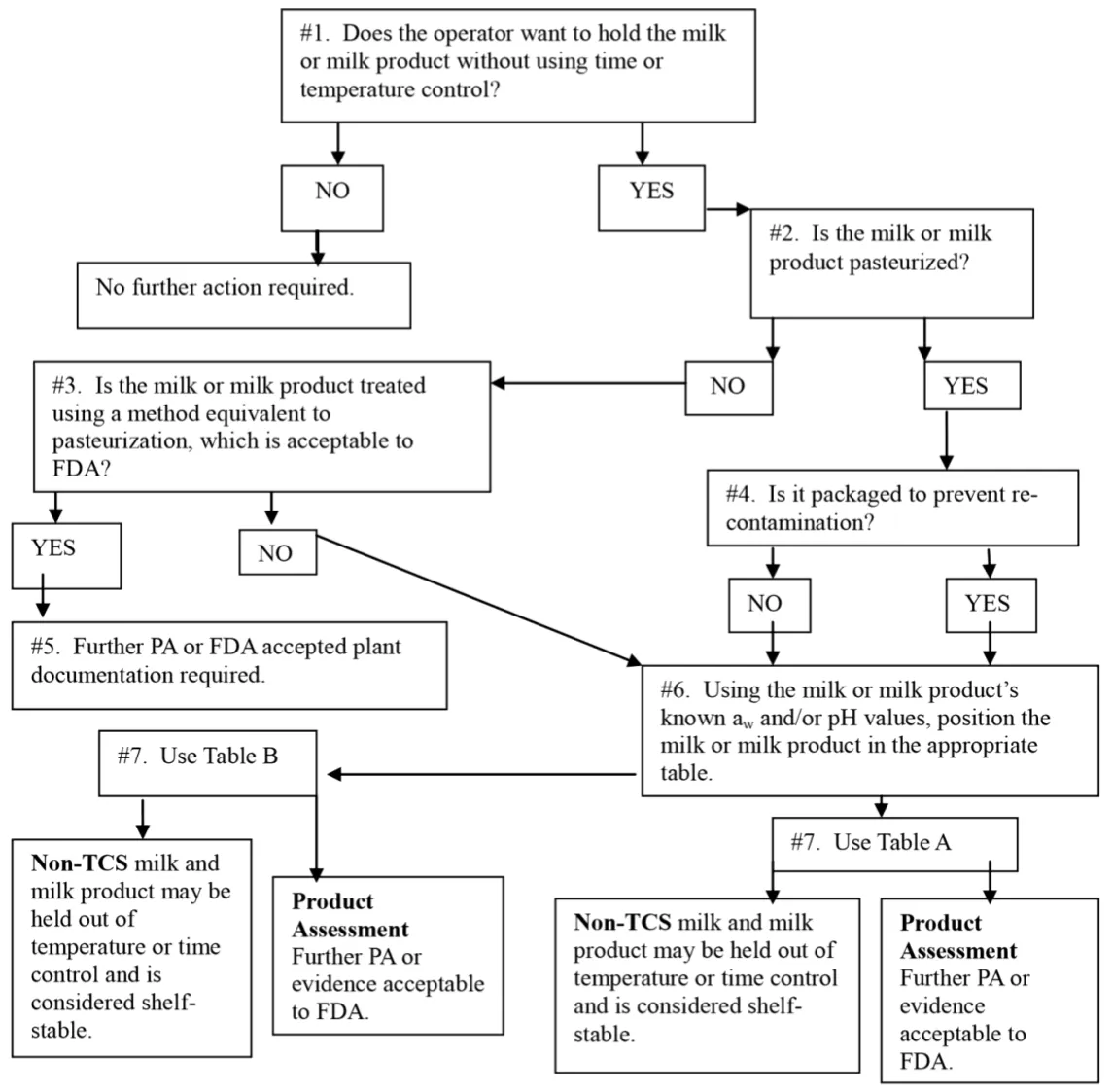
1. Does the operator want to hold the milk or milk product without using time or temperature control?
- a. No: Continue holding the milk or milk product at 7°C (45°F) or less as required in the Grade “A” PMO.
- b. Yes: Continue using the decision tree to identify which table to use to determine whether TCS is required.
2. Is the milk or milk product pasteurized?
- a. No: The milk or milk product is either raw or heat-treated. Proceed to Step 3.
- b. Yes: The milk or milk product is pasteurized to the required minimum time and temperature for the milk or milk product as specified in the definition of pasteurization of these rules. Proceed to Step 4.
3. Is the milk or milk product treated using some other method equivalent to pasteurization?
- a. No: The milk or milk product is raw or heat-treated which may allow vegetative cells and spores to survive. Proceed to Step 6.
- b. Yes: If another method equivalent to pasteurization is used to destroy pathogens such as irradiation, high pressure processing, pulsed light, ultrasound, inductive heating, etc., the new technology shall have been recognized by the FDA as providing milk or milk product safety equal to pasteurization, and the effectiveness of the process shall be demonstrated by sufficient evidence or other means proceed to Step 5.
4. Is it packaged to prevent re-contamination?
- a. No: Re-contamination of the product can occur after pasteurization because it is not immediately packaged. Proceed to Step 6 and use Table B.
- b. Yes: If the milk or milk product is packaged immediately after pasteurization to prevent re-contamination, higher ranges of aw and/or pH can be tolerated because spore-forming bacteria are the only microbial hazard. Proceed to Step 6 and use Table A.
5. Further PA or plant documentation required.
- a. The manufacturer of this product may be able to supply evidence acceptable to the FDA that indicate the milk or milk product can be safely held without TCS.
- b. Milk and milk products prepared or processed using new technologies may be held without time/temperature control provided the new technology has been recognized by the FDA as providing milk or milk product safety equal to pasteurization and provided the effectiveness of the use of such technologies is based on evidence accepted by the FDA.
6. Using the milk or milk product’s processing parameters, known aw and/or pH values, position the milk or milk product in the appropriate table.
- a. Choose the column under “pH Values” that contains the pH value of the milk or milk product in question.
- b. Choose the row under “aw Values” that contains the aw value of the milk or milk product in question.
- c. Note where the row and column intersect to identify whether the milk or milk product is Non-TCS and therefore does not require time/temperature control, or whether further PA is required. Other factors such as redox potential, competitive microorganisms, salt content, or processing methods may allow the product to be held without time/temperature control; however, evidence acceptable to the FDA is required.
- 7. Use Table B for milk or milk products that are not pasteurized or pasteurized but not immediately packaged, where both pathogenic spores and vegetative cells may be a concern, or use Table A for milk and milk products that are pasteurized and immediately packaged, where only pathogenic spores are of concern.
8. Determine if the milk or milk product is Non-TCS or needs further PA.
Figure 59. Decision Tree for Using pH, aw, or the Interaction of pH and aw to Determine if a Milk or Milk Product Requires Time/Temperature for Safety
Source Document: Evaluation and Definition of Potentially Hazardous Foods, IFT, 2001 available at http://www.fda.gov/-comm/ift4exec.html.
Author: G. M. Gallaspy, Jr.
Statutory Authority: Code of Ala. 1975, §§22-2-2, 22-20-7.
History: Repealed and New Rule: Filed October 18, 2018; effective December 2, 2018.