67 Pa. Code § 175.265
Exemption provisions.
Effective Dec 3, 198818 Pa.B. 5362The provisions of this Table X issued under the Vehicle Code, 75 Pa.C.S. § § 4103, 4521, 4524 and 6103.
(a) Exempt vehicles. The following vehicles are exempt from § 175.263 (relating to sun screening location):
- (1) A hearse, ambulance or government vehicle.
- (2) A vehicle for which a certificate of exemption has been issued by the Department under subsection (b).
(b) Certificate of exemption. The Department will issue a certificate of exemption from § 175.263 for the following vehicles:
- (1) A vehicle which was registered in this Commonwealth as of September 8, 1984, and was equipped with a prohibited sun screening device or other prohibited material prior to September 9, 1984. Requests for this type of exemption shall be accompanied by an application for a certificate of exemption, made on a form furnished by the Department, which shall contain a description of the vehicle by make, year, model, vehicle identification number, windows and wings equipped with sun screening device or other material and other information as the Department may prescribe.
(2) A vehicle owned by a person who is afflicted with a condition for which the Department has determined, in consultation with the Medical Advisory Board, that the use of prohibited sun screening devices or other materials is justified; or a vehicle owned by a person residing with a person who is so afflicted, if the afflicted person normally drives or is driven in the vehicle. An application for a certificate of exemption will be granted only for colorless sun screening device or other material and shall be made on a form furnished by the Department, which shall contain the following:
- (i) A description of the vehicle by make, year, model and vehicle identification number.
- (ii) A medical certification of need due to a disability from a licensed physician or optometrist.
- (iii) Other information as the Department may prescribe.
- (c) Display of certificate issued for vehicles registered as of September 8, 1984. Upon compliance with the criteria in subsection (b)(1), the Department will issue a certificate of exemption which shall be carried in the vehicle at all times by the operator of the vehicle and shall be displayed upon request of a police officer. The certificate of exemption shall also be submitted to the inspection station upon submission of the vehicle for inspection.
- (d) Display of certificate issued for medical reasons. Upon compliance with the criteria in subsection (b)(2), the Department will issue a certificate of exemption authorizing the installation of a colorless sun screening device or other material which filters ultraviolet light. This certificate of exemption shall be carried in the vehicle at all times by the operator of the vehicle and shall be displayed upon request of a police officer. The certificate of exemption shall also be submitted to the inspection station upon submission of the vehicle for inspection.
- (e) Sale or transfer of exempted vehicle. Upon the sale or transfer of a vehicle for which a certificate of exemption has been issued under subsection (b)(2), the certificate of exemption is void. Prior to the sale or transfer of a vehicle exempted under subsection (b)(2), it is the sole responsibility of the owner or seller of the vehicle to remove sun screening devices or other materials which do not comply with Departmental regulations. The owner or seller shall destroy the certificate of exemption and provide the purchaser with a notarized statement specifying the name and address of the owner or seller, the vehicle identification number, year and model, and the business entity and process used to remove the sun screening device or other material.
Cross References
This section cited in 67 Pa. Code § 175.67 (relating to glazing); 67 Pa. Code § 175.97 (relating to glazing); 67 Pa. Code § 175.147 (relating to glazing); 67 Pa. Code § 175.176 (relating to glazing); and 67 Pa. Code § 175.226 (relating to glazing).
TABLE I—BRAKE PERFORMANCE
| Passenger carrying vehicles with seating capacity of 10 persons or less and built on passenger frame: | |||
| SERVICE BRAKE SYSTEM | EMERGENCY BRAKE | ||
| Percent braking force | Deceleration in feet/sec. | Stopping dist. in feet at 20 MPH | Stopping dist. in feet at 20 MPH |
| 65.2 | 21 | 20 | 54 |
| Passenger carrying vehicles with seating capacity of over 10 persons built on passenger car chassis; vehicles built on truck or bus chassis with manufacturer’s gross weight of 10,000 lbs. or less: | |||
| Percent braking force | Deceleration in feet/sec. | Stopping dist. in feet at 20 MPH | Stopping dist. in feet at 20 MPH |
| 52.8 | 17 | 25 | 66 |
| All other passenger carrying vehicles: | |||
| Percent braking force | Deceleration in feet/sec. | Stopping dist. in feet at 20 MPH | Stopping dist. in feet at 20 MPH |
| 43.5 | 14 | 35 | 85 |
| Property-carrying vehicles having manufacturer’s gross weight of 10,000 lbs. or less: | |||
| Percent braking force | Deceleration in feet/sec. | Stopping dist. in feet at 20 MPH | Stopping dist. in feet at 20 MPH |
| 52.8 | 17 | 25 | 66 |
| Single property-carrying vehicles having manufacturer’s gross weight over 10,000 pounds except truck tractors. Combinations of 2-axle towing vehicle and trailer having GVRW of 3,000 pounds or less: | |||
| Percent braking force | Deceleration in feet/sec. | Stopping dist. in feet at 20 MPH | Stopping dist. in feet at 20 MPH |
| 3.4 | 14 | 35 | 85 |
| All other property-carrying vehicles and combinations of property carrying vehicles: | |||
| Percent braking force | Deceleration in feet/sec. | Stopping dist. in feet at 20 MPH | Stopping dist. in feet at 20 MPH |
| 43.5 | 14 | 40 | 90 |
Source
The provisions of this Table I readopted December 2, 1988, effective December 3, 1988, 18 Pa.B. 5362. Immediately preceding text appears at serial page (103492).
Cross References
This table cited in 67 Pa. Code § 175.64 (relating to braking systems); 67 Pa. Code § 175.80 (relating to inspection procedure); 67 Pa. Code § 175.94 (relating to braking systems); 67 Pa. Code § 175.144 (relating to braking systems); 67 Pa. Code § 175.160 (relating to inspection procedure) and 67 Pa. Code § 175.203 (relating to braking systems).
TABLE II—REQUIRED MOTOR VEHICLE LIGHTING EQUIPMENT
(as adopted in Chapter 153)
| MULTI-PURPOSE PASSENGER VEHICLES. | |
| ITEM | TRUCKS AND BUSES—80" OR MORE OVERALL WIDTH |
| Headlamps | 2 white 7" Type 2 headlamp units or 2 white, 5¾" Type 1 headlamp units and 2 white 5¾" Type 2A headlamp units and 2 white Type 1A headlamp units |
| 2 white headlamps, Type 2B1 or Type 2D1; or 4 white headlamps; 2 each Type 1C1 and Type 2C1, or Type 2A1 | |
| Tail lamps | 2 red |
| Stoplamps | 2 red |
| License Plate Lamp | 1 white |
| Reflex Reflectors | 4 red; 2 amber |
| Side Marker Lamps | 2 red; 2 amber |
| Backup Lamp | 1 white |
| Turn Signal Lamps | 2 red or amber; 2 amber |
| Turn Signal Operating Unit | 1 |
| Turn Signal Flasher | 1 |
| Vehicular HazardWarning SignalOperating Unit | 1 |
| Vehicular HazardWarning SignalFlasher | 1 |
| Identification Lamps | 3 amber; 3 red |
| Clearance Lamps | 2 amber; 2 red |
| Intermediate SideMarker Lamp | 2 amber |
| Intermediate ReflexReflectors | 2 amber |
Source
The provisions of this Table II readopted December 2, 1988, effective December 3, 1988, 18 Pa.B. 5362. Immediately preceding text appears at serial page (103492).
Cross References
This table cited in 67 Pa. Code § 175.66 (relating to lighting and electrical systems); 67 Pa. Code § 175.96 (relating to lighting and electrical systems); 67 Pa. Code § 175.125 (relating to lighting and electrical systems); 67 Pa. Code § 175.130 (relating to inspection procedure); 67 Pa. Code § 175.146 (relating to lighting and electrical systems); and 67 Pa. Code § 175.175 (relating to lighting and electrical systems).
TABLE III—LOCATION OF REQUIRED EQUIPMENT
Multi-purpose Passenger Vehicles, Trucks, Trailers and Buses—80"
or more Overall Width
| ITEM | LOCATION ON | |
| multi-purpose passenger vehicles, trucks and buses. | Height above road surface measured from center of item on vehicle. | |
| Headlamps | Type 1 headlamps at the same height. 1 on each side of the vertical centerline. Type 2 headlamps at the same height. 1 on each side of the vertical centerline, as far apart as practicable. | Not less than 24" nor more than 54" |
| Taillamps | On the rear, 1 on each side of the vertical centerline, at the same height, and as far apart as practicable. | Not less than 15" nor more than 72" |
| Stop lamps | On the rear,1 on each side of the vertical centerline, at the same height, and as far apart as practicable. | Not less than 15" nor more than 72" apart |
| License Plate Light | At rear license plate, to illuminate the plate from the top or sides. | No requirement |
| Backup Lamp | On the rear. | No requirement |
| Turn Signal Lamps | At or near the front 1 amber on each side of the vertical centerline, at the same height and as far apart as practicable. On the rear 1 red or amber on each side of the vertical centerline, at the same height, and as far apart as practicable. | Not less than 15" nor more than 83" |
| Identification Lamps | On the front and rear 3 lamps, amber in front, red in rear, as close as practicable to the top of the vehicle, at the same height as close as practicable to the vertical centerline, with lamp centers spaced not less than 6" or more than 12" apart. | No requirement |
| Clearance Lamps | On the front and rear 2 amber lamps on front, red in rear, as close as practicable to the top of the vehicle, 1 on each side of the vertical centerline, at the same height, and as near the top as practicable. | No requirements |
| Intermediate Side Marker Lamps | On each side 1 amber located at or near the midpoint between the front and rear side marker lamps. | Not less than 15" |
| Intermediate Side Reflex Reflectors | On each side 1 amber located at or near the midpoint between the front and rear side reflex reflector. | Not less than 15" nor more than 60" |
| Reflex Reflectors | On the rear 1 red on each side of the vertical centerline, as far apart as practicable, and at the same height. | Not less than 15" nor more than 60" |
| Side Marker Lamps | On each side 1 red as far to the rear as practicable, and 1 amber as far to the front as practicable. | Not less than 15" and on the rear of trailers not more than 60" |
Source
The provisions of this Table III readopted December 2, 1988, effective December 3, 1988, 18 Pa.B. 5362. Immediately preceding text appears at serial page (77606).
Cross References
This table cited in 67 Pa. Code § 175.66 (relating to lighting and electrical systems); 67 Pa. Code § 175.96 (relating to lighting and electrical systems); 67 Pa. Code § 175.125 (relating to lighting and electrical systems); and 67 Pa. Code § 175.130 (relating to inspection procedure).
TABLE IV—REQUIRED MOTOR VEHICLE LIGHTING EQUIPMENT
(as adopted in Chapter 153)
| Passenger cars, motorcycles and multi-purpose vehicles, trucks, trailers, and buses of less than 80" overall width: | |
| Headlamps | 2 white, 7", Type 2 headlamp units, or 2 white 5¾", Type 1 headlamp units or 2 white 5¾" Type 2A headlamp units and 2 white Type 1A headlamp units. |
| 2 white headlamps, Type 2B1 or Type 2D1; 4 white headlamps, 2 each Type 1C1 and Type 2C1, or Type 1A1 and Type 2A1 | |
| Taillamps | 2 red |
| Stop Lamps | 2 red |
| License Plate Light | 1 white |
| Parking LampsReflex Reflectors | 2 amber or white4 red, 2 amber |
| Intermediate Side Reflex Reflectors | 2 amber |
| Intermediate Side Marker Lamps | 2 amber |
| Side Marker Lamps | 2 red; 2 amber |
| Backup Lamp | 1 white |
| Turn Signal Lamps | 2 red or amber |
| Turn Signal Operating Unit | 1 |
| Turn Signal Flasher | 1 |
| Vehicular Hazard Warning Signal Operating Unit | 1 |
| Vehicular Hazard Warning Signal Flasher | 1 |
Source
The provisions of this Table IV readopted December 2, 1988, effective December 3, 1988, 18 Pa.B. 5362. Immediately preceding text appears at serial page (77607).
Cross References
This table cited in 67 Pa. Code § 175.66 (relating to lighting and electrical systems); 67 Pa. Code § 175.96 (relating to lighting and electrical systems); 67 Pa. Code § 175.125 (relating to lighting and electrical systems); 67 Pa. Code § 175.130 (relating to inspection procedure); 67 Pa. Code § 175.146 (relating to lighting and electrical systems); 67 Pa. Code § 175.160 (relating to inspection procedure); 67 Pa. Code § 175.175 (relating to lighting and electrical systems); and 67 Pa. Code § 175.190 (relating to inspection procedure).
TABLE V—LOCATION OF REQUIRED EQUIPMENT
MOTORCYCLES
| ITEM | LOCATION ON MOTORCYCLES | Height above road surface measured from center of item on vehicle |
| Turn Signal Lamps | At or near the front 1 amber on each side of the vertical centerline at the same height, and having a minimum horizontal separation distance (centerline of lamps) of 16". Minimum edge to edge separation distance between lamp and headlamp is 4". | Not less than 15" nor more than 83" |
| At or near the rear 1 red or amber on each side of the vertical centerline, at the same height and having a minimum horizontal separation distance (centerline to centerline of lamps) of 9". Minimum edge to edge separation distance between lamp and tail or stop lamp is 4". |
Source
The provisions of this Table V readopted December 2, 1988, effective December 3, 1988, 18 Pa.B. 5362. Immediately preceding text appears at serial page (77607).
Cross References
This table cited in 67 Pa. Code § 175.146 (relating to lighting and electrical systems); 67 Pa. Code § 175.160 (relating to inspection procedure); 67 Pa. Code § 175.175 (relating to lighting and electrical systems); and 67 Pa. Code § 175.190 (relating to inspection procedure).
TABLE VI—VEHICLE GLAZING
ADDITIONAL GLAZING INFORMATION
NOTES: —Table below is an appendix in ANSI Glazing Standard Z26.1
—Glazing marked AS10 or AS11 has bullet resisting qualities.
—Acceptable numbers shown in the two columns to the right, are marked on the glass
and are preceded by the letter ‘‘AS’’
POSITION OF GLAZING IN MOTOR VEHICLE
PASSENGER CARS AND TAXICABS
| Glazing Material Applicable When Marked with ‘‘AS’’ Designation Indicated Below At Levels Requisite for Driving Visibility | At Levels Not Requisite for Driving Visibility | |
| PASSENGER CARS | ||
| Windshields | 1, 10 | 1*, 10* |
| Interior partitions, auxiliary wind deflectors, flexible curtains, readily removable windows, ventilators used in conjunction with readily removable windows, rear windows in tops of convertible cars | 1, 2, 4, 10, 11 | 1, 2, 3, 4, 5, 10, 11 |
| Openings in roofs not required for driving visibility | 1, 2, 3, 4, 5, 6, 7, 10, 11 | |
| All other glazing | 1, 2, 10, 11 | 1, 2, 3, 10, 11 |
| TAXICABS | ||
| Windshields | 1, 10 | 1*, 10* |
| Interior partitions, auxiliary wind deflectors, windows in rear doors | 1, 2, 4, 10, 11 | 1, 2, 3, 4, 5, 10, 11 |
| Openings in roofs not required for driving visibility | 1, 2, 3, 4, 5, 10, 11 | |
| Flexible curtains, readily removable windows, ventilators used in conjunction with readily removable windows | 1, 2, 4, 6, 10, 11 | 1, 2, 3, 4, 5, 6, 7, 10, 11 |
| All other glazing | 1, 2, 10, 11 | 1, 2, 3, 10, 11 |
*Glazing material which is intentionally made so that only a portion of a single sheet has a luminous transmittance of not less than 70 percent shall be marked at the edge of the sheet to show the limits of the area that may be used at levels requisite for driving visibility. The marks A S1 or A S2 etc., shall be used with the arrow pointing to the portion of the sheet having a luminous transmittance of not less than 70 percent and the number indicating the item with which that portion of the sheet complies.
Source
The provisions of this Table VI readopted December 2, 1988, effective December 3, 1988, 18 Pa.B. 5362. Immediately preceding text appears at serial page (77608).
TABLE VII—VEHICLE GLAZING
ADDITIONAL GLAZING INFORMATION
NOTES: —Table below is an appendix in ANSI Glazing Standard Z26.1
—Glazing marked AS10 or AS11 has bullet resisting qualities.
—Acceptable numbers shown in the two columns to the right, are marked on the glass
and are preceded by the letter ‘‘AS’’
POSITION OF GLAZING IN MOTOR VEHICLE
TRUCKS AND TRUCK-TRACTORS AND BUSES
| Glazing Material Applicable When Marked with ‘‘AS’’ Designation Indicated Below At Levels Requisite for Driving Visibility | At Levels Not Requisite for Driving Visibility | |
| TRUCKS AND TRUCK-TRACTORS | ||
| Windshields | 1, 10 | 1*, 10* |
| Windows to immediate right or left of driver | 1, 2, 10, 11 | 1, 2, 3, 10, 11 |
| Rear most window if used for driving visibility | 1, 2, 10, 11 | 1, 2, 3, 4, 5, 8, 9, 10, 11 |
| Glazing to rear of driver where other means to afford visibility of the highway is provided | 1, 2, 3, 4, 5, 8, 9, 10, 11 | |
| Folding doors | 1, 2, 4, 8, 10, 11 | 1, 2, 3, 4, 5, 8, 9, 10, 11 |
| All other glazing | 1, 2, 10, 11 | 1, 2, 3, 10, 11 |
| BUSES | ||
| Windshields | 1, 10 | 1*, 10* |
| Glazing to immediate right and left of driver | 1, 2, 10, 11 | 1, 2, 3, 10, 11 |
| Rear most window if used for driver visibility | 1, 2, 8, 10, 11 | 1, 2, 3, 8, 9, 10, 11 |
| Interior partitions and auxiliary wind deflectors | 1, 2, 4, 10, 11 | 1, 2, 3, 4, 5, 10, 11 |
| Folding doors | 1, 2, 4, 8, 10, 11 | 1, 2, 3, 4, 5, 8, 9, 10, 11 |
| Standee windows | 1, 2, 3, 4, 5, 8, 9, 10, 11 | |
| Opening in roof not required for driving visibility | 1, 2, 3, 4, 5, 10, 11 | |
| Flexible curtains readily removable windows, ventilators used in conjunction with readily removable windows | 1, 2, 4, 6, 10, 11 | 1, 2, 3, 4, 5, 6, 7, 10, 11 |
| All other glazing | 1, 2, 3, 10, 11 | 1, 2, 3, 10, 11 |
*Glazing material which is intentionally made so that only a portion of a single sheet has a luminous transmittance of not less than 70 percent shall be marked at the edge of the sheet to show the limits of the area that may be used at levels requisite for driving visibility. The marks A S1 or A S2 etc., shall be used with the arrow pointing to the portion of the sheet having a luminous transmittance of not less than 70 percent and the number indicating the item with which that portion of the sheet complies.
Source
The provisions of this Table VII readopted December 2, 1988, effective December 3, 1988, 18 Pa.B. 5362. Immediately preceding text appears at serial page (77609).
TABLE VIII—VEHICLE GLAZING
ADDITIONAL GLAZING INFORMATION
NOTES: —Table below is an appendix in ANSI Glazing Standard Z26.1
—Glazing marked AS10 or AS11 has bullet resisting qualities
—Acceptable numbers shown in the two columns to the right, are marked on the glass
and are preceded by the letter ‘‘AS’’
POSITION OF GLAZING IN MOTOR VEHICLE
HOUSE TRAILERS AND PROPERTY-CARRYING TRAILERS
| Glazing Material Applicable When Marked with ‘‘AS’’ Designation Indicated Below At Levels Requisite for Driving Visibility | At Levels Not Requisite for Driving Visibility | |
| HOUSE TRAILERS AND PROPERTY-CARRYING TRAILERS | ||
| All Glazing | 1, 2, 3, 4, 5, 6, 7, 8, 9, 10, 11 | |
*Glazing material which is intentionally made so that only a portion of a single sheet has a luminous transmittance of not less than 70 percent shall be marked at the edge of the sheet to show the limits of the area that may be used at levels requisite for driving visibility. The marks A S1 or A S2 etc., shall be used with the arrow pointing to the portion of the sheet having a luminous transmittance of not less than 70 percent and the number indicating the item with which that portion of the sheet complies.
Source
The provisions of this Table VIII readopted December 2, 1988, effective December 3, 1988, 18 Pa.B. 5362. Immediately preceding text appears at serial page (77610).
TABLE IX—VEHICLE GLAZING
ADDITIONAL GLAZING INFORMATION
NOTES: —Table below is an appendix in ANSI Glazing Standard Z26.1
—Glazing marked AS10 or AS11 has bullet resisting qualities.
—Acceptable numbers shown in the two columns to the right, are marked on the glass
and are preceded by the letter ‘‘AS’’
ADDITIONAL GLAZING INFORMATION
MOTORCYCLES
| Glazing Material Applicable When Marked with ‘‘AS’’ Designation Indicated Below At Levels Requisite for Driving Visibility | At Levels Not Requisite for Driving Visibility | |
| MOTORCYCLES | ||
| Windscreens | 1*, 6, 10*, 11 | 1, 6, 7, 10, 11 |
*Glazing material which is intentionally made so that only a portion of a single sheet has a luminous transmittance of not less than 70 percent shall be marked at the edge of the sheet to show the limits of the area that may be used at levels requisite for driving visibility. The marks A S1 or A S2 etc., shall be used with the arrow pointing to the portion of the sheet having a luminous transmittance of not less than 70 percent and the number indicating the item with which that portion of the sheet complies.
Source
The provisions of this Table IX readopted December 2, 1988, effective December 3, 1988, 18 Pa.B. 5362. Immediately preceding text appears at serial page (77610).
TABLE X—ACCEPTABLE LIGHT TRANSMITTANCE LEVELS
FOR VEHICLE GLAZING
All light transmittance levels listed below assume a 3% accuracy (±3%).
| Front Side | Rear Side | |||
| Vehicle Type | Windshield | Windows/Wings | Windows/Wings | Rear Window |
| Pre-1998 Passenger Cars | 70% | 70% | 70% | VESC-20* |
| 1998 & Newer Passenger Cars | 70% | 70% | 70% | 70% |
| Trucks & Multi-Purpose Passenger Vehicles | 70% | 70% | No Requirement | No Requirement |
| Medium/Heavy Trucks & Buses | 70% | 70% | No Requirement | No Requirement |
| All Other Vehicles | 70% | 70% | No Requirement | No Requirement |
*A label, permanently installed between the sun screening device or other material and the glazing to which it is applied, shall contain the name of the device or material manufacturer or a registration number and the statement, ‘‘Complies with VESC-20.’’
Authority
The provisions of this Table X issued under the Vehicle Code, 75 Pa.C.S. § § 4103, 4521, 4524 and 6103.
Source
The provisions of this Table X adopted September 27, 1996, effective September 28, 1996, 26 Pa.B. 4640.
APPENDIX A
MINIMUM REQUIREMENTS FOR MOTOR VEHICLE
BRAKE LININGS—SAE J998
SAE Recommended Practice
1. Scope—This specification covers brake linings used on motor vehicles operated on the public ways, except those used only for parking brakes. The performance requirements outlined in this SAE Recommended Practice are based on currently available engineering data. It is intended that all portions of this recommended practice will be reviewed periodically and revised as additional knowledge regarding brake lining performance is developed.
2. Purpose—The purpose of this SAE Recommended Practice is to establish minimum coefficient of friction requirements for brake linings used in the service brake system of a motor vehicle. Linings that meet these minimum friction requirements may not be suitable for use on all vehicles because of differences in brake design or application.
3. Test Procedures—Five complete tests shall be conducted on each brake lining in accordance with the SAE J661.
4. Brake Lining Evaluation—Brake linings shall be evaluated for normal and hot friction coefficients in accordance with SAE J866.
5. Minimum Requirements—To meet minimum requirements a brake lining shall have:
5.1. A normal friction coefficient over .25 based on the average of five tests.
5.2. A hot friction coefficient over .15 based on the average of five tests.
5.3. A coefficient of friction of .15 or over on each of the five tests at the following points:
5.3.1. Between 200F and 550F, inclusive, on the second fade run.
5.3.2. Between 300F and 200F, inclusive, on the second recovery run.
5.4. Not more than a 20% or .050 variation of coefficient of friction, whichever is greater, below the average value of all five tests at each temperature point specified in paragraph 5.3.
(Report of SAE Brake Committee approved January 1968.)
Source
The provisions of this Appendix A readopted December 2, 1988, effective December 3, 1988, 18 Pa.B. 5362. Immediately preceding text appears at serial page (77611).
Cross References
This appendix cited in 67 Pa. Code § 175.64 (relating to braking systems); 67 Pa. Code § 175.94 (relating to braking systems); 67 Pa. Code § 175.96 (relating to lighting and electrical systems); 67 Pa. Code § 175.123 (relating to braking systems); 67 Pa. Code § 175.144 (relating to braking systems); and 67 Pa. Code § 175.173 (relating to braking systems).
APPENDIX B
MOTORCYCLE AND MOTOR VEHICLE CYCLE
ELECTRICAL SYSTEM
(MAINTENANCE OF DESIGN VOLTAGE)—SAE J392
SAE Recommended Practice
1. Purpose—This SAE Recommended Practice provides minimum illumination voltage values for motorcycle and motor-driven cycle electrical systems and accompanying test procedures. (Note: Wherever the word ‘‘motorcycle’’ appears in the report, it is understood to include ‘‘motor-driven cycle.’’)
2. Scope—This recommended practice pertains to both battery-equipped and batteryless motorcycle electrical systems.
3. Test Apparatus:
3.1. Voltmeter—0-20 V maximum full-scale deflection, accuracy +1/2% (two voltmeters required).
3.2. Ammeter—Capable of carrying full system load current. Accuracy +3%FS.
3.3. Means for Measuring Engine RPM-Accuracy +3%.
4. Test Procedure.
4.1. Install fully charged original equipment battery on the motorcycle (if motorcycle is battery equipped).
4.1.1. Battery temperature to be 80 + or -10F.
4.2. Connect one voltmeter between the headlamp low beam terminal and the ground; connect the other voltmeter between the tail lamp terminal and the ground.
4.3. Connect the ammeter in series with the battery. (Note: Disregard paragraph 4.3 for batteryless machines.)
4.4. Start engine and turn on headlamp(s).
4.4.1. Switch headlamp to the low beam position.
4.4.2. External fan cooling may be applied to the motor cycle engine.
4.5. Run the engine at an rpm equivalent to 30 mph in top gear for 10 minutes.
4.5.1. Record the lowest and highest headlamp voltage and tail lamp voltage observed during the 10 minute period.
4.6. Increase speed to manufacturer’s suggested maximum rpm.
4.6.1. Record the highest and lowest headlamp and tail lamp voltages observed during a 5-second period.
4.7. Run the engine at manufacturer’s rated idle speed for 10 minutes.
4.7.1. Record the lowest and highest tail lamp voltage observed during the 10 minute period.
4.7.2. Record the lowest and highest headlamp voltage observed during the 10-minute period.
4.8. Slowly increase the engine speed until generating equipment cancels the system load, indicated by ‘‘0’’ reading on the ammeter. (Note: Disregard paragraph 4.8 for batteryless motorcycles.)
4.8.1. Record the engine rpm at ammeter zero point.
5. Test Limits:
5.1. Voltages recorded in paragraphs 4.5.1, 4.6.1 and 4.7.1 shall be between 80% and 120% of the rate headlamp design voltage.
5.2. Voltages observed in paragraph 4.7.2 shall be between 40% and 120% of the rated headlamp design voltage.
5.3. Engine rpm observed in paragraph 4.8.1 shall be less than the motorcycle equivalent speed at 30 mph in top gear operation.
(Reportof Motorcycle Committee and Lighting Committee approved December 1969. Editorial change November 1971.)
Source
The provisions of this Appendix B readopted December 2, 1988, effective December 3, 1988, 18 Pa.B. 5362. Immediately preceding text appears at serial pages (77612) to (77613).
Cross References
This appendix cited in 67 Pa. Code § 175.146 (relating to lighting and electrical systems).
APPENDIX C. [Reserved]
Source
The provisions of this Appendix C readopted December 2, 1988, effective December 3, 1988, 18 Pa.B. 5362; reserved September 27, 1996, effective September 28, 1996, 26 Pa.B. 4640. Immediately preceding text appears at serial pages (132995)) to (132999).
CHART 1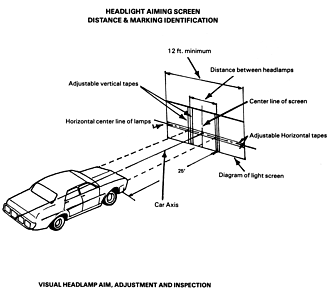
Source
The provisions of this Chart 1 readopted December 2, 1988, effective December 3, 1988, 18 Pa.B. 5362. Immediately preceding text appears at serial page (77617).
Cross References
This chart cited in 67 Pa. Code § 175.80 (relating to inspection procedure); 67 Pa. Code § 175.110 (relating to inspection procedure); 67 Pa. Code § 175.160 (relating to inspection procedure); and 67 Pa. Code § 175.190 (relating to inspection procedure).
CHART 2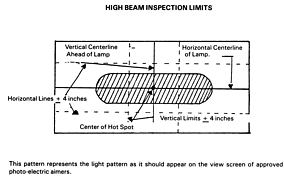
Source
The provisions of this Chart 2 readopted December 2, 1988, effective December 3, 1988, 18 Pa.B. 5362. Immediately preceding text appears at serial page (77618).
Cross References
This chart cited in 67 Pa. Code § 175.80 (relating to inspection procedure); 67 Pa. Code § 175.110 (relating to inspection procedure); 67 Pa. Code § 175.160 (relating to inspection procedure); and 67 Pa. Code § 175.190 (relating to inspection procedure).
CHART 3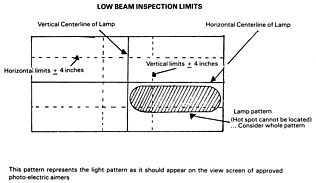
Source
The provisions of this Chart 3 readopted December 2, 1988, effective December 3, 1988, 18 Pa.B. 5362. Immediately preceding text appears at serial page (77618).
Cross References
This chart cited in 67 Pa. Code § 175.80 (relating to inspection procedure); 67 Pa. Code § 175.110 (relating to inspection procedure); 67 Pa. Code § 175.160 (relating to inspection procedure); and 67 Pa. Code § 175.190 (relating to inspection procedure).
CHART 4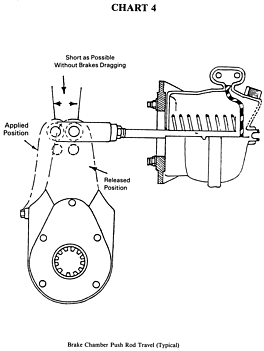
Source
The provisions of this Chart 4 readopted December 2, 1988, effective December 3, 1988, 18 Pa.B. 5362. Immediately preceding text appears at serial page (77619).
Cross References
This chart cited in 67 Pa. Code § 175.94 (relating to braking systems); 67 Pa. Code § 175.123 (relating to braking systems); and 67 Pa. Code § 175.130 (relating to inspection procedure).
CHART 5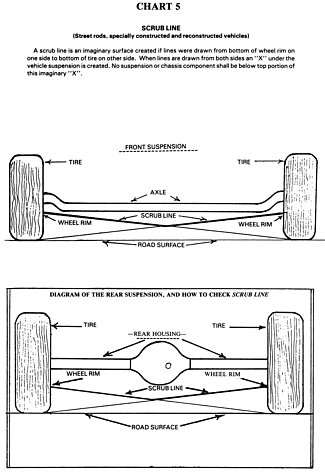
CHART 5 (Continued)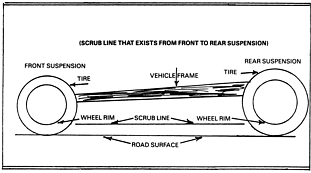
Source
The provisions of this Chart 5 readopted December 2, 1988, effective December 3, 1988, 18 Pa.B. 5362. Immediately preceding text appears at serial pages (77620) to (77621).
Cross References
This chart cited in 67 Pa. Code § 175.209 (relating to chassis).