25 Pa. Code § 129.74
Control of VOC emissions from fiberglass boat manufacturing materials.
Effective Dec 19, 201545 Pa.B. 7127The provisions of this § 129.74 issued under section 5(a)(1) and (8) of the Air Pollution Control Act (35 P.S. § 4005(a)(1) and (8)).
(a) Applicability.
- (1) This section applies to the owner and operator of a facility that manufactures a hull or a deck of a boat or a related part from fiberglass, builds a mold or plug to make a fiberglass boat hull or deck or related part, or makes polyester resin putties for assembling fiberglass boat parts, when the total actual VOC emissions from fiberglass boat manufacturing operations identified in Table I are equal to or greater than 15 pounds (6.8 kilograms) per day or 2.7 tons per 12-month rolling period, before consideration of controls. The total actual VOC emissions include the actual VOC emissions from the manufacture of hulls or decks from fiberglass, fiberglass boat parts (including small parts such as hatches, seats and lockers), molds or plugs for fiberglass hulls, decks or boat parts, resin and gel coat mixing operations, resin and gel coat application equipment and related cleaning activities at the facility.
(2) This section does not apply to the owner and operator of a facility that manufactures boat trailers or parts of boats, such as hatches, seats and lockers, but does not manufacture hulls or decks of boats from fiberglass or build molds to make fiberglass boat hulls or decks.
Open Molding Resin or
Gel Coat MaterialApplication
MethodIndividual Monomer VOC Content or Weighted Average Monomer VOC Content (weight percent) Production Resin Atomized Spray 28 Production Resin Non-atomized 35 Pigmented Gel Coat Any Method 33 Clear Gel Coat Any Method 48 Tooling Resin Atomized Spray 30 Tooling Resin Non-atomized 39 Tooling Gel Coat Any Method 40
(b) Definitions. The following words and terms, when used in this section, have the following meanings, unless the context clearly indicates otherwise:
- (i) A resin application technology in which the resin leaves the application equipment and breaks into droplets or an aerosol as it travels from the application equipment to the surface of the part.
(ii) The term includes resin spray guns and resin chopper spray guns.
Boat—A vessel, other than a seaplane, that can be used for transportation on the water.
Clear gel coat—
- (i) A polyester resin material that is clear or translucent so that underlying colors are visible. These materials are used to manufacture parts for sale.
(ii) The term does not include tooling gel coats used to build or repair molds.
Closed molding—
- (i) A process in which pressure is used to distribute resin through the reinforcing fabric placed between two mold surfaces to either saturate thefabric or fill the mold cavity. The pressure may be clamping pressure, fluid pressure, atmospheric pressure or vacuum pressure used either alone or in combination. The mold surfaces may be rigid or flexible.
- (ii) The term includes compression molding with sheet molding compound, infusion molding, resin injection molding, vacuum assisted resin transfer molding, resin transfer molding and vacuum assisted compression molding.
(iii) The term does not include:
- (A) A process in which a closed mold is used only to compact saturated fabric or remove air or excess resin from the fabric, such as in vacuum bagging.
(B) Open molding steps, such as application of a gel coat or skin coat layer by conventional open molding.
Cured resin—A thermosetting plastic material containing styrene or methyl methacrylate or gel coat that has changed irreversibly from a liquid to a solid.
Fiberglass—A material consisting of glass fibers made in the form of cloth, mat or roving.
Fiberglass boat—A vessel in which either the hull or deck, or both, is built from a composite material consisting of a thermosetting resin matrix reinforced with fibers of glass, carbon, aramid or other material.
Filled resin—A thermosetting plastic material to which an inert material has been added to change viscosity, density, shrinkage or other physical properties, particularly for building molds.
Flowcoater—A non-atomizing application method of applying resins and gel coats to an open mold with a fluid nozzle in a fan pattern with no air supplied to the nozzle.
Gel coat—
- (i) A clear or pigmented polyester resin material that does not contain reinforcing fibers and becomes the outer or inner surface of a finished boat product or mold.
(ii) The term includes a clear or pigmented polyester resin mixed with metal flakes.
Glass cloth—A fabric made of woven yarns of glass fibers.
Glass mat—A prepared material consisting of short glass fibers that are fixed to each other in a random pattern by a chemical binder or are mechanically stitched to a lightweight fabric.
Glass roving—A bundle of continuous glass fibers that is fed from a spool to a specialized gun that chops the bundle into short fibers, mixes the fibers with catalyzed resin and deposits the mixture on the mold surface in a random pattern.
Mixing—An operation in which resin or gel coat, including the mixing of putties or polyester resin putties, is combined with additives that include fillers, promoters or catalysts.
Mold—
- (i) The cavity or surface into or on which gel coat, resin and fibers are placed and from which finished fiberglass parts take their form.
(ii) The term is also known as a tool.
Monomer VOC—A VOC that partially combines with itself or other similar compounds by a cross-linking reaction to become a part of the cured resin.
Monomer VOC content—The weight of the monomer divided by the weight of the polymer.
Non-atomized application method—
- (i) A resin application technology in which the resin is not broken into droplets or into an aerosol as the resin travels from the application equipment to the surface of the part.
(ii) The term includes flowcoaters, chopper flowcoaters, pressure-fed resin rollers, resin impregnators and hand application (for example, paint brush or paint roller).
Open molding—
- (i) A process in which the reinforcing fibers and resin are placed in the mold and are open to the surrounding air while the reinforcing fibers are saturated with resin.
(ii) The term includes:
- (A) An operation in which a vacuum bag or similar cover is used to compress an uncured laminate to remove air bubbles or excess resin or to achieve a bond between a core material and a laminate.
- (B) Application of a gel coat or skin coat layer prior to a closed molding process.
(C) A process in which a closed mold is used only to compact saturated fabric or to remove air or excess resin from the fabric (such as in vacuum bagging).
Pigmented gel coat—
- (i) An opaque polyester resin material used to manufacture parts for sale.
(ii) The term does not include tooling gel coats used to build or repair molds.
Plug—
- (i) A full-size model of the part to be manufactured. The mold is built over the finished model.
(ii) The term is also known as a prototype.
Polyester resin material—An unsaturated thermosetting plastic material, such as an isophthalic, orthophthalic, halogenated, bisphenol A, vinylester or furan resin, a cross-linking agent, a catalyst, a gel coat, an inhibitor, an accelerator, a promoter or other material containing VOC used in polyester resin operations.
Polyester resin operation—A process in which an unsaturated polyester resin material is used to fabricate, rework, repair or touch-up a product for commercial, military or industrial use by mixing, pouring, hand laying-up, impregnating, injecting, forming, winding, spraying or curing.
Polyputty or putty—A polyester or vinylester resin mixed with inert fillers or fibers. The mixture is used to assemble fiberglass parts and to fill gaps between parts. The applied material becomes part of the composite structure. These materials are not considered industrial adhesives.
Production resin—
- (i) A thermosetting plastic material used to manufacture parts for sale.
(ii) The term does not include tooling resins used to build or repair molds and assembly adhesives.
Repair—The addition of polyester resin material to a portion of a previously fabricated product to mend damage.
Resin—A thermosetting plastic material containing styrene or methyl methacrylate, with or without pigment, used to encapsulate and bind together reinforcement fibers in the construction of fiberglass parts.
Resin impregnator—A mechanical non-atomizing composite material application method in which fiber reinforcement is saturated with one or more resins in a controlled ratio for each specific composite product.
Roll-out—The process of using rollers, squeegees or similar tools to compact reinforcing materials saturated with resin to remove trapped air or excess resin.
Skin coat—A layer of resin and fibers applied over the gel coat to protect the gel coat from being deformed by the next laminate layer.
Tooling gel coat—A polyester resin material containing styrene or methyl methacrylate, or both, that becomes the interior surface of a mold, supported by resin and fiberglass, or the exterior surface of a plug used to create a mold or is used to repair a mold.
Tooling resin—A thermosetting plastic material, hardened by a catalyst, used to construct or repair a mold or a plug for a mold for the manufacture of a fiberglass boat hull, deck or other part.
Touch-up—The application of material to cover minor imperfections.
Vacuum bagging—
- (i) A molding technique in which the reinforcing fabric is saturated with resin, covered with a flexible sheet that is sealed to the edge of the mold and a vacuum is applied under the sheet to compress the laminate, remove excess resin or remove trapped air from the laminate during curing.
(ii) The term does not include a process that meets the definition of ‘‘closed molding.’’
Vacuum bagging with roll-out—A partially closed molding technology that rolls the resin and fabric before the application of vacuum bagging materials.
Vacuum bagging without roll-out—A partially closed molding technology that applies vacuum bagging materials to the mold immediately after resin application without rolling the resin and fabric.
Vinylester resin—A thermosetting plastic material containing one or more esters of acrylic or methacrylic acids and having double-bond and ester linkage sites only at the ends of the resin molecules.
Application equipment cleaning—The process of flushing or removing resin or gel coat material, or both, from the interior or exterior of equipment that is used to apply resins or gel coats in the manufacture of fiberglass parts.
Assembly adhesives—A chemical substance that is applied for the purpose of bonding two surfaces together other than by mechanical means.
Atomized application method—
(c) Exceptions. The requirements of this section do not apply to the following circumstances:
- (1) A resin application process in a closed molding operation as defined in subsection (b).
- (2) A surface coating applied to a fiberglass boat.
- (3) A surface coating for a fiberglass and metal recreational boat.
- (4) An industrial adhesive used in the assembly of a fiberglass boat. Industrial adhesives used in fiberglass boat assembly are regulated under § 129.77 or Chapter 130, Subchapter D (relating to control of emissions from the use or application of adhesives, sealants, primers and solvents; and adhesives, sealants, primers and solvents).
- (d) Existing RACT permit. The requirements of this section supersede the requirements of a RACT permit issued to the owner and operator of a source subject to subsection (a) prior to December 19, 2015, under § § 129.91—129.95 (relating to stationary sources of NOx and VOCs) to control, reduce or minimize VOCs from a fiberglass boat manufacturing process, except to the extent the RACT permit contains more stringent requirements.
- (e) Compliance deadline. The owner and operator of a facility subject to this section shall comply with the applicable requirements beginning December 19, 2015.
(f) Emission limits. Except as specified in subsection (h) or (j), the owner and operator of a facility subject to this section may not cause or permit the emission into the outdoor atmosphere of monomer VOCs from an open molding resin or gel coat fiberglass boat manufacturing operation, a resin or gel coat mixing operation, or a resin or gel coat application equipment cleaning operation unless one or more of the following limitations is met:
(1) Compliant materials option. The individual monomer VOC content limit is achieved through the use of low-monomer VOC content open molding resin and gel coat materials by one or more of the following methods:
(i) Using only low-monomer VOC content resin and gel coat materials within a covered operation listed in Table I.
- (A) The monomer VOC content of each resin or gel coat material is equal to or less than the limit specified in Table I.
- (B) The monomer VOC content of each resin or gel coat material includes the amount of non-monomer VOC content that exceeds 5% by weight of the resin or gel coat material.
(ii) Averaging the monomer VOC contents for the open molding resin and gel coat materials used within a covered operation listed in Table I on a weight-adjusted basis.
- (A) The combined total monomer VOC content of resin or gel coat materials of a certain type must meet the applicable monomer VOC content limit for a specific application method on a 12-month rolling weighted-average basis, calculated using the equation in clause (C).
- (B) The monomer VOC content of each resin or gel coat material included in the weighted average specified in clause (A) includes the amount of non-monomer VOC content that exceeds 5% by weight of the resin or gel coat material.
(C) The weighted-average monomer VOC content on a 12-month rolling-average basis shall be calculated as follows:
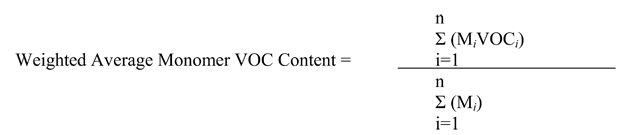 Where:
Mi = Mass of open molding resin or gel coat i used in the past 12 months in an operation, in megagrams.
VOCi = Monomer VOC content, by weight percent, of open molding resin or gel coat i used in the past 12 months in an operation.
n = Number of different open molding resins or gel coats used in the past 12 months in an operation.
(2) Emissions averaging option. The numerical monomer VOC emission rate limit is achieved through averaging emissions among different open molding resin and gel coat operations. The equations in subparagraphs (iii)—(v) shall be used to estimate the monomer VOC emission rates from each operation included in the emissions averaging option based on the material and application method.
- (i) The monomer VOC content of each open molding resin or gel coat material included in the emissions averaging option includes the amount of non-monomer VOC content that exceeds 5% by weight of the resin or gel coat material.
- (ii) The 12-month rolling emissions average shall be determined at the end of each calendar month.
(iii) The facility-specific monomer VOC mass emission limit on a 12-month rolling-average basis shall be calculated as follows:
Where:
Monomer VOC Limit = Total allowable monomer VOC that can be emitted from the open molding operations included in the emissions averaging program, in kilograms per 12-month period.
MR = Mass of production resin used in the past 12 months, excluding exempt VOC materials, in megagrams.
MPG = Mass of pigmented gel coat used in the past 12 months, excluding exempt VOC materials, in megagrams.
MCG = Mass of clear gel coat used in the past 12 months, excluding exempt VOC materials, in megagrams.
MTR = Mass of tooling resin used in the past 12 months, excluding exempt VOC materials, in megagrams.
MTG = Mass of tooling gel coat used in the past 12 months, excluding exempt VOC materials, in megagrams.
Numerical coefficients = The allowable monomer VOC emission rate for that particular material, in units of kg/Mg of material used.
(iv) At the end of the first 12-month rolling-average emissions period and at the end of each subsequent calendar month, the owner or operator of the facility shall demonstrate that the monomer VOC emissions from the operations and materials included in the emissions averaging option do not exceed the emission limit calculated under subparagraph (iii) for the same 12-month period as follows:
Where:
Monomer VOC emissions = Monomer VOC emissions calculated using the monomer VOC emission equation for each operation included in the emissions averaging program, in kilograms.
PVR = Weighted-average monomer VOC emission rate for production resin used in the past 12 months, in kilograms per megagram.
MR = Mass of production resin used in the past 12 months, in megagrams.
PVPG = Weighted-average monomer VOC emission rate for pigmented gel coat used in the past 12 months, in kilograms per megagram.
MPG = Mass of pigmented gel coat used in the past 12 months, in megagrams.
PVCG = Weighted-average monomer VOC emission rate for clear gel coat used in the past 12 months, in kilograms per megagram.
MCG = Mass of clear gel coat used in the past 12 months, in megagrams.
PVTR = Weighted-average monomer VOC emission rate for tooling resin used in the past 12 months, in kilograms per megagram.
MTR = Mass of tooling resin used in the past 12 months, in megagrams.
PVTG = Weighted-average monomer VOC emission rate for tooling gel coat used in the past 12 months, in kilograms per megagram.
MTG = Mass of tooling gel coat used in the past 12 months, in megagrams.
(v) For purposes of subparagraph (iv), the owner or operator of the facility shall determine the weighted-average monomer VOC emission rate for the previous 12 months for each open molding resin and gel coat operation included in the emissions averaging option as follows:
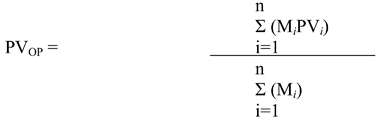 Where:
PVOP = Weighted-average monomer VOC emission rate for each open molding operation (PVR, PVPG, PVCG, PVTR, PVTG) included in the emissions averaging program, in kilograms of monomer VOC per megagram of material applied.
Mi = Mass of resin or gel coat used within an operation in the past 12 months, in megagrams.
n = Number of different open molding resins and gel coats used within an operation within the past 12 months.
PVi = The monomer VOC emission rate for resin or gel coat used within an operation in the past 12 months, in kilograms of monomer VOC per megagram of material applied. PVi shall be calculated using the applicable emission rate formula specified in Table II.
Open Molding Resin or Gel Coat Material Application Method Emission Rate Formula Production Resin,
Tooling ResinAtomized 0.014 x (Resin VOC%)2.425 Production Resin,
Tooling ResinAtomized, plus
vacuum bagging
with roll-out0.01185 x (Resin VOC%)2.425 Production Resin,
Tooling ResinAtomized, plus
vacuum bagging
without roll-out0.00945 x (Resin VOC%)2.425 Production Resin,
Tooling ResinNon-atomized 0.014 x (Resin VOC%)2.275 Production Resin,
Tooling ResinNon-atomized, plus vacuum bagging
with roll-out0.0110 x (Resin VOC%)2.275 Production Resin,
Tooling ResinNon-atomized, plus vacuum bagging
without roll-out0.0076 x (Resin VOC%)2.275 Pigmented Gel Coat All methods 0.445 x (Resin VOC%)1.675 Clear Gel Coat All methods 0.445 x (Resin VOC%)1.675 Tooling Gel Coat All methods 0.445 x (Resin VOC%)1.675
(3) VOC emissions capture system and add-on air pollution control device option. A numerical monomer VOC emission rate, determined for a facility based on the mix of application methods and materials used at the facility, is achieved through the use of a VOC emissions capture system and add-on air pollution control device.
- (i) The equation in paragraph (2)(iii) must be used to determine the emission limit to be achieved by the add-on air pollution control device, but modified as specified in this subparagraph. The mass of each open molding monomer VOC-containing material used during the control device performance test must be used in the equation in paragraph (2)(iii), instead of the mass of each material used over the past 12 months, to determine the emission limit, in kilograms of monomer VOC, that is applicable during the control device test.
- (ii) The measured emissions at the outlet of the control device, in kilograms of monomer VOC, must be less than the emission limit calculated as specified in subparagraph (i).
- (iii) The relevant control device and emission capture system operating parameters must be monitored and recorded during the test.
- (iv) The values of the parameters recorded in subparagraph (iii) must be used to establish the operating limits for those parameters.
- (v) The operating parameters must be maintained within the established operating limits.
(g) VOC emissions capture system and add-on air pollution control device requirements. The owner or operator of a facility subject to this section may elect to comply with the applicable emission limitations of this section through the installation of a VOC emissions capture system and add-on air pollution control device in accordance with subsection (f)(3). The owner or operator shall submit an application for a plan approval to the appropriate regional office. The application for a plan approval must be approved, in writing, by the Department prior to installation and operation of the emissions capture system and add-on air pollution control device. The application for a plan approval must include the following information:
- (1) A description, including location, of each affected source or operation to be controlled with the emissions capture system and add-on air pollution control device.
- (2) A description of the proposed emissions capture system and add-on air pollution control device to be installed.
- (3) A description of the proposed compliance monitoring equipment to be installed.
- (4) A description of the parameters to be monitored to demonstrate continuing compliance.
- (5) A description of the records to be kept that will document the continuing compliance.
- (6) A schedule containing proposed interim dates for completing each phase of the required work to install and test the emissions capture system and add-on air pollution control device described in paragraph (2) and the compliance monitoring equipment described in paragraph (3).
- (7) A proposed interim emission limitation that will be imposed on the affected source or operation until compliance is achieved with the applicable emission limitation.
- (8) A proposed final compliance date that is as soon as possible but not later than 1 year after the start of installation of the approved emissions capture system and add-on air pollution control device and the compliance monitoring equipment.
(h) Emission limits for filled production resins and filled tooling resins. The owner or operator may use an open molding filled production resin or filled tooling resin in each of the emission limit options specified in subsection (f).
(1) If fillers are added to the resin material, the adjusted monomer VOC emission rate of the filled material must be calculated on an as applied basis as follows:
PVF = PVU x (100 - % Filler)
100Where:
PVF = The as-applied monomer VOC emission rate for the filled production resin or tooling resin, in kilograms per megagram of filled material.
PVU = The monomer VOC emission rate for the neat (unfilled) resin, before filler is added, calculated using the applicable emission rate formula in Table II.
% Filler = The weight-percent of filler in the as applied resin system.
- (2) The value of PVF of a compliant material used in subsection (f)(1), calculated as specified in paragraph (1), for a filled resin used as a:
- (i) Production resin shall not exceed 46 kilograms of monomer VOC per megagram of filled resin applied.
- (ii) Tooling resin shall not exceed 54 kilograms of monomer VOC per megagram of filled resin applied.
- (3) The value of PVF, calculated as specified in paragraph (1), must be used in place of the value of PVi for a filled resin included in the emissions averaging option equation in subsection (f)(2)(v).
(4) The monomer VOC content of each as applied filled resin includes the amount of non-monomer VOC content that exceeds 5% by weight of the unfilled resin material.
- (i) Monomer VOC control requirement for an open molding resin, gel coat, filled production resin or filled tooling resin not included in an emissions averaging option. The monomer VOC content of an open molding resin, gel coat, filled production resin or filled tooling resin material not included in an emissions averaging option in subsection (f)(2) shall meet the monomer VOC content requirements of subsection (f)(1) or the add-on air pollution control requirements of subsection (f)(3).
(j) Alternative requirements for control of monomer VOC content for certain resin and gel coat materials. The monomer VOC content limits in Table I do not apply to a tooling or production material used for the following purposes:
- (1) A production resin, including a skin coat resin, that must meet a specification for use in a military vessel or must be approved by the United States Coast Guard for use in the construction of a lifeboat, rescue boat or life-saving appliance approved under 46 CFR Chapter 1, Subchapter Q (relating to equipment, construction, and materials: specifications and approval) or the construction of a small passenger vessel regulated under 46 CFR Chapter 1, Subchapter T (relating to small passenger vessels (under 100 gross tons)). A production resin that meets one or more of these criteria shall be applied with non-atomizing resin application equipment.
- (2) A production or tooling resin or a pigmented, clear or tooling gel coat used for repair and touch up of a part or a mold, if the weight used of resin and gel coat materials that meet one or more of these criteria does not exceed 1% by weight of the total resin and gel coat material used at a facility on a 12-month rolling-average basis.
- (3) Pure 100% vinylester resin used for a skin coat, if the pure 100% vinylester resin used for the skin coat is applied with non-atomizing resin application equipment, and the weight used of resin materials meeting this criterion does not exceed 5% by weight of the total resin used at a facility on a 12-month rolling-average basis.
- (k) Work practices for resin and gel coat materials. The owner or operator of a facility subject to this section shall ensure that resin and gel coat containers with a capacity equal to or greater than 55 gallons (208 liters), including those used for onsite mixing of putties and polyputties, have a cover in place at all times with no visible gaps, except when materials are being manually added or removed from a container or when mixing equipment is being placed in or removed from a container.
(l) VOC content limits and work practices for cleaning materials. The owner or operator of a facility subject to this section shall comply with the following VOC content limits and work practices for VOC-containing cleaning materials:
- (1) Ensure that the VOC content of cleaning solvents used for routine application equipment cleaning is equal to or less than 5% by weight or has a composite vapor pressure equal to or less than 0.50 mmHg at 68°F.
- (2) Use only non-VOC-containing solvent to remove cured resin or gel coat from application equipment.
(m) Compliance and monitoring requirements. The owner or operator of a facility subject to this section shall:
- (1) Use the test methods and procedures in subsection (n) to determine the monomer VOC content of resin and gel coat material.
- (2) Demonstrate compliance of the monomer VOC content of the resin and gel coat material within 90 days of receipt of a written request from the Department in accordance with subsection (n).
- (3) Equip add-on air pollution control devices with the applicable monitoring equipment. The monitoring equipment shall be installed, calibrated, operated and maintained according to manufacturer’s specifications at all times that the add-on air pollution control device is in use.
- (4) Conduct testing of a VOC emissions capture system and add-on air pollution control device installed in accordance with subsection (f)(3) one time every 5 years starting from completion of the initial testing specified in the plan approval application required in subsection (g).
(n) Sampling and testing. The owner or operator of a facility subject to this section shall perform sampling and testing as follows:
(1) Use one or more of the following methods to determine the monomer VOC content of a resin or gel coat.
- (i) SCAQMD Method 312-91, Determination of Percent Monomer in Polyester Resins.
- (ii) Manufacturer’s formulation data.
- (iii) Other test methods or data demonstrated to provide results that are acceptable for purposes of determining compliance with this section if prior approval is obtained in writing from the Department and the United States Environmental Protection Agency.
- (2) Use the test methods and procedures specified in Chapter 139 (relating to sampling and testing) for sampling and testing of add-on air pollution control devices.
(o) Recordkeeping requirements. The owner or operator of a facility subject to this section shall maintain monthly records sufficient to demonstrate compliance with this section. The records must include the following information:
- (1) The name and identification number of each resin and gel coat.
- (2) The total quantity of atomized molding production resin, non-atomized production resin, pigmented gel coat, clear gel coat, atomized tooling resin, non-atomized tooling resin and tooling gel coat used per month.
- (3) The monomer VOC content for each resin and gel coat.
- (4) The non-monomer VOC content for each resin and gel coat.
- (5) The calculations performed for each applicable requirement under subsections (f), (h) and (j).
- (6) The name and identification number only for each resin used in accordance with subsection (j)(1). The records specified in paragraphs (1)—(5) do not apply to resins used in accordance with subsection (j)(1).
- (7) The name, identification number and VOC content or composite vapor pressure for each cleaning solvent used for routine application equipment cleaning.
- (8) The information required by the plan approval issued under subsection (g), as applicable.
- (9) The results of sampling and testing performed in accordance with subsection (n).
- (p) Reporting requirements. The records shall be maintained for 2 years unless a longer period is required by an order issued by the Department or a plan approval or operating permit issued under Chapter 127 (relating to construction, modification, reactivation and operation of sources). The records shall be submitted to the Department in an acceptable format upon receipt of a written request.
Table I: Compliant Monomer VOC Content Limit forOpen Molding Resin and Gel Coat Materials
Monomer VOC Limit = 46(MR) + 159(MPG) + 291(MCG) + 54(MTR) + 214(MTG)
Monomer VOC emissions = (PVR)(MR) + (PVPG)(MPG) + (PVCG)(MCG) + (PVTR)(MTR) + (PVTG)(MTG)
Table II: Monomer VOC Emission Rate Formulas forOpen Molding Resin and Gel Coat Materials
Authority
The provisions of this § 129.74 issued under section 5(a)(1) and (8) of the Air Pollution Control Act (35 P.S. § 4005(a)(1) and (8)).
Source
The provisions of this § 129.74 adopted December 18, 2015, effective December 19, 2015, 45 Pa.B. 7127.
Cross References
This section cited in 25 Pa. Code § 129.96 (relating to applicability); and 25 Pa. Code § 129.111 (relating to applicability).