Ill. Admin. Code tit. 35, § 620.APPENDIX A
Procedures for Determining Human Toxicant Advisory Concentrations for Class I: Potable Resource Groundwater
Effective Mar 28, 202549 Ill. Reg. 4488AUTHORITY: Implementing and authorized by Section 8 of the Illinois Groundwater Protection Act [415 ILCS 55/8] and authorized by Section 27 of the Illinois Environmental Protection Act [415 ILCS 5/27].POLLUTION CONTROL BOARD
a) Calculating the Human Toxicant Advisory Concentration for Noncancer Effects
If USEPA has not adopted a Maximum Contaminant Level Goal (MCLG) for a substance, the Human Threshold Toxicant Advisory Concentration for the substance is calculated as follows:
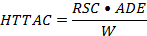
Where:
HTTAC = Human Threshold Toxicant Advisory Concentration in milligrams per liter (mg/L); RSC = Relative contribution of the amount of the exposure to a chemical via drinking water when compared to the total exposure to that chemical from all sources. Valid chemical-specific data must be used if available. If valid chemical-specific data are not available, a value of 20% (= 0.20) must be used; ADE = Acceptable Daily Exposure of substance in milligrams per day (mg/d) as determined under subsection (b); and W = Per capita daily water consumption for a child (0-6 years of age), equal to 0.78 liters per day (L/d). b) Procedures for Determining Acceptable Daily Exposures for Class I: Potable Resource Groundwater
- 1) The Acceptable Daily Exposure (ADE) represents the maximum amount of a threshold toxicant in milligrams per day (mg/d) that, if ingested daily by a child from 0-6 years of age, results in no adverse effects. Subsections (b)(2) through (b)(6) list, in prescribed order, methods for determining the ADE in Class I: Potable Resource Groundwater.
- 2) If the noncancer toxicity value of a substance has been derived and presented in milligrams per kilogram per day (mg/kg/day), the ADE of the substance equals the product of multiplying the toxicity value by 15 kilograms (kg), which is the assumed average weight of a child 0 to 6 years of age.
3) If the oral reference dose of a substance is not available, the ADE of the substance equals the value of the most sensitive Point of Departure (POD) as determined by Benchmark Dose Modeling or the NOAEL/LOAEL approach consistent with current USEPA RfD guidance, followed by the derivation of a Human Equivalent Dose (HED) using physiologically based pharmacokinetic (PBPK) modeling or Dose Adjustment Factor (DAF), then divided by the total Uncertainty Factor (UF) and modifying factor (MF), if applicable. The value is then multiplied by 15 kg (the assumed average weight of a child 0-6 years of age). The equation is as follows:

- 4) Uncertainty Factors must be applied to the Point of Departure (POD) in increments of 1, 3, or 10, not to exceed a total UF of 10,000, and must be used consistent with USEPA guidance. A composite UF of 3 and 10 must be expressed as 30. A composite UF of 3 and 3 must be expressed as 10. UFs may be used to account for the following:
- A) Interspecies Variability
B) Intraspecies Variability
- C) Lowest Observable Adverse Effects Level (LOAEL) to No Observed Adverse Effects Level (NOAEL) Uncertainty
- D) Database Deficiencies
- E) Subchronic to Chronic Duration
c) Procedures for Establishing Validity of Data from Animal Studies
1) High Validity Studies
A) High validity studies use a route of exposure by ingestion or gavage, and are based upon:
- i) Data from animal carcinogenicity studies with a minimum of 2 dose levels and a control group, 2 species, both sexes, with 50 animals per dose per sex, and at least 50 percent survival at 15 months in mice and 18 months in rats and at least 25 percent survival at 18 months in mice and 24 months in rats;
- ii) Data from animal chronic studies with a minimum of 3 dose levels and a control group, 2 species, both sexes, with 40 animals per dose per sex, and at least 50 percent survival at 15 months in mice and 18 months in rats and at least 25 percent survival at 18 months in mice and 24 months in rats, and a well-defined NOAEL; or
- iii) Data from animal subchronic studies with a minimum of 3 dose levels and control, 2 species, both sexes, 4 animals per dose per sex for non-rodent species or 10 animals per dose per sex for rodent species, a duration of at least 5% of the test species' lifespan, and a well-defined NOAEL.
- B) Supporting studies that reinforce the conclusions of a study of Medium Validity may be considered to raise the study to High Validity.
2) Medium Validity Studies
- A) Data from animal carcinogenicity, chronic, or subchronic studies in which minor deviations from the study design elements required for a High Validity Study are found, but that otherwise satisfy the standards for a High Validity Study;
- B) Data from animal carcinogenicity and chronic studies in which at least 25 percent survival is reported at 15 months in mice and 18 months in rats (a lesser survival is permitted at the conclusion of a longer duration study but the number of surviving animals must not fall below 20 percent per dose per sex at 18 months for mice and 24 months for rats), but that otherwise satisfy the standards for a High Validity Study;
- C) Data from animal subchronic or chronic studies in which a Lowest Observable Adverse Effect Level (LOAEL) is determined, but that otherwise satisfy the standards for a High Validity Study; or
- D) Data from animal subchronic or chronic studies that have an inappropriate route of exposure (e.g., intraperitoneal injection or inhalation), but that otherwise satisfy the standards for a High Validity Study, with correction factors for conversion to the oral route.
Medium validity studies are based upon:
3) Low Validity Studies
Low validity studies are studies not meeting the standards specified in subsection (c)(1) or (c)(2).
d) Calculating a Human Nonthreshold Toxicant Advisory Concentration (HNTAC) for Cancer Risk
1) If USEPA has designated a chemical as a "mutagen", the HNTAC of the chemical is calculated as follows:
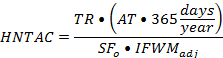
Where:
HNTAC = Human Nonthreshold Toxicant Advisory Concentration, equal to milligrams per liter (mg/L) TR = Target Cancer Risk, equal to one-in-one million cancer risk (1E-06) AT = Averaging Time, equal to 70 years SFo = Oral Slope Factor (chemical-specific), equal to (mg/kg-day)-1 IFWMadj = Age-Adjusted Mutagenic Drinking Water Ingestion Rate, equal to 1,019.0 liters per kilogram (L/kg) 2) If USEPA has not designated a chemical as a "mutagen", the HNTAC of the chemical is calculated as follows:

Where:
HNTAC = Human Nonthreshold Toxicant Advisory Concentration, equal to milligrams per liter (mg/L) TR = Target Cancer Risk, equal to one-in-one million cancer risk (1E-06) AT = Averaging Time, equal to 70 years SFo = Oral Slope Factor (chemical-specific), equal to (mg/kg-day)-1 IFWMadj = Age-Adjusted Mutagenic Drinking Water Ingestion Rate, equal to 327.95 liters per kilogram (L/kg)
The Human Nonthreshold Toxicant Advisory Concentration (HNTAC) is calculated as follows:
(Source: Amended at 49 Ill. Reg. 4488, effective March 28, 2025)