Ill. Admin. Code tit. 35, § 391.APPENDIX E
Sample Calculations of Water Treatment Plant Lime Sludge Application Rates
AUTHORITY: Implementing and authorized by Section 4(g) of the Environmental Protection Act (Ill. Rev. Stat. 1981, ch. 111½ par. 1004(g)) and by 35 Ill. Adm. Code 309.155, 309.208(e), and 309.262.ENVIRONMENTAL PROTECTION AGENCY
I. Laboratory analysis of sludge (dwb):
% Calcium Carbonate Equivalent 94.34 % Total Solids 24 pH 10.4 Arsenic 0.83 mg/kg Barium 8.3 mg/kg Cadmium 0.6 mg/kg Chromium (hexavalent) 0.008 mg/kg Chromium (total) 1.2 mg/kg Copper 3.3 mg/kg Mercury 0.0008 mg/kg Nickel 8.75 mg/kg Selenium 0.4 mg/kg Silver 0.83 mg/kg Zinc 6.6 mg/kg Effective Neutralizing Value (ENV) as calculated below 94.34 ENV = Total fineness efficiency x % calcium carbonate equivalent 100 total fineness efficiency assumed to be 100
Therefore: ENV 100 x 94.34 = 94.34 100 II. Compare ENV of water treatment plant lime sludge to ENV of agricultural limestone.
Given: 1. ENV of typical agricultural limestone = 46.35
2. ENV of water plant lime sludge from (I.) above = 94.34
Correction factor = ENV of typical limestone ENV of water plant sludge = 46.35 = 0.49 or 0.5 94.34 This means that 0.5 tons of water treatment plant lime sludge is approximately equivalent to 1.0 tons of typical agricultural lime.
- III. Lime sludge will be applied to a light-colored silty clay loam soil having a pH of 5.0.
IV. The soil will be used for grain farming.
- V. The following list of soil types are to be used with the corresponding letters shown on Charts I and II for the respective cropping systems:
A) Dark-colored silty clays and silty clay loams.
- B) Light-and medium-colored silty clays and silty clay loams; dark-colored silt and clay loams.
- C) Light- and medium-colored silt and clay loams; dark- and medium-colored loams; dark-colored sandy loams.
- D) Light-colored loams; light- and medium-colored sandy loams; sands.
E) Muck and peat.
VI. With the above assumptions and referring to Chart I the corresponding typical agricultural limestone application rate is 6 tons per acre.
Since 0.5 tons of water treatment lime sludge is approximately equivalent to 1.0 ton of typical agricultural lime (calculated in II. above) apply only 3 dry tons of water treatment plant lime sludge per acre of farm land.
Similar metal loading rates as calculated in APPENDIX D should then be performed based on the 3 dry ton loading rate.
Note that due to the fineness efficiency of 100, the water treatment plant lime sludge may only be effective in raising the soil pH for one or two years after application. Suggested limestone rates based on soil type, pH, and cropping system.
Suggested limestone rates based on soil type, pH, and cropping system.
(Taken from Illinois Agronomy Handbook)
CHART I
GRAIN FARMING SYSTEMS
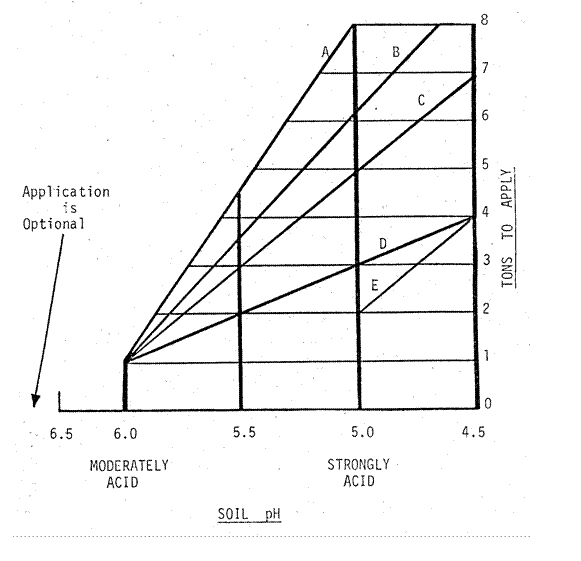
CHART II
CROPPING SYSTEMS WITH
ALFALFA, CLOVER OR
LESPEDEZA
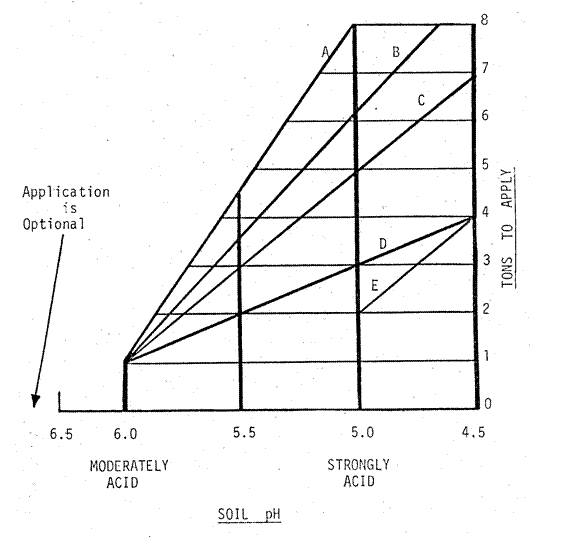
Note: Color is related to organic matter. Light-colored soils usually have less than 2.5 percent organic matter; medium-colored soils have 2.5 to 4.5 percent organic matter; dark-colored soils have above 4.5 percent organic matter; sands are excluded.