Ga. Comp. R. & Regs. r. 110-11-1-.24
International Building Code (IBC), 2024 Edition with 2026 Georgia State Amendments
Effective Jan 1, 2026Published Dec 2, 2025O.C.G.A. § 8-2-20 et seq.RULES OF GEORGIA DEPARTMENT OF COMMUNITY AFFAIRS
Rule 110-11-1-.24. International Building Code (IBC), 2024 Edition with 2026 Georgia State Amendments
 GEORGIA STATE MINIMUM STANDARD BUILDING CODE (INTERNATIONAL BUILDING CODE WITH GEORGIA STATE AMENDMENTS) The INTERNATIONAL BUILDING CODE, 2024 Edition, published by the International Code Council, when used in conjunction with these and any other Georgia State Amendments to the INTERNATIONAL BUILDING CODE, 2024 Edition, shall constitute the officialGeorgia State Minimum Standard Building Code. GEORGIA STATE AMENDMENTS CODE REFERENCE: (a) Replace all references to the ICC Electrical Code with references to the Georgia State Minimum Standard Electrical Code (National Electrical Code with Georgia State Amendments). (b) Replace all references to the International Energy Conservation Code (IECC) with references to the Georgia State Minimum Standard Energy Code (IECC with Georgia State Supplements and Amendments). The Georgia State Minimum Standard Energy Code shall be used for efficiency and coefficient of performance ratings of equipment. (c) By Georgia law, the International Existing Building Code is a permissive or optional State Minimum Standard Code. Consequently, the provisions contained in the International Existing Building Code are not mandatory or applicable unless specifically referenced in the adopting ordinance of local governments or referenced by this code. APPENDICES: Appendices are not enforceable unless they are specifically referenced in the body of the code or adopted by the Department of Community Affairs or the authority having jurisdiction. SCOPE: The provisions of the Georgia State Minimum Standard Building Code shall apply to the construction, alteration, relocation, enlargement, replacement, repair, equipment, use and occupancy, location, maintenance, removal and demolition of every building or structure or any appurtenances connected or attached to such buildings or structures. Exception #1: Detached one- and two-family dwellings and multiple single-family dwellings (townhouses separated by a 2-hour fire-resistance-rated wall assembly) not more than three stories above grade plane in height with a separate means of egress and their accessory structures shall comply with the Georgia State Minimum Standard One-and Two-Family Dwelling Code (International Residential Code for One- and Two-Family Dwellings with Georgia State Amendments). Exception #2: The following table titled 'Codes Reference Guide' establishes specific primary and supplementary code applications and is to be applied by the authority having jurisdiction. CODES REFERENCE GUIDE Area Primary Supplement Occupancy Classification LSC IBC Building Construction Types including allowable height, allowable building areas, and the requirements for sprinkler protection related to minimum building construction types. IBC LSC Means of Egress LSC NONE Standpipes IBC IFC Interior Finish LSC NONE HVAC Systems IMC NONE Vertical Openings LSC NONE Sprinkler Systems minimum construction standard LSC NONE Fire Alarm Systems LSC NONE Smoke Alarms and Smoke Detection Systems State Statute and LSC NONE Portable Fire Extinguishers IFC NONE Cooking Equipment LSC and NFPA 96 NONE Fuel Fired Appliances IFGC NFPA 54 Liquid Petroleum Gas NFPA 58 NFPA 54 Compressed Natural Gas NFPA 52 NONE *Revise the International Building Code, 2024 Edition, to read as follows: CHAPTER 1 SCOPE AND ADMINISTRATION *Delete Chapter 1 'Scope and Administration' entirely without substitution. Chapter 1 to remain in the Code as a reference and guide for local governments to use in the development of their own Administrative Procedures. (Effective January 1, 2026) CHAPTER 2 DEFINITIONS *Revise Definition for 'FLOOD HAZARD AREA' to read as follows: The greater of the following two areas: 1. For Risk Categories II, III, and IV structures, the Flood Hazard Area shall be the 500-year floodplain designated as the Special Flood Hazard Area and the Shaded X-Zone. For Risk Category I structures, the Flood Hazard Area shall be the 100-year floodplain designated as the Special Flood Hazard Area. 2. The area designated as a flood hazard area on a community's flood hazard map, or otherwise legally designated. (Effective January 1, 2026) CHAPTER 3 OCCUPANCY CLASSIFICATION AND USE SECTION 308 INSTITUTIONAL GROUP I *Add new Section 308.3.3 'Assisted living communities' to read as follows: 308.3.3 Assisted living communities. Assisted living communities, licensed by the State, housing twenty-five or more persons, meeting the Georgia State Fire Marshal's Office Life Safety Code requirements shall be deemed as equivalent compliance to the International Building Code Chapters 3, 4, 8, 9 and 10. (Effective January 1, 2026) CHAPTER 4 SPECIAL DETAILED REQUIREMENTS BASED ON OCCUPANCY AND USE SECTION 415 GROUPS H-1, H-2, H-3, H-4 AND H-5 *Revise Section [F] 415.9.2 'Liquefied petroleum gas facilities' to read as follows: [F] 415.9.2 Liquefied petroleum gas facilities. The construction and installation of liquefied petroleum gas facilities shall be in accordance with the requirements of this code, the International Mechanical Code and NFPA 58 and NFPA 54 both as adopted and amended by the Rules and Regulations of the Safety Fire Commissioner Chapter 120-3-16, "Rules and Regulations for Liquefied Petroleum Gases".(Effective January 1, 2026) CHAPTER 5 GENERAL BUILDING HEIGHTS AND AREAS SECTION 504 BUILDING HEIGHT AND NUMBER OF STORIES *Revise Table 504.4 'Allowable Number of Stories Above Grade Plane a, b' for the Occupancy Classification "I-1 Condition 2" as shown and add a new footnote "i" to read as follows: TABLE 504.4 ALLOWABLE NUMBER OF STORIES ABOVE GRADE PLANE a,b OCCUPANCY CLASSIFICATION TYPE OF CONSTRUCTION SEE FOOT NOTES TYPE 1 TYPE II TYPE III TYPE IV TYPE V A B A B A B A B C HT A B I-1 Condition 2 NS d, e NP NP NP NP NP NP NP NP NP NP NP NP S i UL 10 3 2 2 1 7 4 1 2 2 1 i. For all I-1 Condition 2, the building shall be protected throughout with an approved automatic sprinkler system, installed in accordance with NFPA 13 as adopted by the Rules and Regulations of the Safety Fire Commissioner. No increase in story height shall be permitted. (Remainder of table unchanged) (Effective January 1, 2026) CHAPTER 7 FIRE AND SMOKE PROTECTION FEATURES SECTION 706 FIRE WALLS *Revise Section 706.2 'Structural stability' to read as follows: 706.2 Structural stability. Fire walls shall be designed and constructed to allow collapse of construction on either side without collapse of the wall under fire conditions and loading per Section 1607.16.2. Fire walls designed and constructed in accordance with NFPA 221 shall be deemed to comply with this section. Exception: In Seismic Design Categories D through F, where double fire walls are used in accordance with NFPA 221, floor and roof sheathing not exceeding 3/4 inch (19.05 mm) thickness shall be permitted to be continuous through the wall assemblies of light frame construction. (Effective January 1, 2026) *Delete Exception to Section 706.3 'Materials' without substitution. (Effective January 1, 2026) SECTION 713 SHAFT ENCLOSURES *Add new Section 713.14.1 'Designated floor lobbies for elevator return' to read as follows: 713.14.1 Designated floor lobbies for elevator return. New elevators, escalators, dumbwaiters and moving walks shall be installed in accordance with the requirements of ASME A17.1, Safety Code for Elevators and Escalators. The designated elevator lobby of the designated floor and the designated alternate floor specified by ASME A17.1 Section 2.27.3 shall be separated from the remainder of the building by 1-hour fire-rated construction. In buildings equipped with automatic sprinkler protection, smoke partitions in accordance with the 'Rules and Regulations of the Safety Fire Commissioner Chapter 120-3-3 Rules and Regulations for the State Minimum Fire Safety Standards' may be used in lieu of 1-hour fire-rated construction. Except health care occupancies, openings in the elevator lobby shall be limited to those required for access to the elevators from exit access corridors only. Elevator lobbies may be used as part of the means of egress from the building. Exceptions: 1. Designated floor elevator lobbies are not required within an atrium. 2. Designated floor elevator lobbies are not required where elevators are installed on open exterior walls. 3. Designated floor elevator lobbies are not required where elevators are installed in open air parking structures. 4. Designated floor elevator lobbies are not required in buildings three stories or less with vertical openings protected in accordance with the applicable occupancy chapter. 5. Existing installations acceptable to the authority having jurisdiction. 6. For existing buildings or existing structures reference Section 3401.3 (GA Amendments). (Effective January 1, 2026) CHAPTER 9 FIRE PROTECTION AND LIFE SAFETY SYSTEMS SECTION 901 GENERAL *Revise Section 901.2 'Fire protection systems' to add new statement to read as follows: 901.2 Fire protection systems.Section 901.2 shall apply only as referenced by the NFPA standards. Refer to the applicable codes and standards adopted by the Georgia Safety Fire Commissioner. (Effective January 1, 2026) *Revise Section 901.3 'Modifications' to add new statement to read as follows: 901.3 Modifications.Section 901.3 shall apply only as referenced by the NFPA standards. Refer to the applicable codes and standards adopted by the Georgia Safety Fire Commissioner. (Effective January 1, 2026) *Revise Section 901.4 'Threads' to add new statement to read as follows: 901.4 Threads.Section 901.4 shall apply only as referenced by the NFPA standards. Refer to the applicable codes and standards adopted by the Georgia Safety Fire Commissioner. (Effective January 1, 2026) *Revise Section 901.5 'Acceptance tests' to add new statement to read as follows: 901.5 Acceptance tests.Section 901.5 shall apply only as referenced by the NFPA standards. Refer to the applicable codes and standards adopted by the Georgia Safety Fire Commissioner. (Effective January 1, 2026) *Revise Section 901.6 'Supervisory service' to add new statement to read as follows: 901.6 Supervisory service.Section 901.6 shall apply only as referenced by the NFPA standards. Refer to the applicable codes and standards adopted by the Georgia Safety Fire Commissioner. (Effective January 1, 2026) *Revise Section 901.6.1 'Automatic sprinkler systems' to add new statement to read as follows: 901.6.1 Automatic sprinkler systems.Section 901.6.1 shall apply only as referenced by the NFPA standards. Refer to the applicable codes and standards adopted by the Georgia Safety Fire Commissioner. (Effective January 1, 2026) *Revise Section 901.6.2 'Fire alarm systems' to add new statement to read as follows: 901.6.2 Fire alarm systems.Section 901.6.2 shall apply only as referenced by the NFPA standards. Refer to the applicable codes and standards adopted by the Georgia Safety Fire Commissioner. (Effective January 1, 2026) *Revise Section 901.6.3 'Group H' to add new statement to read as follows: 901.6.3 Group H.Section 901.6.3 shall apply only as referenced by the NFPA standards. Refer to the applicable codes and standards adopted by the Georgia Safety Fire Commissioner. (Effective January 1, 2026) *Revise section 901.7 'Fire areas' to add new statement to read as follows: 901.7 Fire areas.Refer to the applicable codes and standards adopted by the Georgia Safety Fire Commissioner. (Effective January 1, 2026) SECTION 902 FIRE PUMP AND RISER ROOM SIZE *Revise Section 902.1 'Pump and riser room size' to add new statement to read as follows: [F] 902.1 Pump and riser room size.Section 902.1 shall apply only as referenced by the NFPA standards. Refer to the applicable codes and standards adopted by the Georgia Safety Fire Commissioner. (Effective January 1, 2026) *Revise Section [F] 902.1.1 'Access' to add new statement to read as follows: [F] 902.1.1 Access.Section 902.1.1 shall apply only as referenced by the NFPA standards. Refer to the applicable codes and standards adopted by the Georgia Safety Fire Commissioner. (Effective January 1, 2026) *Revise Section [F] 902.1.2 'Marking on access doors' to add new statement to read as follows: [F] 902.1.2 Marking on access doors.Section 902.1.2 shall apply only as referenced by the NFPA standards. Refer to the applicable codes and standards adopted by the Georgia Safety Fire Commissioner. (Effective January 1, 2026) *Revise Section [F] 902.1.3 'Environment' to add new statement to read as follows: [F] 902.1.3 Environment.Section 902.1.3 shall apply only as referenced by the NFPA standards. Refer to the applicable codes and standards adopted by the Georgia Safety Fire Commissioner. (Effective January 1, 2026) *Revise Section [F] 902.1.4 'Lighting' to add new statement to read as follows: [F] 902.1.4 Lighting.Section 902.1.4 shall apply only as referenced by the NFPA standards. Refer to the applicable codes and standards adopted by the Georgia Safety Fire Commissioner. (Effective January 1, 2026) SECTION 903 AUTOMATIC SPRINKLER SYSTEMS *Revise Section [F] 903.1 'General' to add new statement to read as follows: [F] 903.1 General.Section 903.1 shall apply only as referenced by the NFPA standards. Refer to the applicable codes and standards adopted by the Georgia Safety Fire Commissioner. (Effective January 1, 2026) *Revise Section [F] 903.1.1 'Alternative protection' to add new statement to read as follows: [F] 903.1.1 Alternative protection.Section 903.1.1 shall apply only as referenced by the NFPA standards. Refer to the applicable codes and standards adopted by the Georgia Safety Fire Commissioner. (Effective January 1, 2026) *Revise Section [F] 903.2 'Where required' to add new statement to read as follows: [F] 903.2 Where required.Section 903.2 shall apply only as referenced by the NFPA standards. Refer to the applicable codes and standards adopted by the Georgia Safety Fire Commissioner. (Effective January 1, 2026) *Revise Section [F] 903.2.1 'Group A' to add new statement to read as follows: [F] 903.2.1 Group A.Section 903.2.1 shall apply only as referenced by the NFPA standards. Refer to the applicable codes and standards adopted by the Georgia Safety Fire Commissioner. (Effective January 1, 2026) *Revise Section [F] 903.2.1.1 'Group A-1' to add new statement to read as follows: [F] 903.2.1.1 Group A-1.Section 903.2.1.1 shall apply only as referenced by the NFPA standards. Refer to the applicable codes and standards adopted by the Georgia Safety Fire Commissioner. (Effective January 1, 2026) *Revise Section [F] 903.2.1.2 'Group A-2' to add new statement to read as follows: [F] 903.2.1.2 Group A-2.Section 903.2.1.2 shall apply only as referenced by the NFPA standards. Refer to the applicable codes and standards adopted by the Georgia Safety Fire Commissioner. (Effective January 1, 2026) *Revise Section [F] 903.2.1.3 'Group A-3' to add new statement to read as follows: [F] 903.2.1.3 Group A-3.Section 903.2.1.3 shall apply only as referenced by the NFPA standards. Refer to the applicable codes and standards adopted by the Georgia Safety Fire Commissioner. (Effective January 1, 2026) *Revise Section [F] 903.2.1.4 'Group A-4' to add new statement to read as follows: [F] 903.2.1.4 Group A-4.Section 903.2.1.4 shall apply only as referenced by the NFPA standards. Refer to the applicable codes and standards adopted by the Georgia Safety Fire Commissioner. (Effective January 1, 2026) *Revise Section [F] 903.2.1.5 'Group A-5' to add new statement to read as follows: [F] 903.2.1.5 Group A-5.Section 903.2.1.5 shall apply only as referenced by the NFPA standards. Refer to the applicable codes and standards adopted by the Georgia Safety Fire Commissioner. (Effective January 1, 2026) *Revise Section [F] 903.2.1.5.1 'Spaces under grandstands or bleachers' to add new statement to read as follows: [F] 903.2.1.5.1 Spaces under grandstands or bleachers.Section 903.2.1.5.1 shall apply only as referenced by the NFPA standards. Refer to the applicable codes and standards adopted by the Georgia Safety Fire Commissioner. (Effective January 1, 2026) *Revise Section [F] 903.2.1.6 'Assembly occupancies on roofs' to add new statement to read as follows: [F] 903.2.1.6 Assembly occupancies on roofs.Section 903.2.1.6 shall apply only as referenced by the NFPA standards. Refer to the applicable codes and standards adopted by the Georgia Safety Fire Commissioner. (Effective January 1, 2026) *Revise Section [F] 903.2.1.7 'Multiple fire areas' to add new statement to read as follows: [F] 903.2.1.7 Multiple fire areas.Section 903.2.1.7 shall apply only as referenced by the NFPA standards. Refer to the applicable codes and standards adopted by the Georgia Safety Fire Commissioner. (Effective January 1, 2026) *Revise Section [F] 903.2.2 'Group B' to add new statement to read as follows: [F] 903.2.2 Group B.Section 903.2.2 shall apply only as referenced by the NFPA standards. Refer to the applicable codes and standards adopted by the Georgia Safety Fire Commissioner. (Effective January 1, 2026) *Revise Section [F] 903.2.2.1 'Ambulatory care facilities' to add new statement to read as follows: [F] 903.2.2.1 Ambulatory care facilities.Section 903.2.2.1 shall apply only as referenced by the NFPA standards. Refer to the applicable codes and standards adopted by the Georgia Safety Fire Commissioner. (Effective January 1, 2026) *Revise Section [F] 903.2.2.2 'Laboratories involving testing, research and development' to add new statement to read as follows: [F] 903.2.2.2 Laboratories involving testing, research and development.Section 903.2.2.2 shall apply only as referenced by the NFPA standards. Refer to the applicable codes and standards adopted by the Georgia Safety Fire Commissioner. (Effective January 1, 2026) *Revise Section [F] 903.2.3 'Group E' to add new statement to read as follows: [F] 903.2.3 Group E.Section 903.2.3 shall apply only as referenced by the NFPA standards. Refer to the applicable codes and standards adopted by the Georgia Safety Fire Commissioner. (Effective January 1, 2026) *Revise Section [F] 903.2.4 'Group F-1' to add new statement to read as follows: [F] 903.2.4 Group F-1.Refer to the applicable codes and standards adopted by the Georgia Safety Fire Commissioner. (Effective January 1, 2026) *Revise Section [F] 903.2.4.1 'Woodworking operations' to add new statement to read as follows: [F] 903.2.4.1 Woodworking operations.Refer to the applicable codes and standards adopted by the Georgia Safety Fire Commissioner. (Effective January 1, 2026) *Revise Section [F] 903.2.4.2 'Group F-1 distilled spirits' to add new statement to read as follows: [F] 903.2.4.2 Group F-1 distilled spirits.Section 903.2.4.2 shall apply only as referenced by the NFPA standards. Refer to the applicable codes and standards adopted by the Georgia Safety Fire Commissioner. (Effective January 1, 2026) *Revise Section [F] 903.2.4.3 'Group F-1 upholstered furniture or mattresses' to add new statement to read as follows: [F] 903.2.4.3 Group F-1 upholstered furniture or mattresses.Refer to the applicable codes and standards adopted by the Georgia Safety Fire Commissioner. (Effective January 1, 2026) *Revise Section [F] 903.2.5 'Group H' to add new statement to read as follows: [F] 903.2.5 Group H.Section 903.2.5 shall apply only as referenced by the NFPA standards. Refer to the applicable codes and standards adopted by the Georgia Safety Fire Commissioner. (Effective January 1, 2026) *Revise Section [F] 903.2.5.1 'General' to add new statement to read as follows: [F] 903.2.5.1 General.Section 903.2.5.1 shall apply only as referenced by the NFPA standards. Refer to the applicable codes and standards adopted by the Georgia Safety Fire Commissioner. (Effective January 1, 2026) *Revise Section [F] 903.2.5.2 'Group H-5 occupancies' to add new statement to read as follows: [F] 903.2.5.2 Group H-5 occupancies.Section 903.2.5.2 shall apply only as referenced by the NFPA standards. Refer to the applicable codes and standards adopted by the Georgia Safety Fire Commissioner. (Effective January 1, 2026) *Revise Section [F] 903.2.5.3 'Pyroxylin plastics' to add new statement to read as follows: [F] 903.2.5.3 Pyroxylin plastics.Section 903.2.5.3 shall apply only as referenced by the NFPA standards. Refer to the applicable codes and standards adopted by the Georgia Safety Fire Commissioner. (Effective January 1, 2026) *Revise Section [F] 903.2.6 'Group I' to add new statement to read as follows: [F] 903.2.6 Group I.Section 903.2.6 shall apply only as referenced by the NFPA standards. Refer to the applicable codes and standards adopted by the Georgia Safety Fire Commissioner. (Effective January 1, 2026) *Revise Section [F] 903.2.7 'Group M' to add new statement to read as follows: [F] 903.2.7 Group M.Section 903.2.7 shall apply only as referenced by the NFPA standards. Refer to the applicable codes and standards adopted by the Georgia Safety Fire Commissioner. (Effective January 1, 2026) *Revise Section [F] 903.2.7.1 'High-piled storage' to add new statement to read as follows: [F] 903.2.7.1 High-piled storage.Section 903.2.7.1 shall apply only as referenced by the NFPA standards. Refer to the applicable codes and standards adopted by the Georgia Safety Fire Commissioner. (Effective January 1, 2026) *Revise Section [F] 903.2.7.2 'Group M upholstered furniture or mattresses' to add new statement to read as follows: [F] 903.2.7.2 Group M upholstered furniture or mattresses.Section 903.2.7.2 shall apply only as referenced by the NFPA standards. Refer to the applicable codes and standards adopted by the Georgia Safety Fire Commissioner. (Effective January 1, 2026) *Revise Section [F] 903.2.7.3 'Lithium-ion or lithium metal battery storage' to add new statement to read as follows: [F] 903.2.7.3 Lithium-ion or lithium metal battery storage.Section 903.2.7.3 shall apply only as referenced by the NFPA standards. Refer to the applicable codes and standards adopted by the Georgia Safety Fire Commissioner. (Effective January 1, 2026) *Revise Section [F] 903.2.8 'Group R' to add new line and new exception to read as follows: [F] 903.2.8 Group R. An automatic sprinkler system installed in accordance with Section 903.3 shall be provided throughout all buildings with a Group R fire area. Exception: Group R-1 and R-2 occupancies which meet the exceptions allowed by the 'Rules and Regulations of the Safety Fire Commissioner Chapter 120-3-3 Rules and Regulations for the State Minimum Fire Safety Standards' are exempt from this requirement. Refer to the applicable codes and standards adopted by the Georgia Safety Fire Commissioner. (Effective January 1, 2026) *Revise Section [F] 903.2.8.1 'Group R-3' to read as follows: [F] 903.2.8.1 Group R-3. An automatic sprinkler system installed in accordance with Section 903.2.8.1 shall be permitted in Group R-3 occupancies. Refer to the applicable codes and standards adopted by the Georgia Safety Fire Commissioner. (Effective January 1, 2026) *Revise Section [F] 903.2.8.2 'Group R-4, Condition 1' to read as follows: [F] 903.2.8.2 Group R-4, Condition 1. An automatic sprinkler system installed in accordance with Section 903.3.1.2 shall be permitted in Group R-4, Condition 1 occupancies. Refer to the applicable codes and standards adopted by the Georgia Safety Fire Commissioner. (Effective January 1, 2026) *Revise Section [F] 903.2.8.3 'Care facilities' to read as follows: [F] 903.2.8.3 Care facilities. An automatic sprinkler system installed in accordance with Section 903.3.1.2 shall be permitted in care facilities with five or fewer individuals in a single-family dwelling. Refer to the applicable codes and standards adopted by the Georgia Safety Fire Commissioner. (Effective January 1, 2026) *Revise Section [F] 903.2.9 'Group S-1' to add new statement to read as follows: [F] 903.2.9 Group S-1.Refer to the applicable codes and standards adopted by the Georgia Safety Fire Commissioner. (Effective January 1, 2026) *Revise Section [F] 903.2.9.1 'Repair garages' to add new statement to read as follows: [F] 903.2.9.1 Repair garages.Section 903.2.9.1 shall apply only as referenced by the NFPA standards. Refer to the applicable codes and standards adopted by the Georgia Safety Fire Commissioner. (Effective January 1, 2026) *Revise Section [F] 903.2.9.2 'Bulk storage of tires' to add new statement to read as follows: [F] 903.2.9.2 Bulk storage of tires.Section 903.2.9.2 shall apply only as referenced by the NFPA standards. Refer to the applicable codes and standards adopted by the Georgia Safety Fire Commissioner. (Effective January 1, 2026) *Revise Section [F] 903.2.9.3 'Group S-1 distilled spirits or wine' to add new statement to read as follows: [F] 903.2.9.3 Group S-1 distilled spirits or wine.Section 903.2.9.3 shall apply only as referenced by the NFPA standards. Refer to the applicable codes and standards adopted by the Georgia Safety Fire Commissioner. (Effective January 1, 2026) *Revise Section [F] 903.2.9.4 'Group S-1 upholstered furniture or mattresses' to add new statement to read as follows: [F] 903.2.9.4 Group S-1 upholstered furniture and mattresses.Refer to the applicable codes and standards adopted by the Georgia Safety Fire Commissioner. (Effective January 1, 2026) *Revise Section [F] 903.2.10 'Group S-2 parking garages' to add new statement to read as follows: [F] 903.2.10 Group S-2 parking garages.Section 903.2.10 shall apply only as referenced by the NFPA standards. Refer to the applicable codes and standards adopted by the Georgia Safety Fire Commissioner. (Effective January 1, 2026) *Revise Section [F] 903.2.10.1 'Commercial parking garages' to add new statement to read as follows: [F] 903.2.10.1 Commercial parking garages.Section 903.2.10.1 shall apply only as referenced by the NFPA standards. Refer to the applicable codes and standards adopted by the Georgia Safety Fire Commissioner. (Effective January 1, 2026) *Revise Section [F] 903.2.10.2 'Mechanical-access enclosed parking garages' to add new statement to read as follows: [F] 903.2.10.2 Mechanical-access enclosed parking garages.Section 903.2.10.2 shall apply only as referenced by the NFPA standards. Refer to the applicable codes and standards adopted by the Georgia Safety Fire Commissioner. (Effective January 1, 2026) *Revise Section [F] 903.2.11 'Specific building areas and hazards' to add new statement to read as follows: [F] 903.2.11 Specific building areas and hazards.Section 903.2.11 shall apply only as referenced by the NFPA standards. Refer to the applicable codes and standards adopted by the Georgia Safety Fire Commissioner. (Effective January 1, 2026) *Revise Section [F] 903.2.11.1 'Stories without openings' to add new statement to read as follows: [F] 903.2.11.1 Stories without openings.Section 903.2.11.1 shall apply only as referenced by the NFPA standards. Refer to the applicable codes and standards adopted by the Georgia Safety Fire Commissioner. (Effective January 1, 2026) *Revise Section [F] 903.2.11.1.1 'Opening dimensions and access' to add new statement to read as follows: [F] 903.2.11.1.1 Opening dimensions and access.Section 903.2.11.1.1 shall apply only as referenced by the NFPA standards. Refer to the applicable codes and standards adopted by the Georgia Safety Fire Commissioner. (Effective January 1, 2026) *Revise Section [F] 903.2.11.1.2 'Openings on one side only' to add new statement to read as follows: [F] 903.2.11.1.2 Openings on one side only.Section 903.2.11.1.2 shall apply only as referenced by the NFPA standards. Refer to the applicable codes and standards adopted by the Georgia Safety Fire Commissioner. (Effective January 1, 2026) *Revise Section [F] 903.2.11.1.3 'Basements' to add new statement to read as follows: [F] 903.2.11.1.3 Basements.Section 903.2.11.1.3 shall apply only as referenced by the NFPA standards. Refer to the applicable codes and standards adopted by the Georgia Safety Fire Commissioner. (Effective January 1, 2026) *Revise Section [F] 903.2.11.2 'Rubbish and linen chutes' to add new statement to read as follows: [F] 903.2.11.2 Rubbish and linen chutes.Section 903.2.11.2 shall apply only as referenced by the NFPA standards. Refer to the applicable codes and standards adopted by the Georgia Safety Fire Commissioner. (Effective January 1, 2026) *Revise Section [F] 903.2.11.3 'Buildings 55 feet or more in height' to add new statement to read as follows: [F] 903.2.11.3 Buildings 55 feet or more in height.Section 903.2.11.3 shall apply only as referenced by the NFPA standards. Refer to the applicable codes and standards adopted by the Georgia Safety Fire Commissioner. (Effective January 1, 2026) *Revise Section [F] 903.2.11.4 'Ducts conveying hazardous exhausts' to add new statement to read as follows: [F] 903.2.11.4 Ducts conveying hazardous exhausts.Section 903.2.11.4 shall apply only as referenced by the NFPA standards. Refer to the applicable codes and standards adopted by the Georgia Safety Fire Commissioner. (Effective January 1, 2026) *Revise Section [F] 903.2.11.5 'Commercial cooking operations' to add new statement to read as follows: [F] 903.2.11.5 Commercial cooking operations.Section 903.2.11.5 shall apply only as referenced by the NFPA standards. Refer to the applicable codes and standards adopted by the Georgia Safety Fire Commissioner. (Effective January 1, 2026) *Revise Section [F] 903.2.11.6 'Other required fire protection systems' to add new statement to read as follows: [F] 903.2.11.6 Other required fire protection systems.Section 903.2.11.6 shall apply only as referenced by the NFPA standards. Refer to the applicable codes and standards adopted by the Georgia Safety Fire Commissioner. (Effective January 1, 2026) *Revise Section [F] 903.2.12 'During construction' to add new statement to read as follows: [F] 903.2.12 During construction.Section 903.2.12 shall apply only as referenced by the NFPA standards. Refer to the applicable codes and standards adopted by the Georgia Safety Fire Commissioner. (Effective January 1, 2026) *Revise Section [F] 903.3 'Installation requirements' to add new statement to read as follows: [F] 903.3 Installation requirements.Section 903.3 shall apply only as referenced by the NFPA standards. Refer to the applicable codes and standards adopted by the Georgia Safety Fire Commissioner. (Effective January 1, 2026) *Revise Section [F] 903.3.1 'Standards' to add new statement to read as follows: [F] 903.3.1 Standards.Section 903.3.1 shall apply only as referenced by the NFPA standards. Refer to the applicable codes and standards adopted by the Georgia Safety Fire Commissioner. (Effective January 1, 2026) *Revise Section [F] 903.3.1.1 'NFPA 13 sprinkler systems' to add new statement to read as follows: [F] 903.3.1.1 NFPA 13 sprinkler systems.Section 903.3.1.1 shall apply only as referenced by the NFPA standards. Refer to the applicable codes and standards adopted by the Georgia Safety Fire Commissioner. (Effective January 1, 2026) *Revise Section [F] 903.3.1.1.1 'Exempt locations' to add new statement to read as follows: [F] 903.3.1.1.1 Exempt locations.Section 903.3.1.1.1 shall apply only as referenced by the NFPA standards. Refer to the applicable codes and standards adopted by the Georgia Safety Fire Commissioner. (Effective January 1, 2026) *Revise Section [F] 903.3.1.1.2 'Bathrooms' to add new statement to read as follows: [F] 903.3.1.1.2 Bathrooms.Section 903.3.1.1.2 shall apply only as referenced by the NFPA standards. Refer to the applicable codes and standards adopted by the Georgia Safety Fire Commissioner. (Effective January 1, 2026) *Revise Section [F] 903.3.1.1.3 'Lithium-ion or lithium metal batteries' to add new statement to read as follows: [F] 903.3.1.1.3 Lithium-ion or lithium metal batteries.Refer to the applicable codes and standards adopted by the Georgia Safety Fire Commissioner. (Effective January 1, 2026) *Revise Section [F] 903.3.1.2 'NFPA 13R sprinkler systems' to add new statement to read as follows: [F] 903.3.1.2 NFPA 13R sprinkler systems.Refer to the applicable codes and standards adopted by the Georgia Safety Fire Commissioner. (Effective January 1, 2026) *Revise Section [F] 903.3.1.2.1 'Balconies and decks' to add new statement to read as follows: [F] 903.3.1.2.1 Balconies and decks.Section 903.3.1.2.1 shall apply only as referenced by the NFPA standards. Refer to the applicable codes and standards adopted by the Georgia Safety Fire Commissioner. (Effective January 1, 2026) *Revise Section [F] 903.3.1.2.2 'Corridors and balconies in the means of egress' to add new statement to read as follows: [F] 903.3.1.2.2 Corridors and balconies in the means of egress.Section 903.3.1.2.2 shall apply only as referenced by the NFPA standards. Refer to the applicable codes and standards adopted by the Georgia Safety Fire Commissioner. (Effective January 1, 2026) *Revise Section [F] 903.3.1.2.3 'Attics' to add new statement to read as follows: [F] 903.3.1.2.3 Attics.Section 903.3.1.2.3 shall apply only as referenced by the NFPA standards. Refer to the applicable codes and standards adopted by the Georgia Safety Fire Commissioner. (Effective January 1, 2026) *Revise Section [F] 903.3.1.3 'NFPA 13D sprinkler systems' to read as follows: [F] 903.3.1.3 NFPA 13D sprinkler systems.Automatic sprinkler systems installed in one- and two-family dwellings; and townhouses separated by 2-hour firewalls shall be permitted to be installed throughout in accordance with NFPA 13D. Refer to the applicable codes and standards adopted by the Georgia Safety Fire Commissioner. (Effective January 1, 2026) *Revise Section [F] 903.3.2 'Quick-response and residential sprinklers' to add new statement to read as follows: [F] 903.3.2 Quick-response and residential sprinklers.Section 903.3.2 shall apply only as referenced by the NFPA standards. Refer to the applicable codes and standards adopted by the Georgia Safety Fire Commissioner. (Effective January 1, 2026) *Revise Section [F] 903.3.3 'Obstructed locations' to add new statement to read as follows: [F] 903.3.3 Obstructed locations.Section 903.3.3 shall apply only as referenced by the NFPA standards. Refer to the applicable codes and standards adopted by the Georgia Safety Fire Commissioner. (Effective January 1, 2026) *Revise Section [F] 903.3.4 'Actuation' to add new statement to read as follows: [F] 903.3.4 Actuation.Section 903.3.4 shall apply only as referenced by the NFPA standards. Refer to the applicable codes and standards adopted by the Georgia Safety Fire Commissioner. (Effective January 1, 2026) *Revise Section [F] 903.3.5 'Water supplies' to add new statement to read as follows: [F] 903.3.5 Water supplies.Section 903.3.5 shall apply only as referenced by the NFPA standards. Refer to the applicable codes and standards adopted by the Georgia Safety Fire Commissioner. (Effective January 1, 2026) *Revise Section [F] 903.3.5.1 'Domestic services' to add new statement to read as follows: [F] 903.3.5.1 Domestic services.Section 903.3.5.1 shall apply only as referenced by the NFPA standards. Refer to the applicable codes and standards adopted by the Georgia Safety Fire Commissioner. (Effective January 1, 2026) *Revise Section [F] 903.3.5.2 'Residential combination services' to add new statement to read as follows: [F] 903.3.5.2 Residential combination services.Section 903.3.5.2 shall apply only as referenced by the NFPA standards. Refer to the applicable codes and standards adopted by the Georgia Safety Fire Commissioner. (Effective January 1, 2026) *Revise Section [F] 903.3.6 'Hose threads' to add new statement to read as follows: [F] 903.3.6 Hose threads.Section 903.3.6 shall apply only as referenced by the NFPA standards. Refer to the applicable codes and standards adopted by the Georgia Safety Fire Commissioner. (Effective January 1, 2026) *Revise Section [F] 903.3.7 'Fire department connections' to add new statement to read as follows: [F] 903.3.7 Fire department connections.Section 903.3.7 shall apply only as referenced by the NFPA standards. Refer to the applicable codes and standards adopted by the Georgia Safety Fire Commissioner. (Effective January 1, 2026) *Revise Section [F] 903.3.8 'Limited area sprinkler systems' to add new statement to read as follows: [F] 903.3.8 Limited area sprinkler systems.Section 903.3.8 shall apply only as referenced by the NFPA standards. Refer to the applicable codes and standards adopted by the Georgia Safety Fire Commissioner. (Effective January 1, 2026) *Revise Section [F] 903.3.8.1 'Number of sprinklers' to add new statement to read as follows: [F] 903.3.8.1 Number of sprinklers.Section 903.3.8.1 shall apply only as referenced by the NFPA standards. Refer to the applicable codes and standards adopted by the Georgia Safety Fire Commissioner. (Effective January 1, 2026) *Revise Section [F] 903.3.8.2 'Occupancy hazard classification' to add new statement to read as follows: [F] 903.3.8.2 Occupancy hazard classification.Section 903.3.8.2 shall apply only as referenced by the NFPA standards. Refer to the applicable codes and standards adopted by the Georgia Safety Fire Commissioner. (Effective January 1, 2026) *Revise Section [F] 903.3.8.3 'Piping arrangement' to add new statement to read as follows: [F] 903.3.8.3 Piping arrangement.Section 903.3.8.3 shall apply only as referenced by the NFPA standards. Refer to the applicable codes and standards adopted by the Georgia Safety Fire Commissioner. (Effective January 1, 2026) *Revise Section [F] 903.3.8.4 'Supervision' to add new statement to read as follows: [F] 903.3.8.4 Supervision.Section 903.3.8.4 shall apply only as referenced by the NFPA standards. Refer to the applicable codes and standards adopted by the Georgia Safety Fire Commissioner. (Effective January 1, 2026) *Revise Section [F] 903.3.8.5 'Calculations' to add new statement to read as follows: [F] 903.3.8.5 Calculations.Section 903.3.8.5 shall apply only as referenced by the NFPA standards. Refer to the applicable codes and standards adopted by the Georgia Safety Fire Commissioner. (Effective January 1, 2026) *Revise Section [F] 903.3.9 'High-rise building floor control valves' to add new statement to read as follows: [F] 903.3.9 High-rise building floor control valves.Section 903.3.9 shall apply only as referenced by the NFPA standards. Refer to the applicable codes and standards adopted by the Georgia Safety Fire Commissioner. (Effective January 1, 2026) *Revise Section [F] 903.4 'Sprinkler system supervision and alarms' to add new statement to read as follows: [A] 903.4 Sprinkler system supervision and alarms.Section 903.4 shall apply only as referenced by the NFPA standards. Refer to the applicable codes and standards adopted by the Georgia Safety Fire Commissioner. (Effective January 1, 2026) *Revise Section [F] 903.4.1 'Electronic supervision' to add new statement to read as follows: [F] 903.4.1 Electronic supervision.Section 903.4.1 shall apply only as referenced by the NFPA standards. Refer to the applicable codes and standards adopted by the Georgia Safety Fire Commissioner. (Effective January 1, 2026) *Revise Section [F] 903.4.2 'Monitoring' to add new statement to read as follows: [F] 903.4.2 Monitoring.Section 903.4.2 shall apply only as referenced by the NFPA standards. Refer to the applicable codes and standards adopted by the Georgia Safety Fire Commissioner. (Effective January 1, 2026) *Revise Section [F] 903.4.3 'Alarms' to add new statement to read as follows: [F] 903.4.3 Alarms.Section 903.4.3 shall apply only as referenced by the NFPA standards. Refer to the applicable codes and standards adopted by the Georgia Safety Fire Commissioner. (Effective January 1, 2026) *Revise Section [F] 903.5 'Inspection, testing and maintenance' to add new statement to read as follows: [F] 903.5 Inspection, testing and maintenance.Section 903.5 shall apply only as referenced by the NFPA standards. Refer to the applicable codes and standards adopted by the Georgia Safety Fire Commissioner. (Effective January 1, 2026) SECTION 904 ALTERNATIVE AUTOMATIC FIRE-EXTIGUISHING SYSTEMS *Revise Section [F] 904.1 'General' to add new statement to read as follows: [F] 904.1 General.Section 904.1 shall apply only as referenced by the NFPA standards. Refer to the applicable codes and standards adopted by the Georgia Safety Fire Commissioner. (Effective January 1, 2026) *Revise Section [F] 904.2 'Where permitted' to add new statement to read as follows: [F] 904.2 Where permitted.Section 904.2 shall apply only as referenced by the NFPA standards. Refer to the applicable codes and standards adopted by the Georgia Safety Fire Commissioner. (Effective January 1, 2026) *Revise Section [F] 904.2.1 'Restriction on using automatic sprinkler system exceptions or reductions' to add new statement to read as follows: [F] 904.2.1 Restriction on using automatic sprinkler system exceptions or reductions.Section 904.2.1 shall apply only as referenced by the NFPA standards. Refer to the applicable codes and standards adopted by the Georgia Safety Fire Commissioner. (Effective January 1, 2026) *Revise Section [F] 904.2.2 'Commercial hood and duct systems' to add new statement to read as follows: [F] 904.2.2 Commercial hood and duct systems.Section 904.2.2 shall apply only as referenced by the NFPA standards. Refer to the applicable codes and standards adopted by the Georgia Safety Fire Commissioner. (Effective January 1, 2026) *Revise Section [F] 904.3 'Installation' to add new statement to read as follows: [F] 904.3 Installation.Section 904.3 shall apply only as referenced by the NFPA standards. Refer to the applicable codes and standards adopted by the Georgia Safety Fire Commissioner. (Effective January 1, 2026) *Revise Section [F] 904.3.1 'Electrical wiring' to add new statement to read as follows: [F] 904.3.1 Electrical wiring.Section 904.3.1 shall apply only as referenced by the NFPA standards. Refer to the applicable codes and standards adopted by the Georgia Safety Fire Commissioner. (Effective January 1, 2026) *Revise Section [F] 904.3.2 'Actuation' to add new statement to read as follows: [F] 904.3.2 Actuation.Section 904.3.2 shall apply only as referenced by the NFPA standards. Refer to the applicable codes and standards adopted by the Georgia Safety Fire Commissioner. (Effective January 1, 2026) *Revise Section [F] 904.3.3 'System interlocking' to add new statement to read as follows: [F] 904.3.3 System interlocking.Section 904.3.3 shall apply only as referenced by the NFPA standards. Refer to the applicable codes and standards adopted by the Georgia Safety Fire Commissioner. (Effective January 1, 2026) *Revise Section [F] 904.3.4 'Alarms and warning signs' to add new statement to read as follows: [F] 904.3.4 Alarms and warning signs.Section 904.3.4 shall apply only as referenced by the NFPA standards. Refer to the applicable codes and standards adopted by the Georgia Safety Fire Commissioner. (Effective January 1, 2026) *Revise Section [F] 904.3.5 'Monitoring' to add new statement to read as follows: [F] 904.3.5 Monitoring.Section 904.3.5 shall apply only as referenced by the NFPA standards. Refer to the applicable codes and standards adopted by the Georgia Safety Fire Commissioner. (Effective January 1, 2026) *Revise Section [F] 904.4 'Inspection and testing' to add new statement to read as follows: [F] 904.4 Inspection and testing.Section 904.4 shall apply only as referenced by the NFPA standards. Refer to the applicable codes and standards adopted by the Georgia Safety Fire Commissioner. (Effective January 1, 2026) *Revise Section [F] 904.4.1 'Inspection' to add new statement to read as follows: [F] 904.4.1 Inspection.Section 904.4.1 shall apply only as referenced by the NFPA standards. Refer to the applicable codes and standards adopted by the Georgia Safety Fire Commissioner. (Effective January 1, 2026) *Revise Section [F] 904.4.2 'Alarm testing' to add new statement to read as follows: [F] 904.4.2 Alarm testing.Section 904.4.2 shall apply only as referenced by the NFPA standards. Refer to the applicable codes and standards adopted by the Georgia Safety Fire Commissioner. (Effective January 1, 2026) *Revise Section [F] 904.4.2.1 'Audible and visible signals' to add new statement to read as follows: [F] 904.4.2.1 Audible and visible signals.Section 904.4.2.1 shall apply only as referenced by the NFPA standards. Refer to the applicable codes and standards adopted by the Georgia Safety Fire Commissioner. (Effective January 1, 2026) *Revise Section [F] 904.4.3 'Monitor testing' to add new statement to read as follows: [F] 904.4.3 Monitor testing.Section 904.4.3 shall apply only as referenced by the NFPA standards. Refer to the applicable codes and standards adopted by the Georgia Safety Fire Commissioner. (Effective January 1, 2026) *Revise Section [F] 904.5 'Wet-chemical systems' to add new statement to read as follows: [F] 904.5 Wet-chemical systems.Section 904.5 shall apply only as referenced by the NFPA standards. Refer to the applicable codes and standards adopted by the Georgia Safety Fire Commissioner. (Effective January 1, 2026) *Revise Section [F] 904.6 'Dry-chemical systems' to add new statement to read as follows: [F] 904.6 Dry-chemical systems.Section 904.6 shall apply only as referenced by the NFPA standards. Refer to the applicable codes and standards adopted by the Georgia Safety Fire Commissioner. (Effective January 1, 2026) *Revise Section [F] 904.7 'Foam systems' to add new statement to read as follows: [F] 904.7 Foam systems.Section 904.7 shall apply only as referenced by the NFPA standards. Refer to the applicable codes and standards adopted by the Georgia Safety Fire Commissioner. (Effective January 1, 2026) *Revise Section [F] 904.8 'Carbon dioxide systems' to add new statement to read as follows: [F] 904.8 Carbon dioxide systems.Section 904.8 shall apply only as referenced by the NFPA standards. Refer to the applicable codes and standards adopted by the Georgia Safety Fire Commissioner. (Effective January 1, 2026) *Revise Section [F] 904.9 'Halon systems' to add new statement to read as follows: [F] 904.9 Halon systems.Section 904.9 shall apply only as referenced by the NFPA standards. Refer to the applicable codes and standards adopted by the Georgia Safety Fire Commissioner. (Effective January 1, 2026) *Revise Section [F] 904.10 'Clean-agent systems' to add new statement to read as follows: [F] 904.10 Clean-agent systems.Section 904.10 shall apply only as referenced by the NFPA standards. Refer to the applicable codes and standards adopted by the Georgia Safety Fire Commissioner. (Effective January 1, 2026) *Revise Section [F] 904.11 'Automatic water mist systems' to add new statement to read as follows: [F] 904.11 Automatic water mist systems.Section 904.11 shall apply only as referenced by the NFPA standards. Refer to the applicable codes and standards adopted by the Georgia Safety Fire Commissioner. (Effective January 1, 2026) *Revise Section [F] 904.11.1 'Design and installation requirements' to add new statement to read as follows: [F] 904.11.1 Design and installation requirements.Section 904.11.1 shall apply only as referenced by the NFPA standards. Refer to the applicable codes and standards adopted by the Georgia Safety Fire Commissioner. (Effective January 1, 2026) *Revise Section [F] 904.11.1.1 'General' to add new statement to read as follows: [F] 904.11.1.1 General.Section 904.11.1.1 shall apply only as referenced by the NFPA standards. Refer to the applicable codes and standards adopted by the Georgia Safety Fire Commissioner. (Effective January 1, 2026) *Revise Section [F] 904.11.1.2 'Actuation' to add new statement to read as follows: [F] 904.11.1.2 Actuation.Section 904.11.1.2 shall apply only as referenced by the NFPA standards. Refer to the applicable codes and standards adopted by the Georgia Safety Fire Commissioner. (Effective January 1, 2026) *Revise Section [F] 904.11.1.3 'Water supply protection' to add new statement to read as follows: [F] 904.11.1.3 Water supply protection.Section 904.11.1.3 shall apply only as referenced by the NFPA standards. Refer to the applicable codes and standards adopted by the Georgia Safety Fire Commissioner. (Effective January 1, 2026) *Revise Section [F] 904.11.1.4 'Secondary water supply' to add new statement to read as follows: [F] 904.11.1.4 Secondary water supply.Section 904.11.1.4 shall apply only as referenced by the NFPA standards. Refer to the applicable codes and standards adopted by the Georgia Safety Fire Commissioner. (Effective January 1, 2026) *Revise Section [F] 904.11.2 'Water mist system supervision and alarms' to add new statement to read as follows: [F] 904.11.2 Water mist system supervision and alarms.Section 904.11.2 shall apply only as referenced by the NFPA standards. Refer to the applicable codes and standards adopted by the Georgia Safety Fire Commissioner. (Effective January 1, 2026) *Revise Section [F] 904.11.2.1 'Monitoring' to add new statement to read as follows: [F] 904.11.2.1 Monitoring.Section 904.11.2.1 shall apply only as referenced by the NFPA standards. Refer to the applicable codes and standards adopted by the Georgia Safety Fire Commissioner. (Effective January 1, 2026) *Revise Section [F] 904.11.2.2 'Alarms' to add new statement to read as follows: [F] 904.11.2.2 Alarms.Section 904.11.2.2 shall apply only as referenced by the NFPA standards. Refer to the applicable codes and standards adopted by the Georgia Safety Fire Commissioner. (Effective January 1, 2026) *Revise Section [F] 904.11.2.3 'Floor control valves' to add new statement to read as follows: [F] 904.11.2.3 Floor control valves.Section 904.11.2.3 shall apply only as referenced by the NFPA standards. Refer to the applicable codes and standards adopted by the Georgia Safety Fire Commissioner. (Effective January 1, 2026) *Revise Section [F] 904.11.3 'Testing and maintenance' to add new statement to read as follows: [F] 904.11.3 Testing and maintenance.Section 904.11.3 shall apply only as referenced by the NFPA standards. Refer to the applicable codes and standards adopted by the Georgia Safety Fire Commissioner. (Effective January 1, 2026) *Revise Section [F] 904.12 'Hybrid fire extinguishing systems' to add new statement to read as follows: [F] 904.12 Hybrid fire extinguishing systems.Section 904.12 shall apply only as referenced by the NFPA standards. Refer to the applicable codes and standards adopted by the Georgia Safety Fire Commissioner. (Effective January 1, 2026) *Revise Section [F] 904.13 'Aerosol fire-extinguishing systems' to add new statement to read as follows: [F] 904.13 Aerosol fire-extinguishing systems.Section 904.13 shall apply only as referenced by the NFPA standards. Refer to the applicable codes and standards adopted by the Georgia Safety Fire Commissioner. (Effective January 1, 2026) *Revise Section [F] 904.14 'Commercial cooking systems' to add new statement to read as follows: [F] 904.14 Commercial cooking systems.Section 904.14 shall apply only as referenced by the NFPA standards. Refer to the applicable codes and standards adopted by the Georgia Safety Fire Commissioner. (Effective January 1, 2026) *Revise Section [F] 904.14.1 'Manual system operation' to add new statement to read as follows: [F] 904.14.1 Manual system operation.Section 904.14.1 shall apply only as referenced by the NFPA standards. Refer to the applicable codes and standards adopted by the Georgia Safety Fire Commissioner. (Effective January 1, 2026) *Revise Section [F] 904.14.2 'System interconnection' to add new statement to read as follows [F] 904.14.2 System interconnection.Section 904.14.2 shall apply only as referenced by the NFPA standards. Refer to the applicable codes and standards adopted by the Georgia Safety Fire Commissioner. (Effective January 1, 2026) *Revise Section [F] 904.14.3 'Carbon dioxide systems' to add new statement to read as follows: [F] 904.14.3 Carbon dioxide systems.Section 904.14.3 shall apply only as referenced by the NFPA standards. Refer to the applicable codes and standards adopted by the Georgia Safety Fire Commissioner. (Effective January 1, 2026) *Revise Section [F] 904.14.3.1 'Ventilation systems' to add new statement to read as follows: [F] 904.14.3.1 Ventilation system.Section 904.14.3.1 shall apply only as referenced by the NFPA standards. Refer to the applicable codes and standards adopted by the Georgia Safety Fire Commissioner. (Effective January 1, 2026) *Revise Section [F] 904.14.4 'Special provisions for automatic sprinkler systems' to add new statement to read as follows: [F] 904.14.4 Special provisions for automatic sprinkler systems.Section 904.14.4 shall apply only as referenced by the NFPA standards. Refer to the applicable codes and standards adopted by the Georgia Safety Fire Commissioner. (Effective January 1, 2026) *Revise Section [F] 904.14.4.1 'Listed sprinklers' to add new statement to read as follows: [F] 904.14.4.1 Listed sprinklers.Section 904.14.4.1 shall apply only as referenced by the NFPA standards. Refer to the applicable codes and standards adopted by the Georgia Safety Fire Commissioner. (Effective January 1, 2026) *Revise Section [F] 904.15 'Domestic cooking facilities' to add new statement to read as follows: [F] 904.15 Domestic cooking facilities.Section 904.15 shall apply only as referenced by the NFPA standards. Refer to the applicable codes and standards adopted by the Georgia Safety Fire Commissioner. (Effective January 1, 2026) *Revise Section [F] 904.15.1 'Protection from fire' to add new statement to read as follows: [F] 904.15.1 Protection from fire.Section 904.15.1 shall apply only as referenced by the NFPA standards. Refer to the applicable codes and standards adopted by the Georgia Safety Fire Commissioner. (Effective January 1, 2026) *Revise Section [F] 904.15.1.1 'Automatic fire-extinguishing systems' to add new statement to read as follows: [F] 904.15.1.1 Automatic fire-extinguishing system.Section 904.15.1.1 shall apply only as referenced by the NFPA standards. Refer to the applicable codes and standards adopted by the Georgia Safety Fire Commissioner. (Effective January 1, 2026) *Revise Section [F] 904.15.1.2 'Ignition prevention' to add new statement to read as follows: [F] 904.15.1.2 Ignition prevention.Section 904.15.1.2 shall apply only as referenced by the NFPA standards. Refer to the applicable codes and standards adopted by the Georgia Safety Fire Commissioner. (Effective January 1, 2026) SECTION 909 SMOKE CONTROL SYSTEMS *Delete Section 909.21.1 'Pressurization requirements' entirely and substitute to read as follows: 909.21.1 Pressurization requirements. The system shall be designed such that the maximum pressure differential shall not restrict or prohibit the free operation of the elevated cab and all hoistway doors serving all levels of the building. The air shall not be introduced into the hoistway in such a manner as to cause erratic operation by impingement of traveling cables, selector tapes, governor ropes, compensating ropes and other components sensitive to excessive movement or deflection. Exception: In existing buildings, when testing existing elevator pressurization systems, they shall be certified to ensure a minimum positive pressure, subject to the approval of the authority having jurisdiction. This pressure shall be measured at the midpoint of each hoistway door, with all elevator cars at the floor of recall and all hoistway doors on the floor of recall open and all other hoistway doors closed. The opening and closing of hoistway doors at each level must be demonstrated during this test. The supply air intake shall be from an outside, uncontaminated source. Refer to the applicable codes and standards adopted by the Georgia Safety Fire Commissioner. (Effective January 1, 2026) CHAPTER 11 ACCESSIBILITY *Delete Chapter 11 'Accessibility' entirely without substitution. {Cross-reference in State law: Title 30, Chapter 3 of the Official Code of Georgia Annotated (O.C.G.A) and the Rules and Regulations of the Georgia Safety Fire Commissioner.} (Effective January 1, 2026) CHAPTER 14 EXTERIOR WALLS SECTION 1404 INSTALLATION OF WALL COVERINGS *Add new Section [BS] 1404.20 'Installation of wall coverings' as follows: [BS] 1404.20 Installation of wall coverings. Except masonry veneer, wall cladding shall be installed a minimum of 6 inches above the finished earth grade, or a minimum of 2 inches above paved areas to provide a clear, visible inspection gap. (Effective January 1, 2026) CHAPTER 16 STRUCTURAL DESIGN SECTION 1609 WIND LOADS *Revise Section 1609.1.1 'Determination of wind loads' to read as follows: 1609.1.1 Determination of wind loads. Wind loads on every building or structure shall be determined in accordance with Chapters 26 to 30 of ASCE 7. Figure 1609.1 shall be used in lieu of ASCE 7 Figure 30.3-3. The type of opening protection required, the basic wind speed, V and the exposure category for a site is permitted to be determined in accordance with Section 1609 or ASCE 7. Wind shall be assumed to come from any horizontal direction and wind pressures shall be assumed to act normal to the surface considered.
  Figure 1609.1 Components and cladding [h<= 60 ft (h<= 18.3 m)]: external pressure coefficients, (GCp), for enclosed, partially enclosed, and partially open buildings, [THETA] <= 7°-stepped roofs. (Effective January 1, 2026) SECTION 1612 FLOOD LOADS *Revise Section 1612.2 'Design and construction' to read as follows: 1612.2 Design and construction. The design and construction of buildings and structures located in flood hazard areas, including coastal high hazard areas and coastal A zones, shall be in accordance with Chapter 5 of ASCE 7 including Supplement 2, and ASCE 24. Elevators, escalators, conveying systems and their components shall conform to ASCE 24 and ASME A17.1/CSA B44 as applicable. Exception: Temporary structures complying with Section 3103.6.1.3. (Effective January 1, 2026) SECTION 1613 EARTHQUAKE LOADS *Add new Section 1613.7 'Site-specific ground motion procedures' to read as follows: 1613.7 Site-specific ground motion procedures. A site response analysis in accordance with ASCE 7 Section 21.1 and a ground motion hazard analysis in accordance with ASCE 7 Section 21.2 shall be performed for structures on site class DE or E sites. The design response spectrum shall be determined in accordance with ASCE 7 Section 21.3, the design acceleration parameters shall be determined in accordance with ASCE 7 Section 21.4, and, if required, the MCEG peak ground acceleration parameter PGAM shall be determined in accordance with ASCE 7 Section 21.5. (Effective January 1, 2026) CHAPTER 17 SPECIAL INSPECTIONS AND TESTS SECTION 1701 GENERAL *Add new Section 1701.2 'Construction documents' to read as follows: 1701.2 Construction documents. The construction documents for special inspections shall include: 1. The statement of special inspections in accordance with 1704.3. 2. The following statement: "Special inspection reports and a final report in accordance with Section 1704.2.4 shall be submitted to the building official prior to the time that phase of the work is approved for occupancy." (Effective January 1, 2026) *Add new Section 1701.3 'Guidelines' to read as follows: 1701.3 Guidelines. The local building official or authority having jurisdiction shall be authorized to use ACEC/SEAOG SI GL 01, Georgia Special Inspections Guidelines, in part or in whole for the purposes of implementing and enforcing the provisions of Chapter 17, 'Special Inspections and Tests', and/or establishing a Special Inspections program for their jurisdiction. (Effective January 1, 2026) SECTION 1704 SPECIAL INSPECTIONS AND TESTS, CONTRACTOR RESPONSIBILITY AND STRUCTURAL OBSERVATION *Add new Table 1704.2 "Minimum Special Inspector Qualifications" to read as follows: TABLE 1704.2 MINIMUM SPECIAL INSPECTOR QUALIFICATIONS Category of Testing and Inspection Minimum Qualifications (refer to key at end of Table) Shop Testing or Inspection Field Testing or Inspection Review Testing, Certification & Lab Reports 1705.1 Special Cases Work of unusual or special nature A, B, O 1705.2, 1705.11, 1705.13 & 1705.14 Steel Construction Verification of welding consumables, filler metals, procedure specifications, procedure qualification records and personnel performance qualification records C, F Nondestructive testing of welding G G Inspection of welding C, F C, F Verification of fabricator and erector documents as listed in AISC 360, chapter N, paragraph 3.2 A, C Material verification of weld filler materials C, F Inspection of high strength bolting, steel frame joint details, and metal building systems A, C Inspection of embedments A, C, F Inspection of steel elements of composite construction A, C, F Verification of reinforcing steel, cold formed steel deck and truss materials A, C, F Inspection of reinforcing steel, cold formed steel deck and trusses A, C 1705.3 Concrete Construction Reinforcing placement, cast-in-place bolts, post installed anchors concrete and shotcrete placement and curing operations. Inspection of formwork for shape, location and dimensions A, C, H Pre-stressing steel installation A, C, D, E TABLE 1704.2 MINIMUM SPECIAL INSPECTOR QUALIFICATIONS Category of Testing and Inspection Minimum Qualifications (refer to key at end of Table) Shop Testing or Inspection Field Testing or Inspection Review Testing, Certification & Lab Reports Erection of pre-cast concrete members A, C, H Concrete field sampling and field testing J Concrete strength testing P Review certified mill reports A, C Verify use of required design mix A, I, J, H, C Pre-stressed (pre-tensioned) concrete force application A, C, E Post-tensioned concrete force application A, C, D Review of in-situ concrete strength, prior to stressing of tendons in post-tensioned concrete and prior to removal of shores and forms from beams and structural slabs A, C, D, H Reinforcing steel weldability, reinforcing welding, weld filler material C, F Testing of welding of reinforcing steel G 1705.4 Masonry Verification of f'm and f'AAC A, C, L, M Mortar joint construction, grout protection and placement, materials proportion, type/size/location of reinforcement, structural elements, anchorage, and connectors A, C, K Sampling/testing of grout/mortar specimens A, C, L, M Observe preparation of masonry prisms for testing of compressive strength of masonry, f'm and f'AAC A, C, K, L, M Inspection of welding of reinforcing steel C, F Testing of welding of reinforcing steel G 1705.6 & 1804 Soils Observe site preparation, fill placement testing of compaction for compliance with the construction documents for the project A, C, I, N Observe test bearing materials below shallow foundations for ability to achieve design bearing capacity A, C, N, I (Level III) Review compaction testing for compliance with the construction documents for the project A 1705.5, 1705.11, 1705.12 & 1705.13 Wood Construction Observe structural panel sheathing, size of framing members, nail or staple diameter and length, number of fastener lines, and spacing of fastener lines and fasteners for compliance with construction documents for the project A TABLE 1704.2 MINIMUM SPECIAL INSPECTOR QUALIFICATIONS Category of Testing and Inspection Minimum Qualifications (refer to key at end of Table) Shop Testing or Inspection Field Testing or Inspection Review Testing, Certification & Lab Reports Observe temporary and permanent truss member restraint/bracing, field gluing of elements. Observe bolting, anchoring or other fastening of: shear walls, diaphragms, drag struts, braces and hold-downs. A 1705.7, 1705.8, 1705.9 & 1810 Pile and Pier Foundations Observe installation A, N Observe load tests A 1705.11 Inspection of Fabricators Pre-cast concrete A, C, E Structural steel construction C, F, G Wood construction A Cold-formed metal construction A 1705.12, 1705.13, Seismic and Wind Resistance Periodic inspection of fabrication, installation and/or anchorage of building systems and components A 1705.15 Sprayed Fire-Resistive Materials Observe surface conditions, application, average thickness and density of applied material, and cohesive/adhesive bond A, C 1705.16 Intumescent fire-resistant coatings Observe application compliance with AWCI 12-B A, C 1705.17 Exterior Insulation and Finish Systems Inspect EIFS systems A, B, C, O 1705.18 Fire-Resistant Penetrations and Joints See Requirements of IBC Sections 1705.18.1 and 1705.18.2 1705.19 Smoke Control See Requirements of IBC Section 1705.19.2 1705.20 Sealing of Mass Concrete A, C KEY: A. Georgia Professional Engineer (GA PE) competent in the specific task area or graduate of accredited engineering/engineering technology program under the direct supervision of a GA PE. B. Georgia Registered Architect (GA RA) or graduate of accredited architecture/architecture technology program under the direction of a GA RA. C. International Code Council (ICC) Special Inspector Certification specific to the particular material and testing methodology applicable to each Category of Testing and Inspection listed in the table. D. Post-tensioning Institute (PTI) Certification, Level 2, bonded or unbonded as applicable. E. Pre-stressed Concrete Institute (PCI) Certified Inspector. F. American Welding Society (AWS) Certified Welding Inspector (CWI) or AWS Certified Associate Welding Inspector working under the direct on-site supervision of a CWI. G. American Society for Nondestructive Testing (ASNT) Level II certification, or a Level III certification if previously certified as a Level II in the particular material and testing methodology applicable to each Category of Testing and Inspection listed in the table. H. American Concrete Institute (ACI) Concrete Construction Special Inspector. I. National Institute for Certification in Engineering Technologies (NICET) Level II or higher certification specific to the particular material and testing methodology applicable to each Category of Testing and Inspection listed in the table. J. ACI Concrete Field-Testing Technician with Grade 1 certification. K. Georgia Concrete and Products Association (GC&PA) - Masonry Association of Georgia (MAG) Masonry Construction Inspector Certification. L. American Concrete Institute (ACI) Masonry Field Testing Technician. M. GC&PA - MAG Masonry Testing Technician certification. N. NICET Certified Engineering Technologist (CT). O. Other Qualified Special Inspector as approved by the Building Official. P. American Concrete Institute (ACI) Strength Testing Technician Notes: 1. The Special Inspector shall meet one of the minimum qualifications listed for the applicable Category of Testing and Inspection. 2. Materials testing shall be done by an Approved Testing Agency meeting the requirements of IBC Section 1703 and ASTM E 329. (Effective January 1, 2026) *Revise Section 1704.2 'Special inspections and tests' to read as follows: 1704.2 Special inspections and tests. Where application is made to the building official for construction, the owner or owner's authorized agent, other than the contractor, shall employ one or more approved agencies to provide special inspections and tests during construction on the types of work specified in Section 1705 and identify the approved agencies to the building official. There special inspections and tests are in addition to the inspections by the building official. Exceptions: 1. Special inspections and tests are not required for construction of a minor nature that does not require the practice of professional engineering or architecture, as defined by Georgia statutes and regulations governing the professional registration and certification of engineers or architects or as warranted by conditions in the jurisdiction as approved by the building official. 2. Unless otherwise required by the building official, special inspections and tests are not required for Group U occupancies that are accessory to a residential occupancy including, but not limited to, those listed in Section 312.1. 3. Special inspections and tests are not required for portions of structures designed and constructed in accordance with the cold-formed steel light-frame construction provisions of Section 2206.1.2 or the conventional light-frame construction provisions of Section 2308. 4. The contractor is permitted to employ the approved agencies where the contractor is also the owner. (Effective January 1, 2026) *Revise Section 1704.2.1 'Special inspector qualifications' to read as follows: 1704.2.1 Special inspector qualifications. Prior to the start of the construction, the approved agencies shall provide written documentation to the building official demonstrating the competence and relevant experience or training of the special inspectors who will perform the special inspections and tests during construction. Experience or training shall be considered to be relevant where the documented experience or training is related in complexity to the same type of special inspection or testing activities for projects of similar complexity and material qualities. The special inspector shall be qualified in accordance with Table 1704.2. These qualifications are in addition to qualifications specified in other sections of this code. The registered design professional in responsible charge and engineers of record involved in the design of the project are permitted to act as an approved agency and their personnel are permitted to act as special inspectors for the work designed by them, provided they qualify as special inspectors. (Effective January 1, 2026) *Revise Section 1704.2.4 'Report requirement' to read as follows: 1704.2.4 Report requirement.Approved agencies shall keep records of special inspections and tests. The approved agency shall submit reports of special inspections and tests to the building official and to the registered design professional in responsible charge at frequencies required by the approved construction documents or the building official. All reports shall describe the nature and extent of inspections and tests, the location where the inspections and tests were performed, and indicate that work inspected or tested was or was not completed in conformance to approved construction documents. Discrepancies shall be brought to the immediate attention of the contractor for correction. If they are not corrected, the discrepancies shall be brought to the attention of the building official and to the registered design professional in responsible charge prior to the completion of that phase of the work. A final report documenting required special inspections and tests, and correction of any discrepancies noted in the inspections or tests, shall be submitted to the building official prior to the time that phase of the work is approved for occupancy. (Effective January 1, 2026) SECTION 1705 REQUIRED SPECIAL INSPECTIONS AND TESTS *Revise Table 1705.3 'Required Special Inspections and Tests of Concrete Construction' to read as follows: TABLE 1705.3 REQUIRED SPECIAL INSPECTIONS AND TESTS OF CONCRETE CONSTRUCTION TYPE CONTINUOUS SPECIAL INSPECTION PERIODIC SPECIAL INSPECTION REFERENCED STANDARDa IBC REFERENCE 1. Inspect reinforcement, including prestressing tendons, and verify placement. - X ACI 318: Ch. 20, 25.2, 25.3, 26.6.1-26.6.3 - 2. Reinforcing bar welding: a. Verify weldability of reinforcing bars other than ASTM A706. - X AWS D1.4 ACI 318: 26.13.1.4 b. Inspect welding of reinforcement for special moment frames, boundary elements of special structural walls and coupling beams. X - AWS D1.4 ACI 318: 26.13.3 - c. Inspect welded reinforcement splices. X - - d. Inspect welding of primary tension reinforcement in corbels. X - - e. Inspect single pass fillet welds, maximum 5/16³. - X AWS D1.4 ACI 318: 26.13.3 f. Inspect all other welds. - X AWS D1.4 ACI 318: 26.13.3 3. Inspect anchors cast in concrete. - X ACI 318: 26.13.3.3 - 4. Inspect anchors post-installed in hardened concrete members.b - a. Adhesive anchors installed in horizontally or upwardly inclined orientations to resist sustained tension loads. X - ACI 318: 26.13.3.2 b. Mechanical anchors and adhesive anchors not defined in 4.a. - X ACI 318: 26.13.3 5. Verify use of required design mix. - X ACI 318: Ch. 19, 26.4.3, 26.4.4 1904.1, 1904.2 6a. Prior to concrete placement, fabricate specimens for strength tests, perform slump or slump flow, air content tests, density and determine the temperature of the concrete with all results included in the test reports. X - ASTM C31 ASTM C172 ACI 318: 26.5, 26.12 - 6b. Verify that concrete specimens for strength tests are maintained in the required initial curing and laboratory curing environment and that the maximum and minimum temperatures during the initial curing period are reported. X - ACI 318 26.12 ASTM C31 - 7. Inspect concrete and shotcrete placement for proper application techniques. X - ACI 318: 26.5 - 8. Verify maintenance of specified curing temperature and - X ACI 318: 26.5.3 26.5.5 - 9. Inspect prestressed a. Application of prestressing X - - b. Grouting of bonded prestressing X - ACI 318: 26.10 10. Inspect erection of precast concrete members. - X ACI 318: 26.9 - 11. For precast concrete diaphragm connections or reinforcement at joints classified as moderate or high deformability elements (MDE or HDE) in structures assigned to Seismic Design Category C, D, E or F, inspect such connections and reinforcement in the field for: ACI 318: 26.13.1.3 - a. Installation of the embedded parts. X - ACI 550.5 b. Completion of the continuity of reinforcement across joints. X - c. Completion of connections in the field. X 12. Inspect installation tolerances of precast concrete diaphragm connections for compliance with ACI 550.5. - X ACI 318: 26.13.1.3 - 13. Verify in-situ concrete strength, prior to stressing of tendons in post-tensioned concrete and prior to removal of shores and forms from beams and structural slabs. - X ACI 318: 26.11.2 - 14. Inspect formwork for shape, location and dimensions of the concrete member being formed. - X ACI 318: 26.11.1.2(b) - For SI: 1 inch = 25.4 mm. a. Where applicable, see Section 1705.13. b. Specific requirements for special inspection shall be included in the research report for the anchor issued by an approved source in accordance with 26.13 in ACI 318, or other qualification procedures. Where specific requirements are not provided, special inspection requirements shall be specified by the registered design professional and shall be approved by the building official prior to the commencement of the work. (Effective January 1, 2026) *Add new Section 1705.3.3 'Testing agency' to read as follows: 1705.3.3 Testing agency. The testing agency performing acceptance testing shall comply with ASTM C1077. (Effective January 1, 2026) *Delete Section 1705.10 'Structural integrity of deep foundation elements' without substitution. (Effective January 1, 2026) SECTION 1708 IN-SITU LOAD TESTS *Revise Section 1708 "In-situ load tests" to title change and read as follows: SECTION 1708 IN-SITU LOAD TESTS, STRUCTURAL ANALYSIS OF AS-BUILT CONDITIONS, AND DEEP FOUNDATION STRUCTURAL INTEGRITY TESTS. 1708.1 General. Whenever there is a reasonable doubt as to the stability or load-bearing capacity of a completed building, structure or portion thereof for the expected loads, an engineering assessment shall be required. The engineering assessment shall involve either a structural analysis or an in-situ load test, or both. Whenever there is a reasonable doubt as to the structural integrity of a deep foundation element, the engineering assessment shall include structural integrity tests for structural defects conducted in accordance with Section 1708.3. The structural analysis shall be based on actual material properties and other as-built conditions that affect stability or load-bearing capacity, and shall be conducted in accordance with the applicable design standard. The in-situ load tests shall be conducted in accordance with Section 1708.2. If the building, structure or portion thereof is found to have inadequate stability or load-bearing capacity for the expected loads, modifications to ensure structural adequacy or the removal of the inadequate construction shall be required. (Effective January 1, 2026) *Add new Section 1708.3 'Structural integrity of deep foundation elements' to read as follows: 1708.3 Structural integrity of deep foundation elements. Structural integrity tests of deep foundation elements shall be conducted in accordance with ASTM D4945, ASTM D5882, ASTM D6760, ASTM D7949, or other approved methods and shall be supervised by a registered design professional. (Effective January 1, 2026) CHAPTER 18 SOILS AND FOUNDATIONS SECTION 1810 DEEP FOUNDATIONS *Revise Section 1810.3.2.6 'Allowable stresses' title to read as follows: 1810.3.2.6 Allowable axial stresses. The allowable stresses for materials used in deep foundation elements shall not exceed those specified in Table 1810.3.2.6. (Effective January 1, 2026) CHAPTER 29 PLUMBING SYSTEMS SECTION 2902 MINIMUM PLUMBING FACILITIES *Delete [P] 2902.1.1 'Fixture calculations' Exception 2 without substitution. (Effective January 1, 2026) *Delete [P] 2902.2 'Separate facilities' Exception 6 without substitution. (Effective January 1, 2026) CHAPTER 30 ELEVATORS AND CONVEYING SYSTEMS SECTION 3001 GENERAL *Revise Table 3001.3 'Elevators and Conveying Systems and Components' under STANDARDS for Elevators, escalators, dumbwaiters, moving walks, and material lifts to add the following standards to read as follows: TABLE 3001.3 ELEVATORS AND CONVEYING SYSTEMS AND COMPONENTS TYPE STANDARDS Elevators, escalators, dumbwaiters, moving walks, material lifts ANSI/ASSE A10.4, ANSI/ASSE A10.5 (Effective January 1, 2026) SECTION 3002 HOISTWAY ENCLOSURES *Revise Section 3002.4 'Elevator car to accommodate ambulance stretcher' to add a new Exception at the end of the section to read as follows: 3002.4 Elevator car to accommodate ambulance stretcher.Exception: Elevators with 50 feet or less of travel serving only one residence of a one-or two-family dwelling or townhouse shall be in compliance with ASME A17.1 as currently adopted and amended by the Georgia Office of Safety Fire Commissioner. (Effective January 1, 2026) SECTION 3005 MACHINE ROOMS *Delete Section 3005.4 'Machine rooms, control rooms, machinery spaces and control spaces' and substitute to read: 3005.4 Machine rooms, control rooms, machinery spaces and control spaces. Elevator machine rooms and machinery spaces shall be enclosed with fire barriers constructed in accordance with Section 707 or horizontal assemblies constructed in accordance with Section 711, or both. The fire- resistance rating shall be not less than two hours. Openings in the fire barriers shall be protected with assemblies having a fire protection rating not less than that required for the hoistway enclosure doors. Exception: Where machine rooms and machinery spaces do not meet the required fire resistance rating, they shall require sprinklers and shunt trip breaker in accordance with NFPA 72. (Effective January 1, 2026) *Revise Section 3005.5 'Shunt trip' to read as follows: 3005.5 Shunt trip. Where elevator hoistways, elevator machine rooms, control rooms and control spaces containing elevator control equipment are protected with automatic sprinklers, a means installed in accordance with Section 21.4 of NFPA 72 shall be provided to automatically disconnect the main line power supply to the affected elevator prior to the application of water. If the means is located in the affected elevator machine room, it shall be in a water-resistant enclosure. This means shall not be self-resetting. The activation of automatic sprinklers outside the hoistway, machine room, machinery space, control room or control space shall not disconnect the main line power supply. Machine rooms having a two- hour fire separation from the building and provided with smoke detection interconnected to the building fire alarm system are not required to be sprinklered. (Effective January 1, 2026) CHAPTER 34 RESERVED *Revise Title of Chapter 34 'Reserved' to 'Existing Buildings': (Effective January 1, 2026) CHAPTER 34 EXISTING BUILDINGS *Add new Section 3401 'General': (Effective January 1, 2026) SECTION 3401 GENERAL *Add new Section 3401.1 'Scope' to read as follows: 3401.1 Scope. The provisions of this chapter shall control the repair, alteration, change of occupancy, addition and relocation of existing buildings and structures. Exception: Detached one and two-family dwellings and townhouses not more than three stories above grade plane in height, shall comply with this chapter or the International Residential Code. (Effective January 1, 2026) *Add new Section 3401.2 'Alternative compliance' to read as follows: 3401.2 Alternative compliance. When approved by the building official, work performed in accordance with the International Existing Building Code shall be deemed to comply with the provisions of this chapter. (Effective January 1, 2026) *Add new Section 3401.3 'Existing systems conformance' to read as follows: 3401.3 Existing systems conformance. The extent to which the existing mechanical, electrical, plumbing and life safety systems shall be made to conform to the requirements of the State Minimum Standard Codes for new construction shall be as follows unless otherwise required by this section: 1. When the estimated cost of the new work is less than fifty percent (50%) of the replacement cost of the existing system, the new work shall be brought into conformance with the requirements of the State Minimum Standard Codes for new construction. 2. When the estimated cost of the new work is equal to or greater than fifty percent (50%) of the replacement cost of the existing system, the entire system shall be made to conform to the requirements of the State Minimum Standard Codes for new construction. 3. For essential service facilities Occupancy Category IV type buildings as defined by Table 1604.5, when the estimated cost of the new work is equal to or greater than thirty percent (30%) of the replacement cost of the existing system, the entire system shall be made to conform to the requirements of the State Minimum Standard Codes for new construction. (Effective January 1, 2026) SECTION 3402 DEFINITIONS *Add new Section 3402.1 'Definitions' to read as follows: 3402.1 Definitions. Unless otherwise expressly stated, words and terms shall, for the purpose of this chapter, have the meanings shown in Chapter 2 of the International Existing Building Code. (Effective January 1, 2026) SECTION 3403 PROVISIONS *Add new Section 3403.1 'Applicability' to read as follows: 3403.1 Applicability. The repair, alteration, change of occupancy, addition and relocation of existing buildings and structures shall comply with Chapters 3, 4, 5, 13, 14 and 16 of the International Existing Building Code. Provisions in Appendices A through E shall not apply unless specifically adopted or referenced. Exception: Section 301.3.2 shall not apply unless specifically adopted or approved. (Effective January 1, 2026) *Add new Section 3403.1.1 'Assisted living communities' to read as follows: 3403.1.1 Assisted living communities. Existing buildings or portions of buildings proposed as a change of occupancy to Assisted Living Communities, licensed by the State, housing twenty-five or more persons, shall be allowed to meet the Georgia State Fire Marshal's Office Life Safety Code requirements for primary equivalent compliance to the International Building Code Chapters 3, 4, 8, 9, and 10. (Effective January 1, 2026) *Add new Section 3403.2 'Construction safeguards' to read as follows: 3403.2 Construction safeguards. Safety during construction and protection of adjacent public and private properties shall comply with Chapter 33 of this code. (Effective January 1, 2026) CHAPTER 35 REFERENCED STANDARDS *Revise Chapter 35 'Referenced standards' to add the following: ACEC/GA ACEG/SEAOG- SI GL 01-24 Georgia Special Inspections Guidelines http://seaog.org/Special_Inspection_Documents 1704.2.1, GA Amendments ACI 318-25 Building Code Requirements for Structural Concrete ASCE/SEI 7-22 Minimum Design Loads and Associated Criteria for Buildings and Other Structures with Supplements 1 and 2 ASTM C1077-17 Standard Practice for Agencies Testing Concrete and Concrete Aggregates for Use in Construction and Criteria for Testing Agency Evaluation. 1705.3.3, GA Amendments E329-17 Standard Specification for Agencies Engaged in Construction Inspection, Testing or Special Inspection 1704.2.1, GA Amendments ANSI/ASSE A10.4-2016 Safety Requirements for Personnel Hoist and Employee Elevators on Construction and Demolition Sites Table 3001.3, GA Amendments A10.5-2020 Safety Requirements for Material Hoists Table 3001.3, GA Amendments (Effective January 1, 2026) APPENDIX Q *The Department of Community Affairs hereby adopts Appendix Q 'Disaster Resilient Construction' as optional. This document can be downloaded at https://dca.georgia.gov/community-assistance/construction-codes. (Effective January 1, 2026)
  GEORGIA STATE INTERNATIONAL BUILDING CODE APPENDIX Q DISASTER RESILIENT CONSTRUCTION The INTERNATIONAL BUILDING CODE, 2024 Edition, published by the International Code Council, when used in conjunction with the Georgia State Amendments to the INTERNATIONAL BUILDING CODE, 2024 Edition and Appendix Q Disaster Resilient Construction, shall constitute the officialGeorgia State Minimum Standard Building Code. FORWARD Introduction The Department of Community Affairs (DCA) was awarded a grant through the U.S. Department of Housing and Urban Development (HUD) to develop Disaster Resilient Building Code (DRBC) Appendices for the International Building Code (IBC) and the International Residential Code (IRC). The DRBC Appendices are optional regulations that local jurisdictions may adopt, in whole or in part, through local ordinance. A task force of stakeholders was appointed to look for opportunities to improve any code provisions relating to damage from hurricane, flood, and tornado disasters. In addition to the approved recommendations from the task force, the state has developed and will conduct a comprehensive training program for code enforcement officials on the importance, implementation and enforcement of the Disaster Resilient Construction Appendices. The meetings for the Disaster Resilient Building Code Appendices Task Force were open to the public, interested individuals and organizations that desired participation. The technical content of currently published documents on flooding, high-wind construction, and storm shelters, were used and referenced. Those publications included documents of the International Code Council (ICC), American Society of Civil Engineers (ASCE), the Federal Emergency Management Agency (FEMA), Mitigation Assessment Team (MAT) Program, Georgia Emergency Management Agency/Homeland Security (GEMA), APA - The Engineered Wood Association, National Institute of Standards and Technology (NIST), National Oceanic and Atmospheric Administration (NOAA), National Science Foundation (NSF), The State of Florida, American Forest & Paper Association's American Wood Council, Southern Forest Products Association, NAHB Research Center, Insurance Institute for Business & Home Safety, and the Federal Alliance for Safe Homes. Adoption Local jurisdictions may adopt this entire appendix with chosen options or specific sections that apply to their communities through a local ordinance. The adopting ordinance must also be filed on record with DCA. A sample ordinance has been included in this document to assist the local jurisdictions with the adoption process. Recommended training is being offered to assist code enforcement officials in the implementation and enforcement of the appendices documents. Contact DCA at (404) 679-3118 or dca.georgia.gov for more information. Neither The Disaster Resilient Building Code Appendices Task Force, its members nor those participating in the development of Appendix Q Disaster Resilient Construction accept any liability resulting from compliance or noncompliance with the provisions of Appendix Q Disaster Resilient Construction. The 2012 Disaster Resilient Building Code (DRBC) Appendices Task Force was charged with the development of two appendices. One appendix is for the International Residential Code and the other appendix is for the International Building Code. These two appendices look for opportunities to improve any provisions relating to hurricane, flood, and tornado disasters. In addition to improving existing provisions in the codes, the task force also developed new provisions to be included in the appendices that address these issues. These appendices contain increased construction requirements for disaster resilience and are intended to be made available for adoption by local jurisdictions in the State of Georgia. These appendices have reasonable and substantial connection with the public health, safety, and general welfare. In addition, the financial impact and costs associated with these appendices have been taken into consideration. Members: Mr. Gregori Anderson, Chairman, States Codes Advisory Committee (SCAC) Mr. David L. Adams, Vice Chairman, States Codes Advisory Committee (SCAC) Mr. Bill Abballe, AIA, American Institute of Architects (AIA) - Georgia Chapter Mr. John Hutton, P.E., S.E., American Council of Engineering Companies of Georgia (ACEC/G) Mr. Ron Anderson, Code Consultant Mr. Lamar Smith, Home Builders Association of Georgia (HBAG) Mr. Thomas Harper, Georgia State Inspectors Association (GSIA) Mr. Tom Buttram, Building Officials Association of Georgia (BOAG) Capt. Zane Newman, Georgia State Fire Marshal's Office (Local Fire Official) Mr. Terry Lunn, Georgia Emergency Management Agency (GEMA) Mr. Alan Giles, CFM, Georgia Department of Natural Resources (EPD / Floodplain Management Unit) Mr. Tony Hebert, HUD Georgia State Representative (Region IV Office) Mr. Jim C. Beck, Sr., Georgia Underwriting Association Mr. Tim Thornton, Georgia Association of Realtors (GAR) Mr. Steve Harrison, Building Owners and Managers Association - Georgia (BOMA) Mr. Tom Aderhold, Georgia Apartment Association (GAA) Mr. Tim Bromley, Accessibility Consultant - Georgia State ADA Coordinator's Office Mayor Mark Mathews, Georgia Municipal Association (GMA) Commissioner Jeff Long, Association of County Commissioners of Georgia (ACCG) Ad Hoc Subcommittee: Mr. Tom Buttram, Chairman, DRBC Task Force Liaison (BOAG) Mr. Ron Anderson, Vice Chairman, Code Consultant Mr. Stephen V. Skalko, Concrete Industry Mr. Jeffrey B. Stone, Wood Industry (AWC) Mr. Robert Wills, Steel Industry (AISC) Mr. Tom Cunningham, PhD., Residential Building Design Mr. Duncan J. Hastie, P.E., Disaster Mitigation DCA Staff: Mr. Ted Miltiades, Director of Construction Codes & Industrialized Buildings Mrs. Deirdre "Dee" Leclair, DRBC Grant Project Manager Mr. Max Rietschier, Lead Codes Consultant Mr. Bill Towson, 2012 International Residential Code Task Force Liaison, Code Consultant Mr. Calvin Jordan, 2012 International Building Code Task Force Liaison, Code Consultant How to UseAppendix Q Disaster Resilient Construction The appendix may be adopted in whole or in part by Local Jurisdictions to fit the needs of their community. The following sample ordinance has been provided to aid in the process of identifying Chapters and Sections of the appendix that may be adopted. The format easily allows for choosing to adopt, revise or delete individual Chapters and Sections. Download the MS Word (.doc) version from the DCA website to take advantage of the drop-down menu choices and edit ability features of the document. Note that in Chapter 3, choose one of three options for flood elevation. Only one option may be chosen and that option must be higher than what has been previously adopted and enforced by the jurisdiction. Also note that in Chapter 4, choose one of three options for increased wind load. Only one option may be chosen and that option must be higher than what has been previously adopted and enforced by the jurisdiction. The Sample Ordinance document takes into account the flood elevation option in Chapter 3 and the wind load option in Chapter 4 of this appendix. SAMPLE ORDINANCE FOR ADOPTION OF GEORGIA STATE INTERNATIONAL BUILDING CODE APPENDIX Q DISASTER RESILIENT CONSTRUCTION ORDINANCE NO. _______________ An ordinance of the [JURISDICTION] adopting the latest edition as adopted and amended by the Georgia Department of Community Affairs of Appendix Q Disaster Resilient Construction regulating and governing the mitigation of hazard to life and property from natural weather related disasters, high-wind damages, flooding, and establishing construction standards for storm shelters in the [JURISDICTION]; providing for the issuance of permits and collection of fees therefore; repealing Ordinance No. of the [JURISDICTION] and all other ordinances or parts of the laws in conflict therewith. The [GOVERNING BODY] of the [JURISDICTION] does ordain as follows: Section 1. That a certain document, three (3) copies of which are on file in the office of the [TITLE OF JURISDICTION'S KEEPER OF RECORDS] of [NAME OF JURISDICTION], being marked and designated as Appendix Q Disaster Resilient Construction to the International Building Code, the latest edition as adopted and amended by the Georgia Department of Community Affairs, be and is adopted as the Appendix Q Disaster Resilient Construction of the [JURISDICTION], in the State of Georgia for regulating and governing the mitigation of hazard to life and property from natural weather related disasters, high-wind damages, flooding, and establishing construction standards for storm shelters; providing for the issuance of permits and collection of fees therefore; and each and all of the regulations, provisions, penalties, conditions and terms of said Appendix Q Disaster Resilient Construction on file in the office of the [JURISDICTION] are hereby referred to, adopted, and made a part hereof, as if fully set out in this ordinance, with the additions, insertions, deletions and changes, if any prescribed in Section 2 of this ordinance. Section 2. [NAME Of JURISDICTION] hereby: Choose an item. CHAPTER AQ1 SCOPE AND ADMINISTRATION Choose an item. Choose an item. SECTION AQ101 ADMINISTRATION Choose an item. Choose an item. AQ101.1 Purpose Choose an item. Choose an item. AQ101.2 Objectives Choose an item. Choose an item. AQ101.3 Scope Choose an item. AQ101.3.1 Insert [Name Of Jurisdiction] for [NAME OF JURISDICTION]. Choose an item. AQ101.4 Violations Choose an item. Insert [Name Of Jurisdiction] for [NAME OF JURISDICTION]. Choose an item. SECTION AQ102 APPLICABILITY Choose an item. Choose an item. AQ102.1 General Choose an item. Choose an item. AQ102.2 Other laws Choose an item. Choose an item. AQ102.3 Referenced codes and standards Choose an item. Choose an item. SECTION AQ103 POST DISASTER EVENT INSPECTIONS GUIDELINES Choose an item. Choose an item. AQ103.1 Inspections Choose an item. Choose an item. AQ103.1.1 Right of entry Choose an item. Choose an item. AQ103.2 Types of inspections Choose an item. Choose an item. AQ103.3 Post disaster building safety evaluation chart Choose an item. Choose an item. Figure AQ103.3 Post Disaster Building Safety Evaluation Chart Choose an item. Choose an item. AQ103.4 Evaluation Forms Choose an item. Insert [Name Of Jurisdiction] for [NAME OF JURISDICTION]. Choose an item. AQ103.5 Placement and remove of placards Choose an item. Choose an item. CHAPTER AQ2 DEFINITIONS Choose an item. Choose an item. SECTION AQ201 GENERAL Choose an item. Choose an item. AQ201.1 Scope Choose an item. Choose an item. AQ201.2 Terms defined in other codes Choose an item. Choose an item. AQ201.3 Terms not defined Choose an item. Choose an item. SECTION AQ202 DEFINITIONS Choose an item. Choose an item. CHAPTER AQ3 FLOOD-RESISTANT CONSTRUCTION Choose an item. Choose an item. SECTION AQ301 HAZARD IDENTIFICATION Choose an item. Choose an item. AQ301.1 Identification of flood hazard areas Choose an item. Insert [Name Of Jurisdiction] for [NAME OF JURISDICTION]. Insert [Date of Issuance] for [DATE OF ISSUANCE]. Choose an item. SECTION AQ302 SCOPE Choose an item. Choose an item. AQ301.1 Flood Loads Choose an item. Choose an item. FLOOD ELEVATION OPTION Choose an item. Choose an item. Choose an item. SECTION AQ303 FLOOD DAMAGE-RESISTANT MATERIALS Choose an item. Choose an item. AQ303.1 Flood damage-resistant materials Choose an item. Choose an item. AQ303.2 Location of flood damage-resistant materials Choose an item. Choose an item. AQ303.3 Fasteners and connectors used for flood-resistant materials Choose an item. Choose an item. CHAPTER AQ4 HIGH-WIND RESISTIVE CONSTRUCTION Choose an item. Choose an item. SECTION AQ401 GENERAL Choose an item. Choose an item. AQ401.1 Applications Choose an item. Choose an item. AQ401.2 Limitations Choose an item. Choose an item. AQ402 DEFINITIONS AND NOTATIONS Choose an item. Choose an item. AQ403 WIND LOADS Choose an item. Choose an item. AQ403.1 Wind Directionality Factor Choose an item. Choose an item. AQ403.2 Exposure Choose an item. Choose an item. AQ403.3 Enclosure classification Choose an item. Choose an item. AQ403.4 Continuous operation of Risk Category IV buildings Choose an item. Choose an item. SECTION Choose an item. Choose an item. Choose an item. CHAPTER AQ5 STORM SHELTERS, SAFE ROOMS AND BEST AVAILABLE REFUGE AREAS Choose an item. Choose an item. SECTION AQ501 GENERAL Choose an item. Choose an item. AQ501.1 General Choose an item. Choose an item. AQ501.2 Occupant load Choose an item. Choose an item. AQ501.3 Construction documents Choose an item. Choose an item. AQ501.4 Signage Choose an item. Choose an item. SECTION AQ502 DEFINITIONS AND NOTATIONS Choose an item. Choose an item. AQ502.1 Definitions Choose an item. Choose an item. AQ502.2 Additional definitions Choose an item. Choose an item. SECTION AQ503 BEST AVAILABLE REFUGE AREAS Choose an item. Choose an item. AQ503.1 General Choose an item. Choose an item. AQ503.2 Occupant Density Choose an item. Choose an item. AQ503.3 Identification of best available refuge areas Choose an item. Choose an item. SECTION AQ504 APPLICABILITY Choose an item. Choose an item. AQ504.1 Required storm shelters or safe rooms Choose an item. Section 3. That Ordinance No. of [JURISDICTION] entitled [FILL IN HERE THE COMPLETE TITLE OF THE LEGISLATION OR LAWS IN EFFECT AT THE PRESENT TIME SO THAT THEY WILL BE REPEALED BY DEFINITE MENTION] and all other ordinances or parts of laws in conflict herewith are hereby repealed. Section 4. That if any section, subsection, sentence, clause or phrase of this ordinance is, for any reason, held to be unconstitutional, such decision shall not affect the validity of the remaining portions of this ordinance. The [GOVERNING BODY] hereby declares that it would have passed this law, and each section, subsection, clause or phrase thereof, irrespective of the fact that any one or more sections, subsections, sentences, clauses and phrases be declared unconstitutional. Section 5. That nothing in this ordinance or in Appendix Q Disaster Resilient Construction hereby adopted shall be construed to affect any suit or proceeding impending in any court, or any rights acquired, or liability incurred, or any cause or causes of action acquired or existing under any act or ordinance hereby repealed as cited in Section 3 of this ordinance; nor shall any just or legal right or remedy of any character be lost, impaired or affected by this ordinance. Section 6. That the [JURISDICTION'S KEEPER OF RECORDS] is hereby ordered and directed to cause this ordinance to be published. (An additional provision may be required to direct the number of times the ordinance is to be published and to specify that it is to be in a newspaper in general circulation. Posting may also be required.) Section 7. That this ordinance and the rules, regulations, provisions, requirements, orders and matters established and adopted hereby shall take effect and be in full force and effect [TIME PERIOD] from and after the date of its final passage and adoption. Section 8. Chapter AQ6 Resources, of this document is intended to be used by the building officials as a resource guide TABLE OF CONTENTS CHAPTER AQ1 Scope and Administration 8 Section AQ101 Administration............... 8 AQ102 Applicability 8 AQ103 Post Disaster Event Inspections Guidelines.......................................................... 9 CHAPTER AQ2 Definitions ......................... 11 Section AQ201 General ............................................... 11 AQ202 Definitions .......................................... 11 CHAPTER AQ3 Flood-resistant Construction......12 Section AQ301 Hazard Identification .......................... 12 AQ302 Scope .................................................. 12 AQ303 Flood damage-resistant materials ........12 CHAPTER AQ4 High-wind Resistive Construction...13 Section AQ401 General ...............................................13 AQ402 Definitions and Notations ............ 13 AQ403 Wind Loads ..........13 AQ404 Wind Load Option A .......................... 13 AQ405 Wind Load Option B ..........................14 AQ406 Wind Load Option C ..........................14 CHAPTER AQ5 Storm Shelters, Safe Rooms and Best Available Refuge Areas .......................... 15 Section AQ501 General ...... 15 AQ502 Definitions and Notations .................. 15 AQ503 Best Available Refuge Areas ............. 15 AQ504 Applicability .......................................15 CHAPTER AQ6 Resources 16 Section AQ601 Contacts ..............................................16 AQ602 Emergency Inspection Kit .................. 16 AQ603 Safety Tips .......................................... 17 AQ604 Major Disaster Process ....................... 17 AQ605 Sample Evaluation Forms and Placards17 CHAPTER AQ7 References ......................... 24 INDEX OF FIGURES................................... 24 APPENDIX Q DISASTER RESILIENT CONSTRUCTION CHAPTER AQ1 SCOPE AND ADMINISTRATION SECTION AQ101 ADMINISTRATION AQ101.1 Purpose. The scope of this appendix is to promote enhanced public health, safety and general welfare and to reduce public and private property losses due to hazards and natural disasters associated with flooding, high-winds, and windborne debris above that which is provided in the general provisions of this appendix. AQ101.2 Objectives. The objectives of this appendix are to: 1. Protect human life, to minimize property loss and to minimize the expenditures of public money associated with natural weather related disasters, including flooding, tornadoes and other high-wind events. 2. Establish enhanced design and construction regulations consistent with nationally recognized good practices for the safeguarding of life and property. AQ101.3 Scope. AQ101.3.1 The provisions of this appendix are not mandatory unless specifically referenced in an adopting ordinance of [NAME OF JURISDICTION]. If adopted, the provisions shall apply to all new development and to substantial improvements to existing development. AQ101.3.2 The provisions of this appendix supplement the jurisdiction's building and fire codes to provide for enhanced provisions to mitigate the hazard to life and property from natural weather related disasters, including flooding, tornadoes and other high- wind events. AQ101.3.3 The provisions of this appendix establish design and construction standards for storm shelters. AQ101.4 Violations. Any violation of a provision of this appendix or failure to comply with a permit of variance issued pursuant to this appendix or any requirement of this appendix shall be handled in accordance with the ordinances of [NAME OF JURISDICTION]. SECTION AQ102 APPLICABILITY AQ102.1 General. This appendix provides enhanced minimum requirements for development of new construction and substantial improvement of existing development above that contained in the International Building Code (IBC). AQ102.1.1 The provisions of this appendix shall apply to all new construction and additions, and shall apply to substantial alterations in flood hazard areas unless it is technically infeasible or otherwise exempted in Section 3403.2 of the International Building Code. AQ102.1.2 Regardless of the category of work being performed, the work shall not cause the structure to become unsafe or adversely affect the performance of the building; shall not cause an existing mechanical or plumbing system to become unsafe, hazardous, insanitary or overloaded; and unless expressly permitted by these provisions, shall not make the building any less compliant with this appendix or to any previously approved alternative arrangements than it was before the work was undertaken. AQ102.1.3 Where there is a conflict between a requirement of the International Building Code and a requirement of this appendix, the requirement of this appendix shall govern. Where there is a conflict between a general requirement of this appendix and a specific requirement of this appendix, the specific requirement shall govern. Where, in any specific case, different sections of this appendix specify different materials, methods of construction or other requirements, the most restrictive shall govern. AQ102.2 Other laws. The provisions of this appendix shall not be deemed to nullify any provisions of local, state or federal law. AQ102.3 Referenced codes and standards. The codes and standards referenced in this appendix shall be those that are listed in Chapter AQ7 and such codes and standards shall be considered as part of the requirements of this appendix to the prescribed extent of each such reference. Where differences occur between provisions this appendix and referenced codes and standards, the provisions of this appendix shall apply. SECTION AQ103 POST DISASTER EVENT INSPECTIONS GUIDELINES AQ103.1 Inspections. The building official or agents shall inspect buildings and structures to determine the habitability of each with the goal of getting the community back into their residences quickly and safely. Inspections shall always be performed by teams of at least two individuals, also known as disaster assessment teams. AQ103.1.1 Right of entry. Unless permitted under the exigent circumstances provisions or from an order from State or Federal Authorities, disaster assessment teams shall confirm the right of Georgia International Building Code 2026 Amendments entry requirements with the incident commander. Upon approval, the assessment teams shall be authorized to enter the structure or premises at reasonable times to inspect or perform duties as provided by this code, provided that the structure or premises be occupied, that credentials are presented, that entry is requested, and that entry is granted by the owner or person having charge over the structure or premises. AQ103.2 Types of inspections. AQ103.2.1 Rapid evaluation. Rapid evaluation is performed after a disaster event to determine if a building is apparently safe or obviously unsafe. The evaluation should last 10 to 30 minutes per building and shall be performed by the building official and/or their designated responders. Evaluation shall determine if a detailed evaluation is necessary. Placards are posted on buildings indicating status as one of the following: 1. INSPECTED 2. RESTRICTED USE 3. UNSAFE See Section AQ605 for Placards that may be reproduced for use in the field during evaluations. The jurisdiction shall alter placards to meet the jurisdiction and building department's requirements. AQ103.2.2 Detailed evaluation. Detailed evaluation is a thorough visual examination of a damaged building performed by a team of two, including an inspector and a design professional. Evaluation should last 30 minutes to 4 hours per building. Evaluation shall determine necessary restrictions on a damaged building's use, the need for an engineering evaluation or to evaluate postings. AQ103.2.3 Engineering evaluation. When indicated by the building official as necessary, engineering evaluations shall be completed by a registered design professional hired by the building owner. AQ103.3 Post disaster building safety evaluation chart. See Figure AQ103.3 for Post Disaster Building Safety Evaluation Chart. AQ103.4 Evaluation Forms.ATC-45 Rapid Evaluation Safety Assessment Form and ATC-45 Detailed Evaluation Safety Assessment Form shall be used by [Name of Jurisdiction]'s Building Official for post disaster inspections. See Section AQ605 for copies of the Safety Assessment Forms. AQ103.5 Placement and removal of placards. AQ103.5.1 Placement. Placards are to be posted in a clearly visible location near the main entrance and shall be visible from the public right-of-way. RESTRICTED USE or UNSAFE placards shall be placed at all entrances. AQ103.5.2 Removal. Placards shall not be removed or replaced, except by the authorized representatives of the local jurisdiction. Figure AQ103.3 Post Disaster Building Safety Evaluation Chart a
 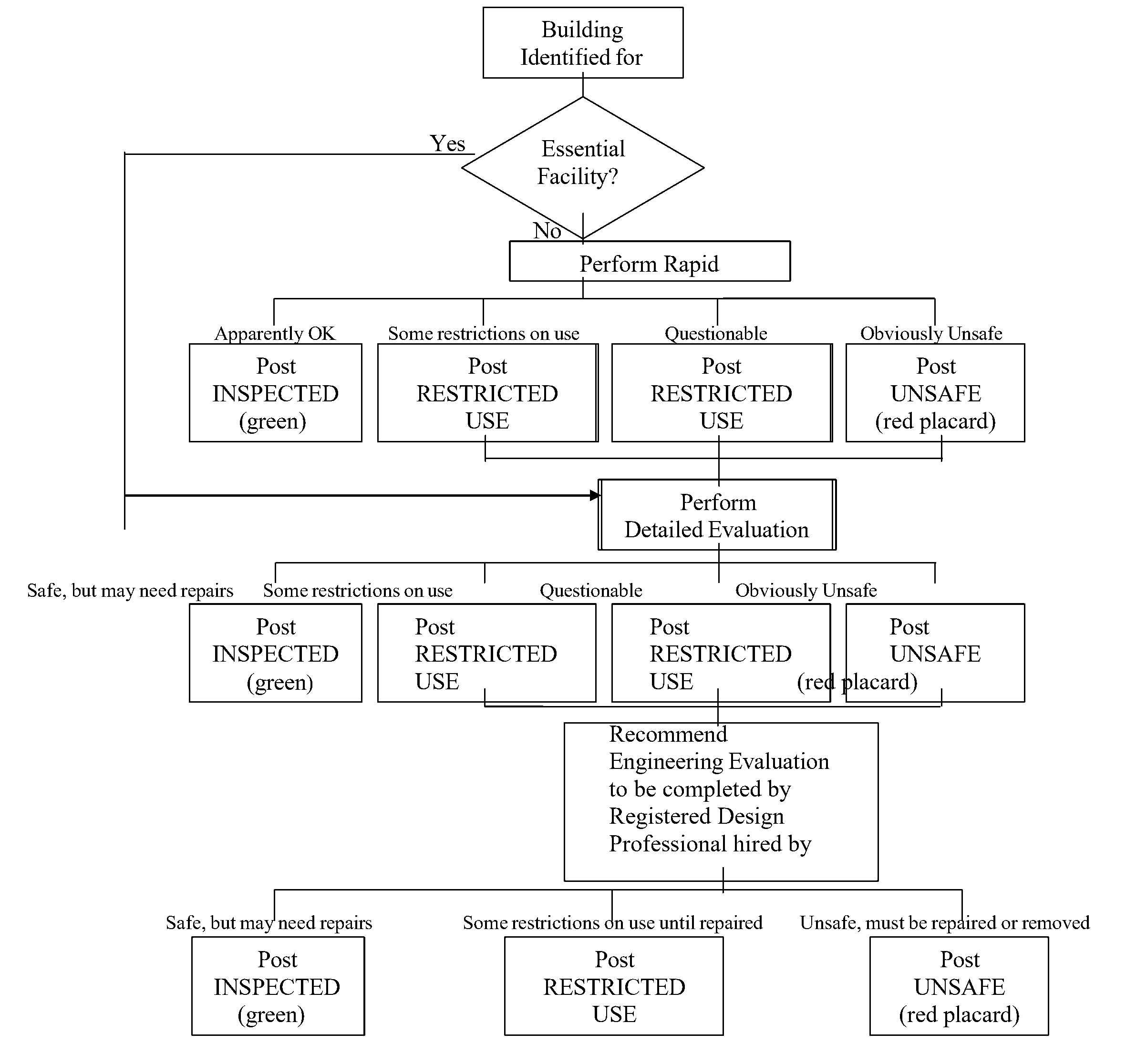 (a)When Disaster Strikes by the International Code Council, Inc., Seventh Printing: November 2011, copyright 2007 CHAPTER AQ2 DEFINITIONS SECTION AQ201 GENERAL AQ201.1 Scope. Unless otherwise expressly stated the following words and terms shall, for the purposes of this appendix, have the meanings shown in this chapter. AQ201.2 Terms defined in other codes.Where terms are not defined in this appendix and are defined in other International Codes, such terms shall have the meanings ascribed to them as in those codes. AQ201.3 Terms not defined. Where terms are not de- fined through the methods authorized by this section, such terms shall have their ordinarily accepted meanings such as the context implies. SECTION AQ202 DEFINITIONS 500-YEAR FLOOD. Flood having a 0.2% annual probability of being equaled or exceeded. ADVISORY BASE FLOOD ELEVATION (ABFE). An advisory base flood elevation (BFE) issued by the Federal Emergency Management Agency (FEMA) that reflects post-storm conditions and vulnerability to damages from future flooding. BASE FLOOD. Flood having a 1% chance of being equaled or exceeded in any given year, also referred to as the 100-year flood. BASE FLOOD ELEVATION (BFE). The elevation of flooding, including wave height, having a 1% chance of being equaled or exceeded in any given year established relative to the National Geodetic Vertical Datum (NGVD), North American Vertical Datum (NAVD) or other datum specified on the Flood Insurance Rate Map (FIRM). BUILDING OFFICIAL. The officer or other designated authority charged with the administration and enforcement of the International Building Code, or the building Georgia International Building Code 2026 Amendments official's duly authorized representative. DESIGN FLOOD. The greater of the following two flood events: (1) The base flood, affecting those areas identified as special flood hazard areas on the community's FIRM; (2) The flood corresponding to the area designated as a flood hazard area on a community's flood hazard map or otherwise legally designated. DESIGN FLOOD ELEVATION (DFE). The elevation of the design flood, including wave height, relative to the datum specified on the community's legally designated flood hazard map. In areas designated as Zone AQ, the design flood elevation shall be the elevation of the highest existing grade of the building's perimeter plus the depth number (in feet) specified on the flood hazard map. FLOOD [DAMAGE]-RESISTANT MATERIAL. Any building product [material, component or system] capable of withstanding direct and prolonged contact with floodwaters without sustaining significant damage. FLOOD HAZARD MAP. Map delineating flood hazard areas adopted by the authority having jurisdiction. FLOOD INSURANCE RATE MAP (FIRM). An official map of a community on which the Federal Emergency Management Agency (FEMA) has delineated both the special flood hazard areas and the risk premium zones applicable to the community. FREEBOARD. A factor of safety expressed in feet above a flood level for purposes of floodplain management. FUTURE-CONDITIONS FLOOD. The flood having a 1% chance of being equaled or exceeded in any given year based on future-conditioning hydrology. Also known as the 100-year future-conditions flood. FUTURE-CONDITIONS FLOOD ELEVATION. The flood standard equal to or higher than the Base Flood Elevation. The future conditions flood elevation is defined as the highest water surface anticipated at any given point during the future conditions flood. CHAPTER AQ3 FLOOD-RESISTANT CONSTRUCTION Forward: This appendix provides three different options for increased freeboard. The jurisdiction may pick only one option that is higher than previously adopted and enforced by the jurisdiction. The National Flood Insurance Program (NFIP) minimum standards reference Base Flood Elevation without any freeboard in high-risk flood hazard areas. Due to the flood damage prevention updates performed during the Map Modernization initiative that led to flood risks being digitally identified in all 159 Georgia counties, all Georgia NFIP participating communities have freeboard standards that meet or exceed the 1-foot standard used in the State model ordinances for areas where BFEs have been established. SECTION AQ301 HAZARD IDENTIFICATION AQ301.1 Identification of flood hazard areas. To establish flood hazard areas: (a) flood hazard map adopted by jurisdiction based on areas of special flood hazard as identified by the Federal Emergency Management Agency in an engineering report entitled "The Flood Insurance Study of [INSERT NAME OF JURISDICTION]," dated [INSERT DATE ISSUANCE] and amended or revised with the accompanying Flood Insurance Rate Map (FIRM) and Flood Boundary and Floodway Map (FBFM) and related supporting data along with any revisions thereto. (b) FIRM maps provided by the Federal Emergency Management Agency. SECTION AQ302 SCOPE AQ302.1 Flood loads. Buildings designed and constructed in flood hazard areas defined in IBC Section 1612.3.1 shall comply with the following: AQ302.1.1 Flood hazard areas without base flood elevations. In flood hazard areas without base flood or future-conditions flood elevation data, new construction and substantial improvements of existing structures shall have the lowest floor of the lowest enclosed area (including basement) elevated no less than three (3) feet above the highest adjacent grade to the building foundation. OPTION A - FLOOD ELEVATION AQ302.1.2 Increase to base flood elevation requirements. Floors required by ASCE 24 to be built above base flood elevations as follows: The higher of: (a) Design flood elevation plus one (1) foot, or (b) Base flood elevation plus one (1) foot, or (c) Advisory base flood elevation, or (d) Future-conditions plus one (1) foot, if known or (e) 500-year flood, if known OPTION B- FLOOD ELEVATION AQ302.1.3 Increase to base flood elevation requirements. Floors required by ASCE 24 to be built above base flood elevations as follows: The higher of: (a) Design flood elevation plus two (2) feet, or (b) Base flood elevation plus two (2) feet, or (c) Advisory base flood elevation, or (d) Future-conditions plus one (1) foot, if known or (e) 500-year flood, if known OPTION C - FLOOD ELEVATION AQ302.1.4 Increase to base flood elevation requirements. Floors required by ASCE 24 to be built above base flood elevations as follows: The higher of: (a) Design flood elevation plus three (3) feet, or (b) Base flood elevation plus three (3) feet, or (c) Advisory base flood elevation, or (d) Future-conditions plus one (1) foot, if known or (e) 500-year flood, if known SECTION AQ303 FLOOD DAMAGE-RESISTANT MATERIALS AQ303.1 Flood damage-resistant materials. Flood damage-resistant materials comply with FEMA Technical Bulletin 2, Table 2. Types, Uses, and Classifications of Materials. AQ303.2 Location of flood damage-resistant materials. Building components and materials located below the increase to base flood elevation as determined by the local jurisdiction in accordance with AQ302.1 shall be flood damage resistant as defined by Section AQ303.1. AQ303.3 Fasteners and connectors used for flood damage-resistant materials. Fasteners and connectors used for flood damage resistant materials to be made of stainless steel, hot-dipped zinc-coated galvanized steel, mechanically deposited-zinc coated, silicon bronze or copper. Copper fasteners shall not be permitted for use in conjunction with steel. CHAPTER AQ4 HIGH-WIND RESISTIVE CONSTRUCTION SECTION AQ401 GENERAL AQ401.1 Applications. Buildings, and parts thereof shall be designed to withstand the minimum wind loads and meet the opening protection requirements of IBC Section 1609 as modified in this chapter. Wind Load Option A, B or C shall be selected. Table AQ401.1 may be used to assist in the selection of an appropriate Wind Load Option. AQ401.2 Limitations. The following limitations shall apply to the design and construction of buildings with respect to winds. AQ401.2.1 Empirical masonry. The empirical masonry provisions in IBC Section 2109 or Chapter 5 of TMS 402/ACI 530/ASCE 5 shall not be permitted to be used for the wind load resisting elements of buildings, or parts of buildings or other structures. AQ401.2.2 Unreinforced (plain) masonry. The unreinforced masonry provisions in IBC Section 2109 or sections 2.2, 3.2 or 8.2 of TMS 402/ACI 530/ASCE 5 shall not be permitted to be used for the wind load resisting elements of buildings, or parts of buildings or other structures. AQ401.2.3 Conventional light-frame construction. The conventional light-frame construction provisions in IBC Section 2308 shall not be permitted to be used for the wind load resisting elements of buildings, or parts of buildings, or other structures. Exception: Compliance with AF&PA WFCM shall be permitted subject to the limitations therein and the limitations of this appendix. SECTION AQ402 DEFINITIONS AND NOTATIONS AQ402.1 General. The following terms are defined in Chapter 2 of the International Building Code: CONVENTIONAL LIGHT-FRAME CONSTRUCTION. MASONRY. Unreinforced (plain) masonry. WIND-BORNE DEBRIS REGION. WIND SPEED,Vult. SECTION AQ403 WIND LOADS AQ403.1 Wind Directionality Factor. The directionality factor for Wind Option B and C shall be taken as 1.0. AQ403.2 Exposure. Wind pressures for Wind Option B and C shall be based on exposure category C or D in accordance with IBC Section 1609.4 or ASCE 7. AQ403.3 Enclosure classification. The enclosure classification shall be determined in accordance with ASCE 7 with the largest door or window on a wall that receives positive external pressure considered as an opening. AQ403.4 Continuous operation of Risk Category IV buildings. When a building or an internal area within a building in Risk Category IV is required to remain operational during a design wind event (target performance level OB), that building or that internal area shall be designed in accordance with ICC-500 or FEMA- 361. SECTION AQ404 WIND LOAD OPTION A AQ404.1 Basic wind speed. The ultimate wind speed, Vult, for use in the design of buildings and structures shall be obtained from IBC Section 1609.3. AQ404.2 Debris Hazard and Protection of Openings. Buildings shall be designed for impact resistance in accordance with IBC Section 1609.2 or ASCE 7. Exception: 1. For Risk Category III buildings with a Life Safety target performance level for the entire building, the exterior glazing shall be impact resistant or be protected with an impact resistant covering meeting the requirements of ASTM E1996. 2. For Risk Category IV buildings with an Immediate Occupancy target performance level for the entire building, the exterior glazing shall be impact resistant or be protected with an impact resistant covering meeting the requirements of ASTM E1996 for Enhanced Protection. SECTION AQ405 WIND LOAD OPTION B AQ405.1 Basic wind speed. The ultimate design wind speed, Vult, for use in the design of Risk Category I buildings and structures shall be obtained from 0 Section 1609.3. The ultimate design wind speed, Vult, for use in the design of Risk Category II buildings and structures shall be obtained from IBC Figure 1609.3(1). The ultimate design wind speed, Vult, for use in the design of Risk Category III and IV buildings and structures shall be obtained from IBC Figure 1609.3(1) or 135 mph, whichever is greater. AQ405.2 Debris Hazard and Protection of Openings. Buildings shall be designed for impact resistance in accordance with this Section in addition to IBC Section 1609.2 or ASCE 7. Exception: 1. For Risk Category IV buildings, all components of the exterior envelope shall be impact resistant or be protected with an impact resistant covering meeting the requirements of ASTM E1996 for Enhanced Protection. SECTION AQ406 WIND LOAD OPTION C AQ406.1 Basic wind speed. The ultimate design wind speed, Vult, for use in the design of Risk Category I buildings and structures shall be obtained from IBC Section 1609.3. The ultimate design wind speed, Vult, for use in the design of Risk Category II buildings and structures shall be obtained from IBC Figure 1609.3(1). The ultimate design wind speed, Vult, for use in the design of Risk Category III and IV buildings and structures shall be obtained from IBC Figure 1609.3(1) or 170 mph, whichever is greater. AQ406.2 Debris Hazard and Protection of Openings. Buildings shall be designed for impact resistance in accordance with this Section in addition to IBC Section 1609.2 or ASCE 7. Exception: 1. For Risk Category IV buildings, all components of the exterior envelope shall be impact resistant or be protected with an impact resistant covering meeting the requirements of ASTM E1996 for Enhanced Protection. Table AQ401.1 WIND-LOAD OPTIONS: TARGET PERFORMANCE LEVELS AND DESIGN CRITERIA4 OPTION DESIGN WIND EVENT Risk Category II1 Risk Category III1 Risk Category IV1 Target Performance Level2 Min Wind Speed Vult Wind-Borne Debris Target Performance Level2 Min Wind Speed Vult Wind-Borne Debris Target Performance Level2 Min Wind Speed Vult Wind-Borne Debris A EF0 & 1 Tornado - IBC level Hurricane CP3 IBC 1609.3 IBC 1609.2 or ASCE 7 CP3 IBC 1609.3 IBC 1609.2 or ASCE 7 CP3 IBC 1609.3 IBC 1609.2 or ASCE 7 LS Glazing IO5 Glazing B EF2 Tornado - Cat 3 Hurricane CP3 for EF0-EF1-IBC Hurricane for Risk Cat. III/IV IBC 1609.3 for Risk Cat. III/IV IBC 1609.2 or ASCE 7 LS 145 mph Req'd for glazing per IBC 1609.2 and ASCE 7 IO5 145 mph Exterior Envelope C EF3 Tornado - Cat 4 Hurricane CP3 for EF0-EF1-IBC Hurricane for Risk Cat. III/IV IBC 1609.3 for Risk Cat. III/IV IBC 1609.2 or ASCE 7 LS 170 mph Req'd for glazing per IBC 1609.2 and ASCE 7 IO5 170 mph Exterior Envelope Notes: 1. Risk Category per IBC Section 1604.5 2. Performance Levels: CP: Collapse Prevention LS: Life Safety IO: Immediate Occupancy OB: Operational Building 3. LS for occupants away from exterior envelope. IO for storm shelters or safe rooms. 4. See Section AQ401 and Section AQ403 for additional limitations and criteria. 5. OB for building or an internal area within a building designed to ICC-500 or FEMA 361. CHAPTER AQ5 STORM SHELTERS, SAFE ROOMS AND BEST AVAILABLE REFUGE AREAS SECTION AQ 01 GENERAL AQ501.1 General. This section applies to the location and construction of storm shelters and safe rooms when constructed as separate detached buildings or as internal areas within buildings for the purpose of providing safe refuge for storms that produce high winds, such as tornados and hurricanes, and to the selection of best available refuge areas. Storm shelters shall be designed and constructed in accordance with IBC Section 423. Safe rooms shall be designed and constructed in accordance with FEMA 361. Storm shelters, safe rooms, and best available refuge areas shall be located on an accessible route. Exception:Residential Safe Rooms and safe rooms serving a Business Group B Occupancy and having an occupant load not exceeding 16 persons may be constructed in accordance with FEMA 320. AQ501.2 Occupant load. The occupant load for storm shelters and safe rooms shall be determined by ICC 500 and FEMA 361 respectively. AQ501.3 Construction documents. Construction documents for buildings containing a storm shelter or safe room shall include the information required in ICC 500 or FEMA 361 respectively. Construction documents for buildings with access to a remote community storm shelter or safe room shall indicate the location of and access to the community storm shelter or safe room. Construction documents for buildings not containing or without access to a remote storm shelter or safe room, shall indicate the best available refuge area. AQ501.4 Signage. The location(s) of storm shelters, safe rooms or the best available refuge area(s) shall be clearly marked with a permanent sign. BEST AVAILABLE REFUGE AREAS. Areas in a building that have been deemed by a registered design professional to likely offer the greatest safety for building occupants during a tornado or hurricane. Because these areas were not specifically designed as storm shelters or safe rooms, their occupants may be injured or killed during a tornado or hurricane. However, people in the best available refuge areas are less likely to be injured or killed than people in other areas of a building. SAFE ROOM. A building, structure or portions thereof, constructed in accordance with FEMA 361 and designed for use during a severe wind storm event, such as a hurricane or tornado. Community Safe Room. A safe room not defined as a "Residential Safe Room" Residential Safe Room. A safe room serving occupants of dwelling units and having an occupant load not exceeding 16 persons. SECTION AQ503 BEST AVAILABLE REFUGE AREAS AQ503.1 General. Best available refuge area occupants may be injured or killed during a tornado or hurricane. However, people in the best available refuge areas are less likely to be injured or killed than people in other areas of a building. AQ503.2 Occupant Density. The minimum required floor area per occupant for best available refuge area(s) shall be determined in accordance with ICC 500 Table 501.1.1. AQ503.3 Identification of best available refuge areas. Best available refuge areas shall be identified by a registered design professional in accordance with the Wind Hazard Checklist of FEMA 361, Appendix B and FEMA P-431. SECTION AQ502 DEFINITIONS AND NOTATIONS AQ502.1 Definitions. The following terms are defined in Chapter 2 of the International Building Code: DWELLING UNITS. OCCUPANT LOAD. STORM SHELTER. Community Storm Shelter. Residential Storm Shelter. AQ502.2 Additional definitions. SECTION AQ504 APPLICABILITY AQ504.1 Required storm shelters or safe rooms. 1. All new kindergarten through 12th grade schools with 50 or more occupants in total, per school, shall have a storm shelter or safe room. 2. All new 911 call stations, emergency operation centers, and fire, rescue, ambulance, and police stations shall have a storm shelter or safe room. CHAPTER AQ6 RESOURCES SECTION AQ601 CONTACTS Georgia Department of Community Affairs (DCA) Construction Codes Georgia State Amendments to the State Minimum Standard Codes DCA.GEORGIA.GOV/COMMUNITY-assistance/construction-codes Phone: 404-679-3118 Georgia Department of Natural Resources (DNR) Floodplain Management 4220 International Parkway, Ste. 101 Atlanta, GA 30354-3902 www.georgiadfirm.com Phone: 404-675-1757 Federal Emergency Management Agency (FEMA)www.fema.gov; www.floodsmart.gov www.fema.gov/rebuild/buildingscience/ FEMA Publications and Technical Bulletins: (www.fema.gov/library/index.jsp) (www.fema.gov/plan/prevent/floodplain/techbul.shtm) Georgia Emergency Management Agency (GEMA) Georgia Office of Homeland Security P.O. Box 18055 Atlanta, GA 30316- 0055 www.gema.ga.gov www.ready.ga.gov Phone: 404-635-7000 Georgia Association of Regional Commissions (GARC) www.garc.ga.gov (http://garc.ga.gov/main.php?Regional-Commissions-2) (for assistance in identifying Flood Hazard Areas) International Code Council (ICC) www.iccsafe.org National Weather Service www.weather.gov State Fire Marshal's Office 2 Martin Luther King Jr. Drive Suite 920 / West Tower Atlanta, Georgia 30334 www.oci.ga.gov Phone: 404-656-7087 SECTION AQ602 EMERGENCY INSPECTION KIT b [] Staff's disaster response management plan [] Sunscreen (SPF 15 or greater) [] Camera [] Team contact list [] Black markers [] Area maps [] Official identification [] Pens & pencils [] Personal identification [] Envelope for expense receipts [] Inspection forms and placards [] Compass, GPS unit [] Communication equipment [] Backpack, waistpack [] Clipboard [] Flashlight and extra batteries [] Hard hat [] Battery-operated radio [] Orange safety vest [] Duct tape [] Dust mask [] Staples & stapler [] Work gloves [] Staple gun [] Steel toe and waterproof boots [] Calculator [] Whistle [] First aid kit [] Tire repair kit [] Latex gloves Remember to grab: [] Safety glasses [] Personal identification [] Sunglasses [] Rain gear, extra clothing [] Pocket knife [] Water bottle [] Matches [] Prescription medication [] Antibacterial hand wipes or alcohol-based hand sanitizer [] Cell phone and charger [] Cash for personal expenses [] Insect repellant ( w/ Deet or Picaridin) [] Toiletries (b) Disaster Mitigation: A Guide for Building Departments by the International Code Council, Inc., copyright 2009 SECTION AQ603 SAFETY TIPS a 1. Always travel in teams of at least two people. 2. Always wear a hard hat, gloves, goggles, safety vest, and dust masks. 3. Always wear safety shoes capable of protecting the toes and bottom of the foot. 4. Survey the building exterior completely before entering. 5. Enter building only if authorized and if deemed safe to do so. 6. Be alert for falling objects. 7. In case of fire, injuries or victims, evacuate the area and alert the fire department immediately. 8. Avoid downed power lines and buildings under them or water surrounding them. 9. In case of gas leaks, shut off the gas (if possible) and report the leak. 10. In a flood situation, have a "walking stick." (a) When Disaster Strikes by the International Code Council, Inc., Seventh Printing: November 2011, copyright 2007 SECTION AQ604 MAJOR DISASTER PROCESS (from link https://www.fema.gov/disaster-declaration-process) A Major Disaster Declaration usually follows these steps:Incident occurs and local government responds, supplemented by neighboring communities and volunteer agencies. If overwhelmed, turn to the state for assistance;Generally the local government will issue a local state of emergencyThe State responds with state resources, such as the National Guard and state agencies;* Prior to committing state resources, the Governor will declare a state of emergency in the counties impacted by the event for which assistance is needed.Damage assessment by local, state, federal, and volunteer organizations determine losses and recovery needs;Generally the locals will submit a preliminary damage assessment to the state and the state will review and determine if state and/or federal assistance is needed. If federal assistance is needed, the state will request FEMA to perform a preliminary joint damage assessment. If the Governor determines that the incident is of such severity and magnitude that effective response is beyond the capabilities of the state and the affected local governments then supplementary Federal assistance is requested (next step).A Major Disaster Declaration is requested by the Governor, based on the damage assessment, and agreement to commit state funds and resources to the long-term recovery;FEMA evaluates the request and recommends action to the White House based on the disaster, the local community and the state's ability to recover;The President approves the request or FEMA informs the Governor it has been denied. This decision process could take a few hours or several weeks depending on the nature of the disasterSECTION AQ605 SAMPLE EVALUATION FORMS AND INSPECTION PLACARDS b (following pages) Figure AQ605.1b Figure AQ605.2 b
 Figure AQ605.3 b
  Figure AO605.4b
  Figure AO605.5b
  CHAPTER AQ7 REFERENCES REFERENCED STANDARDS ASCE Standards ASCE/SEI 24-14 Flood Resistant Design and Construction FEMA P-320, Fourth Edition / December 2014 Taking Shelter From the Storm: Building a Safe Room For Your Home or Small Business, Includes Construction Plans and Cost Estimates FEMA 361, Third Edition / March 2015 Design and Construction Guidance for Community Safe Rooms FEMA P-431, Second Edition/October 2009 Tornado Protection: Selecting Refuge Areas in Buildings FEMA Technical Bulletin 2, Table 2. Types, Uses, and Classifications of Materials REFERENCED RESOURCES a) When Disaster Strikes by the International Code Council, Inc., Seventh Printing: November 2011, copyright 2007 b) Disaster Mitigation: A Guide for Building Departments by the International Code Council, Inc., copyright 2009INDEX OF FIGURES: Figure AQ103.3 Post Disaster Building Safety Evaluation Chart a .................................................. 10 Figure AQ605.1 ATC-45 Rapid Evaluation Form .............................................................................. 18 Figure AQ605.2 ATC-45 Detail Evaluation Form .............................................................................. 19 Figure AQ605.3 Inspected Placard ....................................................................................................... 21 Figure AQ605.4 Restricted Placard ...................................................................................................... 22 Figure AQ605.5 Unsafe Placard ........................................................................................................... 23 INDEX B Best available refuge area Chapter 5, AQ501.1, AQ502.2, AQ503 Connectors ......................................... AQ303.3 Conventional Light-Frame Construction AQ401.2.3 E Emergency operation centers ............ AQ504.1 Enclosure classification ...................... AQ403.3 Essential Facility ................................. AQ103.3 Evaluation Detailed ............... AQ103.2.1, AQ103 3 2.2, AQ103.4 Engineering ..................... AQ103.2.2, AQ103 2.3, Figure 103.3 Rapid ........................ AQ103.2.1, AQ103.4, Figure AQ605.1 Exposure ............................................. AQ403.2 F Fasteners ............................................ AQ303.3 Flood 500-Year ....................... Chapter 2, AQ302.1.2, AQ302 1.3, AQ302.1.4 Base .................................... Chapter 2, AQ302.1.1 Design .............................................. Chapter 2 Future-conditions ............. Chapter 2, AQ302.1.1, AQ302.1.2, AQ302.1.3, AQ302.1.4 Flood Elevation Advisory Base ................................ Chapter 2, AQ302.1.2, AQ302 1.3, AQ302.1.4 Base ............................................... Chapter 2, AQ302.1.2, AQ302 1.3, AQ302.1.4 Design ........................................ Chapter 2, AQ302.1.2, AQ302 1.3, AQ302.1.4 Futures-conditions ........................... Chapter 2 Flood Hazard Area .. AQ102.1.1, Chapter 2, AQ301.1, AQ302.1, AQ302.1.1 Flood-(Damage)Resistant Material Chapter 2, AQ303 Freeboard ............................... Chapter 2, Chapter 3 G Grade Schools ...................................... AQ504 I Impact Resistant ....... .AQ404.2, AQ405.2, AQ406.2 Inspections ........ AQ103.1, AQ103.2 M Masonry Empirical ........................................ AQ401.2.1 Unreinforced ................................... AQ401.2.2 O Opening Protection ..... AQ401.1, AQ404.2, AQ405.2, AQ406.2 P Placards .... AQ103.2.1, AQ103.5, Figure AQ605.3-AQ605.5 S Safe rooms Community ....................................... AQ502.2 Occupant density.......................... AQ501.2, AQ503.2 Residential............................. AQ501.1, AQ502, AQ502.2 Sample Ordinance ....................... Page 2,3,and 4 Storm shelters ........ AQ101.3.3, Table AQ401.1, Chapter AQ5 Substantial alterations .................... AQ102.1.1 Substantial improvements .................. AQ101 3.1, AQ302.1.1 T Table of Contents .................................. Page 7 U Ultimate design wind speed ......... AQ404.1, AQ405.1, AQ406.1 V Violations ............................................ AQ101.4 W Wind Directionality Factor .............. AQ403.1 Wind Load ......................................... AQ401, AQ403, AQ404, AQ405, AQ406 Cite as Ga. Comp. R. & Regs. R. 110-11-1-.24
Authority: O.C.G.A. § 8-2-20 et seq.
History. Original Rule entitled "International Building Code (IBC), 2012 Edition with 2014 Georgia State Amendments" adopted. F. Nov. 13, 2013; eff. Jan. 1, 2014, as specified by the Agency.
Amended: New title, "International Building Code (IBC), 2012 Edition with 2014 and 2015 Georgia State Amendments." F. Nov. 12, 2014; eff. Jan. 1, 2015, as specified by the Agency.
Amended: F. Nov. 17, 2016; eff. Jan. 1, 2017, as specified by the Agency.
Amended: New title, "International Building Code (IBC), 2012 Edition with 2014 and 2015 and 2017 and 2018 Georgia State Amendments." F. Nov. 21, 2017; eff. Jan. 1, 2018, as specified by the Agency.
Amended: New title, "International Building Code (IBC), 2018 Edition with 2020 Georgia State Amendments." F. Dec. 7, 2018; eff. Jan. 1, 2020, as specified by the Agency.
Amended: New title, "International Building Code (IBC), 2018 Edition with 2020 and 2022 Georgia State Amendments." F. Nov. 18, 2021; eff. Jan. 1, 2022, as specified by the Agency.
Amended: New title, "International Building Code (IBC), 2018 Edition with 2020, 2022 and 2024 Georgia State Amendments." F. Oct. 11, 2023; eff. Jan. 1, 2024, as specified by the Agency.
Amended: New title, "International Building Code (IBC), 2018 Edition with 2020, 2022, 2024 and 2025 Georgia State Amendments." F. Nov. 21, 2024; eff. Jan. 1, 2025, as specified by the Agency.
Amended: New title, "International Building Code (IBC), 2024 Edition with 2026 Georgia State Amendment." F. Dec. 2, 2025; eff. Jan. 1, 2026, as specified by the Agency.