2026-12749
91 FR 38162
Safety Standard for Lithium-Ion Batteries Used in Micromobility Products and Electrical Systems of Micromobility Products Containing Such Batteries
Published Jun 24, 202691 FR 38162Consumer Product Safety Commission
CONSUMER PRODUCT SAFETY COMMISSION
16 CFR Parts 1112 and 1265
[CPSC Docket No. CPSC-2025-0012]
RIN 3041-AE10
Safety Standard for Lithium-Ion Batteries Used in Micromobility Products and Electrical Systems of Micromobility Products Containing Such Batteries
AGENCY:
Consumer Product Safety Commission.
ACTION:
Notice of proposed rulemaking.
SUMMARY:
The U.S. Consumer Product Safety Commission (CPSC) issues this notice of proposed rulemaking (NPR) to address the unreasonable risk of death and injury associated with lithium-ion batteries used in micromobility products due to hazards such as thermal runaway of lithium cells, which can lead to fires, explosions, gas releases, burns, overheating, and smoke inhalation. The NPR proposes that electrical systems using lithium-ion batteries in micromobility products comply with applicable voluntary standards, with modifications. Because some micromobility products are children's products requiring third party testing, the NPR also proposes to add this rule to the list of rules that require such testing.
DATES:
Deadline for Written Comments: Written comments on the NPR or the Paperwork Reduction Act (PRA) must be received by August 24, 2026.
Deadline for Request to Present Oral Comments: Any person interested in making an oral presentation must send an email indicating this intent to the Office of the Secretary at cpsc-os@cpsc.gov by July 24, 2026.
ADDRESSES:
Submit comments, identified by Docket No. CPSC-2025-0012, by any of the following methods:
Electronic Submissions: Submit electronic comments to the Federal eRulemaking Portal at: https://www.regulations.gov. Follow the instructions for submitting comments. CPSC typically does not accept comments submitted by email, except through www.regulations.gov. CPSC encourages you to submit electronic comments by using the Federal eRulemaking Portal, as described above.
Mail/Hand Delivery/Courier/Confidential Written Submissions: Submit comments by mail, hand delivery, or courier to: Office of the Secretary, Consumer Product Safety Commission, 4330 East-West Highway, Bethesda, MD 20814; (301) 504-7479. If you wish to submit confidential business information, trade secret information, or other sensitive or protected information that you do not want to be available to the public, you may submit such comments by mail, hand delivery, or courier, or you may email them to: cpsc-os@cpsc.gov.
Instructions: All submissions must include the agency name and docket number. CPSC may post all comments without change, including any personal identifiers, contact information, or other personal information provided, to https://www.regulations.gov. Do not submit through this website: Confidential business information, trade secret information, or other sensitive or protected information that you do not want to be available to the public. If you wish to submit such information, please submit it according to the instructions for mail/hand delivery/courier/confidential written submissions.
Docket: For access to the docket to read background documents, a plain language summary of the proposed rule, or comments received, go to: https://www.regulations.gov, and insert the docket number, CPSC-2025-0012, into the “Search” box, and follow the prompts.
FOR FURTHER INFORMATION CONTACT:
Jay Kadiwala, Project Manager, Electrical Engineer, Office of Risk Reduction, Consumer Product Safety Commission, National Product Testing and Evaluation Center, 5 Research Place, Rockville, MD 20850; telephone: (301) 987-2517; jkadiwala@cpsc.gov.
SUPPLEMENTARY INFORMATION:
I. Introduction
The increasing use of micromobility products powered from multi-cell lithium-ion rechargeable batteries is a growing safety concern because of the potential for deadly smoke and fires that can spread beyond the product. For the purposes of this NPR, a “micromobility product” includes the following lithium-ion battery-powered vehicles, where “e” represents “electric”: eBikes, eScooters, 1 self-balancing scooters (such as Hoverboards; eSBscooters), eSkateboards, eUnicycles, and hybrids of these micromobility products within CPSC's jurisdiction.
1 Includes both stand-up and seated eScooters.
As explained in detail in section III of this preamble, over a five-year period from 2019 through 2023, CPSC is aware of 227 unique incidents—involving fires, explosions, gas releases, burns, overheating, and smoke inhalation—that potentially could have been prevented by this proposed rule; 90 incidents are associated with 39 fatalities and 181 injuries, and 39 out of the 227 incidents involved multiple deaths and injuries. Thus, consumers of micromobility products may be exposed to risks of injury or death from these products. Consequently, the Commission is issuing this NPR to address the unreasonable risk of death and injury associated with lithium-ion batteries used in micromobility products and their electrical systems.
A. Overview of the Proposed Rule
In this NPR, 2 the Commission proposes to regulate lithium-ion batteries used in micromobility products and the electrical systems of micromobility products containing such batteries, including all components that make up an electrical system, such as lithium-ion batteries, battery management systems (BMS), chargers, and any other electrical component addressed in the applicable voluntary standard, collectively, “micromobility electrical systems.” In addition to original equipment manufacturer (OEM) lithium-ion batteries sold with a micromobility product, the NPR proposes to regulate lithium-ion batteries for use in micromobility products but sold separately from the micromobility product (termed “user replaceable battery packs”), including components sold in eBike electrical system conversion kits.
2 This NPR is based on the information and analysis contained in this NPR and in the January 8, 2025, Staff Briefing Memorandum: Draft Proposed Rule to Establish a Safety Standard for Lithium-Ion Batteries Used in Micromobility Products and Electrical Systems of Micromobility Products Containing Such Batteries (Staff's NPR Briefing Memo); available at: https://www.cpsc.gov/s3fs-public/Decisional-Package-Draft-Proposed-Rule-to-Establish-a-Safety-Standard-for-Lithium-Ion-Batteries-and-Micromobility-Products.pdf?VersionId=Ob0VAPOfK5iRbXyKJ8SxqwR9SXLkxOnS. On March 26, 2025, CPSC staff sent corrections to the draft proposed rule to the Commission, available at: https://www.cpsc.gov/s3fs-public/Package-Corrections-to-Draft-Proposed-Rule-to-Establish-a-Safety-Standard-for-Lithium-Ion-Batteries.pdf?VersionId=fhpnWvJVNIRL1dMRP3ByUYel0xPJf_kH.
Based on the incident data and analysis presented in this NPR, the Commission preliminarily determines that micromobility electrical systems, user replaceable battery packs sold separately from a micromobility product, aftermarket battery chargers sold separately from a micromobility product, and components for eBike conversion kits, present an unreasonable risk of injury and death to consumers from electric shock, fires, explosions, expulsion of gas or flames, burns, overheating, and smoke inhalation (collectively the “associated hazards”) if they are not compliant with the requirements of this NPR. Particularly, hazards associated with “thermal runaway,” which is a self-sustaining internal cell chemical reaction that results in the rapid generation of heat that ignites the flammable electrolyte, can lead to serious injury and death. Thermal runaway occurs when burning hot gases create pressure that can cause flaming materials and gases to be ejected from the cell casing, resulting in an explosion and/or fire. The intense fire can in turn induce thermal runaway in adjacent cells and ignite combustible materials near the battery.
Additionally, the products within the scope of this proposed rule may present a risk of electric shock where voltages are at or greater than 42.4 peak VAC (volts alternating current) or 60 VDC (volts direct current). CPSC staff have not identified electric shock incidents involving micromobility products. However, at this time, the majority of micromobility product batteries are rated below 60 VDC and do not present a shock hazard from the battery. As micromobility products become more powerful and extend the range of operation, battery packs may exceed 60 VDC and can present a shock hazard that could result in serious injury or death. Further, chargers (both external and those integrated into the micromobility product) are powered from 120 VAC utility power and can present a shock hazard that could result in serious injury or death.
To address the unreasonable risks of injury associated with lithium-ion batteries used in micromobility products and their electrical systems, the NPR proposes that each product within the scope of the rule meet the performance requirements in the applicable voluntary standard, with modifications as described in sections IV and V of this preamble:
• ANSI/CAN/UL 2849:2020, Standard for Safety for Electrical Systems for eBikes (UL 2849-20) (eBikes);
• ANSI/CAN/UL 2272:2024, Standard for Safety for Electrical Systems for Personal E-Mobility Devices (UL 2272-24) (eScooters, eSBscooters, eSkateboards, eUnicycles, and hybrid products, collectively “other micromobility products,” or “personal eMobility products” (OMPs)); and
• ANSI/CAN/UL/ULC 2271:2023, Standard for Safety for Batteries for Use in Light Electric Vehicle (LEV) Applications (UL 2271-23) (user replaceable battery packs).
Section IV of this preamble evaluates performance and labeling requirements in the voluntary standards and their ability to eliminate or adequately reduce the hazards associated with lithium-ion batteries and micromobility product electrical systems. CPSC's analysis finds that, overall, the performance requirements in UL 2849-20, UL 2272-24, and UL 2271-23 are inadequate to eliminate or adequately reduce the unreasonable risks of injury, because the performance requirements do not address all identified hazards associated with lithium-ion batteries and micromobility product electrical systems. Accordingly, the NPR proposes the following modifications to performance requirements to adequately reduce the associated hazards, including:
• Adding to UL 2849-20 and UL 2271-23 tamper-resistant battery enclosure requirements from UL 2272-24 to reduce the risk of injury associated with consumers accessing the battery pack;
• Adding to UL 2849-20 and UL 2271-23 post-discharge charge test requirements from UL 2272-24 to reduce the risk of injury by ensuring that the BMS prohibits charging the battery if the cell surface temperature exceeds the specified upper limit;
• Adding to UL 2849-20, UL 2272-24, and UL 2271-23, a reverse polarity test to reduce the risk of injury by preventing damage to the battery pack due to use of an incompatible charger.
The NPR also proposes that labeling requirements be revised in each of the three voluntary standards, UL 2849-20, UL 2271-23, and UL 2272-24, for all products within the scope of the rule, to adequately reduce the risk of injury associated with foreseeable consumer use and misuse of lithium-ion batteries and micromobility electrical systems by improving safety messaging addressing electric shock and thermal runaway, and additional identified hazard patterns such as homemade batteries and unsafe battery charging.
As discussed in section IV of this preamble, micromobility products as a whole do not substantially comply with the applicable voluntary standards. Accordingly, the NPR proposes that products within the scope of the rule meet the requirements in applicable voluntary standards, as they are proposed to be modified.
B. Background and Statutory Authority
The Commission proposes this NPR under sections 7 and 9 of the Consumer Product Safety Act (CPSA). 15 U.S.C. 2056 and 2058. Section 7(b)(1) of the CPSA requires the Commission to rely on a voluntary standard, rather than promulgate a mandatory standard, when product compliance with the voluntary standard would eliminate or adequately reduce the risk of injury associated with a product, and it is likely that products are in substantial compliance with the voluntary standard. 15 U.S.C. 2056(b)(1). As explained in section IV of this preamble, the Commission preliminarily determines that the applicable voluntary standards are inadequate to fully address the risks of injury from associated hazards, including thermal runaway, for products within the scope of the rule, and that overall, micromobility products do not substantially comply with the applicable voluntary standards.
Section 9 of the CPSA specifies the procedure the Commission must follow to issue a consumer product safety standard under section 7 of the CPSA. Section 9 authorizes the Commission to issue an NPR, which includes a proposed rule and a preliminary regulatory analysis, in accordance with section 9(c) of the CPSA. 15 U.S.C. 2058(c). We request comments from the public regarding the associated hazard patterns and risks of injury identified by the Commission in section III of this preamble, the regulatory alternatives being considered, and other possible alternatives for addressing the risks discussed in sections III and VI of this preamble. By statute, the preliminary regulatory analysis must include:
• a preliminary description of the potential benefits and potential costs of the proposed rule, including any benefits or costs that cannot be quantified in monetary terms, and an identification of those likely to receive the benefits and bear the costs;
• a discussion of applicable voluntary standards;
• a description of any reasonable alternatives to the proposed rule, together with a summary description of their potential costs and benefits, and a brief explanation of why such alternatives should not be published as a proposed rule.
Id. Tab A of Staff's January 8, 2025, NPR Briefing Memo and section VI of this preamble provide the required preliminary regulatory analysis for a mandatory standard.
After issuing an NPR, the Commission will consider the comments received in response to the NPR and decide whether to issue a final rule, along with a final regulatory analysis. 15 U.S.C. 2058(c)-(f). If requested by commenters, the Commission also will provide an opportunity for interested persons to make oral presentations of data, views, or arguments, in accordance with section 9(d)(2) of the CPSA. 15 U.S.C. 2058(d)(2).
According to section 9(f)(1) of the CPSA, before promulgating a consumer product safety rule, the Commission must consider, and make appropriate findings to be included in the rule, on the following issues:
• The degree and nature of the risk of injury that the rule is designed to eliminate or reduce;
• The approximate number of consumer products subject to the rule;
• The need of the public for the products subject to the rule and the probable effect the rule will have on utility, cost, or availability of such products; and
• The means to achieve the objective of the rule while minimizing adverse effects on competition, manufacturing, and commercial practices.
15 U.S.C. 2058(f)(1). At the NPR stage, the Commission is making these findings preliminarily to allow the public to comment on the findings. Appendix A to the proposed regulation text contains the Commission's proposed findings.
Under section 9(f)(3) of the CPSA, to issue a final rule, the Commission must find that the rule is “reasonably necessary to eliminate or reduce an unreasonable risk of injury associated with such product” and that issuing the rule is in the public interest. 15 U.S.C. 2058(f)(3)(A)-(B). Additionally, if a voluntary standard addressing the risk of injury has been adopted and implemented, the Commission must find that:
• The voluntary standard is not likely to eliminate or adequately reduce the risk of injury, or
• Substantial compliance with the voluntary standard is unlikely.
15 U.S.C. 2058(f)(3)(D). The Commission also must find that the expected benefits of the rule bear a reasonable relationship to its costs and that the rule imposes the least burdensome requirements that would adequately reduce the risk of injury. 15 U.S.C. 2058(f)(3)(E)-(F). As set forth in section XIV of this preamble, the Commission at this time makes preliminary findings on these requirements.
C. CPSC's Jurisdiction Over Micromobility Products
Under the CPSA, CPSC has jurisdiction over “consumer products,” which includes their component parts. 15 U.S.C. 2052(a)(5). The definition of a “consumer product” under the CPSA excludes medical devices under the Federal Food and Drug Administration's (FDA) jurisdiction; articles which are not customarily produced or distributed for sale to, or use or consumption by, or enjoyment of, a consumer; products where a risk of injury could be eliminated or reduced to a sufficient extent by actions taken under the Occupational Health and Safety Act; and “motor vehicles” and “motor vehicle equipment” as defined in the National Traffic and Motor Vehicle Safety Act of 1966. 15 U.S.C. 2052(a)(5)(A) and (C), 2080(a); 49 U.S.C. 30102. A “motor vehicle” is “a vehicle driven or drawn by mechanical power and manufactured primarily for use on public streets, roads, and highways, but does not include a vehicle operated only on a rail line.” 49 U.S.C. 30102. Accordingly, CPSC has jurisdiction over any micromobility product that is not a “motor vehicle” under the jurisdiction of the National Highway Traffic Safety Administration (NHTSA). CPSC's jurisdiction includes commercially owned micromobility products that are used by consumers, for instance in rental fleets. See 47 U.S.C. 2052(a)(5) (defining “consumer product” to include products “produced or distributed . . . for the personal use, consumption or enjoyment of a consumer in or around a permanent or temporary household or residence, a school, in recreation, or otherwise”).
Thus, CPSC has jurisdiction over products such as racing bikes, dirt bikes, all-terrain vehicles (ATVs), scooters, bikes, and skateboards. 3 In contrast to these products, motor vehicles intended for on-road use generally have features such as a Vehicle Identification Number (VIN), as well as other on-road capabilities which may include head lights, taillights, brake lights, and side mirrors. 4 When jurisdictional issues arise, CPSC staff discuss specific products with NHTSA staff.
3 Congress specifically stated CPSC's jurisdiction over low-speed bicycles, which is implemented in CPSC's bicycle regulations. 15 U.S.C. 2085; 16 CFR 1512.2(a)(2). In addition, pedal-assisted eBikes that are not capable of continued self-propulsion fall within CPSC's jurisdiction. See, for example, NHTSA's guidance at: https://www.nhtsa.gov/interpretations/07-001825as.
4 See https://www.nhtsa.gov/importing-vehicle/importation-and-certification-faqs-0.
II. Micromobility Products Within the Scope of the Rule
A. Description of Micromobility Products
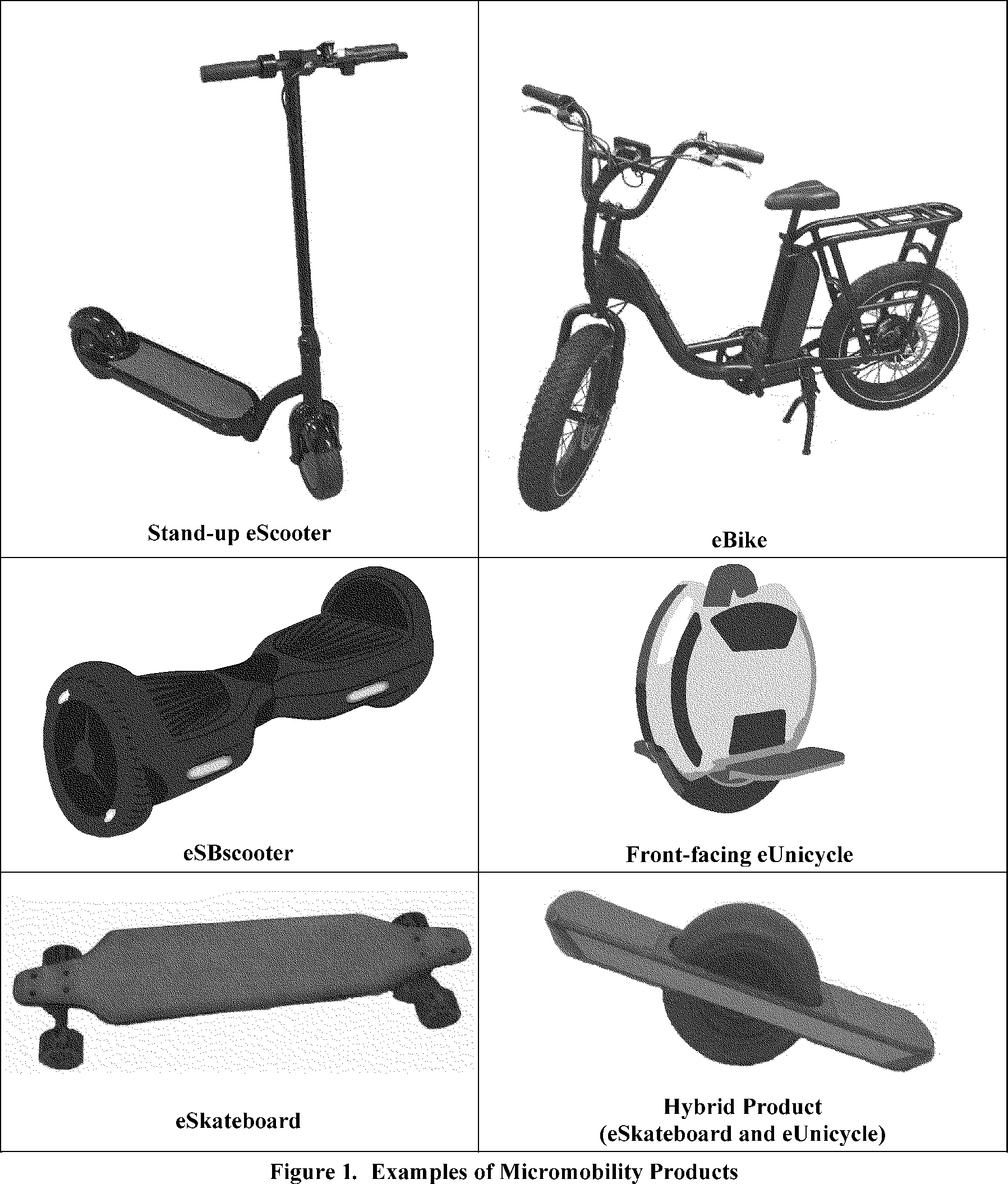
The Commission proposes to regulate lithium-ion batteries used in micromobility products and the electrical systems of micromobility products containing such batteries, including six types of micromobility products: eBikes, eScooters, eSBscooters, eSkateboards, eUnicycles, and hybrids of these products. Figure 1 shows examples of these micromobility products.
Generally, micromobility products are marketed, intended, and designed for recreational off-road use and for transportation in urban and suburban areas, typically for short distances. Micromobility products rely on one or more wheels driven by electric motors that receive electrical power from a rechargeable lithium-ion battery, via a motor control circuit, to start and stop the product and control its speed. The type of micromobility product dictates how a user rides and controls the product. This NPR proposes to address electrical hazards associated with all micromobility products subject to UL 2849-20 and UL 2272-24, as defined in the standards, but excludes products that are not within CPSC's jurisdiction. 5 This NPR also includes user replaceable battery packs subject to UL 2271-23, which are sold separately for use in micromobility products within the scope of this proposed rule.
5 Lithium battery-powered motive products that are not micromobility products are excluded from the scope of this proposed rule including children's battery-powered ride-on toys (defined in 16 CFR part 1250), ATVs (defined in 16 CFR part 1420), Recreational Off-Highway Vehicles (defined in ANSI/ROHVA 1-2023), Multipurpose Off-Highway Utility Vehicles (defined in ANSI/OPEI B71.9-2022), and Golf Cars (defined in ANSI/ILTVA Z130.1).
UL 2849-20 addresses electrical hazards associated with eBikes. All other micromobility products covered by this NPR, including eScooters, eSBscooters, eSkateboards, eUnicycles, and hybrids of these products (collectively, OMPs or personal eMobility products), are defined in section 6.25 of UL 2272-24 as a “Personal E-Mobility Device- [a] consumer mobility device intended for a single rider with a rechargeable electric drive train that balances and propels the rider, and which may be provided with a handle for grasping while riding, but excludes motorized wheelchairs including mobility scooters for medical purposes. This device may or may not be self-balancing.” This section describes products within the scope of this NPR. 6
6 For more information on the generic physical design of micromobility products and common differentiating features, see Society of Automotive Engineers International (SAE) J3194, Taxonomy & Classification of Powered Micromobility Vehicles (SAE J3194).
eBikes —Section 5.4 of UL 2849-20 defines an “eBike” as “[a] two or three wheeled electrical/mechanical device provided with functional pedals that includes one or more electric motors to either assist the rider when pedaling (in Electrically Power Assisted Cycle (EPAC) versions) or provide motive power to the wheels when the rider is not pedaling.” 7 As shown in Figure 1, most eBikes have two wheels with tubed rubber tires that are inline, a seat for a rider, and handlebars for steering the front wheel while power is applied to the rear tire. When the rider pedals an EPAC eBike, a charged onboard battery pack supplies electrical power to a motor that “assists” the rider by reducing the mechanical energy required from the rider to apply a given force to the drivetrain. In this product, the battery pack is generally user replaceable, meaning that it can be removed from the eBike for charging. When the electrical system is not engaged, an EPAC eBike functions as a traditional non-powered bicycle. 8
7 Bicycles are subject to an existing product safety regulation, 16 CFR part 1512. In March 2024, the Commission issued an advance notice of proposed rulemaking for mechanical hazards related to eBikes. 89 FR 18861 (Mar. 15, 2024).
8 Traditional bicycles, as well as some eBikes, are subject to the mechanical requirements set forth in 16 CFR part 1512. The scope of part 1512 includes: (a) two-wheeled bikes whose rear drive wheel is solely human-powered, and (b) two- or three-wheeled bikes with operable pedals, an electric motor of less than 750 watts, and a powered maximum speed on a paved level surface less than 20 miles per hour (mph) when being ridden by a person weighing 170 pounds. 16 CFR 1512.2(a). All lithium-powered eBikes that fall within the scope of § 1512.2(a)(2) are also included within the scope of this NPR, because part 1512 regulates mechanical hazards and this NPR proposes to regulate electrical hazards associated with such eBikes. This rule also includes eBikes that exceed the wattage, speed, and weight limits set forth in § 1512.2(a)(2), as long as the product is not a motor vehicle or otherwise outside the Commission's jurisdiction.
eScooters —UL 2272-24 addresses electrical hazards associated with eScooters. As shown in Figure 1, stand-up eScooters have two inline wheels with a long flat platform between the wheels where the rider places their feet. The rider places one foot in front of the other and is generally in a standing position with their hands on the handlebars to steer the front wheel. A sit-down eScooter looks much like a bicycle but does not have functional pedals. An eScooter battery pack can be either integral to the product or user replaceable. Riders generally control an eScooter's speed using a hand-controlled throttle, and eScooter braking can be actuated either electrically or manually.
eSBscooters —UL 2272-24 addresses electrical hazards associated with eSBscooters. As shown in Figure 1, eSBscooters are battery-powered scooters having two foot pads that are side-by-side with one driven wheel on each side of each foot pad. Battery packs are typically integral to eSBscooters but may be user replaceable. The rider generally controls the scooter by slight tilting of one or both feet or shifting their body weight to angle one or both footpads slightly downward to propel the scooter; eSBscooters generally do not have a handlebar or use hand controls to steer the scooter. Accordingly, eSBscooters require the rider to have the ability to balance on the scooter to effectively steer and operate the product.
eSkateboards —UL 2272-24 addresses electrical hazards associated with battery-powered skateboards. eSkateboards are like traditional non-powered skateboards, except they have a motor powered by a lithium-ion battery pack mounted underneath the foot platform. Riders typically operate eSkateboards using a remote control, but some eSkateboards operate using only body weight, by leaning to one side of the eSkateboard to control both direction and speed. eSkateboards do not have a handlebar.
eUnicycles —UL 2272-24 addresses electrical hazards associated with eUnicycles, shown in Figure 1. eUnicycles, generally powered by one or two lithium-ion battery packs, have one wheel that sits between the rider's feet. To ride, the user stands on two foldable metal flaps on opposite sides of the wheel. The rider causes an eUnicycle to move by leaning forward slightly on the product to propel forward motion.
Hybrid micromobility products —Hybrid micromobility products that fall within the scope of UL 2272, and are not excluded from CPSC's jurisdiction, are within the scope of this NPR. UL 2272-24 addresses electrical hazards associated with micromobility products that are a hybrid design and do not fit squarely within the product descriptions for eScooter, eSBscooter, eSkateboard, and eUnicycle. Examples of hybrid micromobility products within the scope of the NPR include eSBscooters with handlebars or leg bars and eSkateboards with a long platform and one large wheel in the center of the platform, rather than four small wheels. eSBscooters with handlebars or leg bars allow the rider to steer and more easily shift body weight to propel the product forward. Riders mount an eSkateboard with one wheel with feet positioned one in front of the wheel and one foot behind the wheel; the rider's body lean controls the angle, speed, and direction of movement.
Lithium-ion Batteries —Section II.B.3 of this preamble describes user replaceable lithium-ion battery packs, both OEM and third party, within the scope of UL 2271-23 and this proposed rule. OEM batteries that are sold with a micromobility product are generally covered by either UL 2849-20 or UL 2272-24; however, these UL standards reference battery requirements in UL 2271-23 in addition to other UL standards. User replaceable battery packs intended for use in a micromobility product that are sold separately from the product are within the scope of UL 2271-23.
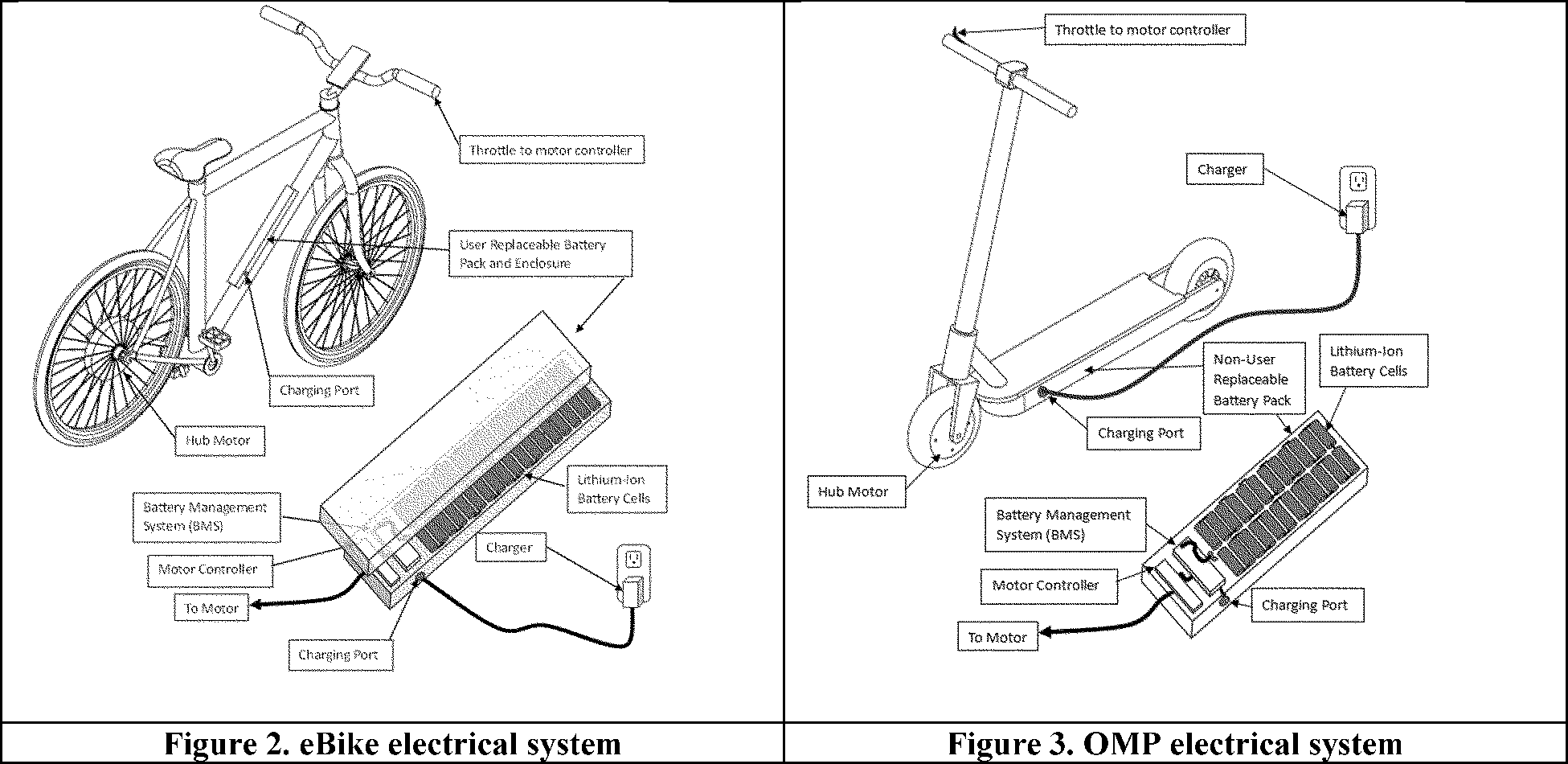
Figures 2 and 3 show representative electrical systems for eBikes and OMPs. Electrical systems consist of a motor powered by a battery pack through the motor controller and throttle. The battery pack consists of individual lithium-ion cells. A safety circuit or BMS compares the voltage, current, and temperature readings with the cell manufacturer's specified limits, and electrically disconnects the cells if the limits are exceeded. Battery chargers are connected to a user replaceable battery pack as shown in Figure 2, and to the on-board battery for non-user replaceable battery packs as shown in Figure 3. Section II.B of this preamble discusses these electrical system components in more detail.
B. Background on Lithium-Ion Batteries Used in Micromobility Products and the Electrical System of Micromobility Products
In this section of the preamble we provide a basic explanation of lithium-ion cells, their construction, and how they function, as well as the other components that comprise the electrical systems of micromobility products, to aid in understanding how the applicable UL voluntary standard requirements described in section IV of this preamble, and CPSC's proposed additions, address the unreasonable risks of death and injury with the associated hazards.
1. Lithium-Ion Cells —A lithium-ion cell is the basic unit of a battery. Lithium-ion cells are rechargeable and include the following parts as shown in Figure 4: a positive electrode (cathode), a negative electrode (anode), a separator in between the electrodes, and an electrolyte (not pictured). The anode typically consists of a copper (Cu) sheet coated with a thin layer of negative active material, such as a graphite compound. The cathode typically consists of an aluminum (Al) sheet coated with a thin layer of positive active material, such as lithium nickel manganese cobalt oxide. The separator is a thin, porous, plastic sheet that electrically insulates the cathode from the anode; it is perforated with sub-micron sized holes to allow lithium ions to move between the anode and cathode. The electrolyte is a solvent in which the electrodes and separator are immersed. The electrolyte is the medium that allows the charged lithium ions to flow between the electrodes. Metal tabs (not shown in Figure 4) are welded to the current collectors (Al and Cu sheets) and attached to the positive and negative terminals of the battery cell to connect to an external circuit. Lithium-ion battery electrolytes are flammable, unlike water-based electrolytes used in other types of rechargeable batteries such as lead-acid or nickel-metal hydride batteries. If a lithium-ion cell overheats it can enter into a self-sustaining reaction called “thermal runaway.” The heat generated by thermal runaway ignites the flammable electrolyte, building internal pressure that can result in the violent expulsion of hot gases, burning cell materials and flames from the cell casing.
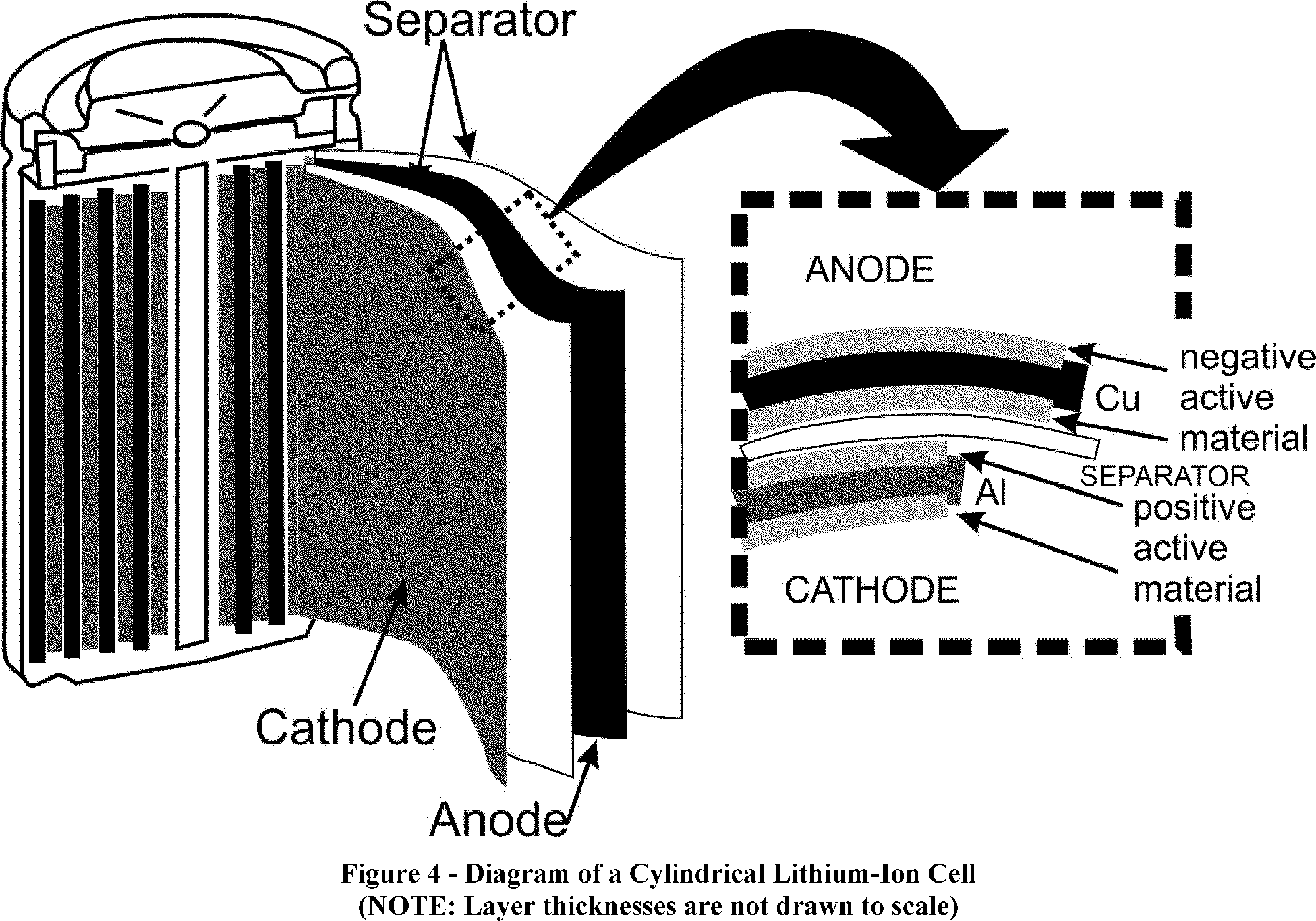
In a final assembly of a cell, long sheets of the electrodes and separator are stacked and concentrically wound in a jellyroll fashion. For a cylindrical cell, the roll is inserted into a cylindrical steel case, the electrolyte is added, and then the case is capped off. Other form factors include prismatic cells, which are wound concentrically but are flat.
2. Charging and Discharging a Cell: Converting Electrical Energy to Chemical Energy —During charging of a cell, an external voltage is applied across the cell's terminals (for a micromobility product the external voltage would be from the charger). Within the cell, lithium ions move from the active material in the cathode to the active material in the anode. This converts the electrical energy from the external power source to chemical energy that the cell stores for later use during discharge. During the charging process, cell voltage increases as the cell stored charge level increases, until the cell reaches its maximum charge voltage. The cell manufacturer specifies the maximum charge voltage, charging current, and the cell surface temperature. Continued charging beyond the maximum voltage is referred to as overcharging, which can damage the electrodes and cause overheating and failure of the cell.
This process is reversed during discharge when an external load (meaning the product the battery powers) is connected across the cell's positive and negative terminals. For a micromobility product, the external load is the electrical system—motor controller/motor etc. Micromobility products require a battery composed of multiple interconnected cells, as explained in section II.B.3 of this preamble describing Lithium Battery Packs. The stored chemical energy in each cell is converted into electrical energy as the lithium ions move from the anode to the cathode inside the battery, producing electrical current flowing out of the cell and into the load. During discharge, the cell voltage drops as the stored energy is depleted. Lithium-ion cells have a minimum voltage to which they can be discharged and below which the electrodes may become damaged. If this occurs, the cell has been overdischarged, and this damage may result in overheating and cell failure during each subsequent charge cycle.
The stored energy that is available in a lithium-ion cell as it is discharged from its maximum voltage (typically 4.2 V) to its minimum voltage (typically 2.5 V) is called the cell's electrical capacity, measured in Wh (Watt-hours). A cell charged to its full capacity is at 100% state of charge (SOC). Because cell voltage ranges from its minimum to its maximum based on the SOC, manufacturers often reference cell voltage by its nominal value (typically 3.7 volts direct current (VDC)). As a convenient reference, manufacturers specify a cell's ampacity, which is the discharge current available for 1 hour; the ampacity is specified in ampere-hours (Ah). The 1-hour discharge rate is designated as C. Cells are typically capable of producing a much higher current than the C rate but for less time. Typically, rated discharge current is up to ten times C or 10C. Charging current is typically between 0.5C for a slow charge and up to three times C (3C) for a fast charge.
Another important specification for safe operation is the surface temperature of the cell during charge, discharge, and storage. The cell manufacturer specifies the temperature ranges a cell may be safely subjected to for specific modes such as charge, discharge, and storage. The typical safe range for cell surface temperatures during charging is between 0 °C and 45 °C. The typical safe range for cell surface temperatures during discharge is between 0 °C and 60 °C. While a cell is discharging, internal heating is produced that is proportional to the current. For a micromobility product, nearly all the battery power is for the motors. When the motor works harder, such as to go faster or ride up an incline, the current increases, and the cells produce more heat. To prevent damage to a battery cell during charge and discharge, a battery-powered system must maintain the battery cells within the described specifications, referred to collectively as the safe area of operation. Battery cells that are overcharged, overdischarged, or that exceed the allowable temperature can suffer catastrophic failure. The most severe type of failure is thermal runaway, which is rapid, extreme overheating of the cell leading to venting of hot, hazardous gases from the cell, which can lead to fire escaping from the product, as detailed in section III of this preamble.
A variety of electrode compounds provide various performance specifications for battery pack designers to use. A cell manufacturer publishes the specifications for voltage, current, cell surface temperature, and capacity so that battery designers can select the cell that meets or exceeds the performance requirements in the end-use application.
3. Lithium-Ion Battery Packs —Micromobility products are typically sold with a battery pack that is rated for the intended use of the product. The battery pack is an assemblage of individual lithium-ion cells connected electrically in series and parallel to achieve the voltage and current ratings for the micromobility product to operate for the desired range, runtime, and top speed. A battery pack may be fixed-in-place (non-replaceable), or it may be replaceable by the user to facilitate charging the battery separately from the product or to allow battery replacement. Removable batteries allow users to ride the product with minimal downtime, because users can charge an extra battery while using the product. Micromobility product manufacturers may sell battery packs specifically for their products, but battery packs may also be sold by third parties.
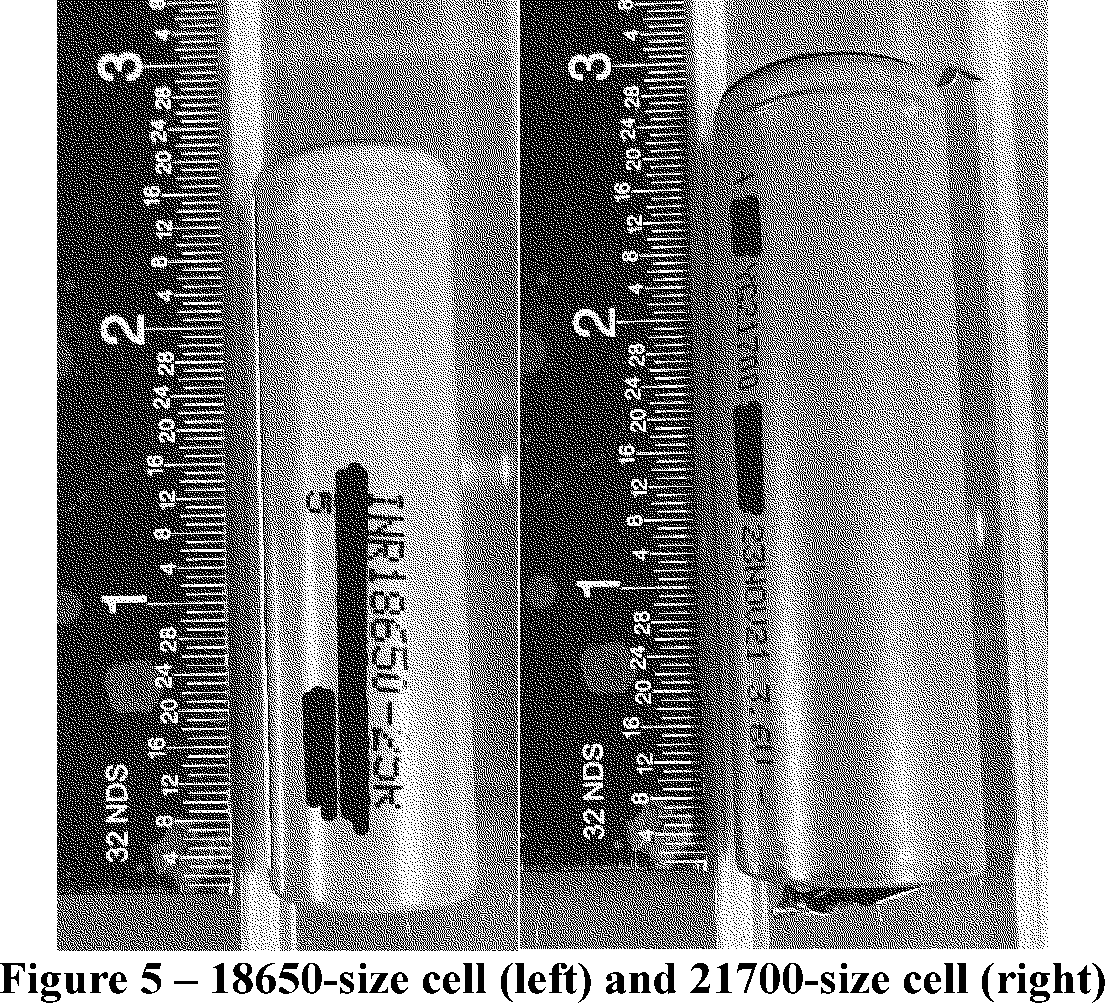
Micromobility product batteries typically use cylindrical lithium-ion cells, often size 18650 or 21700. Figure 5 shows examples of each of these cells. Size 18650 cells are nominally 18 mm in diameter and 65 mm tall; size 21700 cells are nominally 21 mm in diameter and 70 mm tall. Micromobility product battery packs use multiple battery cells connected in series and parallel so that the battery can provide sufficient power and capacity to operate the micromobility product within the manufacturer's desired range or operating time.
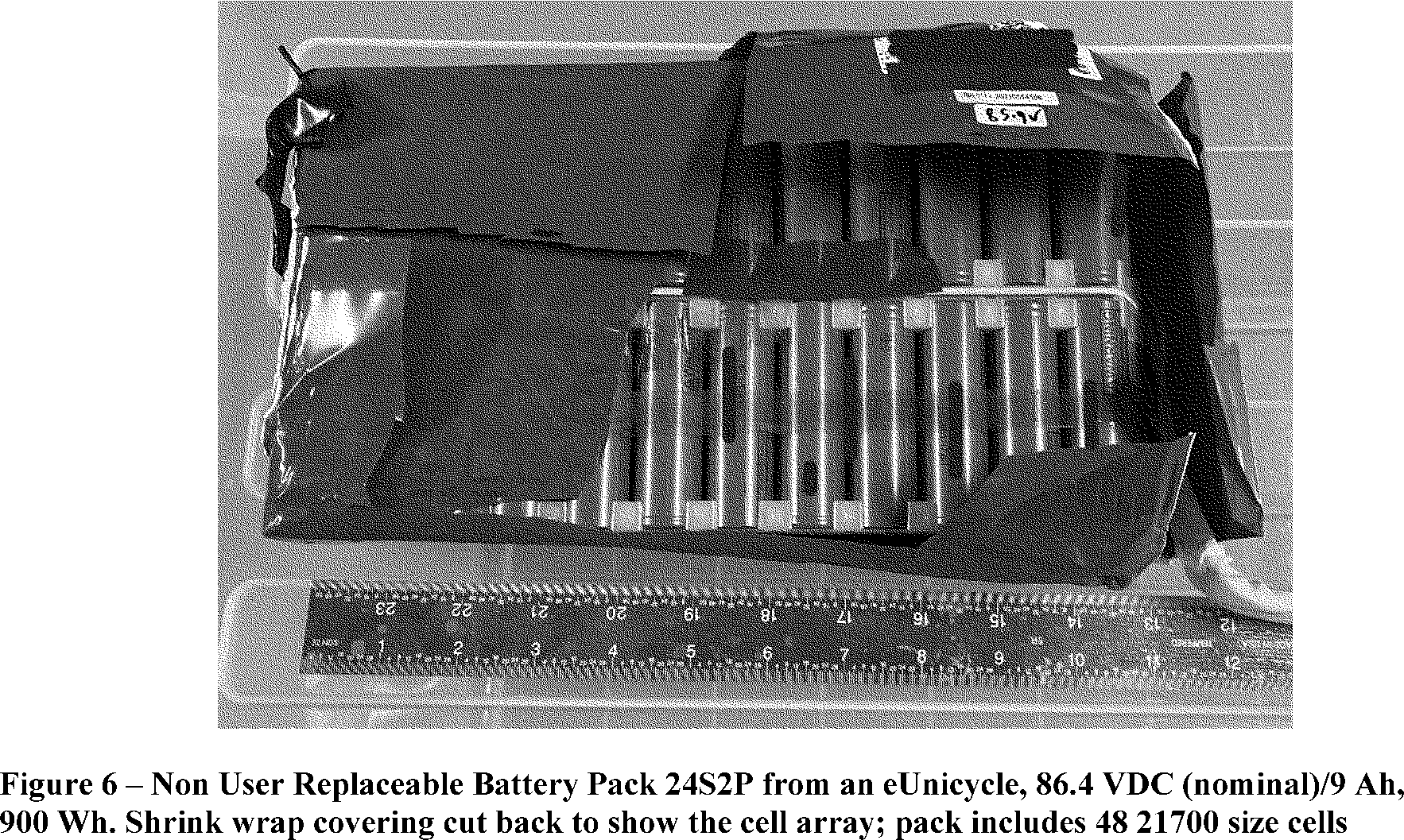
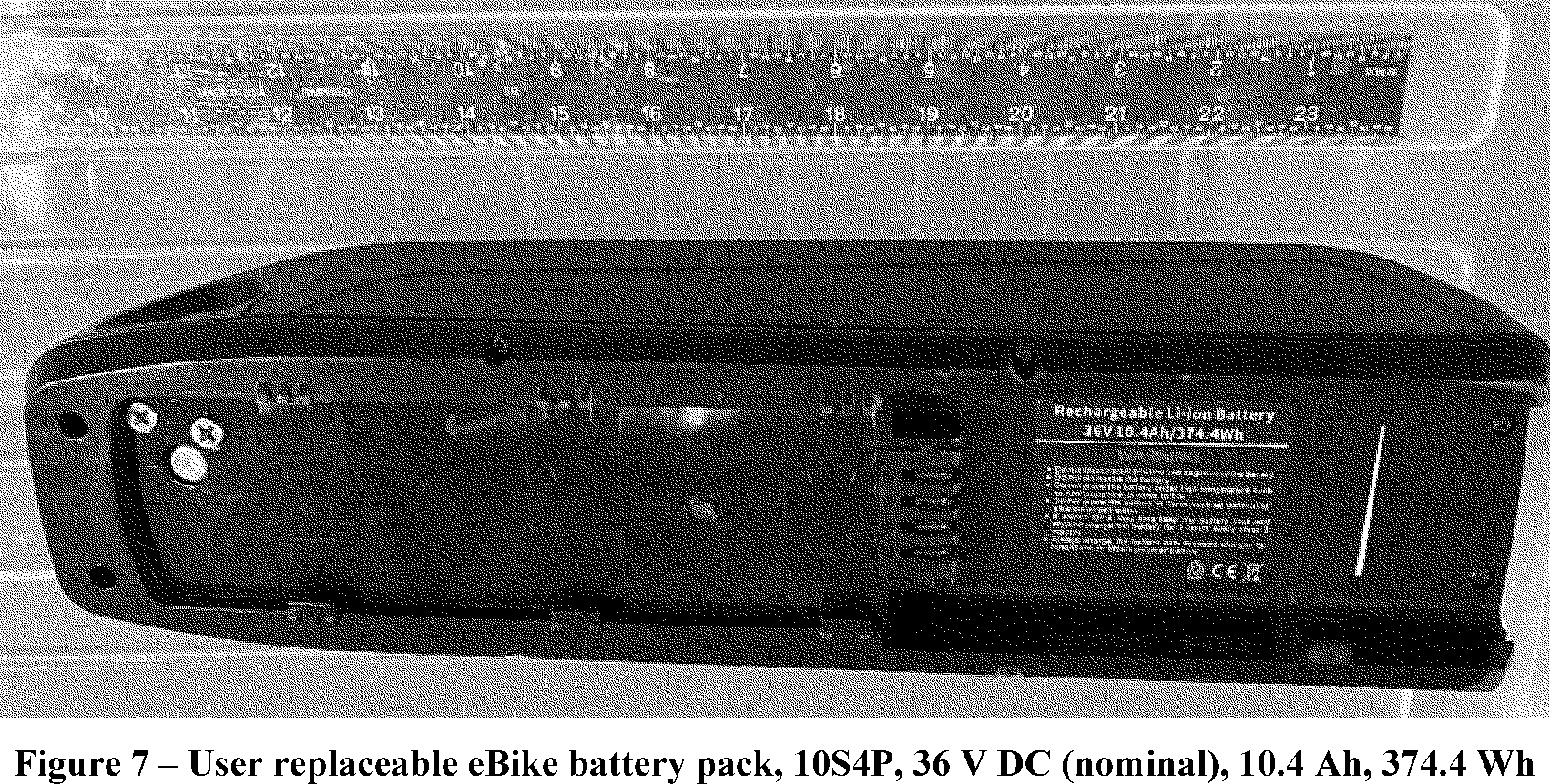
Micromobility product multi-cell battery arrangements are designated by the number of cells connected electrically in a series string, and the number of series strings that are connected in parallel. For example, a 20-cell, 10S2P battery has ten cells connected in each series ( i.e., “10S”) and two parallel series ( i.e., “2P”). Thus, this pack configuration consists of 20 cells. Figures 6 and 7 provide examples of battery packs and their designations.
4. Battery Management Systems —To maintain the individual cells of a battery pack within their specifications for voltage, current, and temperature during charge and discharge, a robustly designed micromobility product electrical system uses a BMS, an example of which is shown in Figure 8. When the BMS detects an out-of-specification cell condition, it uses electronic switches or relays to disconnect the battery pack from the external circuit to stop the flow of current and to prevent damage to battery cells, which could lead to thermal runaway. For example, during charging and discharging, the BMS measures and compares the voltage, current, and temperature readings to the cell manufacturer's specified limits. A BMS measures cell surface temperatures using thermocouples or thermistors, which are sensors attached to the outside of the battery cells inside a battery pack. The BMS controls the charging rate and charge level while monitoring the cell temperature so that the cells stay within their safe area of operation. The BMS stops charging when cells reach their full capacity so that they do not become overcharged. Similarly, the BMS stops discharging when cells reach their minimum voltage so as not to allow overdischarge. Accordingly, the BMS plays a critical role in the safe operation of a micromobility product, particularly when the user is charging or riding the product.
A BMS, however, cannot stop thermal runaway events caused by manufacturing defects in the battery cell itself, such as contaminants, electrode or separator layer misalignment, damaged separator, or folded or torn electrodes.
5. User Replaceable Battery Packs —Some of CPSC's incident reports involve user replaceable batteries that were poorly constructed with substandard cells, BMS, or other components. User replaceable battery packs may be available from the micromobility product OEM or from a non-OEM supplier. User replaceable battery packs (batteries) become part of the product's electrical system. The primary risks associated with user replaceable battery packs, similar to integral batteries, are shock and fire. The cells within battery packs must be maintained within their safe area of operation during both charging and discharging, requiring adequately rated cells and BMS protection. Also, because the battery output terminals for electrically connecting the battery to the micromobility product may be exposed, they need to be properly guarded to protect against possible shorting during connection and disconnection of the battery pack. If the battery pack voltage is higher than 60 V DC, the battery output terminals must also be inaccessible to users to prevent a risk of shock. Further, battery packs without a means to prevent users from accessing the battery, meaning those that are not tamper resistant, present a risk of shock and fire by allowing consumer access to internal parts of the battery pack to, for example, attempt to replace battery cells. CPSC is also aware of consumers trying to build or modify lithium-ion battery packs for micromobility products, without necessarily having technical expertise or knowledge of the risks. These so-called “homemade” or modified batteries may pose a higher risk of a thermal runaway, and potential smoke inhalation and fire, as set forth in section III of this preamble.
6. OEM and Aftermarket Battery Chargers —CPSC is aware of incidents involving chargers provided either with the micromobility product (OEM charger) or obtained afterwards (aftermarket charger). Several risks to the consumer are associated with OEM and aftermarket battery chargers. Battery chargers are powered from 120 VAC power so that basic safety requirements such as proper grounding and power cords ratings are beneficial to protect users against shock and fire. Chargers may also overheat if adequate internal circuit protection is not provided. However, the primary concern with aftermarket chargers is compatibility with the micromobility product charging circuit and battery. It is critical that the charger output voltage and current match the rating of the micromobility product battery to prevent damage to the internal charging circuits or the battery, which can pose a risk of fire. Also, the voltage polarity of the charger connector must match the polarity of the micromobility product charging connector to mitigate the risk of damaging the cells and posing a risk of fire.
C. Market Description
The following discussion provides information about the economic markets in which micromobility products are sold. In 2021, CPSC contracted Euromonitor to conduct an industry-wide market study on micromobility products. The Euromonitor report, completed in February 2022, is titled Micro-Mobility Product Market Research. 9 The information provided in this section, unless otherwise stated, is derived from the Euromonitor report. This market analysis is broken into three product categories: eBikes, eScooters, and OMPs, which for this analysis includes eSBscooters, eSkateboards, eUnicycles, and hybrids of these products). 10
9 This report can be obtained by submitting a request at https://forms.office.com/g/2ubiRFZxfw.
10 The information presented summarizes the market analysis in Tab A of Staff's NPR Briefing Memorandum: Safety Standard for Lithium-Ion Batteries in Micromobility Products Preliminary Regulatory Analysis, available at https://www.cpsc.gov/s3fs-public/LithiumIonBatteriesPreliminaryRegulatoryAnalysis.pdf.
1. eBikes —CPSC staff identified 179 firms that manufacture or supply eBikes to the U.S. Most of these firms import products manufactured in China. Staff have identified just five domestic eBike manufacturers. Overseas companies produce many of the components used by these domestic manufacturers; in particular, nearly all eBike batteries are manufactured overseas. eBikes are typically sold through physical retail outlets; recently, however, an increasing number of eBikes are being sold through online retailers. Staff expect this trend to continue in the short run but do not expect this online sales trend to exceed 30 percent of total sales because eBike firms maintain a physical dealer network.
Currently, the domestic eBike market is growing quickly, with a 31 percent compounding annual growth rate (CAGR) in units sold from 2018 to 2024. Increased recreational use of eBikes and investments made by ride sharing firms in major cities have contributed to the market's quick growth. Despite investments by ride sharing firms having slowed considerably recently, the overall eBike market has continued to grow. High growth rates for this market are likely to continue in the short run.
2. eScooters —Staff identified 81 firms supplying 704 eScooter models/variants to the U.S. market. Nearly all eScooters are imported from China or Taiwan. Of the 81 firms, staff identified seven U.S. domestic eScooter manufacturers and overseas companies produce many of the components used by these domestic manufacturers, including nearly all eScooter battery packs. Private eScooter sales account for approximately 65 percent of the total market with a majority sold via on-line retail channels. A few firms have a limited brick-and-mortar presence. From 2018 to 2021, eScooter sales volume increased at a 9.8 percent CAGR. Over the same period, eScooter gross revenue increased at a 27.7 percent CAGR. The higher growth rate in revenues compared to sales is due to a shift towards higher quality and more durable products. Beyond 2021, sales growth is expected to slow down to 10.64 CAGR and staff expect growth to further decline as the market continues to saturate.
3. OMPs —Staff identified 67 firms that manufacture or supply OMPs to the U.S. market. Nearly all these firms import their products from China. Staff identified 12 domestic OMP manufacturers that assemble OMPs from components largely produced overseas. Most lithium-ion batteries for OMPs are produced in China. Roughly 80 percent of OMPs are sold via online retail channels rather than through brick-and-mortar retailers.
Revenue for eSBscooters with a handlebar (a.k.a. segways) increased at a 4.3 percent CAGR from 2018 to 2021, while units sold increased to 1.7 percent CAGR during the same period. One reason for the increase in retail value is the increase in cost for batteries and electric motors stemming from the COVID-19 pandemic. eSBscooters without a handlebar, such as hoverboards, entered the market in 2015. Sales of these eSBscooter increased at 2.5 percent CAGR from 2018 to 2021. eSBscooter prices have increased marginally because of higher global demand for batteries, but they have generally been constrained by the economies of scale from producing over a million units per year.
eSkateboards and eUnicycles have the highest growth from 2018 to 2021. Sales grew from 2018 to 2021, at a CAGR of 5.3 percent. Retail value grew at a 13 percent CAGR during that same period. Overall, OMPs are forecasted to increase at a 15.6 percent CAGR from 2021 to 2024, reaching a market value of $213.2 million.
D. Overview of Voluntary Standards and CPSC's Participation in Standards Development
UL 2272 Background —UL 2272 was first published in November 2016 as a joint Canada-United States National Standard to address the electrical safety of “Electrical Systems for Personal e-Mobility Devices.” UL 2272-24 defines a “personal e-mobility device” as a single-rider, rechargeable electric device which may or may not be self-balancing, excluding devices for medical purposes. 11 This voluntary standard was created in response to fire incidents with eSBscooters that occurred at the end of 2015 when these products were widely introduced in the market without a standard to ensure safe operation of the battery. The first edition was revised on February 25, 2019. After the 2019 revisions were published, OMP fire incidents continued. To address these incidents, staff wrote a letter to UL Standards and Engagement (ULSE) Technical Commission (TC) on January 14, 2024, indicating a need to create a working group to address OMP incidents. 12 As a result of this letter, the TC for UL 2272 initiated work and, on April 19, 2024, ULSE published the second edition of UL 2272. However, as discussed below, incidents associated with OMPs continue and staff's current assessment of this standard is that it is inadequate to fully address the associated hazards for consumers of OMPs using lithium-ion battery packs.
11 UL 2272 refers to in-scope products as “personal eMobility devices,” but this NPR generally refers to such products as “other micromobility products” or OMPs.
12 The letter is posted on CPSC's website, located at the following link: https://cpsc.gov/s3fs-public/e-MobilityTG-ResponseToWGActivity-ULSE-0.pdf?VersionId=hpYjELySGyjiOrKFUaJCpgJxqCoufjAI.
UL 2271 Background— UL 2271 was first published in December 2013 as a joint Canada-United States bi-national standard to address electrical energy storage assemblies such as battery packs for use in light electric-powered vehicles (LEVs). 13 The second edition was published in 2018. The third and latest version was published in 2023. Although staff assess that the revisions increased safety relative to the previous edition, nevertheless the standard does not fully address the associated electrical hazards for consumers of eBikes and OMPs using these battery packs, as reflected in the discussion of incidents in section III of this preamble.
13 UL 2271-13 includes the following as LEVs: electric bicycles; electric scooters and motorcycles; electric wheelchairs; golf carts; ATVs; non-ride-on industrial material handling equipment; ride-on floor care machines and lawnmowers; and personal mobility devices.
UL 2849 Background— In January 2020 as a joint Canada-United States National Standard to address the electrical system safety of eBikes powered by a lithium-based, rechargeable battery. Staff attended a TC meeting for UL 2849 on December 6, 2021, to review numerous proposals for additional eBike requirements. To date, these proposals have not been balloted. Moreover, as discussed in section III of this preamble, eBike fire incidents continue.
III. Hazards Associated With Lithium-Ion Batteries Used in Micromobility Products
This section discusses the unreasonable risk of death and injury associated with lithium-ion batteries used in micromobility products, provides information on the deaths and injuries associated with micromobility products within the scope of the rule, and describes the associated hazard patterns. 14
14 See also, Consumer Product Safety Commission (2023) Micromobility products-related deaths, injuries, and hazard patterns: 2017-2022, available at: https://www.cpsc.gov/s3fs-public/Micromobility-Products-Related-Deaths-Injuries-and-Hazard-Patterns-2017-2022.pdf?VersionId=BekCvIY03IvMU9nHr2ErziUNXNkPAghJ.
A. Unreasonable Risk of Death or Injury Associated With Lithium-Ion Batteries Used in Micromobility Products
As seen in CPSC's incident data described in section III.B of this preamble, the primary risks of injury are associated with thermal runaway of micromobility electrical systems that use lithium-ion batteries, which can lead to fires, explosions, gas releases, burns, overheating, and smoke inhalation. Consumers are exposed to these risks during charge and discharge of lithium-ion batteries used in micromobility products. Thermal runaway in a lithium-ion battery pack(s) creates a risk of injury that can be mitigated by using high quality cells and monitoring and protection circuitry provided by the electrical system, including such subsystems as the BMS. As described in section II.B.4 of this preamble, a properly designed and well-functioning BMS ensures that if a lithium-ion battery or battery pack operates outside of the safe operating region it will be disconnected from the external circuit, which turns off the battery pack to prevent damage to battery cells within the battery pack, and ultimately may prevent a thermal runaway.
Lithium-ion cells operating outside of their safe operating region may suffer internal damage, which may lead to an internal short circuit that generates extreme heat. Depending on the level of charge, the rapidly released energy may heat the cell much faster than the cell can dissipate the heat. Furthermore, unlike water-based electrolytes used in other types of rechargeable batteries, lithium-ion battery electrolytes are flammable. This may result in a self-heating, exothermic chemical reaction called thermal runaway. A cell in thermal runaway burns and vaporizes the flammable electrolyte building intense internal pressure that may rupture the cell casing explosively, ejecting hot gases, flames and molten materials. In a multicell battery pack, the heat produced by the failure of one cell may propagate to other cells in the pack, expanding the release of extreme heat and fire due to thermal runaway induced in other cells. Tests performed by Naval Surface Warfare Center, Carderock Division demonstrated that cell burn temperatures during thermal runaway can exceed 1000 °C (1832 °F). 15
15 Waller, Ko, Hays, Jiang (2020) Evaluation of Cell-to-Cell Propagation in Lithium-ion Batteries Containing 18650 Sized Cells, NSWCCD-63-TR-2020/01, https://www.cpsc.gov/content/Consumer-Product-Safety-Commission-CPSC-Staff%E2%80%99s-Statement-on-Naval-Surface-Warfare-Center-Carderock-Division%E2%80%99s-NSWCCD-Report-on-%E2%80%9CEvaluation-of-Cell-to-Cell-Propagation-in-Lithium-Ion-Batteries-Containing-18650-Sized-Cells%E2%80%9D.
Once ignited, flaming contents and gases build internal pressure and can be explosively ejected from the cell enclosure. The flaming materials may ignite nearby combustibles. Micromobility products are often left to charge inside of a garage, house, or multifamily dwelling. Fires in these locations can spread to surrounding household goods and combustible materials stored in those locations, such as gas or kerosene in a garage, and carpets, furniture, drapes, decorative items, and other electronic equipment in the house. Fires can also ignite the housing structure itself.
Smoke produced by combustion is a colloid consisting of airborne solids, liquid particles, and gases ( e.g., CO 2 , CO) mixed with air. 16 During combustion inside of a battery, a carbon-based fuel burns in the presence of oxygen. Harmful gases and fire may result in injuries and deaths to anyone inside the house or building. According to CPSC's reports of in-depth investigation (IDI) and the National Electronic Injury Surveillance System (NEISS) submitted from 2019 to 2023, the main causes of human death and injuries associated with micromobility product fires are smoke inhalation and burn injuries.
16 Gill P. and Martin R.V. (2015) Smoke inhalation injury, BJA Education, 15(3): 143.
B. Incident Data Overview
CPSC staff searched CPSC-maintained databases to identify deaths, injuries, and non-injury incidents associated with lithium-ion batteries used in micromobility products, including the Consumer Product Safety Risk Management System (CPSRMS) 17 18 and the National Electronic Injury Surveillance System (NEISS). 19 For this NPR, CPSC identified 227 unique incidents related to associated hazards with micromobility products' lithium-ion batteries from January 1, 2019, through December 31, 2023, which were documented in CPSC databases as of November 1, 2024.
17 CPSRMS includes data primarily from three groups of sources: incident reports, death certificates; and in-depth follow-up investigation reports. A large portion of CPSRMS consists of incident reports from consumer complaints; media reports; medical examiner or coroner reports; retailer or manufacturer reports (incident reports received from a retailer or manufacturer involving a product they sell or make); safety advocacy groups, law firms, and federal, state, or local authorities, among others. It also contains death certificates that CPSC purchases from all 50 states, based on selected external cause of death codes (ICD-10). The third major component of CPSRMS is the collection of in-depth, follow-up investigation reports. Based on the incident reports, death certificates, or NEISS injury reports, CPSC Field staff conduct in-depth investigations (on-site, telephone, or online) of incidents, deaths, and injuries, which are then stored in CPSRMS.
18 CPSC staff searched all data coded under product codes 3215/5045 (eBikes), 5022/5024 (eScooters), 5025 (eSBscooters, eSkateboards, eUnicycles), 1283 (Unicycles), and 5042 (Scooters, eSBscooter, Skateboards). In addition, staff extracted data coded under 884 (Batteries), 883 (Battery Chargers/adapters), and 9901 (Unclerically coded retailer products). Staff further screened data searched from this wide range of products using keywords to identify potentially in-scope micromobility products or lithium-ion batteries which may have been used in micromobility products at the time of the incident. Staff extracted data on November 1, 2024, and reporting for 2022-2023 is ongoing. Counts may change in future reports.
19 NEISS is the source of the injury estimates; it is a statistically valid injury surveillance system. NEISS injury data are gathered from participating hospitals with 24-hour emergency departments and at least 6 beds, selected as a probability sample of all U.S. hospitals. The surveillance data gathered from the sample hospitals enable the staff to make timely national estimates of the number of injuries associated with specific consumer products.
Specifically, CPSC conducted 212 In-Depth Investigations (IDIs), identified 12 additional NEISS cases, 20 and obtained three news reports as presented in table 1.1. Of the resulting total of 227 incidents associated with micromobility product electrical systems, 90 incidents are associated with fatalities (39) and injuries (181), while 39 incidents involved multiple victims with fatalities and injuries. CPSC is also aware of 137 non-injury incidents within the same timeframe.
20 NEISS estimates are not given if they do not meet the NEISS reportability criteria: that the estimated number of injuries be 1,200 or higher, the sample size be 20 or larger, and the coefficient of variation does not exceed 0.33.
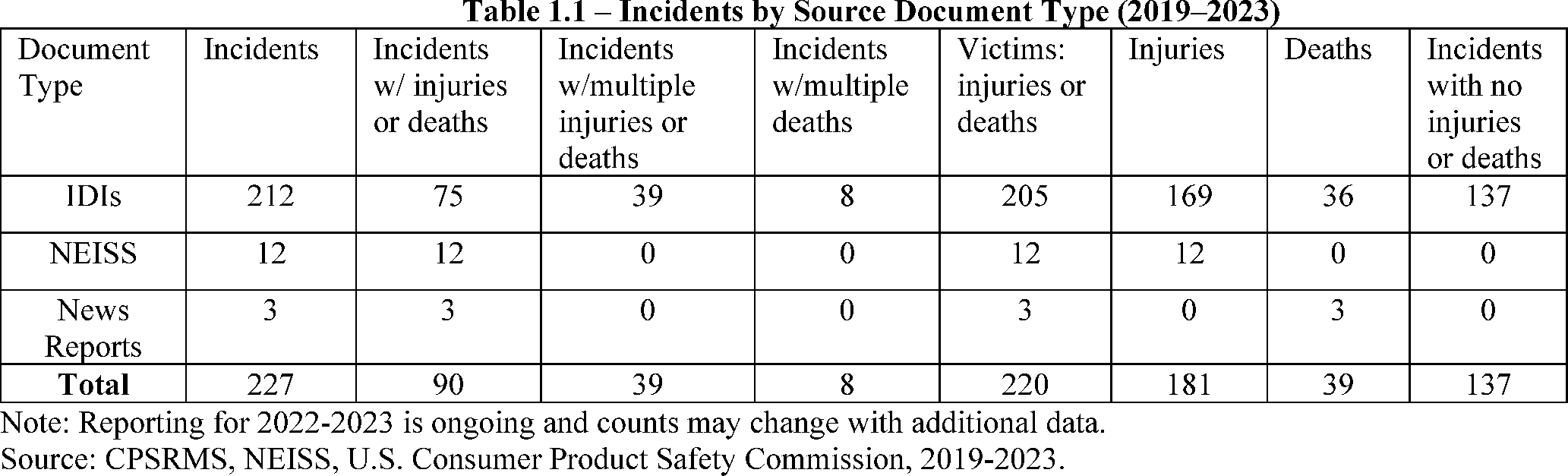
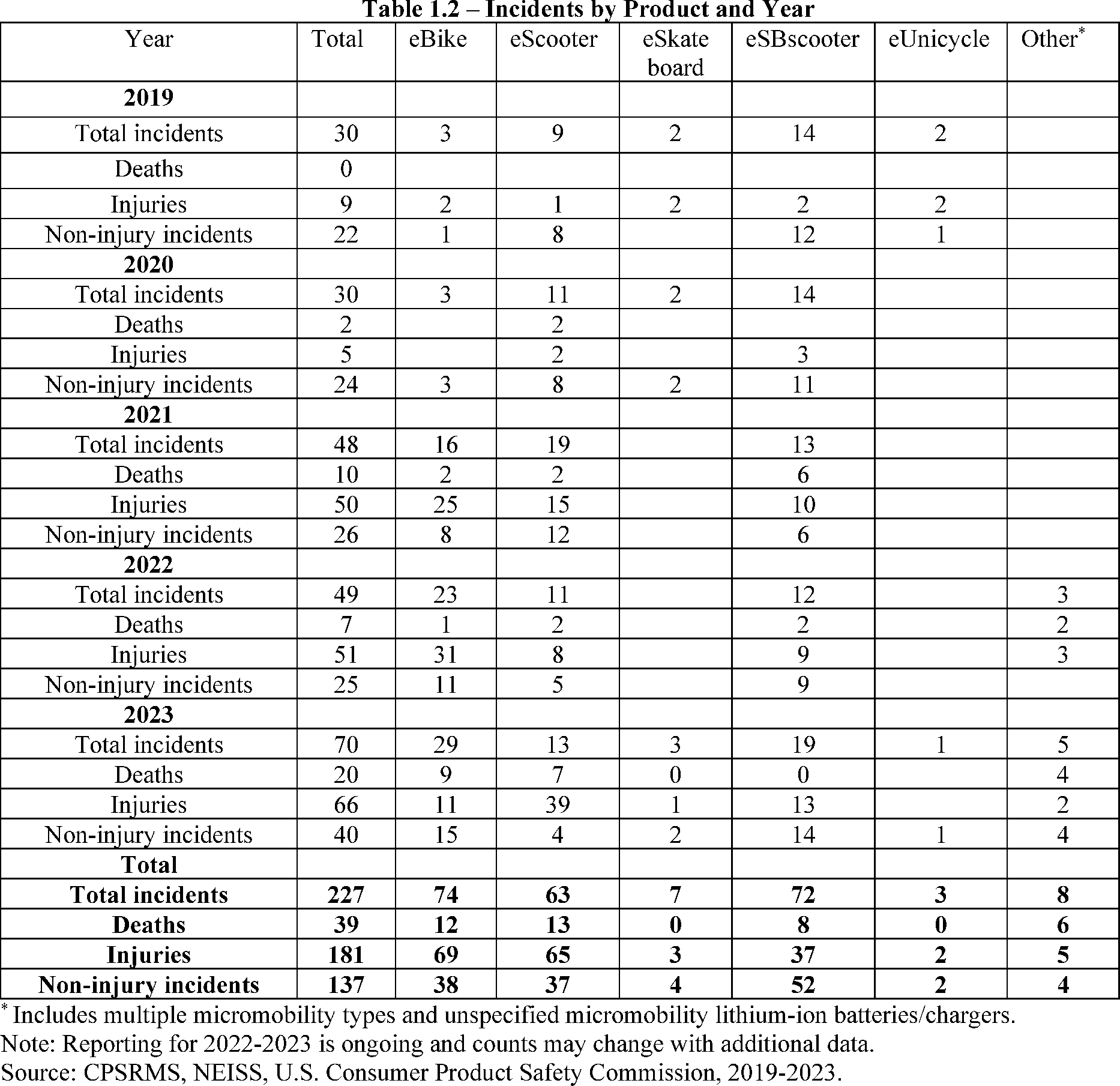
Table 1.2 shows the number of incidents, fatalities, injuries, and non-injury incidents associated with micromobility product electrical system fire, explosion, overheating incidents by year from 2019 through 2023. Table 1.2 summarizes information on deaths, injuries, and non-injury incidents for each product category.
Using these data staff identified hazards associated with lithium-ion batteries used in micromobility product electrical systems, including fires, explosions, and other hazards such as gas releases, burns, overheating, and smoke inhalation. Table 1.3 shows the overall incident counts, fatalities, injuries, and non-injury incident counts. Out of the 227 incidents, fire incidents accounted for 195 incidents (86 percent), 39 fatalities (100 percent), 174 of the 181 injuries (96 percent), and 112 of the 137 non-injury incidents (82 percent).
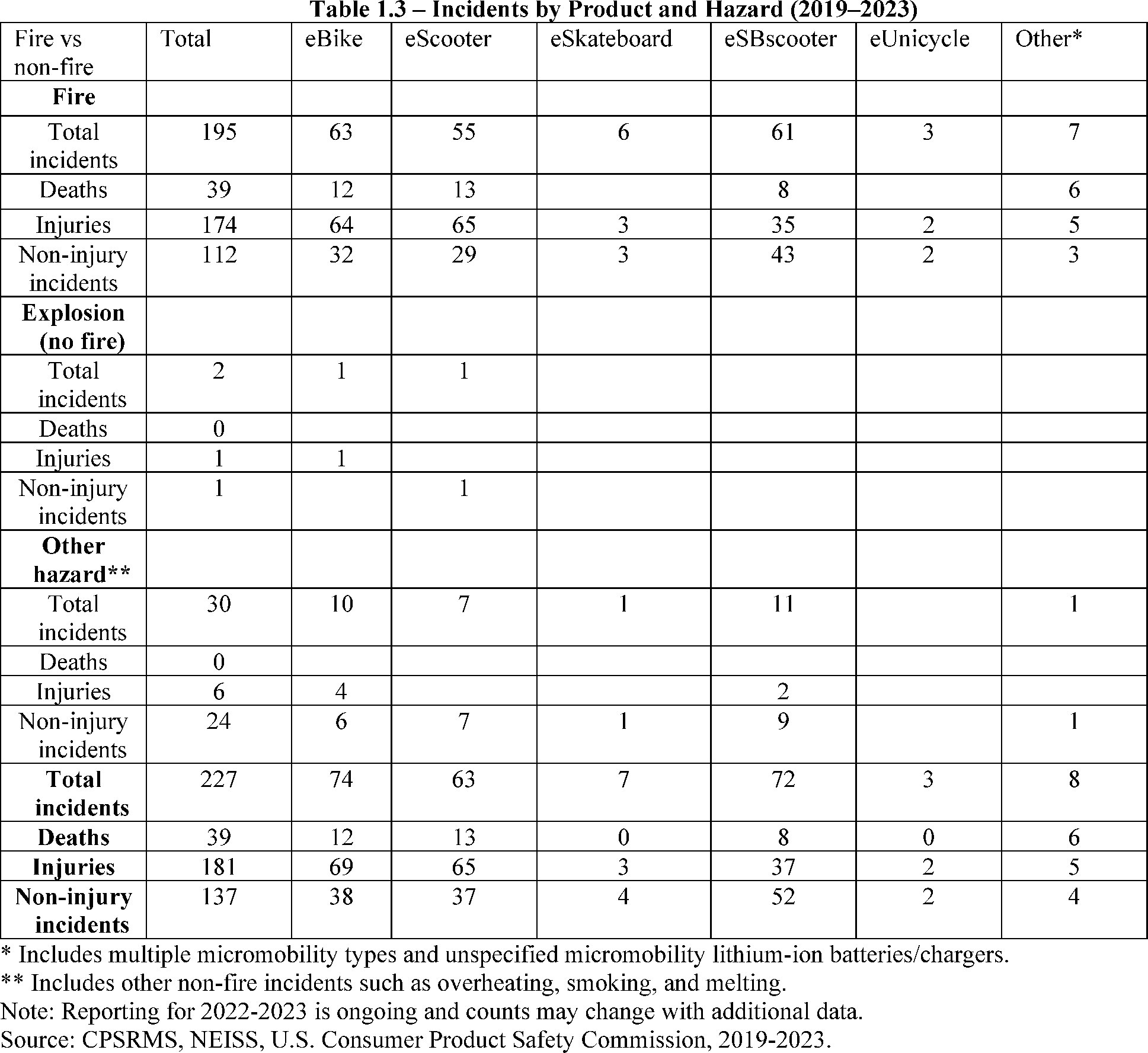
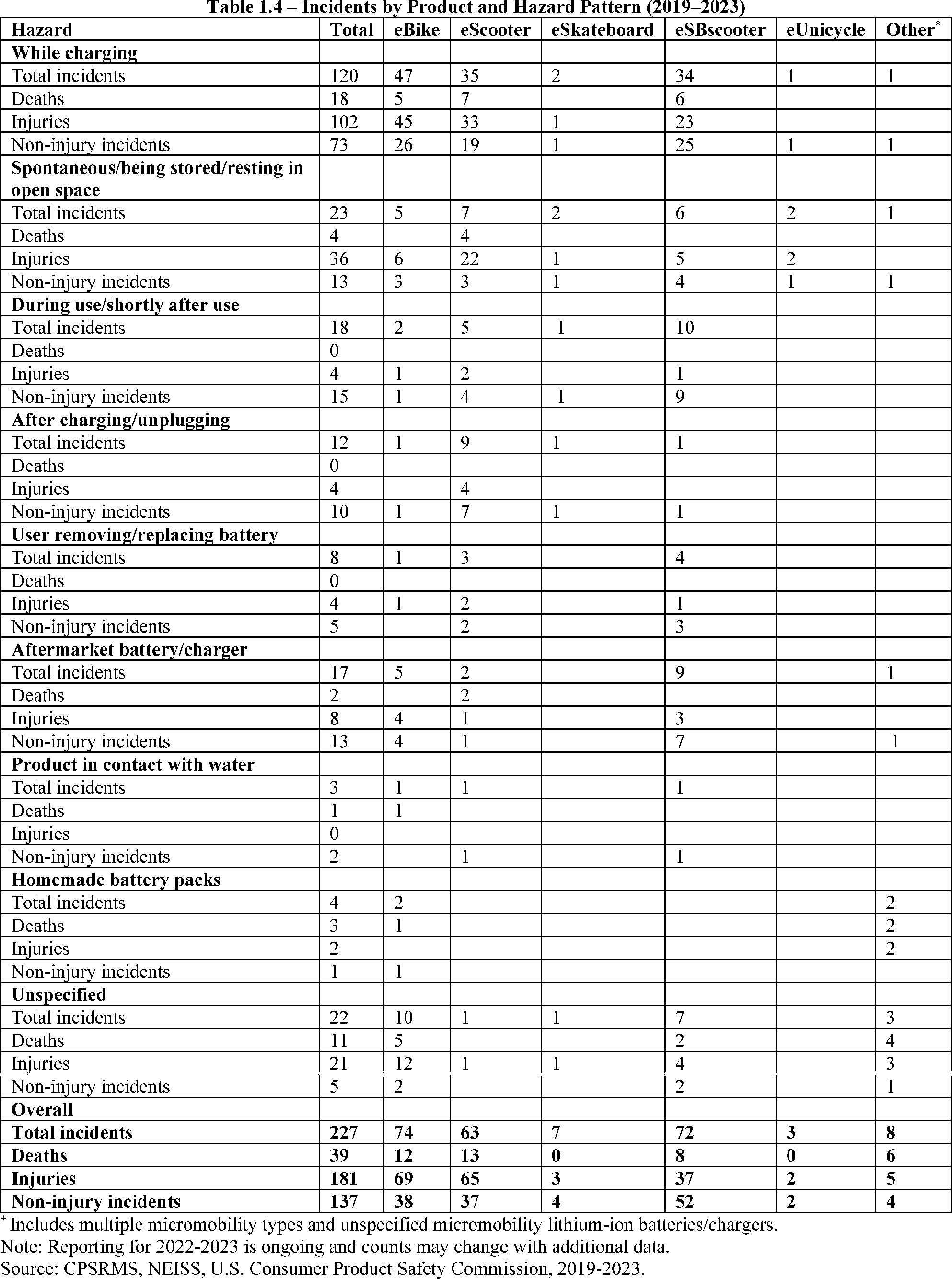
Table 1.4 summarizes the hazard pattern counts of different product types for each incident associated with a lithium-ion battery used in a micromobility product electrical system. Out of the 227 total incidents, 120 incidents (53 percent) occurred while the product was plugged in charging, including 18 fatalities (46 percent), 102 injuries (56 percent), and 73 non-injury incidents (53 percent). Another 23 incidents were reported while the product was being stored or resting in open space and unexpectedly caught fire, causing a total of four deaths and 36 incidents of non-fatal injury. Thirty incidents with no deaths, which injured eight people, were mainly associated with products while in use, shortly after use, or after charging. User removing/replacing battery packs or using an aftermarket battery/charger accounted for 25 incidents, two deaths, and 12 people injured. Three incidents associated with the product contacting water were reported, including one death and no non-fatal injuries. Four incidents associated with homemade battery packs were reported with three fatalities and two injuries while victims were manufacturing, repairing, or charging batteries. The remaining 22 incidents did not provide specific hazard descriptions but accounted for 11 deaths and 21 injuries.
BILLING CODE 6355-01-P
BILLING CODE 6355-01-C
Among the 39 fatalities associated with micromobility lithium-ion battery fires, each sex had 19 fatalities, as well as one fatality for unknown sex. Of the 159 injured victims with known age, 85 were males (53 percent) and 74 females (47 percent). Of the 129 non-injury incidents with known sex, 95 were males (74 percent) and 34 females (26 percent). Table 1.5 presents the distribution of victims by product type and sex.
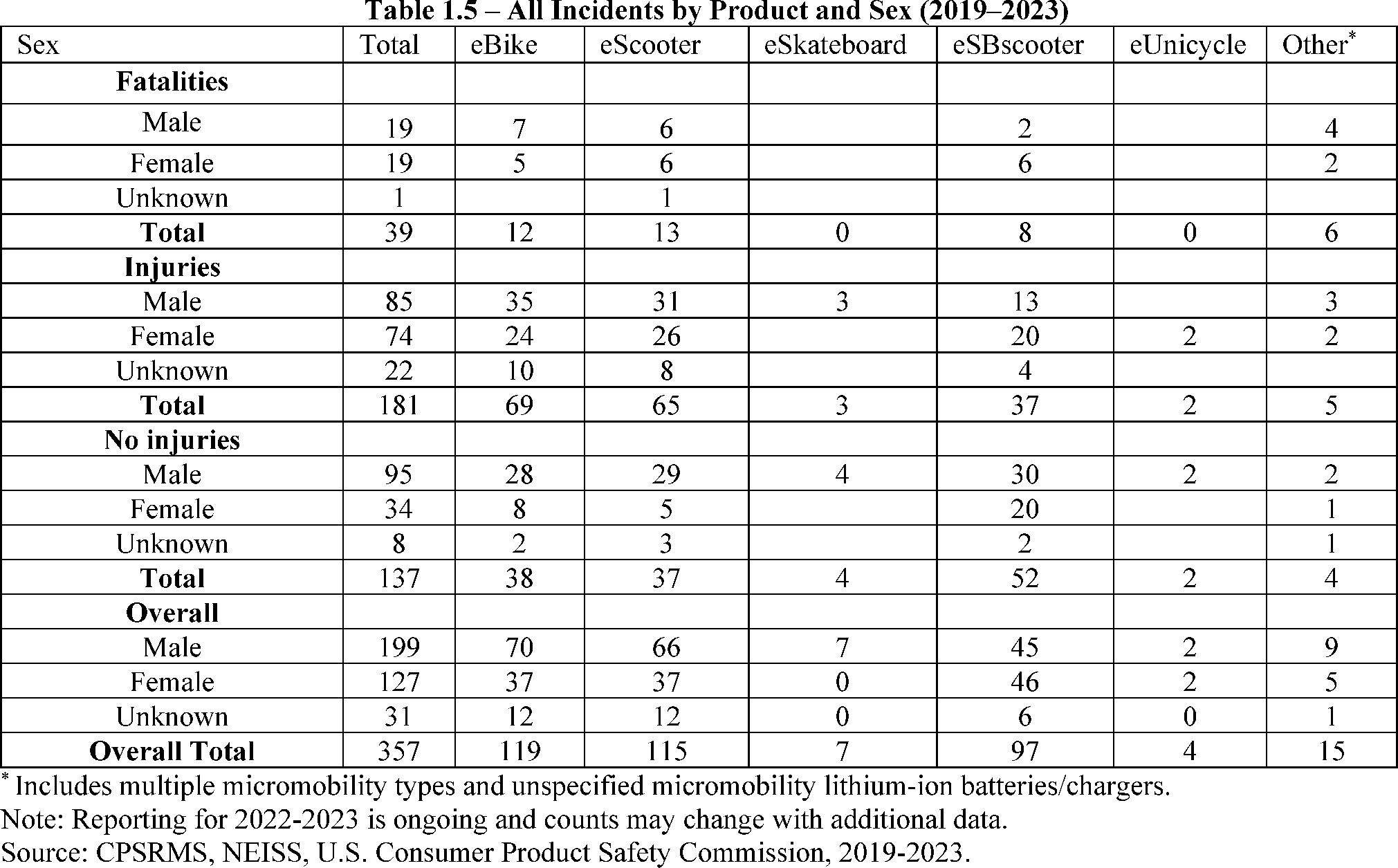
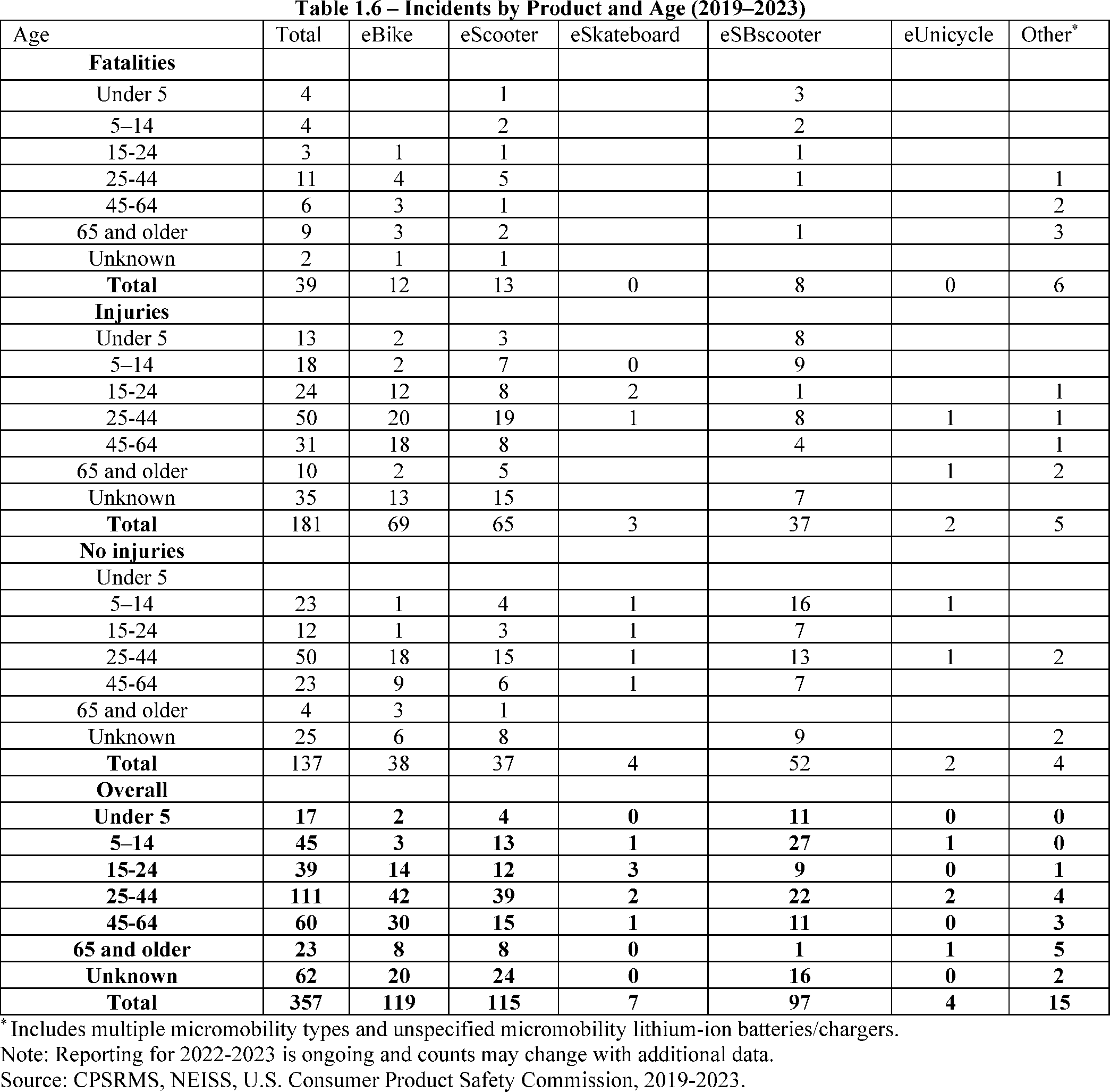
Table 1.6 presents the incident data by product type and victim age group. Two hundred ninety-seven (about 83 percent) out of 357 total victims had age information provided. Of the 37 fatalities with age information, four (about 11 percent) were under 5 years old and nine (about 24 percent) were 65 and older. These fatality rates for both the `under 5 years old' and `65 and older' groups were disproportionately higher compared to their corresponding proportions in the general U.S. population. Among the 112 non-injury victims with age information, 50 (about 45 percent) were in the 25-44 age group which is also disproportionately higher compared to the general population.
1. Incidents with Multiple Victims —Thirty-nine incidents involved multiple injured or deceased victims, including eight incidents involving fire that resulted in two or more deaths in each incident (collectively accounting for 24 deaths and 19 injuries). An additional 31 incidents involving a fire resulted in multiple victims with one or no deaths in each incident (collectively accounting for eight deaths and 118 injuries). Table 2.1 summarizes information on incidents, deaths, and injuries in multiple victim incidents involving lithium-ion batteries used in micromobility products and the associated hazards, including fires.

Of the 169 victims involved in multi-victim incidents, 32 were killed and an additional 137 were injured. Of the 32 fatalities, 15 were males, 16 were females, and one unknown sex. One hundred sixteen out of the 137 injury incidents identified the sex of the victim, and these were equally divided between males and females. Table 2.2 presents the distribution of sex by product type.
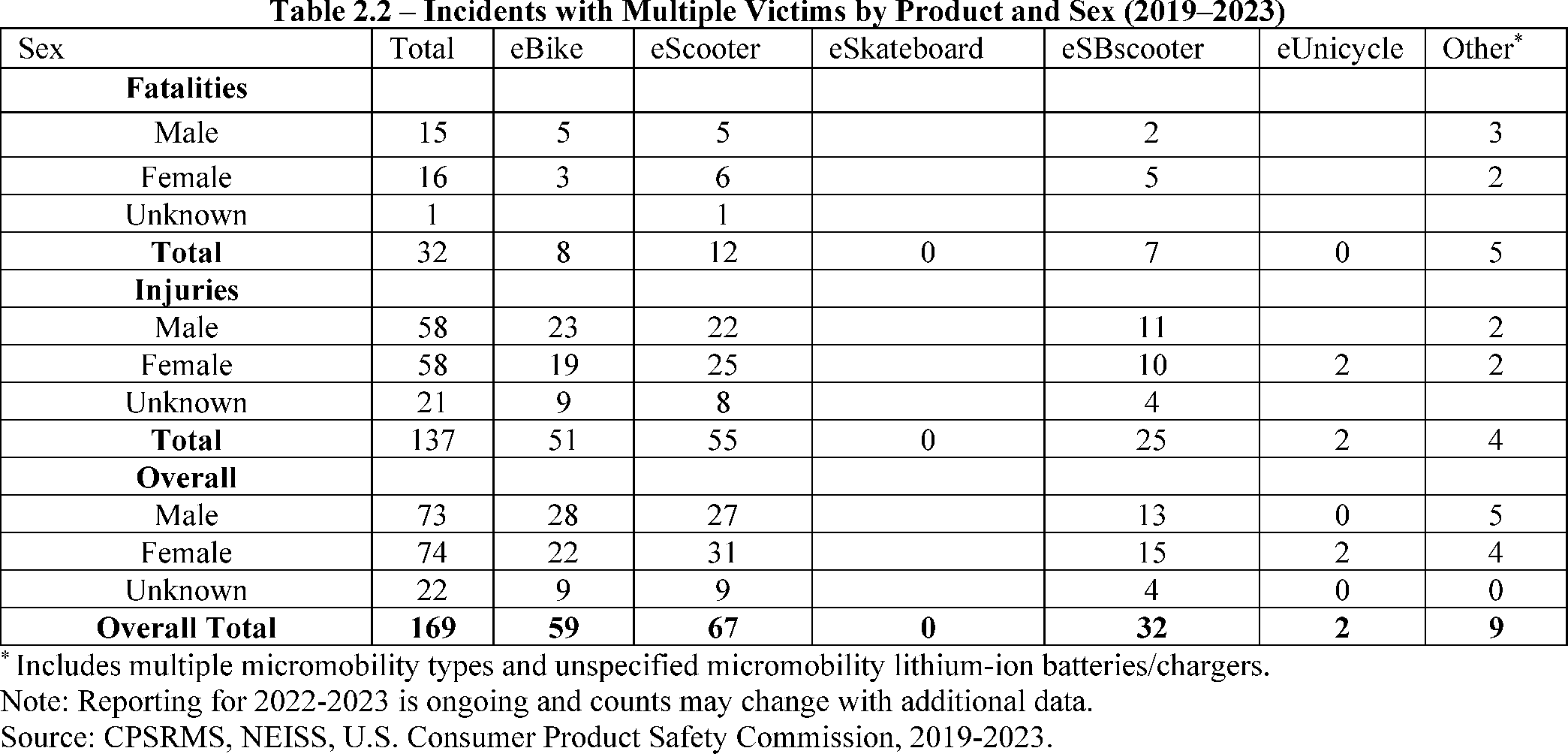
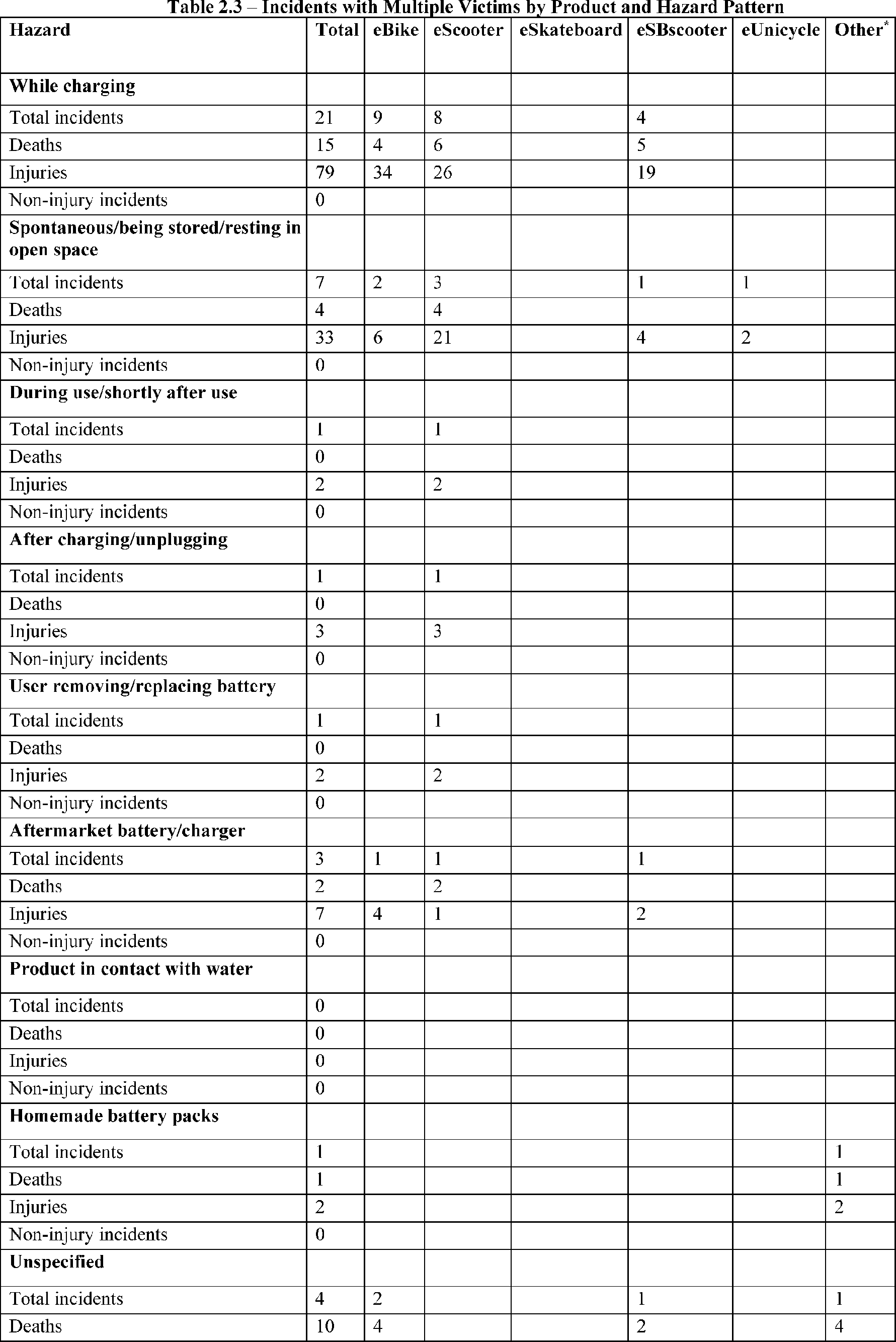
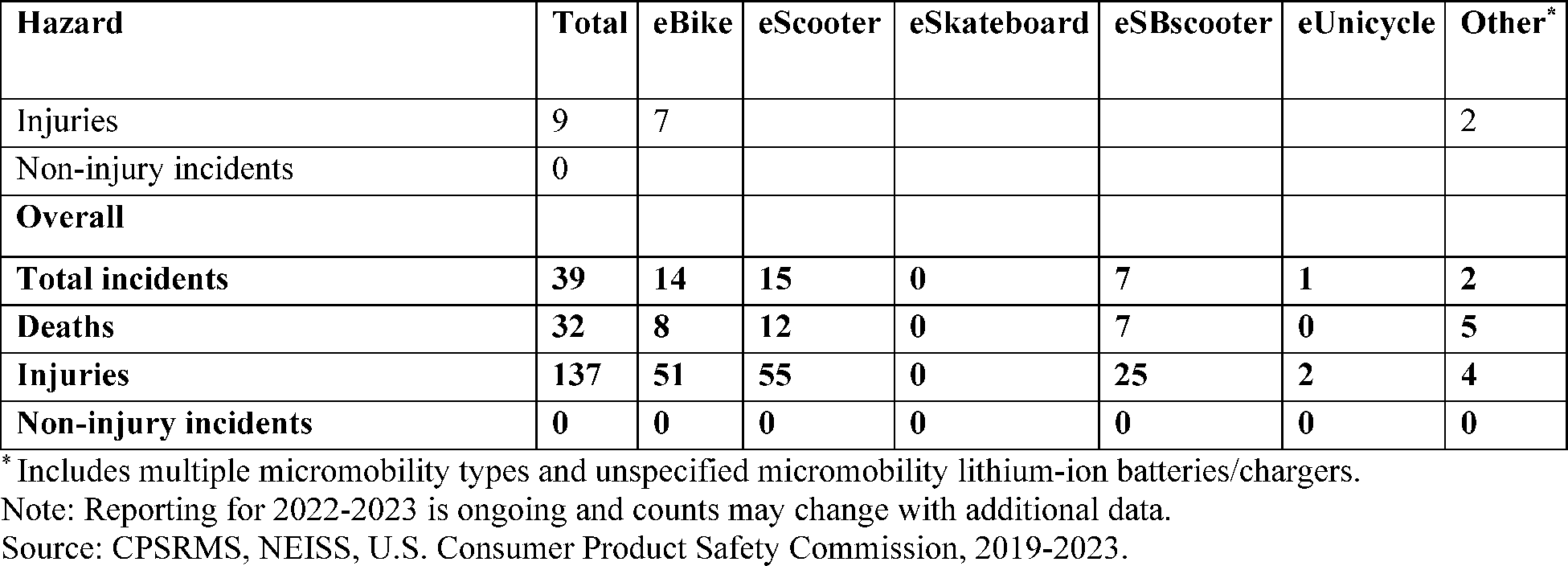
Table 2.3 shows the hazard pattern data by product type. Twenty-one out of the 39 incidents involving multiple-victim incidents (about 54 percent) occurred while the product was plugged in charging, including 15 out of 32 fatalities (about 47 percent) and 79 out of 137 injuries (about 58 percent). Seven multi-victim incidents were reported while the products were being stored or resting in open space and unexpectedly catching fire, causing four deaths and 33 injuries. Two incidents with five injuries were associated with products during use, shortly after use, or after unplugging a charger from the product. Users removing or replacing the battery and using a user replaceable battery or aftermarket charger were associated with four incidents, two deaths, and nine injuries. An incident was reported in which the victim was manufacturing, repairing, and charging homemade lithium-ion batteries, resulting in one death and two injuries. The remaining four multiple-victim incidents did not provide specific hazard description but accounted for 10 deaths and nine injuries.
BILLING CODE 6355-01-P
BILLING CODE 6355-01-C
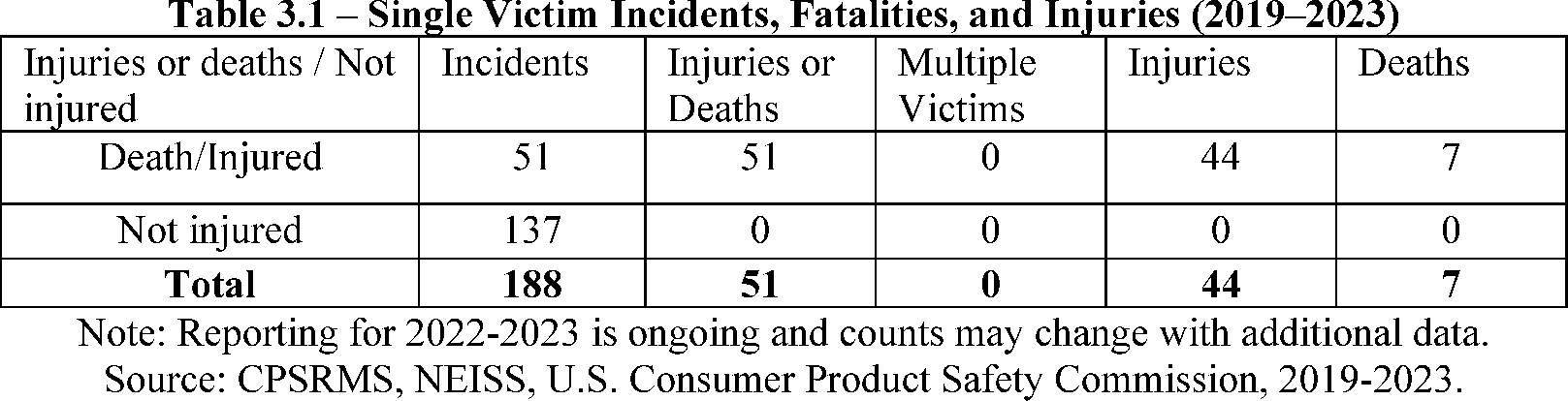
2. Incidents involving Single Victim —Of the 188 incidents with single victims, 51 incidents resulted in seven deaths and 44 injuries, as set forth in table 3.1.
Of the seven fatalities, four were males and three were females. Twenty-seven out of 43 single-injury incidents with known sex (about 63 percent) were males versus 16 females (about 37 percent). Table 3.2 presents the distribution of sex by product type.
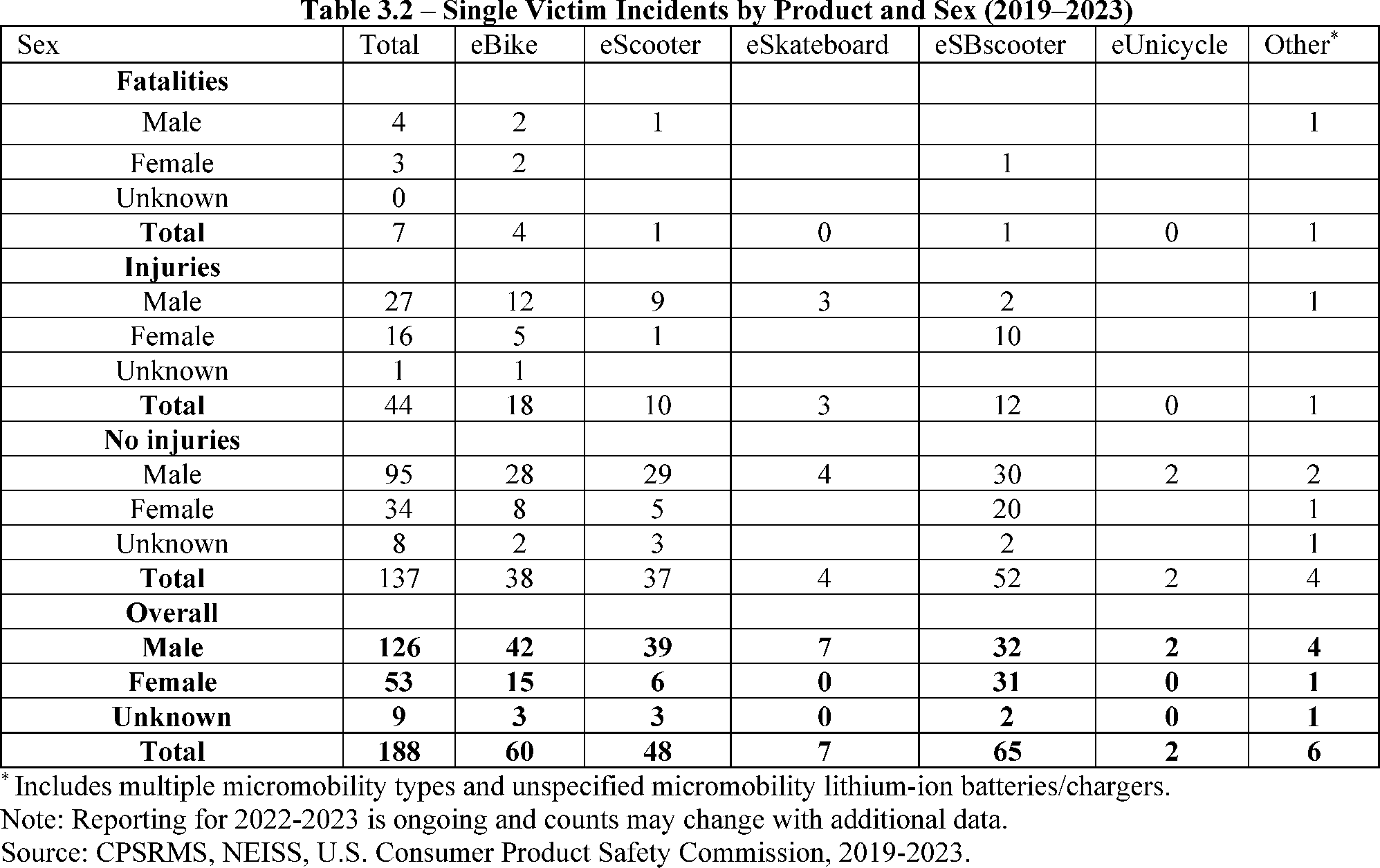
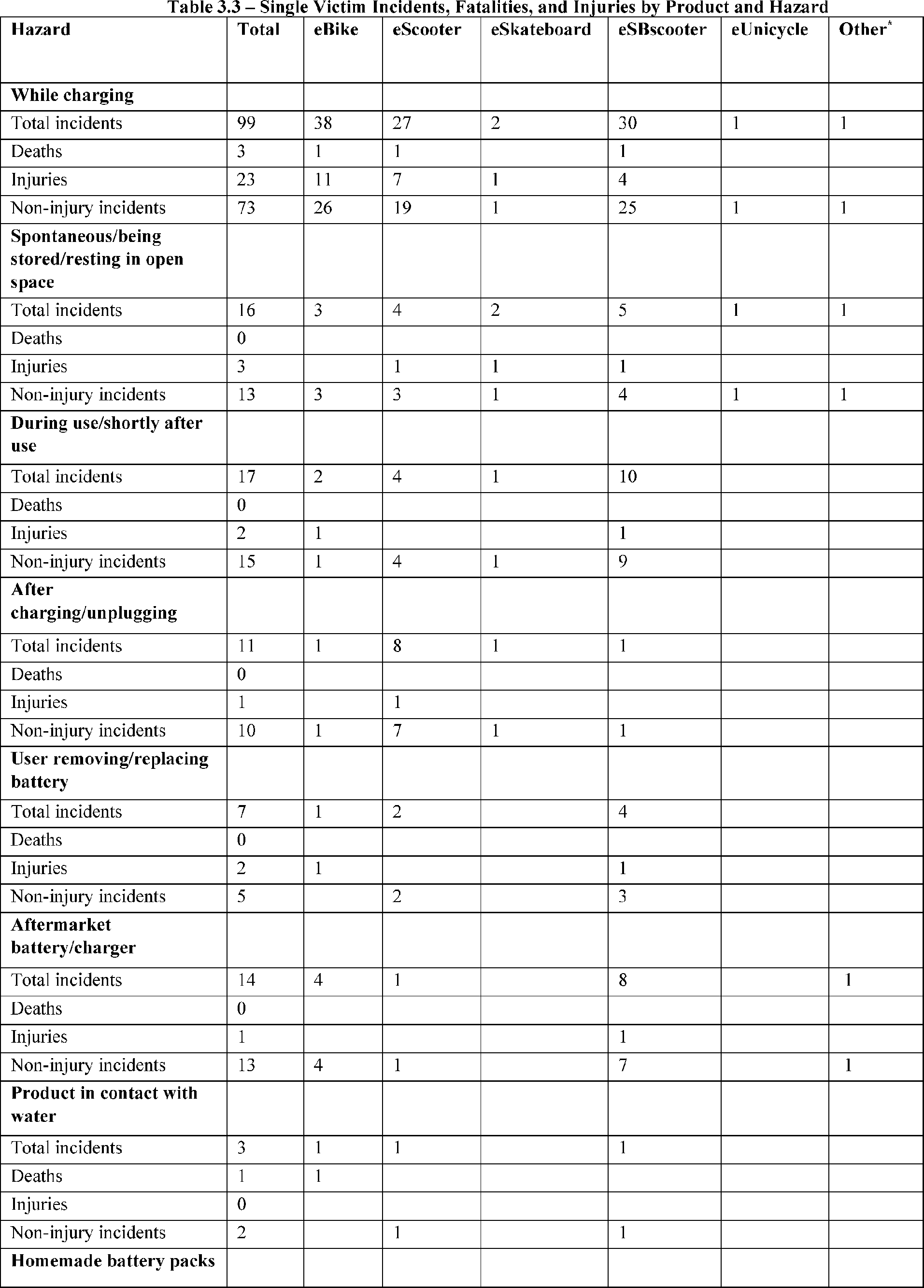
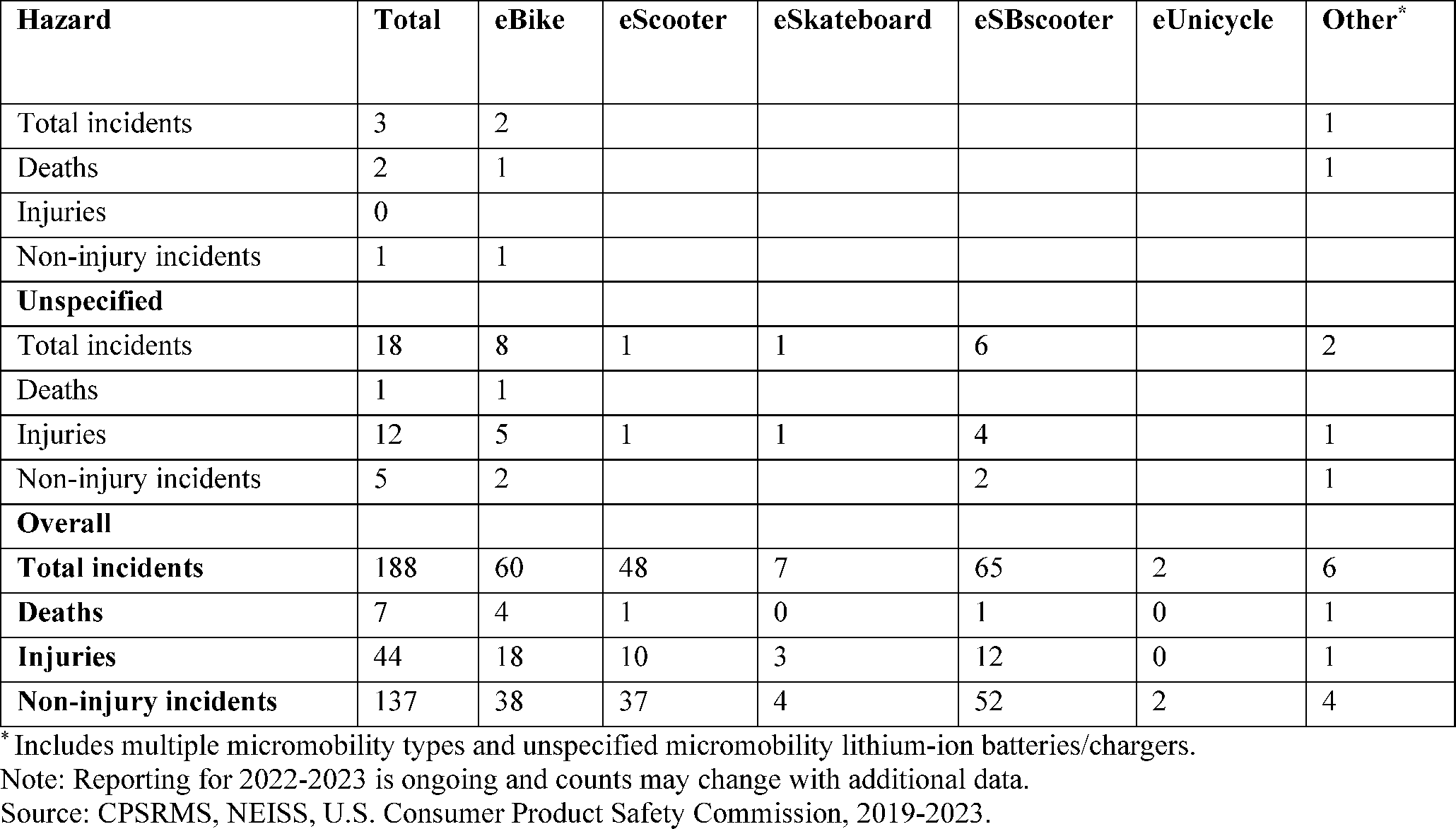
Table 3.3 shows the distribution of hazard pattern data by product type. Out of the 188 incidents, 99 incidents (about 53 percent) occurred while the products were plugged in charging, leading to three out of seven fatalities (about 43 percent), 23 of 44 injuries (about 52 percent), and 73 out of 137 non-injury incidents (about 53 percent). Another 16 incidents were reported while the products were being stored or resting in an open space and unexpectedly catching fire, causing three injuries. Twenty-eight incidents with three injuries were mainly associated with products while in use, shortly after use, or soon after charging. `User removing/replacing battery' and `Aftermarket battery/charger' accounted for 21 incidents with three injuries. Three incidents involved products in contact with water, causing one death. Three incidents, resulting in two deaths, were associated with the victims manufacturing, repairing, and charging lithium-ion batteries. The remaining 18 incidents did not provide specific hazard description but accounted for one death and 12 injuries.
BILLING CODE 6355-01-P
BILLING CODE 6355-01-C
C. Hazard Patterns From the Incident Data
As summarized in table 1.4 in section III.B of this preamble, CPSC identified the following nine hazard patterns in the incident data associated with lithium-ion batteries used in micromobility products, or within an electrical system of a micromobility product.
1. Charging —CPSC is aware of 120 incidents associated with thermal runaway during normal charging of micromobility products, resulting in 18 deaths and 102 injuries. For example, in IDI 211005CAA1026 the consumer fully charged an eBike battery after purchase and approximately 3-5 times each week thereafter. A few months after purchase, the consumer reportedly used the adapter that came with the eBike to charge the battery. The consumer arrived home in the evening to discover that the fire department had extinguished a fire in his living room, where the eBike was located. Fire officials determined that the rechargeable battery on the eBike had exploded and started a fire. The consumer found the remains of the battery on the floor next to the bike, surmising that it had blown off when the battery exploded.
In another example, IDI 220119CCC1747, an eSBscooter reportedly caught fire while on an extended charge. The eSBscooter had been purchased new by the consumer about 19 months earlier from an online retailer and used without incident until the fire. The consumer used the product and then plugged it in to charge in the garage. Approximately one week later, the consumer heard a smoke alarm and observed flames coming from the garage. Firefighters determined the fire originated from the eSBscooter, which had overheated from being charged and began to melt, catching a nearby mattress on fire.
2. Spontaneous (Stored or Resting in Open Space) —CPSC is aware of 23 spontaneous incidents while the micromobility product was being stored or resting in an open space. These incidents resulted in four deaths and 36 injuries. For example, in IDI 231221CCC1586, a fire originated in an apartment with two skateboards that were left by the front entrance door. Neither product was being charged at the time of the incident or was recently used.
3. Discharge (During or Shortly After Riding) —CPSC is aware of 18 incidents while the micromobility product was in use, resulting in four injuries. For example, in IDI 230713CFE0001, a 14-year-old male was riding an approximately year-and-a half old stand-up, rechargeable eScooter when the battery caught fire and started smoking and burst into flames, shooting out individual battery cells up to four feet away from the eScooter. The teen reported that he always used the original factory charger to charge the eScooter.
Another example of a discharging incident is documented in IDI 231130CCC1429. A 67-year-old female started her eBike and reported that the battery suddenly exploded with flames bursting out of the bike. The eBike was purchased new a month or so before the incident along with a second identical unit. The consumer reported assembling the product per the instructions, but did not assemble anything in relation to the battery.
4. After Charging or Unplugging —CPSC is aware of 12 incidents after the micromobility product was charged and unplugged, resulting in four injuries. For example, in IDI 220525CBB3911, the consumer went to unplug the charger from an eScooter with an OEM replacement battery after about a month on the charger, and the product sparked, caught fire, and emitted smoke. The area above the charge port was scorched and the eScooter was no longer operable.
In IDI 210824CFE0001, the consumer was awakened by a loud explosion and saw dark black smoke and fire emitting from the area where his eScooter was located after being charged overnight. The apartment sustained fire, smoke, soot, and water damage, leaving it uninhabitable.
5. Battery Removal or Replacement —CPSC is aware of eight incidents after the user removed or replaced the battery, resulting in four injuries. In several of these incidents, consumers were attempting to install a replacement battery sent by the manufacturer (IDI 220908CCC1337, 220908CCC1339, 220908CCC1340).
6. Aftermarket Battery or Charger —CPSC is aware of 17 incidents involving aftermarket batteries or chargers, resulting in two deaths and eight injuries. For example, in IDI 220805CFE0001, lithium-ion batteries self-ignited during the charging process in an apartment, resulting in a fire and the deaths of a 5-year-old female and a 36-year-old female. The batteries were being charged using an aftermarket charger plugged into an extension cord. During a federal line-of-duty death investigation of a career firefighter, investigators determined that the fire origin was from using a lithium-ion battery-powered device and an aftermarket charger together, causing the batteries to overheat, go into thermal runaway, and start a fire. CPSC has warned consumers against using aftermarket universal chargers that are not compatible with their intended micromobility products. 21
21 https://www.cpsc.gov/Warnings/2024/CPSC-Warns-Consumers-to-Immediately-Stop-Using-SafPow-and-AMPOWSURE-Battery-Chargers-Sold-on-Amazon-com-Due-to-Fire-and-Burn-Hazards-Risk-of-Serious-Injury-and-Death.
7. Contact with Water —CPSC is aware of three incidents involving micromobility products having been in previous contact with water, resulting in one death. In the fatal incident (X2390880A), a fire started on a boat. According to the police, the cause of the fire was an eBike battery that had fallen into the water the day before the incident.
8. Homemade Battery —CPSC is aware of four incidents involving homemade batteries, resulting in three deaths and two injuries. In IDI 200909CFE0001, the consumer used parts of a camper battery to make a homemade eBike battery. In IDI 230213CAA1777, investigators believe the consumer purchased a conversion kit that changes a standard bicycle into an eBike. Investigators hypothesize the battery was “homemade” because they found remnants of cardboard and duct tape.
9. Unspecified —CPSC is aware of 22 incidents involving micromobility products with no identified hazard patterns, resulting in 11 deaths and 21 injuries.
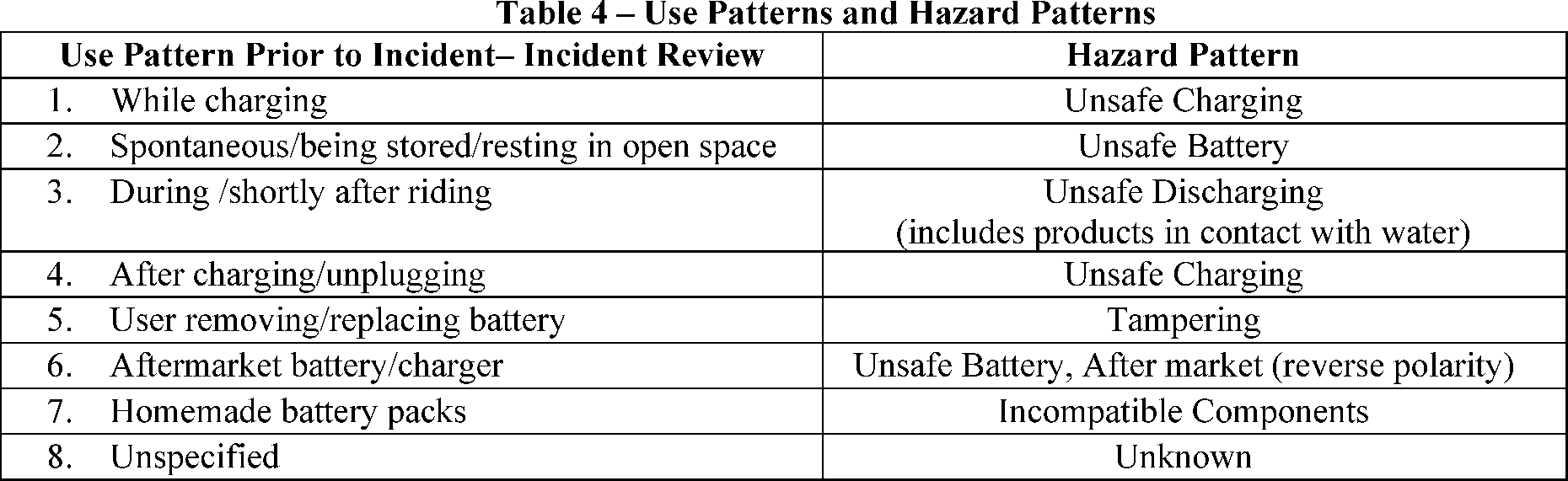
10. Use and Hazard Patterns Associated with Micromobility Products —CPSC staff categorized the use patterns and associated hazard patterns prior to the fires identified from the incident data, including Unsafe Battery, Unsafe Charging, Unsafe Discharging, Incompatible Components, Tampering and Unknown. Table 4 provides a summary of the use patterns observed in the incident data and the associated hazard patterns.
D. Mechanisms of Injury
1. Smoke Inhalation —In general, smoke inhalation is the most common cause of death in fire incidents. 22 The reported casualties (fatality and serious injury) were primarily caused by fires of house structures and surrounding combustible materials ( e.g., furniture, bedding items) after an initiation of fire from a lithium-ion battery for micromobility products. Smoke inhalation produces respiratory complications and injuries, including thermal injury to the upper airway from heated gases, irritation to the airways, asphyxiation or oxygen depletion by carbon monoxide (CO) and hydrogen cyanide (HCN), 23 hydrogen chloride (HCl) gas inhalation-associated airway blockage, and atmospheric oxygen depletion by burning. 24
22 Gill P. and Martin R.V. (2015) Smoke inhalation injury, BJA Education, 15(3): 143.
23 Lafferty KA, Bonhomme K, Martinez CV et al. Smoke inhalation Injury (2021). Available from http://emedicine.medscape.com/article/771194-overview (accessed 04 June 2024).
24 Alarie Y. (2002) Toxicity of fire smoke, Crit. Rev. Toxicol. 32(4): 259.
Patients who suffer burn injury also are likely to be exposed to smoke and hazardous gases. Asphyxiation, or insufficient oxygen levels, is the primary cause of unconsciousness or death from such exposure. CO is the main asphyxiant gas in fires, and CO poisoning is the primary cause for half of all deaths during fire. 25 CO binds with hemoglobin in red blood cells, which is responsible for carrying oxygen to all parts of the body. CO has a much higher binding affinity to hemoglobin than oxygen. This competitive binding of CO over oxygen with hemoglobin reduces oxygen transportation to the cells, resulting in hypoxic (or insufficient oxygen associated) injury of all tissues of exposed subjects. The brain and the heart are particularly vulnerable to hypoxia, and prolonged exposures are increasingly harmful.
25 Roeland Bisschop, Per Blomqvist, Alastair Temple, Johan Anderson, RISE (2020) Toxic Gases from Fire in Electric Vehicles, Ola Willstrand, RISE Research Institutes of Sweden, RISE Report 2020:90.
HCN is also generated in fires, particularly those involving synthetic materials ( e.g., furnishings, plastics, vinyl). HCN binds the enzyme cytochrome C oxidase and blocks the mitochondrial transport chain that results in the depletion of adenosine triphosphate (ATP), the source of energy at the cellular level. The depletion of ATP is followed by the impairment of vital functions of cells that ultimately disable organs, such as the lung, the heart, and the central nervous system. The presence of HCN also increases the adverse effects of CO when it is also present. 26
26 Gill P. and Martin R.V. (2015).
HCl is a corrosive irritant that is generated in fires, particularly those involving materials containing chlorine ( e.g., polyvinyl chloride). The presence of gaseous HCl exacerbates the irritating and choking effects of the smoke. HCl in fire smoke when inhaled causes laryngeal and bronchial spasm and generates massive pulmonary edema, leading to suffocation. 27
27 Alarie Y. (2002).
Fires consume oxygen and therefore can significantly reduce the levels of oxygen in the air indoors. Reduced oxygen levels can result in incapacitation or loss of consciousness of people near fires and contribute to deaths and serious injuries. 28 Furthermore, the heat of active fires may cause heat shock injury and death in nearby people, especially if victims are incapacitated.
28 Alarie Y. (2002).
2. Exposure to Chemicals —In addition to the generation of asphyxiant and corrosive gases and heat, lithium-ion battery fires and involvement of surrounding household goods and combustible materials may produce other chemical substances that could be inhaled or absorbed through the skin. Fire-associated chemicals (and their associated potential adverse effects) may include:
• Metals, such as aluminum (Al), lithium (Li), cobalt (Co), nickel (Ni), and manganese (Mn): respiratory tract irritation and asthma; 29 30
29 RISE (2023) Investigation of extinguishing water and combustion gases from vehicle fires, Hynynen J., Willstrand O., Blomqvist P., Quant M. RISE Research Institutes of Sweden, RISE Report 2023:22.
30 Nemery B. (2022) Chapter 19—Metals and the Respiratory Tract, Pages 421-443, Handbook on the Toxicology of Metals (Fifth Ed.), Editors: Gunnar F. Nordberg and Max Costa, Academic Press
• Other irritant gases, such as hydrogen fluoride (HF), sulfur dioxide (SO 2 ), and nitrogen dioxide (NO 2 ): respiratory tract irritation and corrosion of upper respiratory tract tissues; 31 32 33
31 RISE (2020).
32 National Research Council (US) Committee on emergency and continuous Exposure Guidance Levels for Selected Submarine Contaminants (2009) Emergency and continuous exposure guidance levels for selected submarine contaminants: Volume 3, National Academies press, Washington, DC https://www.ncbi.nlm.nih.gov/books/NBK219903/.
33 Gaskin S., Heath L., Pisaniello D., Logan M., and Baxter C. (2019) Skin permeation of oxides of nitrogen and sulfur from short-term exposure scenarios relevant to hazardous material incidents. Sci. Total Environ. 665, 937.
• Per- and polyfluoroalkyl substances (PFAS): changes in enzymes and adverse physiological responses, altered immune and thyroid function, lipid and insulin dysregulation, adverse reproductive and developmental outcomes; 34 35
34 Quant M., Willstrand O., Mallin T, and Hynynen J. (2023) Ecotoxicity Evaluation of Fire-Extinguishing Water from Large-Scale Battery and Battery Electric Vehicle Fire Tests. Environ. Sci. Technol. 57, 4821.
35 Fenton SE, Ducatman A., Boobis A., DeWitt J.C., Lau C., Ng C., Smith J.S., and Roberts S.M. (2021) Per- and polyfluoroalkyl substance toxicity and human health review: Current state of knowledge and strategies for informing future research. Environ. Toxicol. Chem. 40, 606.
• Volatile organic compounds (VOCs) and polycyclic aromatic hydrocarbons (PAHs), including benzene and benzo(a)pyrene: 29 31 respiratory tract irritation and inflammation, 36 37 and;
36 Agency for Toxic Substances and Disease Registry (ATSDR) (2007) Toxicological Profile for Benzene. https://www.ncbi.nlm.nih.gov/books/NBK591289/.
37 Bukowska B., Mokra K., and Michalowicz J. (2022) Benzo[a]pyrene-Environmental occurrence, human exposure, and mechanisms of toxicity. Int. J. mol. Sci. 23, 6348.
• Particulates: respiratory irritation, increased severity of asthma and chronic obstructive pulmonary disease (COPD) in patients with the symptoms. 38 39 40 41
38 Premnath V., Wang Y., Wright N., Khalek I., and Uribe S. (2022) Detailed characterization of particle emissions from battery fires. Aerosol Sci. Technol. 56, 337.
39 Quant M. et al. (2023).
40 RISE (2020).
41 ATSDR (2024) Guidance for inhalation exposures to particulate matter.
The hazards associated with exposure to chemicals released or generated by lithium-ion battery fires and involvement of surrounding combustible materials depend on the specific substances emitted during the event, levels of toxicity of the substances, and levels of exposure, as well as vulnerability of exposed subjects. Exposure to chemicals from a lithium-ion battery fire likely will be limited if individuals notice the fire at an early stage and are able to escape. However, in the case that a failing battery or fire is not immediately recognized, or when individuals cannot escape, prolonged exposure to the emitted chemicals may be associated with more severe injury and death from exposure to asphyxiant gases, heat, or the fire itself.
3. Electric Shock —An electric shock occurs when an electric current passes through a human body. The electric shock can cause death and injuries to humans. Three basic factors that determine effects of electric shock are current levels, exposure duration of contact, and electrical frequency. 42 Although current is the primary determinant of subsequent health adverse effects of electric shock, voltage also influences the outcome of an electric shock. 43 Electric current, measured in amperes (A), is defined as a flow of charged electrons or ions. There are two types of electric current, alternating current (AC) and direct current (DC). The current associated with household electrical outlets is AC that continuously changes direction from a positive to a negative value. In contrast, DC current, such as from batteries, is a unidirectional current. Voltage is defined as electric potential between two points, functioning as a force moving the current from one point to another point.
42 BrightHub Engineering, AC and DC Electric Shock Effects Compared, available at: https://www.brighthubengineering.com/power-plants/89792-ac-and-dc-shock-comparison/ (last accessed 09/10/2024).
43 Fish R.M. and Geddes L.A. (2009) Conduction of electrical current to and through the human body: A review, Eplasty, 9: e44.
Exposure to electric current causes various effects on a human body, depending on the level, including stimulation of muscles and nerves, and respiratory or cardiac arrest. 44 The maximum current under which an average adult can voluntarily release an electrified object is called the “let go” current. The let-go currents of AC and DC are 16 mA and 75 mA for most adults, respectively. 45 46 For electric currents above the let-go levels, exposed humans may not be able to drop an energized object because of muscle contraction, unless the current flow stops. 47
44 Fish R.M. and Geddes L.A. (2009).
45 Fish R.M. and Geddes L.A. (2009).
46 Zemaitis M.R. et al. (2023).
47 NIOSH (1998) Worker deaths by electrocution: A Summary of NIOSH Surveillance and Investigative Findings.
Electrical injuries can be differentiated between low-voltage (<600V) and high-voltage (≥600 V) injuries. Most micromobility products are designed to operate using low voltage ( e.g., 60 VDC or less). Patients who experience low-voltage injuries may present with only minor or no skin burns. However, if there is prolonged contact or muscle tetany, 48 low voltage electrical energy can result in cardiac or respiratory arrest, arrhythmias ( e.g., ventricular fibrillation) or seizures. In addition to the characteristics of the electrical system, other factors can affect severity of injuries. For example, a victim contacting current in wet conditions may face a higher electric risk than in dry conditions. 49
48 Muscle tetany is an involuntary muscle contraction accompanied by overly stimulated peripheral nerves.
49 Zemaitis M.R. et al. (2023).
Depending on the severity of electrical injury, short-term immediate effects may include tingling or prickling sensation, skin burns, headache, irregular heartbeat, seizures, and loss of consciousness. After the immediate injury, patients may experience long-term adverse effects, such as post-traumatic stress disorder (PTSD), depression, anxiety, insomnia, reduced attention span, and panic attacks. 50 The skin has the highest electrical resistance and tends to suffer the greatest level of damage ( i.e., skin burns). The electric resistance of the skin may prevent severe internal damage from the electric shock. Low skin resistance due to the presence of water or damaged skin may result in less severe skin burns, but a larger amount of electrical energy may be transferred to internal tissues leading to a higher risk of internal tissue damage. 51
50 Eagle R. How various levels of electric shocks affect the body and how to recover. MedicalNewsToday, available at: https://www.medicalnewstoday.com/articles/electric-shock (January 11, 2024).
51 Zemaitis M.R. et al. (2023).
E. Availability of Incident Data
Upon publication of this NPR in the Federal Register , CPSC will make available for review and comment the CPSRMS and NEISS incident reports relied upon and discussed in this NPR, to the extent allowed by applicable law, including any IDIs conducted by CPSC. Upon publication of this NPR, these data can be obtained by submitting a request at https://forms.office.com/g/2ubiRFZxfw. If you do not receive access to the data within one business day after submitting your request, or if you have any issues accessing the data, please contact the phone number or email address listed in the FOR FURTHER INFORMATION CONTACT section at the beginning of this NPR.
F. Recalls, Unilateral Press Releases, and Enforcement Letters
Since 2016, consumer use of micromobility products has greatly expanded, as has CPSC's engagement to mitigate the associated health and safety risks. This section of the preamble summarizes CPSC's efforts to inform industry about, and protect consumers from, associated fires, explosions, gas releases, burns, overheating, and smoke inhalation risks. From January 1, 2016, through November 30, 2024, CPSC conducted 29 voluntary recalls involving micromobility products associated with fire, overheating, and smoke inhalation hazards. Table 5 summarizes CPSC recalls.
BILLING CODE 6355-01-P
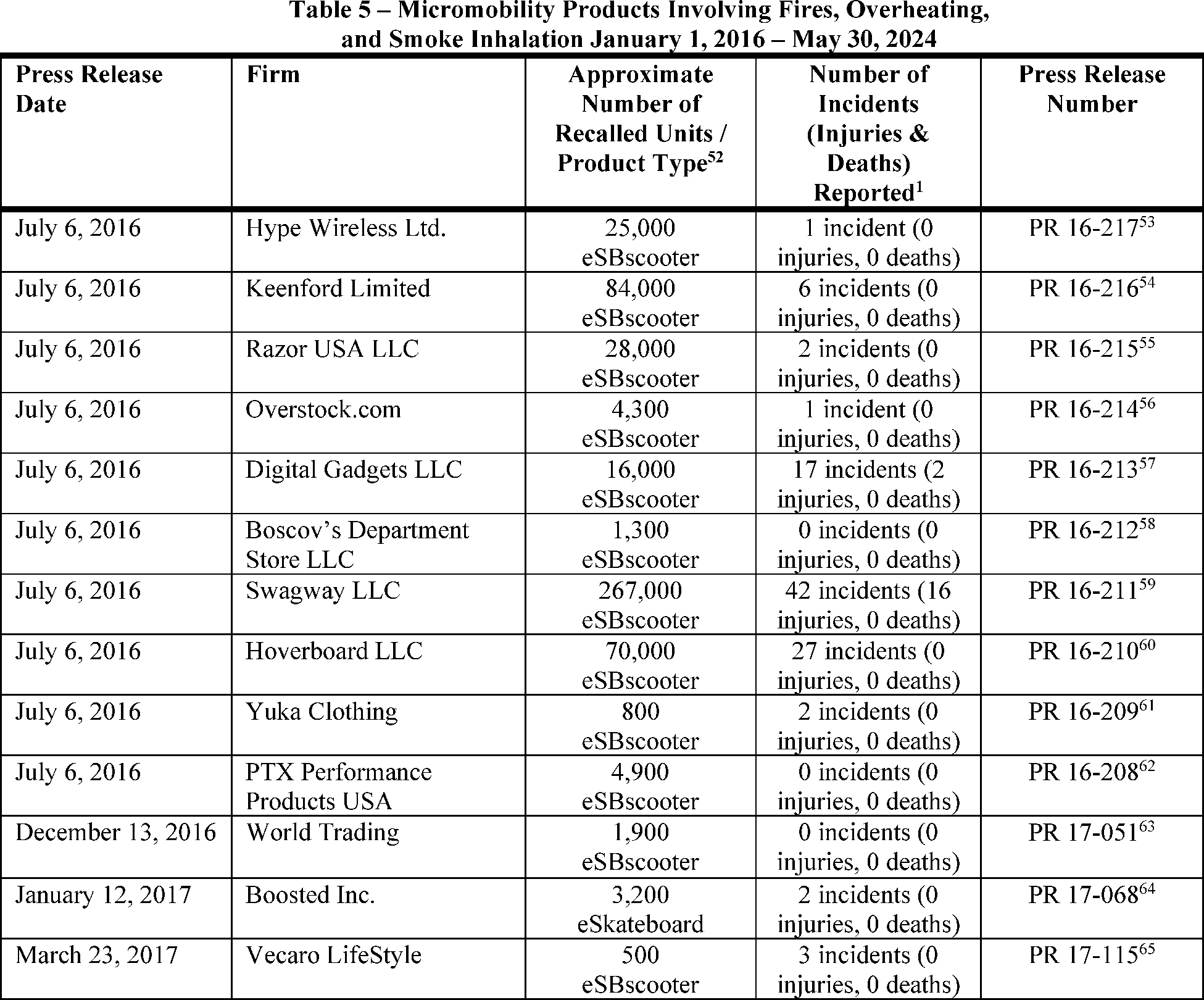
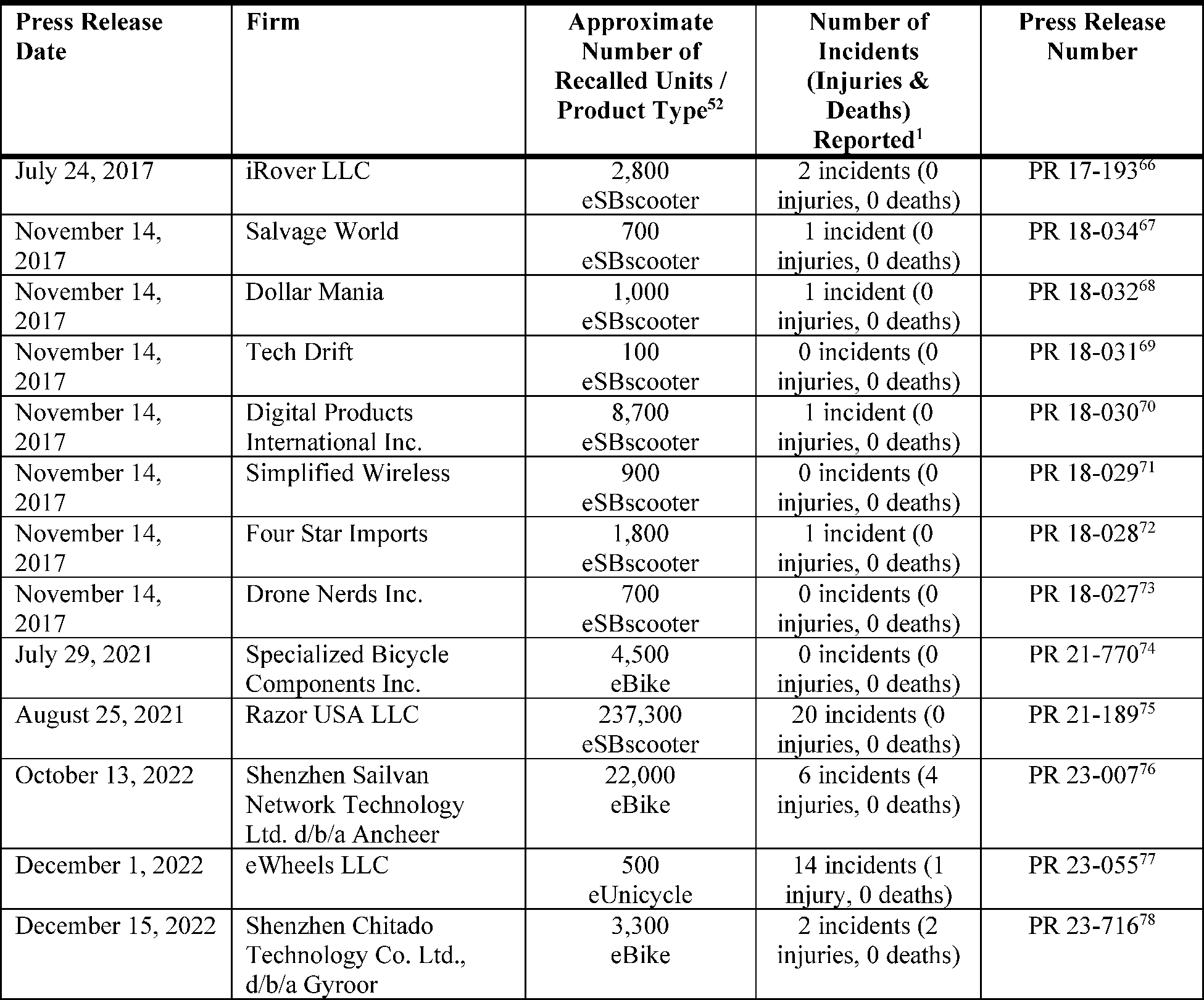
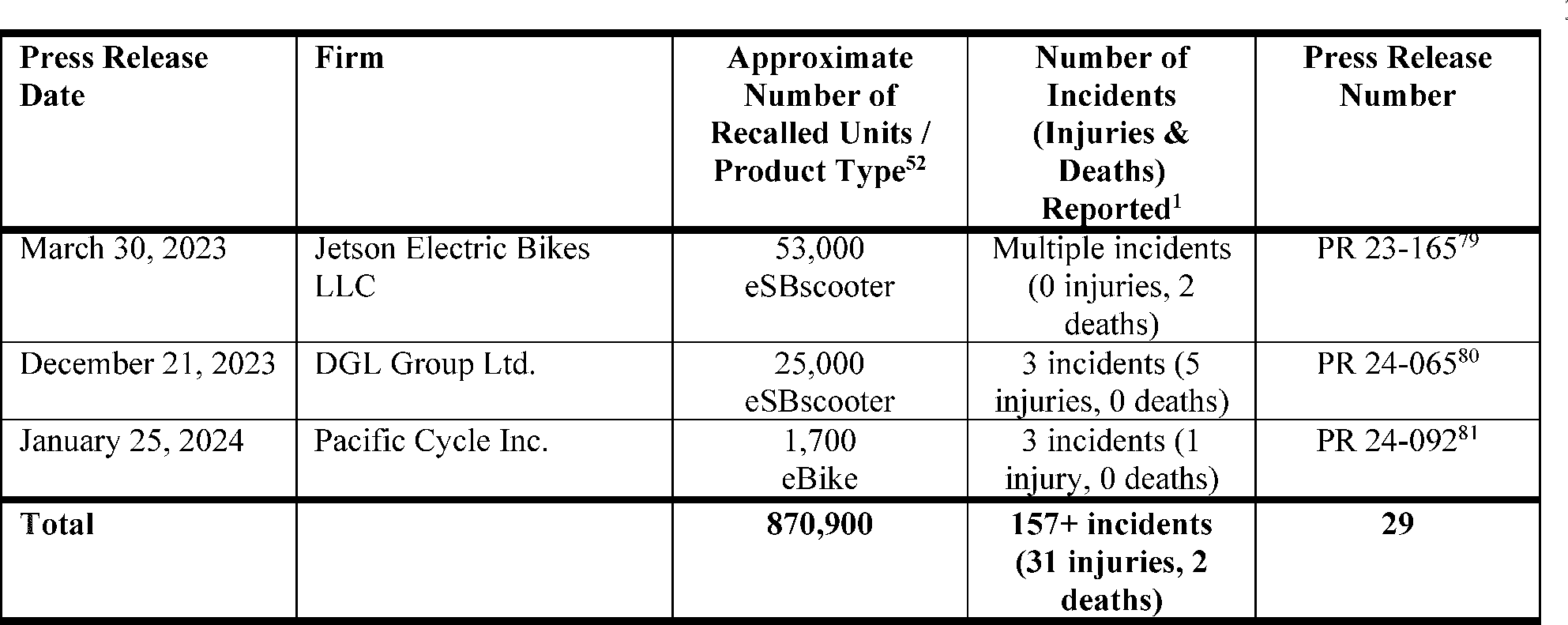
BILLING CODE 6355-01-C
Additionally, during this same period CPSC issued nine press releases warning the public to stop using lithium-ion batteries and micromobility products because of associated safety hazards, such as fires, overheating, and smoke inhalation. Table 6 lists such press releases.
52 When the recall press release delineates the approximate number of recalled units, number of incidents, or number of injuries by country, this summary only includes the reported United States values.
53 https://www.cpsc.gov/Recalls/2016/Hype-Wireless-Recalls-Self-Balancing-Scooters-Hoverboards .
54 https://www.cpsc.gov/Recalls/2016/Keenford-Limited-Recalls-Self-Balancing-Scooters-Hoverboards .
55 https://www.cpsc.gov/Recalls/2016/Razor-Recalls-Self-Balancing-Scooters-Hoverboards .
56 https://www.cpsc.gov/Recalls/2016/Overstock-Recalls-Self-Balancing-Scooters-Hoverboards .
57 https://www.cpsc.gov/Recalls/2016/Digital-Gadgets-Recalls-Self-Balancing-Scooters-Hoverboards .
58 https://www.cpsc.gov/Recalls/2016/Self-Balancing-Scooters-Hoverboards .
59 https://www.cpsc.gov/Recalls/2016/Swagway-Recalls-Self-Balancing-Scooters-Hoverboards .
60 https://www.cpsc.gov/Recalls/2016/Hoverboard-LLC-Recalls-Self-Balancing-Scooters-Hoverboards .
61 https://www.cpsc.gov/Recalls/2016/Yuka-Clothing-Recalls-Self-Balancing-Scooters-Hoverboards .
62 https://www.cpsc.gov/Recalls/2016/PTX-Performance-Products-Recalls-Self-Balancing-Scooters-Hoverboards .
63 https://www.cpsc.gov/Recalls/2017/World-Trading-Recalls-Orbit-Self-Balancing-Scooters-and-Hoverboards .
64 https://www.cpsc.gov/Recalls/2017/Boosted-Recalls-Electric-Skateboards .
65 https://www.cpsc.gov/Recalls/2017/Vecaro-LifeStyle-Recalls-Self-Balancing-Scooters-Hoverboards .
66 https://www.cpsc.gov/Recalls/2017/iRover-Recalls-Self-Balancing-Scooters-Hoverboards .
67 https://www.cpsc.gov/Recalls/2018/Smart-Balance-Wheel-SelfBalancing-ScootersHoverboards-Recalled-by-Salvage-World-Due-to-Explosion-and-Fire-Hazards .
68 https://www.cpsc.gov/Recalls/2018/Sonic-Smart-Wheels-SelfBalancing-ScootersHoverboards-Recalled-by-Dollar-Mania-Due-to-Explosion-and-Fire-Hazards.
69 https://www.cpsc.gov/Recalls/2018/Tech-Drift-Recalls-SelfBalancing-ScootersHoverboards-Due-to-Fire-and-Explosion-Hazards .
70 https://www.cpsc.gov/Recalls/2018/iLive-SelfBalancing-ScootersHoverboards-Recalled-by-Digital-Products-Due-to-Fire-Hazard .
71 https://www.cpsc.gov/Recalls/2018/iHoverspeed-SelfBalancing-ScootersHoverboards-Recalled-by-Simplified-Wireless-Due-to-Fire-Hazard .
72 https://www.cpsc.gov/Recalls/2018/Go-Wheels-SelfBalancing-ScootersHoverboards-Recalled-by-Four-Star-Imports-Due-to-Fire-and-Explosion-Hazards-Sold-Exclusively-at-Village-Mart .
73 https://www.cpsc.gov/Recalls/2018/Drone-Nerds-Recalls-SelfBalancing-ScootersHoverboards-Due-to-Fire-and-Explosion-Hazards .
74 https://www.cpsc.gov/Recalls/2021/Specialized-Bicycle-Components-Recalls-Electric-Mountain-Bike-Battery-Packs-Due-to-Fire-and-Burn-Hazards-Recall-Alert .
75 https://www.cpsc.gov/Recalls/2021/Razor-USA-Recalls-GLW-Battery-Packs-Sold-with-Hovertrax-2-0-Self-Balancing-Hoverboards-Due-to-Fire-Hazard .
76 https://www.cpsc.gov/Recalls/2023/E-Bikes-Recalled-Due-to-Fire-Explosion-and-Burn-Hazards-Distributed-by-Ancheer .
77 https://www.cpsc.gov/Recalls/2023/eWheels-Recalls-Gotway-and-Begode-Unicycles-Due-to-Fire-Hazard .
78 https://www.cpsc.gov/Recalls/2023/E-Bikes-Recalled-Due-to-Fire-and-Burn-Hazards-Distributed-by-Gyroor-Recall-Alert .
79 https://www.cpsc.gov/Recalls/2023/Jetson-Electric-Bikes-Recalls-42-Volt-Rogue-Self-Balancing-Scooters-Hoverboards-Due-to-Fire-Hazard-Two-Deaths-Reported .
80 https://www.cpsc.gov/Recalls/2024/DGL-Group-Recalls-Hover-1-Helix-Hoverboards-Due-to-Fire-Hazard .
81 https://www.cpsc.gov/Recalls/2024/Pacific-Cycle-Recalls-E-Bikes-Due-to-Fire-Hazard .
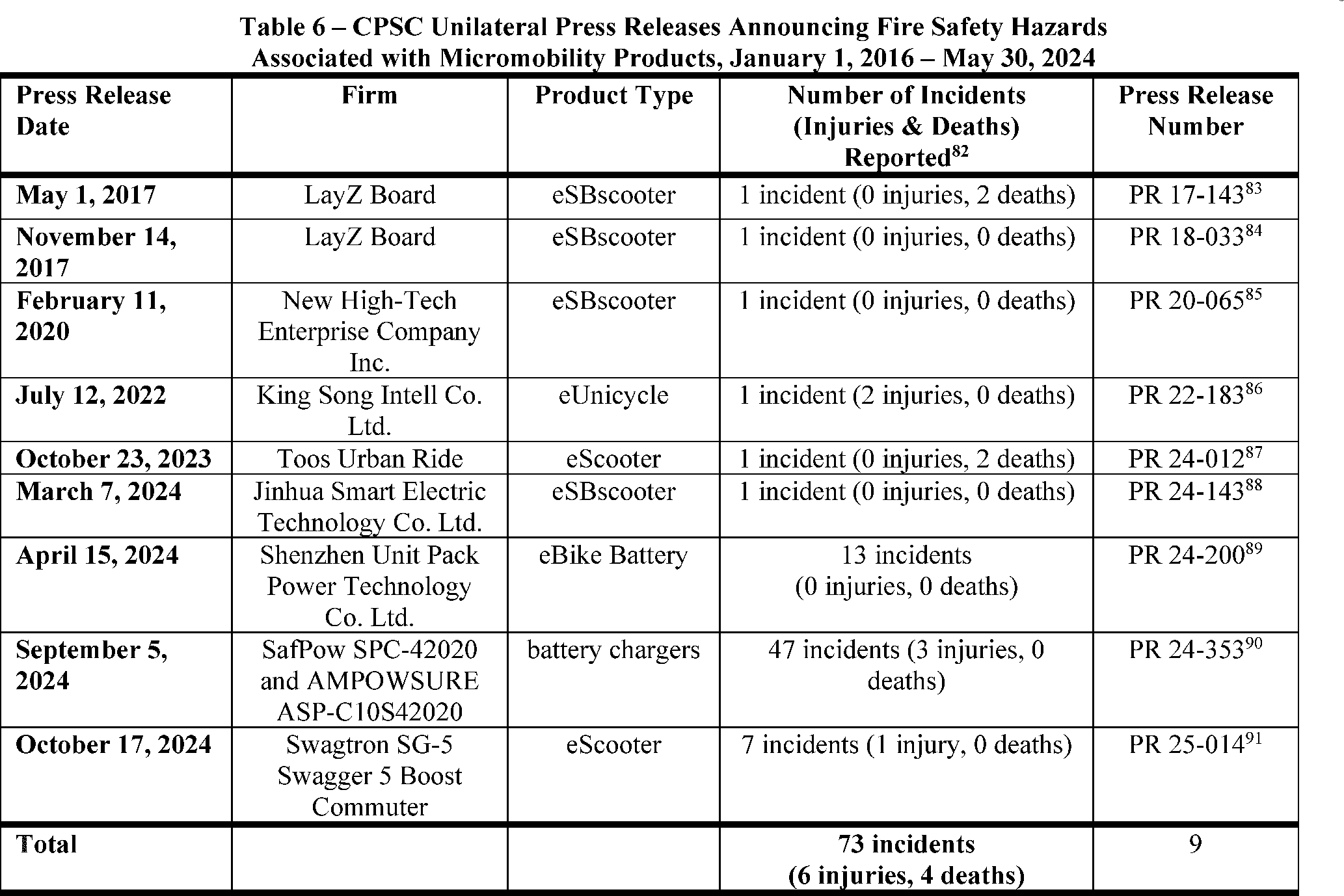
Finally, CPSC's Office of Compliance and Field Operations issued two enforcement letters advising manufacturers and importers of micromobility products to address fire hazards associated with such products to meet the requirements in the applicable voluntary standards. Table 7 describes these two letters.
82 When the press release delineates the number of incidents or number of injuries by country, this summary only includes the reported United States values.
83 https://www.cpsc.gov/Newsroom/News-Releases/2017/following-fatal-house-fire-cpsc-warns-consumers-to-stop-using-layz-board-hoverboards-0 .
84 https://www.cpsc.gov/following-second-house-fire-cpsc-warns-consumers-to-stop-using-layz-board-hoverboards .
85 https://www.cpsc.gov/Newsroom/News-Releases/2020/CPSC-Warns-Consumers-Not-to-Charge-or-Use-New-High-Tech-X1-5-Hoverboards-Due-to-Fire-Hazard .
86 https://www.cpsc.gov/Newsroom/News-Releases/2022/CPSC-Warns-Consumers-to-Immediately-Stop-Using-King-Song-Electric-Unicycles-Due-to-Fire-Hazard-Fire-and-Injuries-Reported .
87 https://www.cpsc.gov/Warnings/2024/CPSC-Warns-Consumers-to-Stop-Using-Toos-Elite-Electric-Scooters-Due-to-Fire-Hazard-Two-Deaths-Reported .
88 https://www.cpsc.gov/Newsroom/News-Releases/2024/CPSC-Warns-Consumers-to-Immediately-Stop-Using-EVERCROSS-EV5-Hoverboards-Due-to-Fire-Hazard-Sold-on-Amazon-com-and-Walmart-com .
89 https://www.cpsc.gov/Newsroom/News-Releases/2024/CPSC-Warns-Consumers-to-Stop-Using-Unit-Pack-Power-UPP-E-bike-Batteries-Due-to-Fire-and-Burn-Hazards-Risk-of-Serious-Injury-and-Death .
90 https://www.cpsc.gov/Warnings/2024/CPSC-Warns-Consumers-to-Immediately-Stop-Using-SafPow-and-AMPOWSURE-Battery-Chargers-Sold-on-Amazon-com-Due-to-Fire-and-Burn-Hazards-Risk-of-Serious-Injury-and-Death .
91 https://www.cpsc.gov/Warnings/2025/CPSC-Warns-Consumers-to-Immediately-Stop-Using-Swagtron-SG-5-Swagger-5-Boost-Commuter-Electric-Scooters-Due-to-Fire-and-Burn-Hazards-Risk-of-Serious-Injury-and-Death .
92 https://www.cpsc.gov/Business--Manufacturing/Business-Education/Business-Guidance/Hoverboards .
93 https://www.cpsc.gov/Newsroom/News-Releases/2023/CPSC-Calls-on-Manufacturers-to-Comply-with-Safety-Standards-for-Battery-Powered-Products-to-Reduce-the-Risk-of-Injury-and-Death.
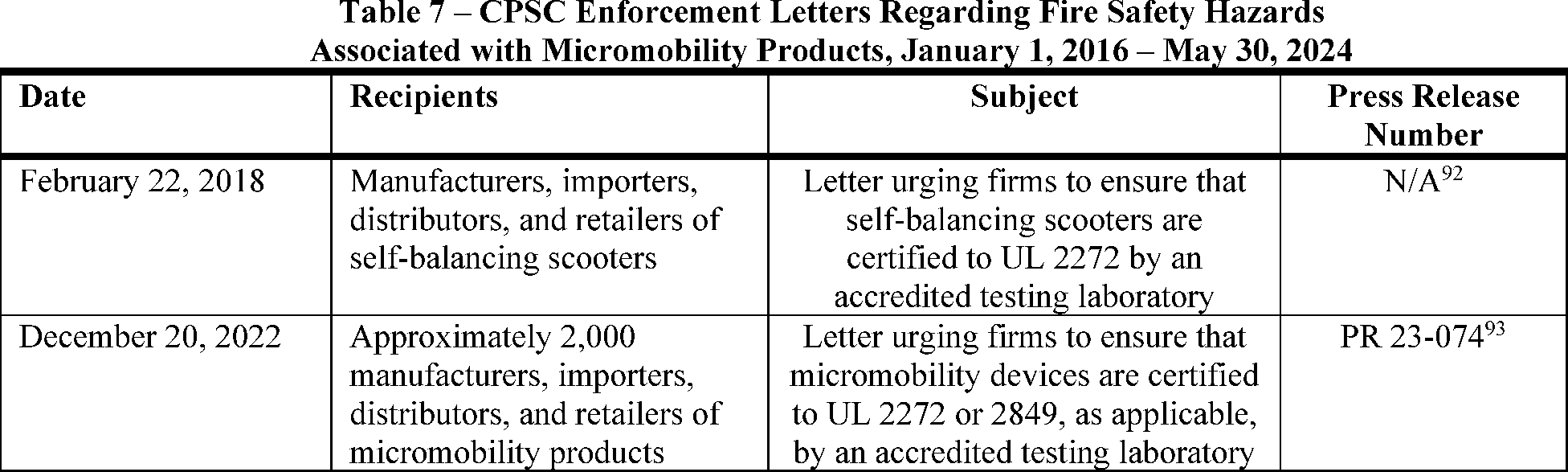
IV. Voluntary Standards Description, Assessment, and Substantial Compliance
In this section of the preamble, we describe the requirements of each of the three voluntary standards CPSC proposes to incorporate by reference and assess the adequacy of each standard, including proposed modifications to these standards, to preliminarily determine whether the NPR would address the risks of injury with the associated hazards identified in section III of this preamble. Additionally, we discuss whether the micromobility products distributed in U.S. commerce substantially comply with the existing applicable voluntary standards.
A. eBikes—UL 2849-20
In January 2020, ULSE published UL 2849-20, the bi-national safety standard for eBike electrical systems, which is still the current version of this standard. The following discussion summarizes and assesses the requirements in UL 2849.
1. Scope and Definitions
Introduction: Scope. Section 1 of UL 2849-20 sets forth the scope of the standard, which includes (i) the electrical system of eBikes, both Electrically Power Assisted Cycle (EPAC—pedal assist) and non-pedal assist, that are powered by a lithium-based, rechargeable battery, as well as (ii) any additional electrical components or systems required to demonstrate compliance. 94 Electrical systems covered by the UL 2849-20 include onboard components, meaning those installed on the eBike, and off board components, including chargers used to charge batteries both on and off the eBike. UL 2849-20 includes some mechanical requirements for the eBike that are not applicable to the identified electrical hazards and are not proposed to be incorporated by the proposed rule.
94 Sit-down products without functional pedals are classified as an eScooter.
Introduction: Components. Section 2 of UL 2849-20 states that critical safety components covered in the standard must meet the requirements in the standard. Sections 2.2-2.4 provide general guidance regarding the proper use and application of a component within the eBike's electrical system.
Introduction: Definitions. Section 5 of UL 2849-20 defines terms used in the standard, including, for example: battery management system (BMS), charger, eBike, and enclosure. Defined terms provide context and clarity to the construction, performance, and labeling requirements in UL 2849-20. Accordingly, the NPR proposes to incorporate all definitions in section 5 of UL 2849-20 into the mandatory rule without modification.
2. Construction Requirements
The second major section of the standard is “Construction,” which specifies assembly requirements for product components ( e.g., battery pack, motor, charger and wiring), subsystems ( e.g., definition of hazard voltage and energy levels), and safety considerations ( e.g., safety circuits and analysis and flammability) that ensure that the eBike electrical system is comprised of components that meet applicable safety standards ( e.g., the motor complies with UL 1004-1, Rotating Electrical Machines—General Requirements) and are assembled in accordance with industry best practices. To mitigate the associated eBike risks to consumers, the “Performance” section of UL 2849-20, described below in section IV.A.3 of this preamble, defines the test methods to validate composition of the overall electrical system and components under foreseeable use and misuse conditions.
Construction: 7 General. Section 7 of UL 2849-20 specifies general construction of safe electrical requirements for eBikes. For example, section 7.3 of UL 2849-20 states that eBikes consist of both EPAC and non-EPAC types, and all eBikes must have functional pedals. Products without pedals are definitionally not eBikes and would be considered a sit-down eScooter subject to UL 2272. Also, section 7.3 states that motors on motor-assisted eBikes (EPACs) must stop their assist function when the rider stops pedaling, when reaching a manufacturer's pre-determined speed, or when the user applies the brakes, to ensure that the drive system only assists the rider in the EPAC mode of operation, as would be expected. Motors for non-EPAC eBikes are not required to disengage when the user stops pedaling, because the eBike in the non-pedal assist mode of operation is expected to provide motive power independently of the user pedaling. Also, UL 2849-20 states that non-EPAC eBikes can include an EPAC mode.
Section 7.4 requires the eBike electrical system to be assessed for safe operation for environmental conditions of maximum altitude (6562 feet), ambient temperatures from 32 °F to 104 °F, and ingress protection from water exposure (section 36). If electrical systems can safely operate beyond these environmental limits, UL 2849-20 requires the manufacturer to specify the acceptable limits and provide instructions to inform consumers of the actual range of operation.
Construction: 8 Power Levels. Section 8 of UL 2849-20 defines thresholds for voltage, current, and energy levels associated with the eBike electrical system; systems that exceed these thresholds are potentially hazardous and require design considerations to protect the user. To mitigate these hazardous conditions, these parts or circuits require an enclosure and or electrical insulation to prevent a user from contacting the parts.
Staff have not identified electric shock incidents involving micromobility products in the data examined. However, at this time the majority of micromobility product batteries are rated below 60 VDC. As micromobility products become more powerful and extend the range of operation, battery packs may exceed 60 VDC and can present a greater shock hazard. Furthermore, chargers (both external and those integrated into the micromobility product) are powered from 120 VAC utility power. As with any 120 VAC-connected product, the inherent risk of electric shock while using a charger may be mitigated through design and construction techniques consistent with appropriate standard industry practices. Staff advise that the voltage and current limitations in section 8, in conjunction with other sections of the standard, are based on well-established consumer product safety best practices and adequate to address the shock and fire hazards associated with eBikes.
Construction: 9 Combination of Battery, Battery Management System and Charger. Section 9 explains that a BMS can be either fully integrated into the battery pack or external to the battery pack. Additionally, section 9.2 of UL 2849-20 requires that all testing be performed with the actual battery, BMS, and charger recommended by the manufacturer. Staff advise that evaluating the BMS in conjunction with the battery and charger, as provided in section 9, is necessary to ensure that these subsystems work together to mitigate the risk of causing cell damage and thermal runaway.
Construction: 10 User Protection While Charging —eBike battery packs are charged either while installed on the bike or while removed from the eBike, depending on the eBike. To ensure that consumers do not get shocked in the process of charging an eBike or battery pack, section 10.1 of UL 2849-20 requires batteries that are only intended to be charged when not installed on an eBike to have an inherent means to ensure that the battery cannot be charged when installed on the product.
Also, UL 2849-20 requires that eBike batteries being charged when they are installed on the eBike must protect consumers from a shock hazard from any exposed conductive surfaces of the eBike during charging. To meet the requirement, manufacturers must use a protection system, such as double insulation systems or protective grounding, onboard the eBike. Finally, to prevent potential injury to consumers from inadvertent operation of the drive motor, eBikes must have a charger connect-interlock to prevent the motor from activating while a charger is plugged into an outlet. eBikes without an interlock must provide another means of preventing inadvertent motor activation, such as a switch to keep power from being applied to the motor drive circuit while charging the battery.
Section 10 of UL 2849-20 is adequate to protect consumers from electric shock and death during charging because the standard addresses potential electrical injuries during both on-board and off-board charging based on requirements that are well-known and tested in other similar voluntary standards. For example, the protective grounding requirement of section 10.2.3, the grounding and bonding requirement of section 10.2.4, and the double insulation requirement of section 10.2.5 are common to electrical standards and these requirements are contained in many electrical standards, including UL 2580 and in UL 2594— Electric Vehicle Supply Equipment.
Construction: 11 Battery Packs— Addressing one of the hazard patterns identified above (table 4, unsafe battery) to ensure safe use of battery packs, section 11 of UL 2849-20 requires that lithium-ion battery packs comply with UL 2271-23 or UL 2580-22, Batteries for Use in Electric Vehicles.
UL 2271-23 and UL 2580-22 address the risk of thermal runaway and fire in a battery pack used in a motive platform by requiring:
• Protective circuits ( i.e., BMS) that shut down the charging or discharging of a battery if the normal limits of cell voltage, current, or temperature are exceeded;
• Mechanical and environmental tests, such as vibration endurance, drop, crush, thermal cycling, immersion and external fire exposure, to ensure battery packs can safely withstand a reasonable range of operating conditions;
• Thermal cycling to evaluate the ability of the battery pack of the eBike to withstand rapidly changing temperatures such as those encountered by moving a battery pack from an unheated garage in winter into a heated house;
• Secondary lithium cell manufacturing production line testing to ensure sufficient safety measures that mitigate internal short circuits, overcharge, crush, impact, mechanical shock, vibration, heating and other hazardous conditions during the life of the cells; and
• Single cell failure mitigation requirement to prevent a significant external hazard from a thermal runaway failure spreading to neighboring cells that could lead to a thermal runaway of that cell.
These UL standards are adequate to address the risk of thermal runaway because each has a BMS or protective cell requirement that provides for shut off of the electrical circuit if an individual battery or battery pack is operating outside of its safe operating region. Cutting off the circuit as soon as the battery closely approaches the limit of its safe operating range limits the progression of the underlying chemical reactions contributing to thermal runaway and reduces the probability of a hazardous thermal event. Each of these UL component standards also contains individual cell and battery pack enclosure requirements, and mechanical and environmental tests to simulate use and abuse of the battery/electrical system. Batteries complying with UL 62133-20, Secondary Cells and Batteries Part 2: Lithium Systems or UL 2054-21, Household and Commercial Batteries are also permitted to be used but must pass the tests in section 11.2 of UL 2849-20, which evaluate the battery/BMS to ensure it safely withstands normal and foreseeable misuse conditions for eBike electrical systems. Accordingly, incorporating these requirements into the rule improves the total safety of the eBike electrical system.
One of the hazard patterns identified in the incident data (table 4) is tampering. Section 11 of UL 2849-20 is not adequate to address the risks associated with users accessing the battery compartment. Consumers may attempt to modify or replace battery packs, including individual cells, even though they are not intended to be replaced or modified by the consumer. For example, in IDI No. 220908CCC1340, a consumer opened an eSBscooter and removed the battery pack. Although the incident product was an eSBscooter, this battery modification risk applies to all micromobility products within the scope of the rule, including eBikes.
To address this risk, the NPR proposes an additional requirement in relation to section 11 of UL 2849-20 that would reduce the likelihood of consumers easily accessing the battery compartment using common household tools, such as a flat blade or Philips head screwdriver. The new requirement, as stated in proposed § 1265.2(b)(1), would require a battery compartment to be inaccessible using simple household tools or to be ultrasonically welded or secured by equivalent means, such as adhesives compliant with UL 746C or tamper-proof screws.
Construction: 12 Safety Circuits and Safety Analysis —To address one of the hazard patterns identified in the incident data (table 4, Unsafe Charging and Discharging), section 12 of UL 2849-20 requires the manufacturer to perform a safety analysis of their product to determine the specific fire and shock risks. This analysis sets the testing parameters such as the maximum charging voltage and current and the maximum temperature of the battery. The safety analysis must show that the BMS will limit or shut down the charging or discharging if normal limits of the battery are exceeded. The analysis is used to determine the electrical specification in the Performance section of UL 2849-20. Finally, the safety analysis ensures that protective circuits monitor events such as maximum assist speed and cutoff assistance due to braking, to mitigate the risk of thermal runaway. Staff advise that the required safety analysis in section 12 of UL 2849-20 is necessary to ensure that a BMS or other critical protective circuit addresses the potential hazards associated with eBike electrical system performance. The required evaluation and the described methods have been key elements of many other electrical voluntary standards, such as section 6.6.4 of UL 2054 and section 13 of UL 2580. 95
95 UL 2054 was published in May 1997 and UL 2580 was published in October 2011; both predate UL 2849-20.
Construction: 13 Enclosing and Insulating Hazardous Parts —To reduce the risk of electric shock and thermal runaway that can lead to fires, section 13 of the UL 2849-20 requires eBikes to have one or more enclosures that contain all hazardous live electrical parts, including battery packs. Required enclosures must have sufficient strength and rigidity to withstand the potential physical abuse associated with the intended use of eBikes. This section sets forth requirements for the types and durability of materials for these enclosures, including nonmetallic and metallic materials, and criteria to determine the suitability of polymeric materials, gaskets, and seals.
For example, non-metallic materials must have a minimum flame rating and consider suitability factors such as: resistance to impact; crush resistance; abnormal operations; severe conditions; and mold stress relief distortion. The enclosure itself must also be subject to the impact test in section 33 of UL 2849-20. Enclosures, frames, or handles on the eBike must not have sharp edges that would create a risk of injury during the normal use and maintenance of the product. Finally, openings in an enclosure must be designed to prevent inadvertent access to hazardous electrical parts.
UL 2849-20 also contains the following requirements that are consistent with other electrical standards, representing the best practices for safe electrical components, and CPSC preliminarily assesses that these requirements provide adequate protection to the consumer.
Construction: 14 Mounting —Section 14 of UL 2849-20 requires that components that are mounted on the eBike be subjected to the vibration test in section 38 of the standard, as described in section IV.A.3 of this preamble. Vibration tests are commonly used in other electrical standards, such as section 35 of UL 2580 applicable to lithium-ion batteries, to ensure that components and connections remain functional and within the safe operating envelope even when subjected to dynamic loading. Applying the vibration test to the battery/battery pack and the entire eBike thus addresses electrical shock and fire hazards.
Construction: 15 Printed Wiring Boards —Section 15 of the UL 2849-20 requires printed wiring boards to comply with the requirements in UL 796, and to have a flammability rating as described in section 17 of UL 2849-20. Staff advise that this requirement is adequate to address flammability and construction risks associated with printed wiring boards, and that this requirement is consistent with other electrical standards that reference UL 796 to establish safety requirements for printed wiring boards.
Construction: 16 Spacings and Separation of Circuits —To prevent electrical shocks and fires, section 16 of UL 2849-20 requires physical spacing between parts of opposite polarity. Proper spacings prevent a short circuit, i.e., an unintentional connection that draws excess current in the circuit and produces extreme heat, stresses components/wires, and can cause fires. As the voltage between two electrical points increases, the distance between them must comply with section 16 to prevent arcing, which could create an electrical shock and/or fire hazard. Section 16 of UL 2849-20 outlines what the minimum physical spacing must be, both through air and over-the-surface. Staff advise that the requirement for electrical spacings and table 16.1 are common electrical construction requirements that are consistent with other electrical standards and have been effective in preventing short circuits that can lead to fires.
Construction: 17 Flammability —To ensure that nonmetallic eBike parts do not propagate flames or fire, section 17 of UL 2849-20 requires such nonmetallic materials used for enclosures, internal parts, or internal parts of components, to meet the flammability requirement specified in UL 94. UL 94 specifies test procedures to classify polymeric materials based on their vertical flammability performance. The ratings are V-2, V-1, and V-0 in order from least to most flame resistant. These ratings are based on the amount of time it takes for the test flame to extinguish, the afterglow to disappear, and whether tissue paper ignites under the test sample. Staff advise that the electrical industry has relied on the flame ratings in UL 94 since the first edition of that standard in 1972, and that the industry has relied on V-1 rated plastics for electrical enclosures as a suitable means of fire containment for more than 50 years. However, stakeholders have noted concerns with adverse health effects from the application of some flame retardant chemicals in plastics and reported that plastic battery enclosures using flame retardant plastic are ineffective in containing a lithium-ion battery fire and therefore unnecessary. 96 As such, CPSC seeks comments on use of flame-resistant plastic for battery enclosures.
96 January 10, 2024, CPSC staff Discussions with Green Science Policy on Lithium-Ion Battery Standards https://www.cpsc.gov/s3fs-public/Green-Science-Policy-Meeting-Log.pdf?VersionId=sHgYg9z5yBmsMgQD9W1I9zpheKcysF.A.
Construction: 18 Internal Wiring and Terminals —Section 18 of UL 2849-20 requires wiring used in an eBike electrical system to be insulated and acceptable for the purpose used, to prevent electric shock and fires. This means that manufacturers must consider the voltage, temperatures, and conditions of use. The wiring must be routed and reliably secured to the eBike to reduce excessive strain on the wires and to prevent loosening of wire connections and damage to insulation during use of the eBike. External terminals, meaning terminals that could be exposed to contact by the consumer and could be used for charging, must be designed to prevent misalignment, disconnection, or inadvertent short circuiting. Charging terminals must be designed to prevent misalignment or short circuiting when connected to the charging equipment. Any terminals presenting hazardous voltage must be designed to prevent consumer access and must not be able to be short-circuited by external metal parts. Wiring that may be flexed during operation must comply with the Flexing Test in section 35 of UL 2849.
Staff advise that the wiring requirements in section 18 are adequate to address the risk of shock and fire from wiring that is not suitably routed, secured, and connected. Additionally, the temperature and overcurrent requirements of this standard address the ability of the wiring to carry the intended current without overheating of the eBike electrical system.
Construction: 19 Overcurrent Protection —To prevent overheating of the eBike electrical system, section 19 of UL 2849-20 requires that power, control, and auxiliary circuits be sufficiently sized to prevent overheating of the smallest conductor. UL 2849-20 requires compliance with two applicable consensus standards for components: positive temperature coefficient (PTC) overcurrent protection must comply with UL 60730-1, and fuses must comply with UL 248-1. These standards have long been commonly used in electrical system requirements, such as UL 1598, section 6.6, covering fuses used in Luminaires.
Construction: 20 Motors and Motor Controllers —To mitigate the potential of shock and fires from overheating motors and motor controllers, section 20 of UL 2849-20 requires that motors must not overheat and motors in hazardous voltage circuits, meaning those that have either an input voltage or output voltage considered hazardous according to UL 2849-20, must comply with UL 1004-1 or CSA C22.2 No. 100. If the motor is not in a hazardous circuit, then motors are required to comply with either UL 1004-1 or CSA C22.2 No. 100, or UL 2849-20 requirements. CPSC preliminarily assesses that section 20 is adequate to mitigate shock and fires associated with overheating motors and motor controllers because there is a reference standard covering the entire motor assembly and the motor assembly is tested as part of an eBike electrical system within the requirements of UL 2849-20.
Construction: 21 Operator Interface —Operator interface refers to the part of the eBike that the user engages with by touching or contacting a screen, switch, or other mechanical or electrical switch, or lever, to actuate the motor or other electrical controls of the eBike. Because the consumer interacts with the operator interface, section 21 of UL 2849-20 requires hazardous electrical parts to be adequately enclosed or protected to mitigate injury. If the consumer has access to hazardous electrical parts, UL 2849-20 requires that such parts be enclosed as described in section 13 of UL 2849-20; the interface must also comply with section 21.2, requiring compliance with UL 60950-1 or UL 62368-1, if the interface has battery circuits with a touchscreen or high voltage backlights. CPSC preliminarily determines that the requirement in section 21 is adequate to protect consumers from shock due to exposure to hazardous electrical parts through enclosure or testing to referenced electrical consensus standards, which are commonly used in electrical standards.
Construction: 22 Grounding and Bonding —Grounding of electrical current routes hazardous energy away from the consumer to prevent electric shocks during charging and to facilitate tripping the branch circuit breaker to remove power and prevent overheating if a ground fault occurs, i.e., if a metal part that is not part of a circuit and not intended to be electrically energized, becomes energized accidentally. Section 22 of UL 2849-20 requires that eBikes use a grounded and bonding system to achieve this protection. This requirement applies to both on-board and off-board chargers (separate power supply). Sections 22.2.1 through 22.2.11 reference and describe adequate grounding and bonding requirements used in other electrical consensus standards for this purpose. The requirements in this section ensure that the eBike electrical system is designed and manufactured with properly rated and integrated components and enclosures. Accordingly, incorporating these requirements into the rule is adequate to ensure the overall safety of the eBike electrical system.
CPSC preliminarily assesses that the grounding requirement in UL 2849-20 is based on well-established consumer product safety best practices, included in consensus standards used in the industry to address shock hazards such as UL 2594, Electric Vehicle Supply Equipment, and adequate to address the shock and fire hazards associated with eBikes.
Construction: 23 Chargers —The charger provides an electrical voltage which, if properly matched to the maximum battery pack charging voltage, will safely charge the battery using an electrical current that is within the voltage, current, and temperature specifications of the cells contained in the battery pack. UL 2849-20 requires compliance with one of four consensus standards for power supplies: UL 1012, UL 1310, UL 60950-1, or UL 62368-1. 97 These power supply safety standards include requirements to ensure the safety of the charger with respect to its operation, i.e., a charger that is compliant with these standards will not itself pose a risk of fire or shock to users during its normal and abnormal conditions. These standards find common use across a wide range of products including laptop computers. CPSC preliminarily assesses that section 23 of UL 2849-20 is adequate to protect consumers from electrical shock and fire during charging because the charger requirements in the reference standards above also address electric shock and fire.
97 UL 1012— Power Units Other Than Class 2, UL 1310— Class 2 Power Units, UL 60950-1— Information Technology Equipment—Safety—Part 1: General Requirements, or UL 62368-1— Audio/Video, Information and Communication Technology Equipment—Part 1: Safety Requirements.
Construction: 24 Electrical Cables and Connectors Between the eBike and the Equipment —Electric cables can transport hazardous energy to consumers if the cables break or if they are not constructed to carry the intended electrical energy. Accordingly, eBike cables and connectors must be suitably rated for use in the eBike. To address one of the hazard patterns identified in the incident data (table 4, Unsafe Charging and Discharging), and to prevent electric shock and fire hazards associated with electrical cables and connections, section 24 of UL 2849-20 requires that cables used to connect off board equipment to the eBike, such as a home eBike wall mount with integral charging port/connector, be permanently connected to the charger or connected to the charger with a connector that complies with section 24.2, which requires compliance to UL 2251 or UL 1977. The cable itself must comply with UL 62, which requires cables to be properly rated for anticipated current and to be suitably rated for the voltage and temperature used for the specific eBike. The conductor, which is the metal part of the wire inside the insulation material, must be sufficiently sized to conduct the anticipated current. Connectors used to connect off-board equipment to the eBike, such as such a charging dock or right-angle charging adapter, must comply with UL 2251 or UL 1977, and the connectors must be suitably rated for the specific eBike use.
Based on staff's analysis, CPSC preliminarily assesses that section 24 is adequate to protect consumers against exposure to hazardous energy from cables and connectors because the requirements are based on long-standing effective consensus standards. UL 1977 is an industry-recognized standard for electrical connectors and UL 2251 expands these requirements to include additional electrical equipment charging scenarios.
Construction: 25 Supply Connections —To address one of the hazard patterns identified in the incident data (table 4, Unsafe Charging and Discharging), section 25 of UL 2849-20 requires that chargers and all other equipment located off board the eBike that is involved in transferring power to the eBike must comply with the applicable consensus standard for that equipment. CPSC preliminarily assesses that this requirement is adequate to address the associated risk of injury.
3. Performance Tests
The third major section of the standard is “Performance,” which establishes test methods and pass-fail criteria for the electrical system of the eBike. These tests stress the electrical system, including the battery and other electrical components, and require that the electrical system stay within its specifications (as determined in section 12) during normal and abnormal operations. Tests identified in the Performance section are either conducted to stress the battery pack, or the remainder of the electrical system of the eBike. Battery-specific tests may be waived when the test contains an exception for compliance with section 11.1(a) or 11.1(b).
Performance: 26 General —Section 26 of UL 2849-20 requires that performance tests be conducted on representative electrical systems of eBikes and outlines the basic testing required for determining battery pack compliance and for determining whether the battery pack is operational, before proceeding to other tests that may use the same sample. Staff advise that these requirements are adequate tests to ensure that hazardous outcomes such as fire or shock do not result from exposures to foreseeable conditions such as excessive temperature or current. Further, the range of temperatures, currents, abnormal operations, etc., represented in section 26 adequately address the failure modes seen in incidents and known to exist from engineering experience with other products.
Performance: 27 Input Test —Staff identified unsafe charging and discharging as a hazard pattern in the incident data (see table 4). eBike charging is done by the consumer, typically while the eBike is unattended, even when against the manufacturer's recommendation. As such, the amount of energy going into the eBike during charging should not be hazardous to the consumer or create a fire hazard. To address this risk of injury, section 27 of UL 2849-20 requires that the input current to an eBike while charging a fully discharged battery should not be more than 110 percent of the manufacturer-rated input current. For an external charger, the measured current shall not exceed the charger's output current rating.
Charging a battery too fast or using more current than anticipated could cause cells to overheat, particularly if the additional current allows the cells to charge faster than the safe operating region as defined by the cell's electrical specification. The charger plays a critical role by making sure that the output current of the charger limits the amount of energy going into the battery pack for safe charging and no increased risk of fire. Based on staff's review, this test is adequate to protect against possibly overcharging cells, which would increase the risk of thermal runaway.
Performance: 28 Temperature Test —To address one of the hazard patterns identified in the incident data (table 4, unsafe charging and discharging), section 28 of UL 2849-20 ensures that safety critical components in the eBike electrical system and the cells within the battery pack do not exceed their temperature ratings while the eBike is operating at the maximum rider weight and power and also when being charged. Exceeding the temperature ratings could damage a component and degrade its performance and create an unsafe condition. As such, the standard ensures that cells are monitored to ensure that they do not exceed their voltage, current and temperature ratings. Also, these tests measure user-accessible surfaces on the eBike during the same operating conditions to verify that the remain below acceptable limits to prevent thermal contact burns. This test uses two procedures. In the first, the battery, separate from the bike, is evaluated during charging from full discharge and during discharge at a current representing the manufacturer's rated maximum rider weight and operating conditions until fully discharged in accordance with the manufacturer's specified final voltage. The other procedure tests the eBike with a power supply representing the battery pack under a mechanical load reflecting the manufacturer's rated maximum rider weight and operating conditions (such as speed, rider weight, or slope angle). This test ensures that the drivetrain components do not exceed their rated temperatures and fail, producing a risk of fire, shock, or thermal burns conditions.
The discharge/charge cycles specified in sections 28.4 and 28.5 do not indicate a timeframe between the termination of the full discharge and the start of the next charge cycle. It is foreseeable, however, that a user will ride an eBike or other micromobility product until the battery dies and then immediately plug in the product to recharge. In this situation, the battery cells may be at a temperature higher than the manufacturer-specified maximum charging temperature. In IDI 240112CCC1726, for example, the original charger that came with the eSBscooter was lost, and the consumer bought a replacement charger and used it a number of times without incident. On the day of the incident, after riding the eSBscooter until its battery depleted, the consumer placed his eSBscooter on the charger in the garage. After a short period of time the consumer's brother noticed smoke in the garage. The fire investigator assessed that the hoverboard had exploded and a fire ensued.
To address worst-case temperature scenarios such as this, where a battery is charged immediately after discharge, the NPR proposes a performance requirement based upon section 28.5 of UL 2849-20 but further specifies that prior to the second and third charge/discharge cycle in the test, the second charge cycle be initiated immediately after the first full discharge. This modification tests whether the BMS prohibits charging the battery if the cell surface temperature exceeds the specified upper limit. This test is an existing requirement in UL 2272-24 but not UL 2849-20.
Performance: 29 Isolation Resistance Test —To prevent electric shock to consumers through contact with any accessible part of the eBike as well as thermal runaway, section 29 evaluates electrically insulating materials to ensure that they have a minimum level of resistance and do not conduct electricity that could pose a risk of shock to a user contacting the insulation, or a short circuit that could cause overheating and fire. This test also ensures that the electrically insulating materials do not absorb moisture that could decrease resistance. Moisture resistance is assessed in conjunction with the section 31 humidity conditioning. CPSC preliminarily assesses that these requirements are adequate to protect consumers from both shock and from risk of overheating and fire.
Performance: 30 Dielectric Strength Test —To prevent an electric short that can result in a shock or fire hazard as well as thermal runaway, section 30 of UL 2849-20 prescribes a standard diagnostic test procedure in which the electrical insulation and spacing between parts are evaluated by imposing a high voltage on the circuits, looking for weaknesses in the insulation or opposite polarity parts too close to each other. Inadequate electrical insulation and spacing may result in short circuits and fire, or inadequate user protection and electric shock. The test occurs after other electrical tests, to make sure that the underlying test condition does not result in the consumer being exposed to an electrical hazard. Staff advise that the test method is based on well-established consumer product safety best practices, included in voluntary consensus standards such as UL 2580, covering Batteries for Use in electric Vehicles, and is adequate to address the shock and fire hazards associated with eBikes.
Performance: 31 Humidity Conditioning Test — To address thermal runaway and shock, section 31 of UL 2849-20 requires eBikes to comply with the requirements for the Dielectric Strength Test, in section 30, and the Isolation Resistance Test, in section 29, following exposure to air having a relative humidity of 88 ± 2 percent at a temperature of 32 ± 2 °C (90 ± 3.6 °F). The purpose of this test is to ensure that the eBike electrical system does not present a fire or shock hazard due to environments with high temperature and high humidity. Increased humidity lowers the surface resistance of non-metallic parts. Testing for increased humidity provides a critical condition for evaluating the minimum resistance value of the electrical system, and CPSC preliminarily concludes that section 31 adequately addresses the hazards associated with this condition.
Performance: 32 Abnormal Operation Tests —To address unsafe charging and discharging, section 32 of UL 2849-20 is a series of nine tests for eBikes to evaluate the potential consequences to consumers of product or component failure. During the tests in sections 32.2 through 32.10, the eBike must not emit flames or molten metal, or become a risk of fire or electric shock. Section 32 requires the Abnormal Operation Tests to be conducted on separate eBikes. Following each test, any hazardous voltage circuits are also subjected to the Isolation Resistance Test in section 29 (without humidity conditioning) or the Dielectric Strength Test in section 30. Each test must be continued until further change as a result of the test condition is reduced significantly. These are stress tests to ensure safe operation of the electrical system during these extreme but foreseeable operating conditions.
Section 32.1, General, defines the failing criteria that constitute a fire or shock risk as result of the abnormal operation tests being conducted.
Section 32.2, Overcharging, tests assess the safe operation of the electrical system due to a component failure in the charging protection circuit that allows the battery to be overcharged by 10 percent, which is consistent with the same requirement in UL 2580, which is a well-established standard for electric vehicle batteries. As discussed elsewhere, overcharging may lead to thermal runaway. An eBike that uses a battery that meets the requirements in UL 2271-23 or UL 2580 is not subjected to this testing because it already meets this requirement.
Section 32.3, Component Fault, assesses the safety impact of the failure of a single electrical component in the input and output power circuits. This includes capacitors, diodes, or solid-state devices ( e.g., transistors) that may fail. This test assesses the fault tolerance of the input and output circuits to ensure that a single component failure will not create a risk of fire, shock, or injury.
Section 32.4, Forced Ventilation/Blocked Ventilation, assesses eBikes with forced and blocked ventilation for hazardous conditions to consumers. The test requires the eBike to be operated with a fully charged battery supplying electrical energy to the fan/ventilation motor while the motor is in a locked state to determine whether the electrical system shuts down prior to overheating or electrical shock hazard. An eBike electrical system that relies on a fan or fans and vents for cooling is tested with the ventilation fans disabled and the ventilation openings blocked to ensure that these foreseeable fault conditions do not result in a risk of fire, shock, or injury.
Section 32.7, Short Circuit, evaluates the ability of the eBike battery pack to withstand short circuiting with a fault in the charging control circuit. For these tests the battery pack is short circuited, while each protective device in the charge control circuitry is shunted to simulate its failure. Examples of protective devices include overcurrent protection and temperature limiting fuses. An eBike that uses a battery that meets the requirements in UL 2271-23 or UL 2580 is not subjected to this testing because it already meets this requirement.
Section 32.8, Imbalanced Charging, is a test on battery packs, which consists of a number of cells connected electrically in series and parallel. The cells are intended to all be at the same voltage during charging and discharging. However, over time some cells may lose their capacity more quickly than others and may not hold their charge as long. When one or more cells are at a different voltage from the remaining cells in the pack, this is an imbalance, creating the potential for overheating when charging or discharging. This testing forces a cell or cell block to be at a 50 percent higher SOC than the rest of the cells and then charges the pack to ensure that the imbalanced cells do not become overcharged. This is the same procedure as in UL 2580. A battery that meets the requirements in UL 2271-23 or UL 2580 is not subjected to this testing because it already meets this requirement.
Section 32.9, Shock, ensures that the battery pack does not pose a risk of fire or electrical shock as a result of a mechanical shock or impact. The test requirements are the same as those in UL 2580-22. A battery that meets the requirements in UL 2271-20 or UL 2580-22 is not subjected to this testing because it already meets the requirement.
Section 32.10, Thermal Cycling, evaluates the ability of the battery pack to withstand rapidly changing temperatures such as moving a battery pack from an unheated garage in winter into a heated house. The battery is placed in a conditioning chamber at one extreme of its recommended ambient temperature range for at least 6 hours, then switched to its opposite extreme rating in 15 minutes or less for five cycles at each temperature extreme. At the end of the thermal cycling the battery is subjected to a discharge/charge cycle. The thermal cycling shall not cause the battery to create a risk of fire or shock. A battery that meets the requirements in UL 2271-23 or UL 2580 is not required to be subjected to this testing because it already meets this requirement.
The abnormal operation tests in section 32 outline a program for stressing batteries of eBike electrical systems that staff advise is appropriate. The tests are waived for previously qualified micromobility battery packs.
In addition, the following tests contribute to the overall safety of the eBike electrical system, ensuring that it is designed and manufactured in accordance with best industry practices with properly rated and integrated components and enclosures.
Section 32.5, Locked Rotor Motor, evaluates whether the drive motor can safely withstand a locked rotor condition, which would simulate a motor becoming jammed and not able to spin. The motor must not exceed temperatures that could ignite tissue or cheesecloth. The motor rotor is locked for seven hours and temperatures monitored. The motor can be tested on the bike or removed if the motor temperatures cannot be measured with the motor installed. Motors that have already been tested to one of the equivalent UL 1004 series electric motor standards do not need to satisfy this test. This requirement is intended to ensure that a locked motor condition will not result in a fire that could propagate and ignite the battery.
Section 32.6, Running Overload, evaluates a motor's ability to safely withstand an overload condition in conditions such as going up a very steep grade, carrying a rider weighing more than the specified limit, or a failing wheel bearing. Similar to the locked rotor test, a motor that is not tested for compliance with one of the UL 1004 series electric motor standards must not exceed temperatures that could ignite tissue or cheesecloth. For this testing, which may be conducted with the motor removed from the vehicle, load is progressively increased until overload protection activates or the motor's windings fail. This requirement, too, is intended to ensure that a locked motor condition will not result in a fire that could propagate and ignite the battery.
Additional Requirement Addressing Incompatible Chargers —UL 2849-20 does not address the risk of electric shock and fire associated with use of an aftermarket eBike charger that uses the same charging connector as the OEM charger but is configured in the opposite polarity, i.e., the positive and negative contacts reversed. The reversed polarity of an aftermarket charger may result in a cell being exposed to an out-of-specification voltage, causing excessive current and possibly fire or damage to the cell. For example, in IDI 240112CCC3378, the consumer plugged in an aftermarket charger to an eSBscooter. The consumer smelled smoke and the eSBscooter emitted sparks after charging for approximately 30 minutes. An unsafe rapid discharge can occur if the charger's output connector polarity is the reverse of the battery polarity. Although this incident occurred on an eSBscooter, this incident is also possible with eBike electrical systems if the charger connector polarity is reversed. Section 18.4 of UL 2849-20 requires the OEM eBike charger output connector polarity to match the micromobility battery polarity.
To address the unreasonable risk of injury and death associated with incompatible chargers with reversed polarity from the battery, the NPR proposes to add a reverse polarity test to section 32 of UL 2849-20. The test would require, while monitoring temperature, a reverse voltage to be applied to the eBike electrical system for 4 hours or until a fire or explosion occurs. The test would require that no reverse voltage be imposed on the battery cells. This would require the eBike's electrical system to have a means to prevent an incorrect charging polarity from damaging the battery pack.
Other Performance Requirements addressing Fire and Shock Hazards not associated with Battery Thermal Runaway —The requirements below address fire and shock hazards not associated with battery thermal runaway and contribute to the overall safety of the eBike electrical system, ensuring that products are designed and manufactured in accordance with best industry practices with properly rated and integrated components and enclosures. Accordingly, incorporating these requirements improves the total safety of the eBike electrical system.
Performance: 33 Impact Test —Section 33 of UL 2849-20 subjects an eBike to blows simulating objects hitting the eBike in intended and foreseeable misuse conditions, to determine whether such impacts pose a risk of electric shock or fire hazard to the consumer. Section 33 requires the battery enclosure to withstand an impact of 6.8 J (5 foot-pounds) by dropping a 535g (1.18 pound) steel ball onto the battery enclosure from a height of 1.29 m (51 inches). All exposed surfaces of the battery enclosure must be tested. Additionally, eBikes must not show signs of cracking or other deleterious effects from the oven conditioning and must not be distorted. After the impact test, any openings resulting from the test must be assessed for access to hazardous live parts. This impact test is commonly used in other electrical standards such as section 62.3, Steel Sphere Impact Test, in UL 1449, covering Surge Protective Devices. CPSC preliminarily assesses that the impact requirements are adequate to evaluate whether the eBike electrical system poses an electric shock or fire hazard to the consumer.
Performance: 34 Mold Stress Test —Section 34 of UL 2849-20 tests for shrinkage or distortion of an eBike thermoplastic enclosure that could result in consumer exposure to hazardous parts or reduced electrical spacings. Fully discharged eBike samples must first be conditioned in an oven for seven hours. After removal from the conditioning oven and cooled to room temperature, each sample is subjected to the Isolation Resistance Test in section 29 (without humidity conditioning) or the Dielectric Strength Test in section 30, and there must be no damage of the eBike system enclosure that would allow access to parts of hazardous voltage, as tested by using the 2.5 mm diameter by 100 mm long rod described in UL 2271-23 and the articulate finger probe used in Figure 18.1 of UL 2849-20. Based on staff's review, CPSC preliminarily concludes that the requirements of the mold stress test are adequate at protecting the consumer from electrical shock because the requirements are based on well-established consumer product safety best practices and included in voluntary consensus standards such as UL 1449, Surge Protective Devices.
Performance: 35 Flexing Test —Section 35 of UL 2849-20 evaluates the protection of wiring that is subject to movement during use of the eBike to ensure that the wires do not fray and become damaged and pose a risk of fire or shock by creating conditions for an internal short. The moving part is flexed 500 cycles, then subjected to a dielectric voltage withstand test as in section 30 to assess the continued effectiveness of the electrical insulation properties of the wires. The wires are also visually inspected for any other signs of fraying or compromised insulation that would contribute to a possible short circuit between conductors of opposite polarity or to metal parts that are accessible to the user. CPSC preliminarily finds that this test is adequate to assess risks of fire and shock related to wire flexing because the test method is substantially similar to the flexing test in section 11.9, Cord Sets and Power Supply Cords, in UL 817, which has demonstrated value in protecting consumers.
Performance: 36 Ingress Protection Tests —Section 36 of UL 2849-20 evaluates the ability of the eBike to withstand potential water exposure. The test requires the eBike battery enclosure be exposed to splashing water in accordance with the Standard for Degrees of Protection Provided by Enclosures (IP Code), IEC 60529, Tests for Protection Against Water Indicated by the Second Characteristic Numeral 4 (IPX4). IPX4 corresponds to a splash rating. If the equipment is operational after water exposure, a charge and discharge cycle is conducted. There should be no indication of shock or fire hazard. If the manufacturer intends for the eBike to withstand a higher level of water resistance, then the eBike shall be evaluated and marked accordingly. As discussed in the Marking and Instructions section below, the NPR additionally proposes that instructions must include warnings and appropriate actions that consumers should take to avoid injury in the event that an eBike submerges in the water.
Performance: 37 Permanence of Marking Test —Section 37 of UL 2849-20 requires a test to determine the permanence of required marking and labeling adhered to the product surface, unless the labels already comply with UL 969, Marking and Labeling Systems (UL 969). The test requires soaking a cloth with water and then rubbing the label with the cloth for 15 seconds; the same test is then repeated using a cloth soaked with the petroleum spirit in section 37.3. After rubbing with water and the petroleum spirit, the label should not show evidence of damage, including curling, should still be legible, and should not be easily removable by hand. This test is commonly used in electrical standards relying upon product labeling to inform consumer about technical ratings and other safety information related to the safe use of electrical products, including UL 1449, the Standard for Surge Protective Devices, and ANSI/UL 1598-2021 & CSA C22.2 No. 250.0:21, the Standard for Luminaires. CPSC preliminarily assesses that the permanency requirement is adequate to ensure required markings and labels retain their utility after exposure to reasonably foreseeable environmental conditions.
Performance: 38 Vibration Test —As stated in the discussion on section 14, components that are mounted on the eBike must be subjected to the vibration test in section 38 of the standard. CPSC preliminarily concludes that this test is adequate at assessing hazards related to vibration because vibration testing of the battery pack ensures minimum mechanical integrity of the components. Moreover, these tests are commonly used in other electrical standards, such as section 35 of UL 2580, which is applicable to lithium-ion batteries. Subjecting the entire eBike to the vibration test is a best practice to mitigate electrical shock and fire hazards and CPSC preliminarily assesses that it is necessary to ensure the battery pack maintains safe operations after being exposed to dynamic loads expected during reasonably foreseeable use conditions.
Performance: 39 Strain Relief Test —Section 39 of UL 2849-20 evaluates the strength of interconnecting cables to withstand pulling and pushing against electrical wires during eBike use, using a strain relief pull and push back test. The test is designed to determine whether the movement of conductors results in a reduction of electrical spacings or exposed electrical conductors, potentially creating an electrical shock or fire hazard. The strain relief test assesses whether an interconnecting cable is prevented from being pushed or pulled into the product through the cord entry hole, which could expose the cable to mechanical damage, high temperature, reduced spacings, or internal damage to connectors or components. This test to protect consumers from shock and fire hazards is commonly used in electrical standards, such as UL 1449, Surge Protective Devices, section 57, and has been widely accepted by industry.
4. Sections That Are Out-Of-Scope of the Proposed Rule
The NPR does not propose to require two sections of UL 2849-20 that address mechanical rather than electrical hazards associated with eBikes: section 40 of UL 2849-20, Performance: Startup Assistance Mode Test, which evaluates the eBike startup assistance mode; and section 41 of UL 2849-20, Performance: Motor Assistance Control Test, which assesses the motor assistance of EPAC eBikes. 98
98 On March 15, 2024, the Commission has issued an advance notice of proposed rulemaking concerning eBike mechanical hazards. 89 FR 18861.
5. Marking and Instructions
Marking: 42 General —Section 42 of UL 2849-20 contains general marking requirements. Markings must be legible and have an adhesive backing compliant with UL 969 and CSA C22.2 No 0.15, or the label must comply with the permanency test in section 37. CPSC preliminarily assesses that these are adequate requirements to ensure permanency as the markings and labeling systems are referenced across not only UL standards, such as UL 507 Electric Fans and UL 749 Household Dishwashers, but also ANSI standards ( e.g., ANSI/OPEI B175.3 Internal Combustion Engine-Powered Hand-Held Grass Trimmers and Brushcutters, ANSI 325 Door, Drapery, Gate, Louver, Window Operators and Systems).
Marking: 43 Nameplate and Identification —Section 43 requires eBikes to be marked with the manufacturer's name or other descriptive marking identifying the organization, part number, model number, electrical ratings, and date of manufacture. Section 43 also requires that if the product has been manufactured at more than one factory location, the markings must include a distinctive marking to identify that the product was manufactured in a particular factory. Based on staff's review, the above requirements are adequate to position consumers to order the correct replacement parts and respond to a recall when necessary. The requirement to display such product identifying information is consistent with other consumer product safety standards such as those for durable infant or toddler products.
Section 43.3 states that if an eBike is sold with a battery pack that has its battery management system residing in components or circuits outside the battery pack, then the eBike must display the following statement or an equivalent: “Use Only Charger (__).” The blank must contain identifying information for the charger. Section 43.4 requires that all external terminals and connections, including the battery terminals if the battery pack is not keyed, 99 be provided with identification and, if applicable, with polarity markings. These requirements reduce fire risk by informing consumers about the specific charger that is compatible with the eBike and accurately identifying the external terminals, connections, and polarity markings.
99 Keyed means the charging input connector is designed so that it fits into the micromobility product only one way.
Marking: Cautionary Markings —Section 44 requires specific wording for cautionary markings on eBikes and specifies required text formatting. The primary voluntary consensus standard providing guidelines for the design of safety signs and labels for application to consumer products is ANSI Z535.4, American National Standard Product Safety Signs and Labels. 100 The ANSI standard includes recommendations for the design, application, use, and placement of warning labels. CPSC relies on ANSI recommendations when assessing the adequacy of warning design for voluntary standards, including this assessment of the warnings in UL 2849-20. The safety hierarchy or hazard control hierarchy is a priority scheme to address product hazards. The fundamental sequence of priorities in the safety hierarchy includes three approaches to address product safety: (1) design out the hazard; (2) guard against the hazard; and (3) warn about the hazard. For a warning to be effective, it must first capture the user's attention. People do not typically seek out warnings, therefore warnings must be located prominently and have design characteristics that make them stand out. Further, the content of the warning must motivate safe behavior. 101 When assessing the adequacy and efficacy of a warning, CPSC considers a warning's content, design, and location.
100 American National Standards Institute (2023). ANSI Z535.4. American National Standard for Product Safety Signs and Labels. Rosslyn, VA: National Electrical Manufacturers Association.
101 Laughery, K.R., & Wogalter, M.S. (2006). Designing effective warnings. In R. Williges (ed.) Reviews of Human Factors and Ergonomics, Vol. 2. (pp. 241-271), Santa Monica, CA: Human Factors and Ergonomics Society.
Section 44.1 describes specific wording to utilize in a cautionary marking and specifies text height requirements, such as requiring use of the word “CAUTION” or “WARNING,” and requiring that the letters shall not be less than 3.2 mm ( 1/8 inch) high, and the remaining letters be at a minimum of 1.6 mm (1/16 inch) high. Although text sizes required by UL 2849-20 are within the dimensions suggested by ANSI Z535.4 for small products (table B1), eBikes are not small products. Therefore, the NPR proposes to increase the text size requirement to 5 mm (0.2 inch) for the signal words ( e.g., “WARNING”) and 2.5 mm (0.1 inch) for the remaining letters, which aligns with ANSI Z535.4 recommendation for a 2-feet viewing distance, which is a likely distance from which these warnings would be viewed.
Section 44.1 also states that “WARNING” or “DANGER” can be used as alternatives for “CAUTION.” Allowed signal words ( e.g., WARNING, DANGER, CAUTION) are commonly used signal words for cautionary markings in the safety literature, including ANSI Z535.4.
Section 44.2 requires that cautionary markings remain visible and legible during normal eBike operation and cannot be located on a removable component. If a marking appears on a removable component, removal of that part must impair the operation of the entire product; in addition, the marking must be visible and legible to the operator during normal operation of the unit. CPSC preliminarily assesses that the visibility requirement in UL 2849-20 is adequate to provide visible and legible cautionary markings because ANSI Z535.4 states that warnings must be placed so they are “readily visible to the intended viewer” and will “alert the viewer to the hazard in time to take appropriate action” (section 9.1). However, the requirement for warnings to be visible and legible to the user while riding the eBike may not be appropriate for the battery-related warnings because research shows that most effective warnings are placed proximate to the hazard. 102 CPSC preliminarily determines that locations that are proximate to the battery would be more effective for warnings that are related to batteries and for the proposed warnings discussed below, the NPR proposes specific locations that may supersede 44.2.
102 Wogalter, M.S., Conzola, V.C., & Smith-Jackson, T.L. (2002). Research-based guidelines for warning design and evaluation. Applied Ergonomics, 33, 219-230. https://doi.org/10.1016/S0003-6870(02)00009-1.
Section 44.3 of UL 2849-20 requires a replacement marking for user replaceable fuses. Either the fuse or fuse holder must be labeled if the fuse reduces the risk of fire or electric shock and the fuse is user replaceable. The marking must be readily visible during replacement of the fuse, consist of the word “WARNING,” and contain the following statement or equivalent: “Risk of Fire and Electric Shock—Replace Only With Same Type and Ratings of Fuse.” Warning information should include a description of the hazard and instructions for specific actions to avoid or prevent the hazard. 103 Staff assess that the warning content of the user replaceable fuse label includes both a description of the hazard and how to avoid it and is therefore clear and adequate. In addition, the placement for fuse warnings is adequate because it follows ANSI recommendations and ensures the warning is readily visible to the consumer during replacement of the fuse.
103 Ibid.
Warning Statement Formatting: An effective warning label first must be visible and noticeable, and it must capture and maintain consumers' attention. ANSI Z535.4 includes several design requirements that UL 2849-20 is lacking. To align with ANSI Z535.4 and improve the noticeability of the warning labels, the NPR proposes an additional marking requirement in new section 44.4 of UL 2849-20 and applicable for all warning statements in the standard. The new provision would require formatting modifications to the warning statements to, for example, be in contrasting color to the background; require the safety alert symbol and signal word to be in black letters on an orange background if the label is already using color processing; and specify heights and fonts of safety messaging.
Homemade Battery Warning: Staff reviewed four incidents involving homemade batteries, three of which resulted in a fatality. In one incident (IDI 220908CAA1357), the victim and his landlord were manufacturing, repairing, charging, and selling lithium-ion batteries in the basement of their residence. In the second incident (IDI 220413CAA1350), the victim was reportedly manufacturing lithium-ion battery packs and repairing micromobility units in his apartment. A lithium-ion battery pack self-ignited, resulting in a fire and death of the victim. In the third incident (IDI 230213CAA1777), the victim and his pets died in a house fire that involved homemade batteries. In the fourth incident (IDI 200909CFE0001), the consumer “used parts of a camper battery to make his homemade bike battery . . . and built a system on the bicycle to use the battery for power.” According to the fire investigator and the consumer, the homemade battery was charged for several hours just before the fire occurred. No injury was reported.
CPSC assesses from the IDIs that a warning describing the consequences of using homemade batteries on micromobility products would help deter consumers from utilizing or manufacturing homemade batteries described in the reported incidents. Accordingly, the NPR proposes that eBikes include a warning against the use of homemade batteries. The proposed language stating “WARNING—Homemade batteries have caused fire and death. Never use a homemade battery with your [type of product]” describes hazard, the severe consequences of using homemade batteries (fire and death), and how to avoid the hazard.
Lifetime of the Battery/Charging Frequency: CPSC is aware of several fire incidents involving the charging of a micromobility product battery after an extended period of disuse. In one incident (IDI 231114HCC3195), a consumer purchased an eBike and stored it in a garage for almost a year before charging it for the first time. The consumer later found soot and smoke damage in the garage and that the battery of the eBike had exploded. The consumer's neighbor was a fire commissioner and determined that the cause of the fire was the battery suffering thermal runaway, which caused the battery cells to rocket out.
Another incident (IDI 220428CFE0001) led to fatalities of two children involved an eScooter battery that had not been used for over three months. In another OMP incident (IDI 211130HFE0002), an inoperable eScooter caused a fire after the battery was plugged in for charging for approximately one year.
To address the risk of fire from infrequent charging of lithium-ion batteries, the NPR proposes to add a new section 44.6 building on UL 2849-20, requiring cautionary markings to include language informing consumers about the frequency with which to charge the lithium-ion battery and when to discard the battery. If the battery is not replaceable, the warning must be on the eBike including on the battery; if replaceable, the warning must be located on the battery. This language will alert consumers to safer battery charging behavior, particularly focusing on the amount of time since the last battery charge and whether the battery is still safe and functional for use.
Hazardous Voltage Warning: UL 2849-20 does not contain a warning about hazardous voltage circuits, even though the standard defines the threshold for a circuit to be operating at a hazardous voltage. Therefore, the NPR proposes to add a new section 44.7 to UL 2849-20, which adds a warning statement for such products to inform consumers that hazardous voltage may be present, stating “Warning: Hazardous Voltage Circuits” or using an International Organization for Standardization (ISO) symbol for this hazard and that consumers should not open the enclosure.
Non-Replaceable Battery Warning: Staff also observed that UL 2849-20 does not have a warning about batteries that are not user replaceable. eBikes with non-replaceable batteries must include warnings about a potential electric shock and fire hazard resulting from opening, disassembling, repairing or modifying the battery. Accordingly, to address the risk of shock and fire to consumers, the NPR proposes adding a new section 44.8, requiring a warning on the battery enclosure and/or eBike/OMP enclosure that serves as the outer enclosure of the battery, so that consumers are informed about the risk of fire and electric shock associated with consumers attempting to manipulate a battery that is not user replaceable. The proposed warning would state: “WARNING—Risk of Fire and Electric Shock—Battery and/or battery components are not user replaceable. Do not attempt to open, disassemble, or repair.”
Cooling down the Battery: The NPR proposes adding a new warning in section 44.9 advising consumers to allow their eBike to cool down after use and before plugging it in to charge. Similar statements are in online “Best Practices,” and CPSC is aware of various micromobility products that contain this information on the products. 104 105 As noted above, allowing charging of the battery when cells are more than their maximum specified charging temperature may damage the cell, possibly leading to overheating, thermal runaway, and a potential fire hazard. For micromobility products with limited physical space, markings may be displayed within an app that is used to operate or maintain the eBike or on the eBike screen. The Commission requests comments on the feasibility of this requirement considering the physical space for such information.
104 https://fluidfreeride.com/blogs/news/how-to-charge-electric-scooter .
105 https://www.cyrusher.com/blogs/news/summer-ebike-battery-tips .
Instructions: General —Sections 45 through 50 of UL 2849-20 require that the product contain legible instructions, including for installation, operation, and risk of fire, electric shock, or injury to the users of the product.
Section 45 of UL 2849-20 contains general requirements for instructions, such as user maintenance, moving, and storage. Instructions must be provided in separate manuals or combined in one or more manuals, and contain details emphasizing the risk of fire, electrical shock, and injury from use of the product. The standard states that instructions may not replace written and detailed instruction with images; however, images may be accompanied by written instructions. Specific sections of the instructions must be written entirely in upper case letters and emphasize headings, such as, installation, operation, user maintenance, moving and storage, and require the following statements or an equivalent, “IMPORTANT SAFETY INSTRUCTIONS” and “SAVE THESE INSTRUCTIONS.” Such statements must be clear and understandable. When the associated risk involves death or serious injury, UL 2849-20 allows substitution of the signal word “DANGER” for “WARNING”. Section 45.1 provides that the instruction manual must include the same cautionary information found on the product, in the same format.
Section 46 of UL 2849-20 requires that all instructions pertaining to the risk of fire or electric shock are to be properly titled and must be provided to users; manufacturers can add more instructions as long as they do not conflict with the basic precautions listed in the standard. Based on best practices in developing instructions, CPSC preliminarily assesses the detailed list of statements and specifications in the instructions is adequate to address the fire and shock risks; however, the list lacks needed instructions based on incidents that would inform consumers on safely handling a removable battery pack what to do if the micromobility product submerges in the water. Accordingly, the NPR proposes adding two additional requirements to the instructions, to address the associated risk of shock and fire:
• To address the risk of fire associated with battery removal and storage safety, the NPR proposes a new section 51 requiring that a battery pack intended for removal and charging outside of the eBike must be provided with instructions for the safe handling, removal, and insertion of the battery pack into the eBike. Instructions must cover such handling during charging and for battery storage outside of the eBike.
• CPSC is aware of three fire or explosion incidents, resulting in one death, that involved prior or contemporaneous exposure to water (X2390880A, IDI 230912CCC1279, IDI 220511CCC3843). Given the nature of these incidents, the NPR proposes that instructions must include warnings and appropriate actions that consumer should take in the event that a micromobility product submerges in the water.
Removing instructions about the use of specific charger (48.4): The NPR proposes removing the language in section 48.4 of UL 2849-20 as contradictory to the proposed rule, because it discusses utilizing the manufacturer's recommended chargers only, while the proposed rule allows the use of aftermarket chargers as long as they comply with the applicable section of UL 2849-20 and the proposed requirement that aftermarket chargers are provided with a marking to indicate the specific eBike(s) for which they are intended to be used.
6. Other Voluntary Standards for eBikes—EN 15194
The Commission is aware of and considered the European standard (EN) for eBikes, EN 15194—Cycles—Electrically power assisted cycles—EPAC Bicycles (EN 15194), which has a narrower scope than UL 2849, and only covers EPAC (pedal-assisted) eBikes. Table 9 compares the requirements in UL 2849-20 with those in EN 15194. Compared to UL 2849-20, the EN standard does not include requirements for electrical systems that provide a higher level of safety than the requirements in UL 2849-20, and in some instances, falls short of adequately addressing all of the product's hazards covered by the UL 2849-20. For example, EN 15194 does not include any of the requirements for flammability as found in section 17 of UL 2849-20. The Commission considers the flammability requirements in UL 2849-20 critical for fire safety because they help to deter the spread of fire during a thermal runaway event by requiring that the polymeric material extinguish within a specific maximum amount of time as to limit or slow down fire propagation. Accordingly, the NPR does not propose to incorporate requirements of EN 15194 into the rule because UL 2849-20 is more robust in addressing the hazards associated with eBikes. The Commission requests comment on this proposal.
7. Adequacy of UL 2849-20 To Address Identified Hazards
Table 8 summarizes how various sections of UL 2849-20 apply to the hazard patterns identified in the incident data. For each use and hazard pattern, table 8 also summarizes (in italics) the NPR's proposed modifications and additions to UL to address inadequate provisions.
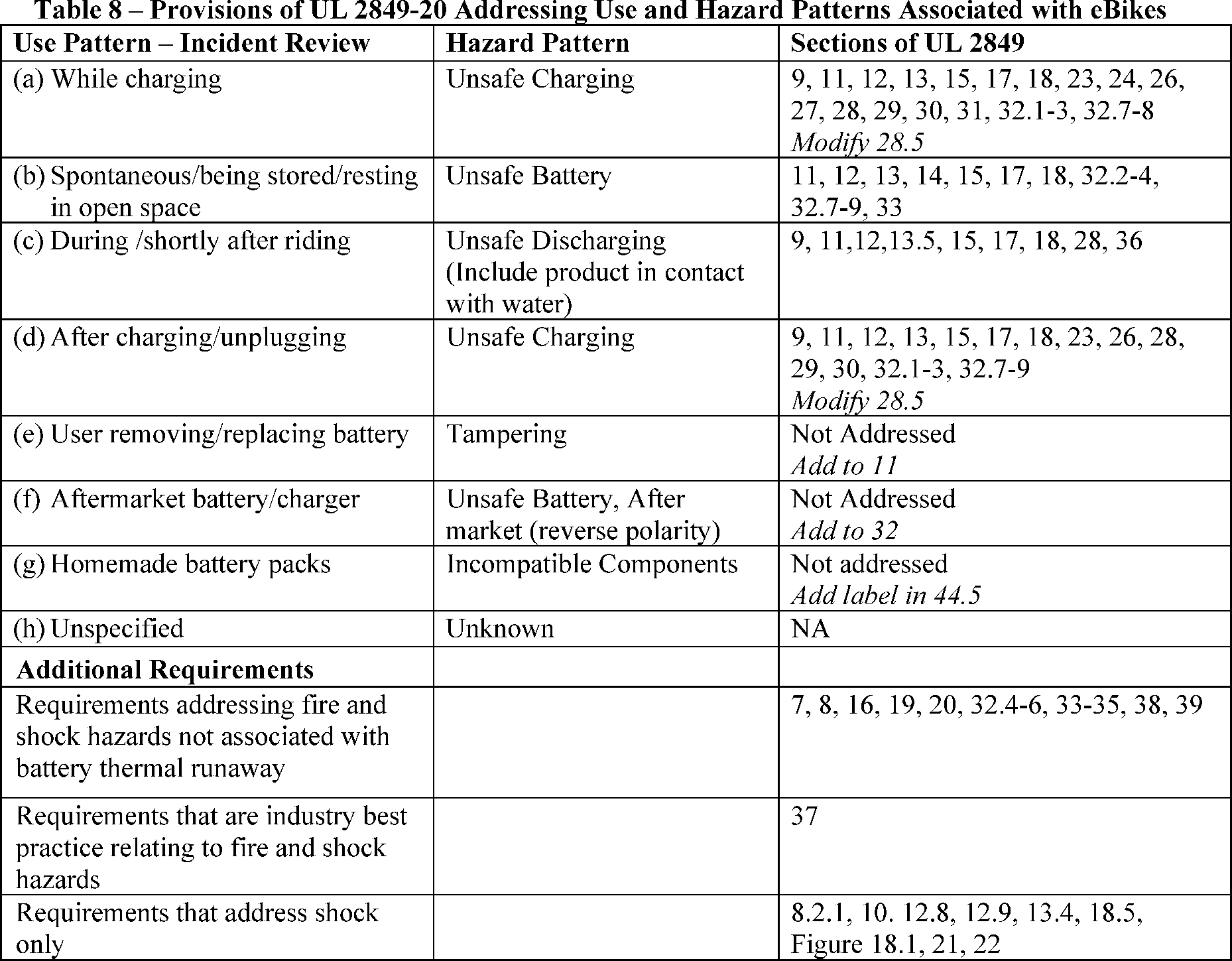
As described in section III, incidents associated with micromobility products within the scope of this NPR experienced instances of smoking, overheating, and fire. The incidents of smoking resulted in the user physically seeing smoke coming from the incident product. The incidents of overheating involved the user indicating a burning smell, physically getting burned from trying to move or handle the product, or getting burned while in physical contact with the product. The incidents of fire are associated with an electrical failure where the battery pack was the source of the fire. A thermal runaway failure of a cell within the battery pack can result in a battery fire. The intense heat generated by the failing cell may initiate thermal runaway in adjacent cells. This may ignite the micromobility product enclosure and propagate to adjacent combustible materials. Gases generated within the burning cells may also develop internal pressure that forcibly ejects the cell contents that escape the micromobility product enclosure and spread fire farther.
From fall 2015 through early 2016, in the absence of a product safety standard for personal eMobility products, staff's eSBscooter assessments of products involved in fire incidents identified deficiencies in the design and construction of the electrical systems including inadequate temperature limiting by the BMS, poor cell quality, and inferior workmanship. Subsequent to publication of the first edition of UL on November 21, 2016, staff began to see personal eMobility products that were compliant with the first edition of UL 2272 with integrated electrical system designs and battery packs with certified cells to maintain cells within their specifications while charging and riding and reduce the risk of fire from cell thermal runaway. The results for eBikes were similar relative to UL 2849's publication date of January 2, 2020. For the other assessments completed, staff observed that products that are certified to the three voluntary standards incorporated by reference in this proposed rule result in a decreased likelihood of fire risk.
CPSC's analysis nevertheless finds that, overall, the requirements in UL 2849-20 do not address all identified hazards associated with lithium-ion batteries and eBike electrical systems. Because of this, as noted above, the NPR proposes several modifications to the standard's performance, marking, and labeling requirements. These modifications are summarized below.
As incident data shows, consumers may attempt to modify or replace battery packs, including individual cells, even though they are not intended to be replaced or modified by the consumer. The NPR proposes to add requirements (section 11) for both consumer replaceable and non-consumer replaceable battery packs to prevent a consumer from opening the battery pack outer enclosure or the eBike enclosure and attempting to modify the battery.
To address the unreasonable risk of injury and death associated with incompatible chargers with reversed polarity from the battery, the NPR proposes to add to the requirements of section 32 of UL2849-20 a reverse polarity test that requires the eBike's electrical system to have a means to prevent an incorrect charging polarity from damaging the battery pack. The BMS should prevent charging in the foreseeable scenario where a user will ride the bike until the battery dies and then immediately plug in the product to recharge, in which case the cells may be at a temperature higher than the manufacturer-specified maximum charging temperature. Accordingly, the NPR proposes a performance testing procedure that would be based upon UL 2849-20 section 28.5 but specify that between the second and third charge/discharge cycle, a charge be initiated immediately after the full discharge to simulate the worst case temperature scenario and test that BMS prohibits charging the battery if the cell surface temperature exceeds the specified upper limit. The NPR is also proposing to add warnings about the need to cool down the product after each use and before plugging it in to charge (section 44.9).
To address the use of homemade batteries in micromobility products as seen in the incident data, the NPR proposes to add a warning label (section 44.5) alerting against the use of homemade batteries.
To address the unsafe charging hazard due to infrequent charging or prolonged duration of not charging the battery, the NPR proposes to inform consumers about the recommended frequency of charging or discarding the battery after a certain duration of non-use (section 44.6).
To address the unintended consequences of battery/eBike contact with water and submersion in water as seen in the incident data, the NPR proposes language in the instructions warning against immersing or submerging the eBike, the battery, or any of the electrical components in water and also providing steps for consumers to take in the event that submersion occurs (section 52).
To align with other standards and best practices, the NPR proposes to require: markings about hazardous voltage and not opening enclosures with hazardous circuits, where applicable; warnings not to open, disassemble, or attempt to repair battery enclosures or device enclosures; and instructions that include all warnings for the eBike, information on safe handling of battery packs, and additional formatting requirements to improve the visibility of warning statements.
8. Ability of the NPR To Address eBike Incidents
Staff assess that out of the 67 eBike battery incidents reported via CPSRMS, 56 would have been addressed by compliance with UL 2849-20 as modified in this NPR. Staff further advise that the NPR's provisions would address the hazard patterns seen in seven of the nine deadly incidents that collectively resulted in 12 fatalities (with some incidents having multiple fatalities). Staff could not identify the specific hazard pattern in the remaining 11 incidents, although the proposed rule could potentially address some or all of these incidents. Therefore, the NPR would address, at a minimum, approximately 84 percent of the eBike incidents identified as relating to lithium-ion batteries.
B. Other Micromobility Products (OMPs) and Batteries
1. Technical Requirements in UL 2272-24, UL 2271-23 and EN 15194
This section describes and evaluates the adequacy of the requirements in UL 2272-24 (OMPs), UL 2271-23 (lithium-ion batteries), and EN 15194 (EPAC eBikes). Table 9, below, cross references the most significant requirements of these three standards. 106 The far-left column in table 9 states each requirement in UL 2849-20, including the Commission's preliminary determination regarding adequacy of the provision to address associated risks of injury. Each column to the right compares another standard to UL 2849-20: cross-referencing the applicable section; stating whether the requirement is the same (M) or similar (R); and noting whether the requirement is adequate to address the associated hazards to prevent or reduce an unreasonable risk of injury (A), inadequate to address the associated hazards (I), not addressed (Blank), addressed in a different way (O), or not applicable (N/A).
106 We note that the introductions to all four standards contain the same or similar types of information, such as Scope, Definitions, and Units of Measurement.
Table 9 reflects that the majority of requirements that address battery and charger fire hazards in UL 2722-24 and UL 2271-23 are identical or substantially similar to those in UL 2849-20. Additionally, as with UL 2849-20, both UL 2272-24 and UL 2271-23 lack a reverse polarity test to address the risk of fire involving use of chargers of opposite polarity than the originally intended charger, and thus the NPR proposes to add a new test to prevent reverse polarity, as described in section IV.A.3 of this preamble. Finally, table 9 identifies that the performance requirements in the EN standard for eBikes are not as robust as those in UL 2849-20.
BILLING CODE 6355-01-P
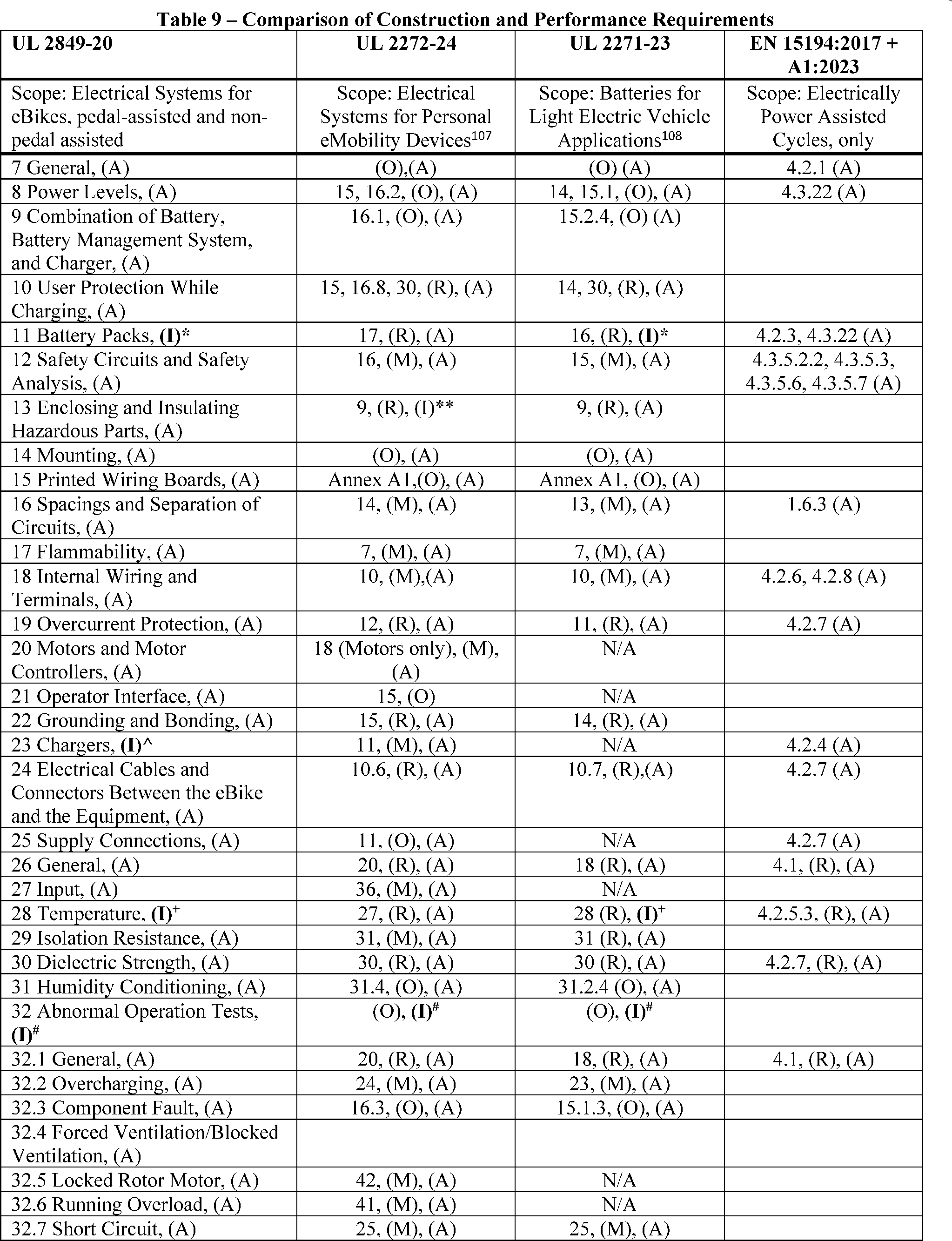
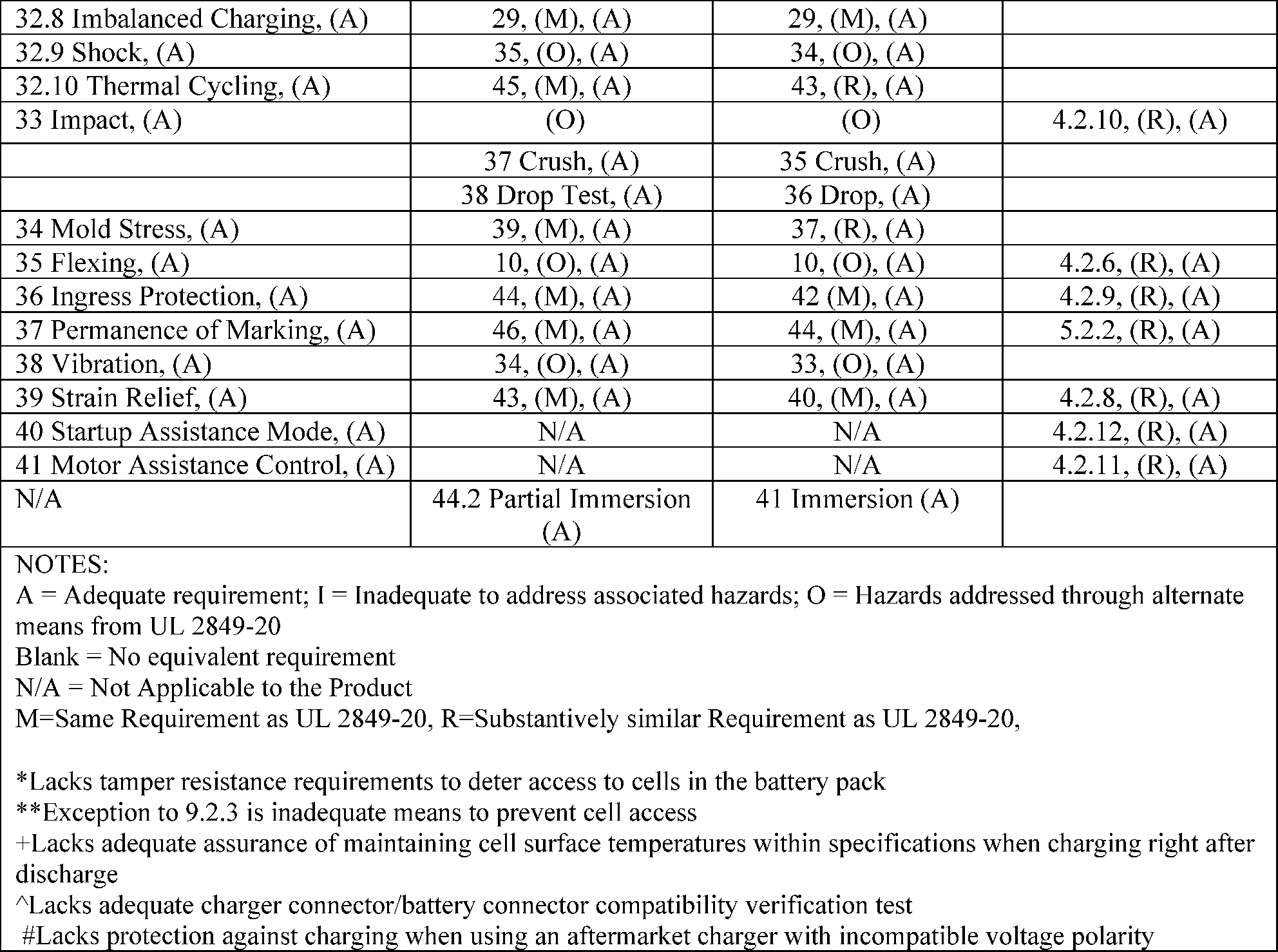
BILLING CODE 6355-01-C
UL 2272-24 (OMPs) —The performance requirements for electrical systems contained in UL 2849-20 and UL 2272-24 are almost identical, and include the same test methods, compliance criteria, and requirements for electrical system components. These requirements with the same test and pass-fail criteria specified for both UL 2849-20 (eBike) and UL 2272-24 (OMPs) are marked (M) in table 9. For example, as shown in the row numbered 11 in the left column, section 11 of UL 2849-20 and section 17 of UL 2272-24 both accept battery packs that have been tested to UL 2271-23, without additional testing, to reduce testing burden.
107 This NPR describes the products as OMPs, and includes eScooters, eSBscooters, eSkateboards, eUnicycles, and hybrids of these products.
108 This NPR refers to these as aftermarket batteries used in products subject to the rule, which includes all micromobility products that are consumer products under the Commission's jurisdiction.
Performance requirements for major electrical system components, including the battery pack comprised of cells, a BMS, charger, and motor, are substantively similar in both standards. For example, while section 10 of UL 2849-20, User Protection While Charging, and section 15 of UL 2272-24, Insulation Levels and Protective Grounding, specify electrical insulation and grounding to address the same shock hazard, the language is different. These requirements are marked (R) in table 9 to indicate that both standards have similar requirements but are worded differently.
Requirements marked (O) in table 9 provide for different test methods or pass-fail criteria compared to UL 2849-20 (eBikes) but address the same hazard. For example, sections 14 and 38.2 in UL 2849-20 and section 34 in UL 2272-24 both require vibration tests to evaluate the battery packs. The vibration test in UL 2849-20 specifies mounting the battery pack onto the vibration table while UL 2272-24 requires that the entire OMP be mounted to the vibration table. In general, differences between eBikes and OMPs account for the testing variations. For example, while both UL 2849-20 (eBike) and UL 2272-24 (OMPs) address battery pack integrity due to vibration, the test methods are different because an eSBscooter typically has a non-user replaceable battery and solid tires without a shock absorbing suspension. CPSC preliminarily assesses the vibration requirements in UL 2272-24 (OMPs), sections 14 and 38.2, are adequate to address these risks as indicated in table 9 with an (A) marking.
If the standard is inadequate to address the hazard, table 9 is marked (I) for the relevant requirement with a footnote explaining the assessment. For example, the requirements for battery packs are inadequate in UL 2849-20 and UL 2271-23 because they do not address tamper-resistance requirements for the battery enclosure/compartment to deter access to the cells.
Sections 24 and 25 of UL 2849-20 regarding electrical connections and cables for eBikes apply specifically to eBikes and are therefore not addressed in UL 2272-24.
Section 9.2.3 of UL 2272-24 requires that the outer enclosure of the battery be ultrasonically welded, use tamper-proof screws or have other equivalent means to ensure that it cannot be opened using a common household tool such as a flat blade or Philips head screwdriver. However, this section also provides an exception that a broken seal (or other easily detectable means for identifying a new opening) can replace the above requirement to remind users that a product with a broken seals should not be used and must be recycled. CPSC staff assess that replacing a tamper-proof means with a tamper-evident seal and relying on the consumer to not access the battery, rather than constructing the battery enclosure to resist user access, does not provide an equal level of protection against users accessing cells in the battery pack. For this reason, the NPR proposes to remove the exception in section 9.2.3 of UL 2272-24.
Finally, both UL 2849-20 and UL 2272-24 fail to mitigate the fire hazard associated with aftermarket chargers (row 32 Abnormal Operation Test in table 9), as described in section IV.A of this preamble, and thus the NPR proposes to add to the requirements of both standards a new performance requirement for reverse polarity protection.
UL 2271-23 —UL 2271-23 (Batteries) for light electric vehicles (LEV) contains requirements for battery packs, including for BMS, that protect the cells within the battery pack during charging and discharging. Examples of LEVs within the scope of this NPR and UL 2271-23 include electric bicycles, electric scooters, and personal e-mobility devices (described as OMPs in this proposed rule). Comparing the requirements of UL 2271-23, applicable to lithium-ion batteries, with those of UL 2849-20 for eBikes, the requirements fall into two groups. As shown in table 9, the first group of requirements, including sections 20, 21, 23, 24, and 25 of UL 2849, are not applicable to batteries; these requirements state requirements for a complete eBike, not for component batteries.
The remaining requirements in UL 2271-23 are similar to tests in UL 2849-20 that expose batteries to stresses similar to those imposed by the micromobility products in which the batteries are intended to be used. For these tests, table 9 cross-references the battery tests in UL 2271-23 that are the same or similar to those in UL 2849-20. Several UL 2849-20 battery stress tests, such as sections 32.2 and 32.7, waive the test if the battery already complies with section 11.1(a) or 11.1(b) of UL 2849-20, which references the same test requirements in UL 2271-23. Except for section 16 of UL 2271-23, the battery electrical requirements contained in UL 2271-23 are similar to those contained in UL 2849-20, and as discussed in section IV.A of this preamble, are adequate to address the associated risks of injury.
Section 16 of UL 2271-23, Cells, Electrochemical Capacitors, and Repurposed Cells and Batteries, is substantially similar to section 11 of UL 2849-20. However, this requirement is inadequate (as marked (I) in table 9) because both standards fail to mitigate the foreseeable risk of injury from consumers accessing the battery compartment on a micromobility product. The Commission preliminarily determines that these provisions in both UL standards are inadequate to address the risk of injury from accessing the batteries. For example, IDI 220908CCC1340 was for an eSBscooter battery incident associated with a consumer who performed work inside the battery compartment enclosure, resulting in smoke at the battery connection port. To better address this risk, the NPR proposes to add to the requirements of UL 2271-23 a new section 16.9 that is identical to the proposed section 11 augmenting UL 2849-20, to tamper-proof micromobility battery enclosures.
Table 9 indicates section 28.5 of UL 2271-23 is inadequate (I) because it does not address the risk of injury from damage to the battery due to charging immediately after a fully discharging the battery. Therefore, this NPR proposes to specify that between the second and third charge/discharge cycle a charge be initiated immediately after the full discharge to simulate a scenario in which the user attempts to recharge the battery immediately after it is fully discharged. This test is intended to ensure that the battery will not charge when its cells exceed their maximum charging temperature; otherwise, charging may damage the cell and lead to overheating, thermal runaway, and fire. This is the same requirement proposed in this NPR for UL 2849-20 and is similar to the requirement included in UL 2272-24. With the proposed revisions, CPSC concludes that UL 2271-23 would adequately address the electrical hazards for batteries intended, marketed, or designed for use with micromobility products subject to this NPR.
UL 2271-23 does not have requirements to address a reverse polarity charging condition as may occur with use of a charger connector configured in the opposite polarity as the battery terminal. This NPR proposes to add a new reverse polarity charging test that is the same as the proposal for UL 2849-20 as described in section IV.A.3 of this preamble.
EN 15194 —Table 9 also compares the current European standard for electric pedal-assisted eBikes, EN 15194:2017+A1:2023, with UL 2849-20. The scope of EN 15194 is limited to pedal-assisted eBikes, while UL 2849-20 covers both electric pedal-assisted cycles and electric cycles not requiring pedaling to operate. Compared to UL 2849-20, EN 15194 either does not include requirements that are critical to protect consumers from electric shock and fire, or its requirements are inadequate. For example, the blank boxes in table 9 demonstrate that EN 15194 does not contain equivalent requirements as those stated in sections 9, 10, 13, 14, 15, 17, 20, 21, and 22 of UL 2849-20. These requirements address important electrical hazards associated with eBikes, including: testing the combination of the battery, battery charger, and battery management system circuit; user protections while charging; enclosing and insulating hazardous parts; component mounting (vibration test); displacement of components mounted on printed wiring boards and minimum flammability requirements; flammability of non-metallic materials; thermal protection for motors and motor controllers; operator interface protections; and protecting consumers through grounding and bonding of electrical connections.
EN 15194 also does not contain equivalent tests for abnormal eBike operations contained in UL 2849-20 sections 32.2-32.10, intended to address electrical systems tests that force the battery pack or motor to operate outside their safe operating conditions, nor the vibration test in section 38. 109 Although EN15194 conducts temperature tests on the EPAC eBike, and addresses battery performance in section 4.2.3, referencing EN 50604-1:2016 and EN 50604-1:2016/A1:2021, EN 15194 does not test the entire electrical system using the intended battery, as is done under UL 2849-20 and UL 2272-24. Based on staff's analysis, as summarized in table 9, UL 2849-20 is more robust and more protective of consumer safety during reasonably foreseeable use and misuse scenarios than EN 15194.
109 Battery tests in the referenced EN 15194 standard are not as comprehensive as those in UL 2849-20 and only cover EPAC eBikes.
Based on staff's analysis of EN 15194, as summarized in table 9, the Commission preliminarily determines that EN 15194 is inadequate to address the unreasonable risks of injury that can be associated with lithium-ion batteries and the electrical systems of eBikes.
2. Marking and Labeling Requirements in UL 2272-24
Markings: General— Section 47 of UL 2272-24 describes, at a minimum, that markings must be legible, adhered to the product, and comply with associated standards including UL 969, Standard for Safety of Marking and Labeling Systems, or CSA C22.2 No 0.15, Adhesive Labels. These requirements address permanency of markings and are commonly referenced tests for electrical products.
Sections 47.3, 47.4 and 47.5 of UL 2272-24 require:
• The product must include the date of manufacture.
• The product must contain identifying information about the manufacturer, such as name, trade name, trademark including part number or model number; electrical ratings listed in volt dc and Ah or Wh; and maximum weight in lbs or kg and speed in mph or km/h.
• The product must be marked with charging instructions and the standard provides prescriptive language such as “Use Only (__) Charger.” All external terminals and connections must contain identification and polarity markings that comply with associated standards.
CPSC staff assess that the required markings identifying the product, manufacturer, and the appropriate charger are adequate to inform consumers. Beyond these requirements, however, the Commission proposes that if the product is manufactured in more than one factory, a distinctive marking to identify that the product was manufactured in a particular factory shall be included to allow the consumer to properly identify the product in the case of a recall.
Section 47.6 of UL 2272-24 states the products with separable battery packs that are intended to be user removable must include markings indicating the appropriate battery pack and use the following or equivalent statements, “Use only (__) battery pack with this personal e-mobility device.” In addition, the appropriate separable battery pack must be marked with the following or equivalent statement, “Use only with (__) personal e-mobility device.” The blanks are filled with the manufacturer's name and model number of the product in which the batteries are used.
The required statement about using a certain battery pack with the micromobility product does not cover aftermarket battery packs that may be designed and manufactured according to the proposed rule and can be used safely with the micromobility product. The NPR therefore proposes that the micromobility product not include a statement about which battery packs are suitable, but rather that battery packs that are sold separately indicate which micromobility products can be used with the battery pack.
Section 47.7 of UL 2272-24 requires specific words, letters, or symbols illustrating the grounding system, which CPSC staff assess as adequate. In addition, section 47.8 states products which contain hazardous voltage circuits must be marked as such. Staff assess that although this requirement is adequate to identify the potential shock associated with hazardous voltage circuits, it lacks the instruction on how to avoid it, therefore, the NPR proposes to add “Do not open the enclosure.” to section 47.8 of UL 2272-24.
When applicable, section 47.9 of the standard requires that the product must include the following statements or equivalent, “WARNING—To reduce risk of injury, user must read instruction manual” (or the product must be marked with relevant ISO symbols representing general warning sign containing an exclamation mark within a triangle and referring to instruction manual sign containing a human figure holding an open manual/booklet). CPSC preliminarily concludes that this requirement is adequate to inform consumers about referencing the instruction manual. Section 47.11 of UL 2272-24 also requires the following or equivalent statement “Store Indoors When Not In Use” for personal eMobility products with plastic enclosures not evaluated for UV rays and rain.
In addition, section 47.12 of UL 2272-24 requires the following or equivalent marking on the battery enclosure and/or device enclosure that serves as the outer enclosure of the battery “WARNING—Risk of Fire and Electric Shock—Battery and/or battery components are not user replaceable.” Although this warning informs consumers about the risk associated with user replaceable batteries, it does not instruct users on how to avoid the hazards. Accordingly, the NPR proposes to add a statement “Do not attempt to open, disassemble or repair” to 47.12 of UL 2272-24.
To improve the noticeability of the warnings, the NPR proposes that the text size requirements in UL 2849-20 be applied to UL 2272-24 as well. Also, to improve the noticeability of the warnings, the NPR proposes that the design of required warnings proposed in new section 44.4 of UL 2849-20 be applied to warnings required in UL 2272-24 as well, in a new section 47.14. In addition, to improve the noticeability of the required markings, the NPR proposes that UL 2272-24 be supplemented with similar requirements to UL 2849-20 to ensure that the cautionary marking is located on a part of the product that is either not removable or that impairs the operation of the product when removed.
Homemade Batteries: As discussed in section IV.A of this preamble, homemade batteries pose a risk of fire when used with a micromobility product. Therefore, the NPR proposes a new section 47.15 be added to the requirements of UL 2272-24 to require the same homemade battery warning for OMPs that is proposed for eBikes in section 44.5 of UL 2849-20.
Lifetime of Batteries/Frequency of Charging: As discussed in section IV.A of this preamble, some micromobility product incidents are associated with the condition of the battery and the frequency of charging. Therefore, to address battery fires related to charging, this NPR proposes to add a new section 47.16 in connection with UL 2272-24, the same as proposed in section 44.6 to complement UL 2849-20, to require improved warnings pertaining to the frequency with which to charge the battery.
Cooling down the Battery: As discussed in section IV.A of this preamble, the NPR proposes to require warnings on OMPs subject to UL 2272-24 to advise consumers to allow their micromobility products to cool down after use and before plugging in to charge the product. The NPR proposes a new section 47.17 supplementing UL 2272-24 that would require this warning in the same location as is proposed to be added to the provisions of UL 2849-20.
Manufacturing Location: Although the markings required in UL 2272-24 to identify the product and manufacturer are helpful for consumers to potentially respond to a recall involving a hazardous defect, the markings fail to indicate a particular manufacturing facility if the product is manufactured in more than one factory. Therefore, the NPR proposes that if a product is manufactured in more than one factory, a distinctive marking to identify in which factory the product was manufactured is required; this proposed requirement is in new proposed section 47.18.
Instructions: General —Section 48 describes that the product must contain instructions for proper use including charging, operating, storage, and disposal. The standard requires instructions to include specific details such as temperature limits, appropriate charger usage, weight limits for the product, maximum permissible speed, and surfaces appropriate for using the device. In addition, instructions for replacement of user replaceable fuses and lightbulbs must be included with the product.
Section 48.2 states that if a product contains a user removable battery pack, then the instructions must address safe handling, including removal and insertion, during charging and specification of storage outside of the product. Section 48.3 of the standard requires the two warning statements (“WARNING—Risk of Fire and Electric Shock—No User Serviceable Parts” and “WARNING—Risk of Fire and Electric Shock—Battery and/or battery components are not user replaceable”) to be included in the instructions. Section 48.5 requires that products not intended for high altitude locations indicate that they are not intended for use at elevations greater than 2000 m above sea level. Section 48.6 requires the following or equivalent statements in the instructions: “Prolonged Exposure to UV Rays, Rain and the Elements May Damage the Enclosure Materials, Store Indoors When Not in Use.”
To better address the unreasonable risks of injury or death associated with OMP battery fires, the NPR proposes that OMPs within the scope of UL 2272-24 must follow the same, more comprehensive and detailed, instructional requirements as in sections 45 through 50 of UL 2849-20 (but replacing the term “eBike” with “personal eMobility product”). Like the requirements in UL 2849-20, the NPR also proposes to add to UL 2272-24 the same requirements that instructions be visually distinguishable from the remainder of the text and that illustrations accompany, but not replace, textual warnings. Finally, as with UL 2849-20, the NPR proposes to require that OMP instructions in UL 2272-24 include all warnings.
Instructions associated with micromobility products submerged in water: As with the proposals for supplementing UL 2849-20, the NPR proposes that OMPs also contain added instructions, in section 48.11 associated with UL 2272-24, regarding warnings and appropriate actions that consumers should take in the event a micromobility product is submerged in water.
3. Marking and Labeling Requirements in UL 2271-23
Markings: General —Section 46 of UL 2271-23 describes that, at a minimum, battery markings must be legible, permanent, adhered to the product, and comply with associated standards such as UL 969, Standard for Safety of Marking and Labeling Systems, or CSA C22.2 No. 0.15, Adhesive Labels. These requirements are commonly referenced tests for electrical products. Section 46.2 of UL 2271-23 states that batteries must be marked with specified information about the manufacturer, such as name, trade name, or trademark as well as part number or model number, and electrical ratings in volts dc (direct current) and Ah (Ampere-hour) or Wh (Watt-hour) and battery chemistry. Section 46.3 of UL 2271-23 states that terminals must be marked positive or negative with words or symbols representing the polarity unless the terminal is keyed in a manner that prevents incorrect connections. The standard states all external terminals and connections must also contain identification and polarity markings that comply with associated standards. Section 46.5 states batteries must also be marked with the date of manufacture, charging instructions, and required prescriptive language, such as “Use Only (__) Charger.” The standard requires that the statement must be visible to the user, including after installation, if the battery is not removed for charging. Section 46.7 states batteries must also be marked with specific symbols illustrating the battery grounding system.
CPSC preliminarily assesses that the markings required in UL 2271-23 are necessary and largely adequate to inform consumers about the specifics of the product, battery chemistry, and appropriate charger to use to reduce the risk of fire and/or shock. Although the markings identifying the product and manufacturer are helpful for consumers to respond to a potential recall, the required markings fail to indicate a particular manufacturing facility if the product is manufactured in more than one factory. Therefore, the NPR proposes a new requirement in section 46.16 requiring that if a product is manufactured in more than one factory, a distinctive marking is required to identify in which factory that the product was manufactured. The proposed language is the same as current section 43.5 proposed in connection with UL 2849-20 and proposed new section 47.18 associated with UL 2272-24.
According to UL 2271-23, batteries that contain hazardous voltage circuits must be marked “WARNING: Hazardous Voltage Circuits. To Reduce the Risk to Electric Shock, Never Disassemble. No User Serviceable Parts” or must include the electric shock hazard symbol ISO 3864 No. 5036 (lightning bolt within a triangle). UL 2271-23 states that, when applicable, batteries and battery systems must be marked, “Repurposed” or “Second Life” and “UL 1974.” The marking requirements in UL 2271-23 appear adequate to address the risk of death and injury associated with hazardous voltage circuits, because they describe the hazard and explain how to avoid it. However, UL 2271-23 does not specify the design of the warning. Accordingly, to improve the visibility of warnings so that consumers may see and heed them, the NPR proposes to add a new section 46.12 to supplement UL 2271-23, to require revisions to the warning text size requirements for batteries, like those the NPR proposes for eBikes. In addition, as discussed in section IV.A of this preamble, the NPR proposes that the requirement be included in new section 44.4 of UL 2849-20 also be included in a new section 46.13 of UL 2271-23 to improve the noticeability of the warnings on batteries.
Lifetime of Batteries/Frequency of Charging: As discussed in section IV.A of this preamble, some micromobility product incidents have been associated with the lifetime of the battery or frequency of charging. Similar to proposed section 44.6 UL 2849-20, the NPR proposes adding markings to UL 2271-23 as new section 46.14, with improved noticeability pertaining to frequency with which to charge the battery.
Specifying the compatible micromobility product: The NPR also proposes to add a warning statement on the removable battery pack about the specific micromobility product in which the battery pack is intended to be used. This requirement is already included in section 47.6 of UL 2272-24, which requires the appropriate separable battery pack to be marked with the following or equivalent statements, “Use only with (__) personal e-mobility device.” This requirement assists consumers in selecting a compatible battery pack for their micromobility product.
Instructions: General —Section 47 of UL 2271-23 states that batteries must be provided with instructions for their proper use, including temperature limits, charging, discharging, storage, disposal, and replacing user replaceable fuses. Section 47.3 of UL 2271-23 states that non-removable batteries must contain a marking or indication located near the accessible charging port of the product. Section 47.5 states the battery instructions must include the following or equivalent statements, “WARNING: Risk of Fire and Electric Shock. Never Disassemble. No User Serviceable Parts.” Although CPSC preliminarily assesses that these instructions adequately inform consumers on how to handle the batteries in expected use scenarios, the instructions should be legible and include all warnings, which is proposed in new section 47.6.
Table 10 provides a summary of the proposed marking and labeling requirements for all three standards.
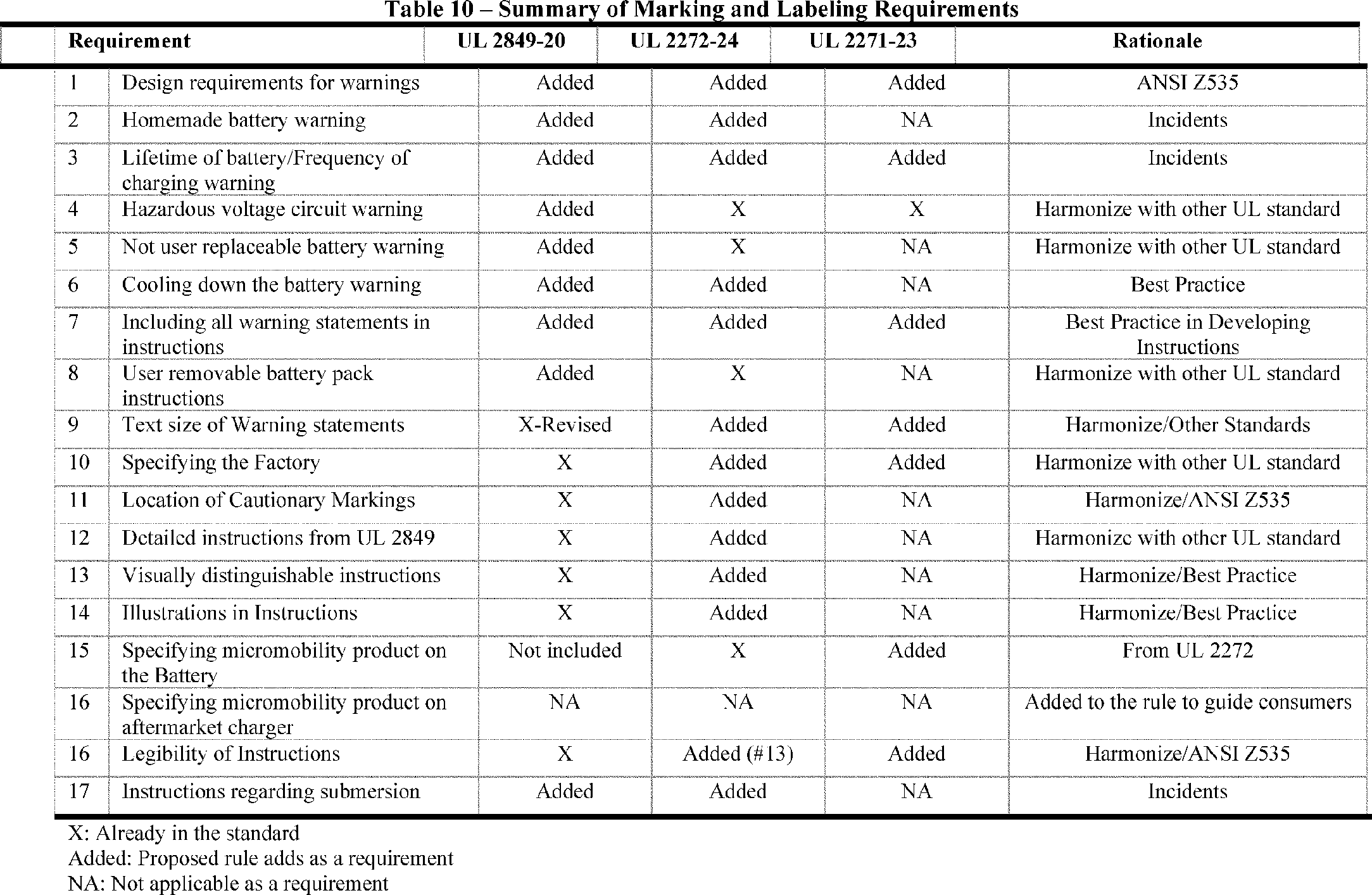
4. Other Voluntary Standards—EN 17128
EN 17128:2020, Light motorized vehicles for the transportation of persons and goods and related facilities and not subject to type-approval for on-road use—Personal light electric vehicles (PLEV)—Requirements and test methods, applies to personal light electric vehicles totally or partially electrically powered from self-contained power sources with or without self-balancing system, with exception of vehicles intended for hire from unattended station. Staff reviewed this European standard, the requirements of which are primarily focused on mechanical performance of off-road micromobility products. The safety performance requirements for electrical systems of the covered products are not as comprehensive as those in UL 2272-24. Therefore, this NPR is not based on the provisions in EN 17128.
5. Ability of UL 2272-24 and UL 2271-23 To Address the Identified Hazards
CPSC's analysis finds that, overall, the requirements in UL 2272-24 and UL 2271-23 do not address all identified hazards associated with lithium-ion batteries and OMP electrical systems. Because of this, the NPR proposes several modifications to both standards as noted above. These modifications are summarized below,
As incident data shows, consumers may attempt to modify or replace battery packs, even though they are not intended to be replaced or modified by the consumer. The NPR proposes to add requirements (section 16.9 to UL 2271-23) to reduce the likelihood of users accessing battery cells on a user replaceable battery pack intended to provide power to the motor(s) of an eBike or personal eMobility product. Further, the NPR proposes to remove the exception for a tamper-evident seal to replace the stricter requirement in section 9.2.3 of UL 2272-24.
Similar to the proposal in eBikes, the NPR proposes to revise section 28.5 of UL 2271-23 to test whether BMS prevents charging when the cells are at a temperature higher than the manufacturer-specified maximum charging temperature, addressing the scenario where a user rides the micromobility product until the battery dies and then immediately plugs in the product to recharge.
To address charger-related incidents resulting from incompatibility, the NPR proposes new requirements (section 32 in UL 2271-23 and section 33 in UL 2272-24) to add a reverse polarity test to prevent damage to the battery pack due to use of an incompatible charger.
The NPR proposes to add several warnings for OMPs to address scenarios observed in the incident data, similar to eBikes, including against using homemade batteries (section 47.15), about the need to cool down the product after each use and before plugging it in to charge (section 47.17), and for both OMPs and user replaceable battery packs about recommended frequency of charging or discarding the battery after a certain duration of non-use (section 47.16 in UL 2272-24 and section 46.14 in UL 2271-23).
To inform consumers of the proper match between battery pack and micromobility product, the NPR proposes that each battery pack specify the micromobility product name and model for which the battery pack is intended (section 46.15 of UL 2271-23).
To address the unintended consequences of battery/eBike contact with water and submersion in the water as seen in the incident data, the NPR proposes language in the instructions warning against immersing or submerging the OMP, the battery, or any of the electrical components in water and also providing steps for consumers to take in the event submersion occurs (section 48.11).
To align with other standards and best practices, the NPR proposes additional formatting requirements for both UL standards to improve the visibility of warning statements; and for OMPs to require markings about hazardous voltage and not opening enclosures with hazardous circuits, where applicable; warnings not to open, disassemble, or attempt to repair battery enclosures or device enclosures; and instructions that include all warnings for the OMP.
6. Ability of the NPR To Address OMP Incidents
Of the 65 eScooter incidents reported via CPSRMS, CPSC staff assess that 54 incidents can be addressed by compliance with UL 2272-24 and four incidents can be addressed by compliance with UL 2271-23, either through existing requirements or the proposed modifications in this NPR. Staff assess that the NPR would address six of the seven fatal incidents (nine of 13 fatalities). Staff could not identify the specific hazard pattern in eight incidents (spontaneous, after charging or unknown). Staff accordingly estimate that, at a minimum, 88 percent of the eScooter incidents would be addressable by the proposed rule.
CPSC staff assess that out of the 86 micromobility product incidents other than eScooters and eBikes reported via CPSRMS, 64 incidents can be addressed by compliance with UL 2272-24 and five incidents can be addressed by compliance with UL 2271-23, either through existing requirements or the proposed requirements. The assessment indicates that the NPR would address four of the six fatal incidents (eight of 14 fatalities). Staff could not identify the specific hazard pattern in 17 incidents (spontaneous or unknown). Accordingly, at a minimum, 80 percent of the OMP incidents would be addressable by the proposed rule.
C. Compliance With Voluntary Standards
As described in Tab A to Staff's Briefing Memorandum, CPSC obtained estimated compliance rates from a 2023 survey of “brick and mortar” retail stores. This survey found that 10 of 93 eBikes, and 17 of 19 OMPs, displayed a mark from an accredited certification lab that serves as a proxy for compliance with a voluntary safety standard such as UL 2849-20 or UL 2272-24. 110 The initial weighted compliance rate across all product types is approximately 45 percent. 111 Together with the substantial number of incidents involving death and injury associated with noncompliant micromobility products, the survey data show that product compliance with the UL voluntary standards has not yet reached the level where the risk to consumers from these products is comprehensively mitigated. Accordingly, the Commission preliminarily determines that micromobility products within the scope of the rule are unlikely to substantially comply with UL 2849-20, UL 2272-24, or UL 2271-23 in the absence of the proposed rule.
110 This survey includes caveats ( e.g., small and non-representative sample, not including online retailers, not testing products to confirm compliance) that introduce uncertainty. In addition, staff's review of online retail brands presents an inconsistent picture. CPSC requests data from stakeholders on the compliance rate of micromobility products that would be subject to the rule proposed in the NPR.
111 Staff forecast an annual average of 19.2 million products in use each year from 2026 to 2030. eBikes (11.2 million), eScooters (1.6 million), and OMP's (6.4 million) represent approximately 58.3, 8.4, and 33.3 percent of these total units in use, respectively. Out of these 19.2 million products in use, 8.3 million compliant products are in use within the same period, or roughly 45 percent (8.3 million compliant products in use = 11.2 million * 10.75% + 1.6 million * 89.47% + 6.4 million * 89.47%).
V. Description of the Proposed Rule
To eliminate or adequately reduce the unreasonable risks of injury and death to consumers from electric shock, fires, explosions, expulsion of gas or flames, burns, overheating, and smoke inhalation, associated with lithium-ion batteries used in micromobility products and the electrical systems of micromobility products, this NPR proposes to require products within the scope of the rule to comply with the applicable UL voluntary standard, with modifications, as explained in section IV of this preamble and summarized below.
A. 1265.1—Scope, Purpose, Definitions, and Effective Date
Proposed § 1265.1(a) describes the purpose of the NPR, which is to establish a mandatory rule to address the risks of death and injury associated with lithium-ion batteries used in micromobility products, as defined in the rule, and the electrical systems of such products. Proposed § 1265.1(a) also explains that the scope of the NPR includes lithium-ion batteries used in micromobility products and the electrical systems of such products, including lithium-ion batteries provided or sold separately from the micromobility product (user replaceable battery packs), aftermarket battery chargers provided or sold separately from a micromobility product, and components provided or sold with eBike conversion kits.
Proposed § 1265.1(b) contains definitions applicable to the rule, relying on the definitions in section 3 of the CPSA, 15 U.S.C. 2052, such as the definition of a “consumer product,” as well as definitions that are specific to the rule. Specific definitions include products within the scope of the rule, including: “aftermarket battery charger,” “eBike conversion kit,” “user replaceable battery pack,” “eBike,” “micromobility product,” and “personal eMobility product” (which refers to a non-eBike product and is also called “other micromobility product” or “OMP” in this proposed rule). The definition of “micromobility product” explains that the term applies to all products within the scope of the rule, including: electric bicycles (eBikes), electric scooters, both stand-up and seated (eScooters), electric self-balancing scooters (eSBscooters), electric skateboards (eSkateboards), electric unicycles (eUnicycles), and hybrids of these products. The rule also defines the regulated components of micromobility products, such as battery management systems and enclosures.
Proposed § 1265.1(c) provides the effective date of a final rule, stating that the Commission issues the rule to address the unreasonable risk of death and injury associated with lithium-ion batteries used in micromobility product electrical systems, and that all products within the scope of the rule that are manufactured after the proposed 180-day effective date must comply with the rule.
B. 1265.2—Requirements for eBikes
Proposed § 1265.2 contains requirements for eBikes. Proposed § 1265.2(a) states that except for the additions and modifications provided in paragraph (b), each eBike must comply with all provisions of UL 2849-20 that apply to the product. Proposed § 1265.2(b) requires that eBikes also comply with the additions and exclusions stated in the rule, including three new performance requirements, several exclusions, and several additions and modifications to the warnings and instruction requirements.
Proposed new substantive requirements in § 1265.2(b)(1) through (3) include:
(1) tamper-resistant battery enclosure to prevent consumers from accessing the battery pack;
(2) post-discharge charge test to ensure that the BMS prohibits charging the battery if the cell surface temperature exceeds the specified upper limit to prevent the risk of fire associated with charging; and
(3) reverse polarity test to prevent damage to the battery pack associated with use of an incompatible battery charger.
Proposed § 1265.2(b)(4) does not require compliance with sections 40 and 41 of UL 2849-20, because these requirements apply to mechanical characteristics of eBikes, as opposed to electrical characteristics. Finally, proposed § 1265.2(b)(5) through (9) describe additions and modifications to the warnings and instruction requirements for eBikes, as explained in section IV.A.6 and table 10 of this preamble.
C. 1265.3—Requirements for Personal eMobility Products
Proposed § 1265.3 contains requirements for personal eMobility products, or OMPs. Proposed § 1265.3(a) states that except for the additions and modifications provided in paragraph (b), each personal eMobility product must comply with all provisions of UL 2272-24 that apply to the product. Proposed § 1265.3(b) requires that personal eMobility products also comply with the stated additions and exclusions.
Proposed § 1265.3(b) requires personal eMobility products to comply with UL 2272-24 with one substantive exclusion, one substantive addition, as well as modifications and additions to the warning and instruction requirements. Proposed § 1265.3(b)(1) states that personal eMobility products cannot satisfy the requirements of the rule by relying on the exception in section 9.2.3 of UL 2272-24 that allows a tamper-evident seal instead of a tamper-resistant battery enclosure. Replacing a tamper-proof means with a tamper-evident seal does not provide an equal level of deterrence to users accessing cells in the battery pack, because a tamper-evident seal relies on the consumer to understand and heed a warning not to access or use the battery if the seal is broken. Proposed § 1265.3(b)(2) inserts a new substantive reverse polarity test for aftermarket battery chargers to prevent damage to the battery pack associated with use of an incompatible battery charger. Proposed § 1265.3(b)(3) through (7) include additions and modifications to the warnings and instructions in UL 2272-24, as explained in section IV.B.2 and table 10 of this preamble.
D. 1265.4—Requirements for User Replaceable Battery Packs
Proposed § 1265.4 contains requirements for user replaceable battery packs sold separately from a micromobility product. Proposed § 1265.4(a) states that except for the additions and modifications provided in paragraph (b), each user replaceable battery pack must comply with UL 2271-23. Proposed new substantive requirements in § 1265.4(b)(1) through (3) include: (1) tamper-resistant battery enclosure to prevent consumers from accessing the battery pack; (2) post-discharge charge test to ensure that the BMS prohibits charging the battery if the cell surface temperature exceeds the specified upper limit to prevent the risk of fire associated with such charging; and (3) reverse polarity test to prevent damage to the battery pack associated with use of an incompatible battery charger. Proposed § 1265.4(b)(4) and (5) contain additions and modifications to the warnings and instructions in UL 2271-23, as explained in section IV.B.3 and table 10 of this preamble.
E. 1265.5—Requirements for eBike Conversion Kits
Proposed § 1265.5 contains requirements for components marketed, intended, or designed as part of an eBike conversion kit. Proposed § 1265.5(a) states that except for the additions and modifications provided in paragraph (b), components marketed, intended, or designed as part of an eBike conversion kit must comply with the specified sections of UL 2849-20. Proposed § 1265.5(b)(1) through (5) state the specific substantive provisions of UL 2849-20, and the new proposed requirements, to which components of conversion kits must comply. Proposed § 1265.5(b)(6) and (7) state the marking and instructions required for battery packs and chargers provided as part of an eBike conversion kit. In summary, the requirements in § 1265.5(b) are:
• If provided in a conversion kit, the battery pack must comply with sections 9 ( Combination of Battery, Battery Management System, and Charger ) and 12 ( Battery Packs ) of UL 2849-20, and all sections referenced in those sections.
• To prevent a user from accessing battery cells within a battery pack, the outer enclosure of the battery pack must not be capable of being opened using common household tools, such as a flat blade or Philips head screwdriver. The enclosure shall be ultrasonically welded or secured by equivalent means. Equivalent means include adhesives complying with the adhesive requirements of UL 746C, or single use or tamper-proof screws.
• If provided, each battery charger must comply with sections 7 ( General ), 8 ( Power Levels ), 9 ( Combination of Battery, Battery Management System, and Charger ), 10 ( User Protection While Charging ), and 23 ( Chargers ) of UL 2849-20, and all referenced sections within those sections. Additionally, the connector provided with the charger for connecting to the battery terminal for charging shall prevent misalignment, reverse polarity, or electrical mismatch. Compliance with this provision must be observable or, if necessary, meet the Protective Circuits and Safety Analysis requirements in section 12 in UL 2849-20.
• If provided, the operator interface must comply with sections 7 ( General ), 8 ( Power Levels ), and 21 ( Operator Interface ) of UL 2849-20, and all sections referenced in those sections.
• If provided, the motors and motor controllers in eBike conversion kits shall comply with sections 7 ( General ), 8 ( Power Levels ), and 20 ( Motors and Motor Controllers ) of UL 2849-20, and all sections referenced in those sections.
• If provided, a user replaceable battery pack must comply with sections 46 ( Markings ) and 47 ( Instructions ) of UL 2271-23, including all sections referenced in those sections, as well as the additional markings and instructions for user replaceable battery packs required in § 1265.4(b)(4) and (5).
• If provided, each battery charger must comply with the marking and instructions for aftermarket battery chargers in § 1265.6(a) and (c).
F. 1265.6—Requirements for Aftermarket Battery Chargers
Proposed § 1265.6 provides requirements for aftermarket battery chargers based on the micromobility product with which they are associated. Proposed § 1265.6(a) requires aftermarket battery chargers marketed, intended, or designed to charge an eBike battery to comply with section 23 of UL 2849-20, incorporated by reference in § 1265.7, and the additional requirements stated in § 1265.2(b)(2). Proposed § 1265.6(b) requires aftermarket battery chargers marketed, intended, or designed to charge a personal eMobility product battery to comply with section 11 of UL 2272. Finally, proposed § 1265.6(c) requires that all aftermarket battery chargers be marked with the following statement: “Use only with [manufacturer to insert appropriate micromobility product name and model].” The warning text must include the safety alert symbol, the signal word “WARNING”, and text.
G. 1265.7—Standards Incorporated by Reference
Proposed § 1265.7 sets forth the Office of the Federal Register's (OFR) approval of incorporation by reference and describes how interested parties can obtain a copy of each voluntary standard incorporated.
H. 1265.8—Prohibited Stockpiling
Proposed § 1265.8 prohibits manufactures and importers of noncompliant micromobility products from stockpiling products after the publication of a final rule. The Commission's authority to issue an anti-stockpiling provision is in section 9(g)(2) of the CPSA. 15 U.S.C. 2058(g)(2). Accordingly, § 1265.8(a) prohibits manufacturers and importers of micromobility products, including the components addressed in this proposed rule (user replaceable battery packs, aftermarket battery chargers, and components of eBike conversion kits), from manufacturing or importing products that do not comply with the requirements of the final rule in the 180-day period between the date of the final rule's publication in the Federal Register and the effective date of the rule, at a rate that is greater than 120 percent of the rate at which they manufactured or imported such products during the base period for the manufacturer. The base period described in § 1265.8(b) is the average monthly manufacturing or importing volume for the 13-month period immediately preceding promulgation of the final rule. “Promulgation” means the date the final rule is published in the Federal Register .
I. 1265.9—Severability
Proposed § 1265.9 contains a severability clause. This NPR contains multiple sections and requirements intended to address the unreasonable risks of death and injury associated with products within the scope of the rule. Because the NPR includes multiple requirements, the NPR proposes to state the Commission's intent that if certain requirements in a final rule are stayed or determined to be invalid by a court, the remaining requirements in the rule should continue in effect.
J. Proposed Appendix A to Part 1265
The findings required by section 9 of the CPSA are discussed in the regulatory text in an appendix A to part 1265 (Findings Required by the Consumer Product Safety Act).
VI. Preliminary Regulatory Analysis
A proposed consumer product safety rule published in the Federal Register in accordance with the requirements of sections 7 and 9 of the CPSA must include a preliminary regulatory analysis that contains: a preliminary description of the potential benefits and potential costs of the proposed rule; a discussion of relevant voluntary standards; and a description of any reasonable alternatives to the proposed rule, together with a summary description of their potential costs and benefits, and a brief explanation of why such alternatives should not be published as a proposed rule. 15 U.S.C. 2056, 15 U.S.C. 2058. The information and analysis in this section is based on Tab A of Staff's NPR Briefing Memorandum.
A. Preliminary Discussion of Potential Benefits and Costs of the Rule
1. Quantified Benefits and Costs
The micromobility market includes emerging products, some of which have only been introduced in the last decade and are rapidly growing in popularity and consumer acceptance. The relative novelty of these products poses challenges in the data. For example, fire incident data that CPSC staff use to identify addressable fire incidents do not have a product category for lithium-ion batteries. This could cause lithium-ion battery fires from micromobility products to be mislabeled or not identified if micromobility products were not mentioned in the narrative for the incident. eBike data especially have a high degree of uncertainty because eBikes are the least mature segment of the micromobility marketplace, with substantial uncertainties related to product safety, consumer demand, producer behavior in the absence of a CPSC regulation addressing battery safety, and a growing presence of other regulation—particularly at the state and local levels. The uncertainty surrounding these factors represent the most significant source of variability in this analysis.
Given these uncertainties, we present the results of the staff's benefits and costs analyses for this NPR under two framings: (1) an estimate that uses the incident data collected despite likely underestimation of incidents, and (2) an upper-bound estimate in which staff address the uncertainty in incidents by aligning eBike fatality rate with the rate of eScooters-which are the most developed micromobility product market.
CPSC staff conducted a benefits analysis for the NPR which accounted for mitigated deaths, injuries, and property damage from the proposed rule by monetizing deaths using the value of statistical life (VSL), injuries using CPCS's Injury Cost Model (ICM), and property damage based on historical damage assessments. Over a 30-year study period, staff's estimate of the total annualized benefits from the proposed rule, discounted at 3 percent, is $61.17 million due to mitigating deaths and injuries from battery fires. The upper-bound estimate identifies total annualized benefits of $472.97 million, discounted at 3 percent, from the same mitigation.
The safety improvements proposed in this NPR would involve two main costs: (1) a compliance cost to upgrade micromobility products to meet CPSC's performance requirements; and (2) deadweight losses or market impacts caused by the increased price associated with compliance with the regulation and the subsequent decline in demand. As detailed in Tab A of Staff's NPR Briefing Memorandum, staff estimate the total annualized costs from the proposed rule, discounted at 3 percent, to be $146.52 million.
When costs are compared to the conservative estimate of benefits, the estimated costs of the rule exceed benefits. Staff calculate annualized net benefits (benefits less costs) to be −$85.35 million, discounted at 3 percent. Based on these estimates, the NPR would have a benefit-cost ratio of 0.42 for all micromobility products, meaning it returns $0.42 of benefits for every $1 in cost. For the upper-bound estimate of benefits, benefits exceed costs. The NPR would yield estimated annualized net benefits of $326.45 million and a benefit-cost ratio of 3.23, or $3.23 of benefits for every $1 in cost. Staff consider this plausible projection to represent an upper bound of the estimated net benefits for this NPR.
Tables 11 and 12 display the annualized benefits, costs, and net benefits, along with the benefit-cost ratio, for both the estimates.
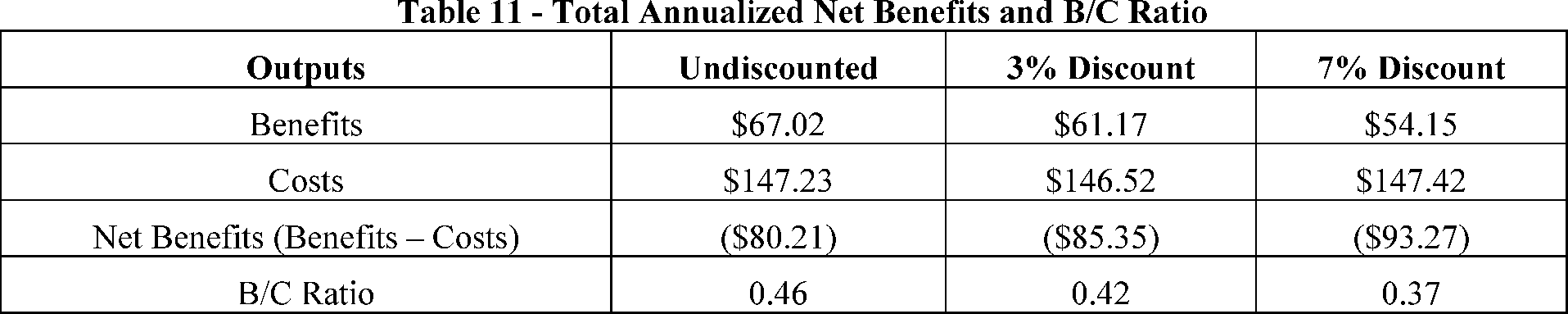
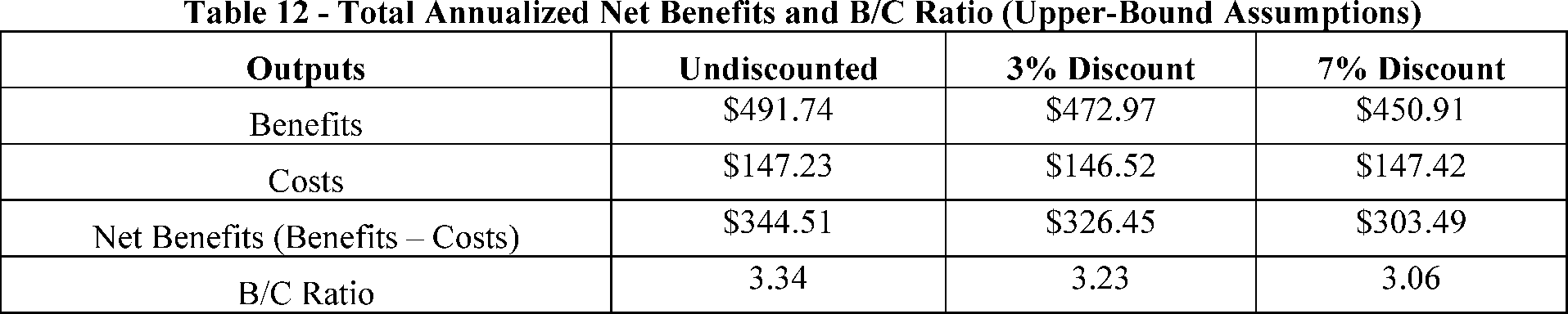
2. Unquantified Benefits and Costs
CPSC assesses that there are likely both unquantified benefits and unquantified costs from the proposed rule. The unquantified benefits stem from avoided property damage, legal costs, and insurance premium increases. Because the data on fire incidents did not have a product category for lithium-ion batteries, staff's analysis could be underestimating the number of incidents and the magnitude of loss from fires from these batteries. Additionally, fires in multi-dwelling units have the potential to impose significant negative externalities, such as a fire that results in property loss for a neighbor. Staff could not quantify these impacts due to a lack of robust data in the various data sources reviewed. Secondly, fires spreading to nearby structures could result in additional legal costs. Legal costs are likely a fraction of the total property losses associated with these fires; however, the potential large magnitude of these losses could make some legal fees significant. Staff do not have the robust data to estimate potential legal costs avoided based on the proposed rule.
B. Assessment of Voluntary Standards
Sections IV.A and IV.B of this preamble describe the adequacy of the voluntary standards, improvements made by the NPR, and the level of compliance with the voluntary standards for each product covered by the NPR. Based on this analysis, the Commission preliminarily determines that the voluntary standards are inadequate to address the risk of injury, and that micromobility products do not substantially comply with the voluntary standards at this time. Therefore, the Commission preliminarily determines that relying on voluntary standards development in lieu of rulemaking would not eliminate or adequately reduce an unreasonable risk of injury.
C. Alternatives to the Proposed Rule
The Commission considered six alternatives to the proposed rule: (1) limit the scope of the rule to eScooters and OMPs; (2) conduct marketing campaigns instead of promulgating a final rule; (3) conduct recalls instead of promulgating a final rule; (4) rely only on voluntary standards development; (5) propose a later effective date; and (6) take no action.
1. Limit the Scope of the Rule to eScooters and OMPs
The Commission could limit the scope of the NPR to OMPs, removing eBikes, because the estimated benefits and costs from those products are more certain than for the less mature eBike market, and estimated benefits of the proposed rule for OMPs more assuredly outweigh the estimated costs from the rule. With this alternative, estimated benefits of the NPR would be highly likely to exceed its estimated costs.
Section 9(c) of CPSA directs staff to identify potential benefits and costs. Although this alternative would provide greater confidence that the rule would generate positive net benefits, a positive economic case is not required for the Commission to improve consumer product safety by rule. This alternative would leave the fire hazard from lithium-ion batteries unreasonably high for eBikes and expose eBike riders and others, including vulnerable young children and seniors, to this fire hazard. As the youngest of the three product types, eBikes have the least mature market with the highest growth potential, creating uncertainty about what the future of the product, market, and safety record will be. An argument against excluding eBikes is the Commission should not wait for the eBike to mature and potentially harm more consumers.
2. Conduct Marketing Campaigns Instead of Promulgating a Final Rule
Rather than promulgating a final rule, the Commission could issue news releases or utilize other information and marketing techniques to warn consumers about the identified associated hazards with micromobility product electrical systems, including lithium-ion batteries. With this alternative, micromobility product manufacturers would incur no costs to modify or test their products to comply with a final rule.
Information and marketing campaigns may change consumer preferences, increasing demand for micromobility products that comply with the voluntary standard relative to those that do not. However, staff estimate that the resulting, market-driven compliance rate for producers would be well below the (nearly) 100 percent compliance rate that a final rule can produce. Therefore, much of the societal costs would continue to be incurred by consumers in the form of deaths, injuries, and property damage. For this reason, the Commission is not pursuing this alternative.
3. Conduct Recalls Instead of Promulgating a Final Rule
The Commission could continue to negotiate recalls that reduce the number of fire/electric shock incidents and their societal costs by removing unsafe products from the market. As with consumer education campaigns, this option would merely maintain the status quo and staff estimate the compliance rate would be far below the nearly 100 percent compliance rate that a mandatory rule can produce. Section III.F of this preamble details the 29 micromobility product recalls CPSC conducted from January 2016 through November 2024. Furthermore, unlike a rule that would apply to newly manufactured micromobility products, recalls only apply to an individual manufacturer and product, do not extend to similar products, and occur only after consumers have purchased and used such products and have been exposed to and potentially injured or killed by the hazard. Additionally, recalls can only address products that are already on the market and cannot prevent unsafe products from entering the market. As with information and marketing campaigns, much of the societal costs would continue to be incurred by consumers in the form of deaths, injuries, and property damage. For these reasons, recalls would not eliminate or adequately reduce an unreasonable risk of injury associated with these products in the absence of rulemaking.
4. Rely on Voluntary Standard Development
The Commission could direct CPSC staff to work with voluntary standards development organizations to address the associated hazards. This alternative would allow firms and other participants in the voluntary standards process to collectively determine the degree, manner, and timing of hazard mitigation, which could lead to approaches that delay or reduce costs incurred by firms to address the hazard. In addition, firms may choose not to comply with the voluntary standards and therefore incur no associated costs.
Staff already participate in the UL process for all three of the UL standards the NPR proposes to incorporate by reference, so this alternative, like education campaigns and recalls, maintains the status quo. Technical staff in recent years have made proposals to UL 2849 and attended meetings, including comments made to other proposals for the three technical standards identified, UL 2849, UL 2272, and UL 2271. Furthermore, societal benefits would be limited to products manufactured by firms that choose to comply with the voluntary standard; and, as discussed, micromobility products and aftermarket batteries do not substantially comply with the applicable voluntary standards.
5. Set a Later Effective Date
The Commission could establish an effective date for its proposed rule later than 180 days. The proposed rule includes an effective date that is 180 days after the final rule is published in the Federal Register . A later effective date would allow manufacturers more time to redesign their micromobility products, modify production lines, spread research and development costs over a greater period, and mitigate supply chain sues.
However, staff analysis indicates existing micromobility products and associated lithium-ion battery pack containers may accommodate UL-compliant cells, battery management systems, and controllers with little or no required modifications. Therefore, costs associated with these manufacturing activities to achieve compliance are unlikely to be significant. Based on the foregoing, the Commission is not proposing an effective date later than 180 days.
6. Take No Regulatory Action
The Commission considered the merits of taking no action. As the relevant UL voluntary standards are relatively new, in particular the UL 2272-24 revision, compliance rates may improve in the future. State and local regulation mandating compliance with voluntary standards for micromobility products, insurance availability, and other forces may accelerate compliance with the standards. However, without a mandatory regulation, firms could choose to continue to produce non-compliant micromobility products for the U.S. market. Given persistent deaths and injuries from micromobility product fires, the risk of lithium-ion battery fires destroying entire houses or structures, the number of deaths and injuries involving multi-unit dwellings, and increasing micromobility product sales, the Commission is not pursuing this alternative.
VII. Initial Regulatory Flexibility Act Analysis
Whenever an agency publishes an NPR, the Regulatory Flexibility Act (5 U.S.C. 601-612; RFA) requires that the agency prepare an initial regulatory flexibility analysis (IRFA) that describes the impact that the proposed rule would have on small businesses and other entities, unless the agency has a factual basis for certifying that the proposed rule “will not have a significant economic impact on a substantial number of small entities.” 112 The IRFA must contain:
112 5 U.S.C. 605 (b) of The Regulatory Flexibility Act of 1980, as amended. Available at https://www.sba.gov/advocacy/regulatory-flexibility-act.
• a description of why action by the agency is being considered;
• a succinct statement of the objectives of, and legal basis for, the proposed rule;
• a description of and, where feasible, an estimate of the number of small entities to which the proposed rule will apply;
• a description of the projected reporting, recordkeeping, and other compliance requirements of the proposed rule, including an estimate of the classes of small entities which will be subject to the requirement and the type of professional skills necessary for preparation of the report or record; and
• an identification to the extent practicable, of all relevant Federal rules which may duplicate, overlap or conflict with the proposed rule.
An IRFA must also contain a description of any significant alternatives that would accomplish the stated objectives and would minimize any significant economic impact of the proposed rule on small entities.
A. Reason for Agency Action
As stated in section I of this preamble, this NPR is intended to address an unreasonable risk of injury and death to consumers from electric shock, fires, explosions, expulsion of gas or flames, burns, overheating, and smoke inhalation, particularly hazards associated with thermal runaway, in micromobility products that use lithium-ion batteries. CPSC anticipates that, if finalized, the proposed rule would be highly effective and would likely mitigate approximately 90 percent of deaths and injuries associated with lithium-ion batteries used in micromobility products within the scope of the rule, depending on the type of micromobility product.
B. Objectives of and Legal Basis for the Rule
As stated in section I of this preamble, the Commission proposes this rule under sections 7 and 9 of the CPSA to reduce the risks of death and injury associated with lithium-ion batteries used in micromobility products and their electrical systems.
C. Small Entities to Which the Rule Will Apply
The NPR would apply to all manufacturers and importers of micromobility products. Micromobility product manufacturers may be classified in the North American Industrial Classification (NAICS) category 336991 (Motorcycle, Bicycle and Parts Manufacturing), or possibly 336999 (All Other Transportation Equipment Manufacturing), or 335910 (Battery Manufacturing). The Small Business Administration (SBA) size standards for these NAICS classifications are 1,050 employees, 1,000 employees and 1,250 employees, respectively. CPSC staff identified 36 U.S. micromobility product manufacturers with fewer than 1,050 employees.
Importers of micromobility products could be wholesale or retail distributors. Micromobility product wholesalers may be classified in NAICS categories 423860 (Transportation Equipment and Supplies (except Motor Vehicle) Merchant Wholesalers), 423910 (Sporting and Recreational Goods and Supplies Merchant Wholesalers), or 441228 (Motorcycle, ATV, and All Other Motor Vehicle Dealers). The SBA size standard for NAICS classification 423860 is 175 employees and NAICS classification 423910 is 100 employees. The SBA size standard for NAICS classification 441228 is $35 million. CPSC staff identified 20 firms distributing foreign manufactured micromobility products in 2024 that could be considered small businesses. 113
113 Staff made these determinations using information from Pitchbook and ReferenceUSAGov.
D. Compliance Requirements of the Proposed Rule, Including Reporting and Recordkeeping Requirements
The NPR would establish a mandatory standard for lithium-ion batteries used in micromobility products and the electrical systems of such products. If the proposed rule is finalized, suppliers would have to meet the proposed performance and labeling requirements to sell products in the United States. Under the NPR, all micromobility products and all spare, replacement, conversion kit, and other aftermarket batteries would be required to comply with UL 2849-20, UL 2272-24, and UL 2271-23, as applicable, including modifications to performance requirements for electrical systems for eBikes and OMPs, as well as batteries intended for those products, and for operating instructions, labeling, and safety markings. Firms with noncompliant products would need to procure and install compliant batteries to test micromobility products and aftermarket batteries.
E. Federal Rules That May Duplicate, Overlap, or Conflict With the Proposed Rule
At the time of this document, no Federal rules duplicate, overlap, or conflict with the proposed rule.
F. Potential Impact on Small Entities
One purpose of the IRFA is to evaluate the impact of a regulatory action on small entities and determine whether that impact is economically significant. CPSC typically uses one percent of gross revenue as the threshold for determining whether an NPR could be “economically significant.” When the expected impact is 1 percent of gross revenue or more, CPSC staff prepare an initial regulatory flexibility analysis. 114
114 The one percent of gross revenue threshold is cited as example criteria by the SBA and is commonly used by agencies in determining economic significance. See U.S. Small Business Administration, Office of Advocacy. A Guide for Government Agencies: How to Comply with the Regulatory Flexibility Act and Implementing the President's Small Business Agenda and Executive Order 13272. May 2012, pp 18-20, available at: http://www.sba.gov/sites/default/files/rfaguide_0512_0.pdf.
1. Impact on Small Manufacturers
The summary of the preliminary regulatory analysis in section VI of this preamble, and the full regulatory analysis in Tab A of the Staff Briefing Memorandum, discuss costs more fully. Based on that analysis, micromobility product suppliers may incur costs to redesign, manufacture, and test product electrical systems to achieve compliance with the NPR's requirements. However, the cost analysis bases its per-unit compliance cost on the difference in price between batteries that are compliant with the current UL standards and those that are noncompliant as an appropriate proxy. Manufacturers would choose to develop their own compliant battery systems only if this option is less costly in the long run than sourcing compliant battery and electrical systems from currently compliant suppliers.
Staff identified 36 micromobility product manufacturers that meet SBA size standards for small businesses. CPSC expects compliant components to easily integrate into current micromobility product models with little to no required modification of existing frames or other components. CPSC also expects additional internal battery components, or changes to existing components, required to comply with the NPR would fit within current case and frame designs. CPSC staff, however, expect the costs of the new components to exceed the 1 percent of gross revenue threshold for a significant economic effect. Staff estimated the compliance cost per unit to be $230 for eBikes, $114.86 per eScooters, and $162.79 per OMPs, all above 1 percent of the price for each product. A substantial number of small micromobility firms will incur these costs; in particular, the estimated compliance rate of eBike products is low at approximately 11 percent. Therefore, the Commission preliminarily determines that the economic impact of the proposed rule on small manufacturers likely will be significant.
2. Impact on Small Importers
Staff identified 20 possible importers of micromobility products from foreign suppliers considered small businesses based on SBA size standards. A small importer could be significantly adversely impacted by NPR if its foreign supplier withdrew from the U.S. market rather than incur the costs of compliance. If sales of micromobility products are a substantial source of the importer's business, and the importer cannot find an alternative supplier of micromobility products, the economic impact on these firms may be significant. Staff, however, advise that it is unlikely that foreign manufacturers will exit such a fast-growing market. Moreover, many micromobility products are manufactured in China and these manufacturers sell other similar products as well. Accordingly, a decline in micromobility product sales may be offset by sales and revenue from other products.
Staff expect a decline in demand from the expected increase in price due to compliance; however, this is not expected to significantly affect the market. This is because many non-eBike micromobility products currently follow UL standards and the costs to ensure compliance with the NPR for compliant products are negligible. While staff estimate that only a small share of eBikes currently comply with UL 2849-20, state and local regulations, along with insurance requirements, may push the eBike industry in the direction of compliance with the UL standard, independent of CPSC rulemaking. Overall, the cost of compliance is expected to exceed the 1 percent of revenue threshold applied by CPSC and as such even importing firms that continue supplying these products to the U.S. market will incur a significant impact if the Commission finalizes the rule.
G. Alternatives for Reducing the Adverse Impact on Small Entities
The Commission considered several alternatives to the proposed rule, which are discussed in section VI.C of this preamble.
H. Conclusion
Staff identified 36 micromobility product manufacturers that meet the SBA criteria to be considered small firms and assessed that the proposed rule is likely to have a significant economic impact on these 36 firms. Staff estimated that there are 20 importers of foreign manufactured micromobility products that meet the SBA criteria to be considered small. A small importer whose supplier exits the market could experience a significant adverse economic impact. However, given the fast-growing market, staff do not anticipate foreign manufacturers to exit the U.S. market. Given that assumption, CPSC assesses that the economic impact on the importers of foreign manufactured micromobility products will be limited to the production costs to manufacture compliant products. These costs are expected to exceed the 1 percent of gross revenues threshold. The Commission welcomes public comments on this IRFA. Small businesses that believe they will be affected by the proposed rule are encouraged to submit comments. The comments should be specific and describe the potential impact, magnitude, and alternatives that could reduce the impact of the proposed rule on small businesses.
VIII. Environmental Considerations
Generally, the Commission's regulations are considered to have little or no potential for affecting the human environment, and environmental assessments and impact statements are not usually required. See 16 CFR 1021.5(a). This NPR to create mandatory requirements lithium-ion batteries used in micromobility products is not expected to have an adverse impact on the environment and is considered to fall within the “categorical exclusion” for the purposes of the National Environmental Policy Act. 16 CFR 1021.5(c).
IX. Paperwork Reduction Act
This NPR contains information collection requirements that are subject to public comment and review by the Office of Management and Budget (OMB) under the Paperwork Reduction Act of 1995 (PRA; 44 U.S.C. 3501-3521). Under the PRA, an agency must publish the following information:
• a title for the collection of information;
• a summary of the collection of information;
• a brief description of the need for the information and the proposed use of the information;
• a description of the likely respondents and proposed frequency of response to the collection of information;
• an estimate of the burden that will result from the collection of information; and
• notice that comments may be submitted to OMB.
44 U.S.C. 3507(a)(1)(D). In accordance with this requirement, the Commission provides the following information:
Title: Safety Standard for Lithium-Ion Batteries Used in Micromobility Products and Electrical Systems of Micromobility Products Containing Such Batteries
Summary, Need, and Use of Information: The Commission is considering a proposed rule to establish a mandatory safety standard to address the unreasonable risks of death and injury to consumers from electric shock, fires, explosions, expulsion of gas or flames, burns, overheating, and smoke inhalation associated with lithium-ion batteries used to power micromobility products, including eBikes, eScooters, self-balancing scooters (eSBscooters), eSkateboards, eUnicycles, and hybrids of these products. The NPR includes recordkeeping, labeling, and third-party disclosure requirements that are considered information collections under the Paperwork Reduction Act of 1995 (PRA; 44 U.S.C. 3501-3521). The proposed rule would incorporate by reference existing voluntary standards: UL 2849-20 (eBikes), UL 2272-24 (other micromobility products), and UL 2271-23 (user replaceable battery packs) with performance and labeling modifications, and covers aftermarket battery chargers and eBike conversion kits within its scope. The proposed information collections support the effectiveness of the proposed rule.
Respondents and Frequency: The information collection would apply to all manufacturers and importers of micromobility products subject to proposed rule and user replaceable battery packs used in micromobility products. Typically, manufacturers and importers of micromobility products subject to the rule will not respond to the collection annually and will only respond on occasion.
Estimate of Respondent Burden:
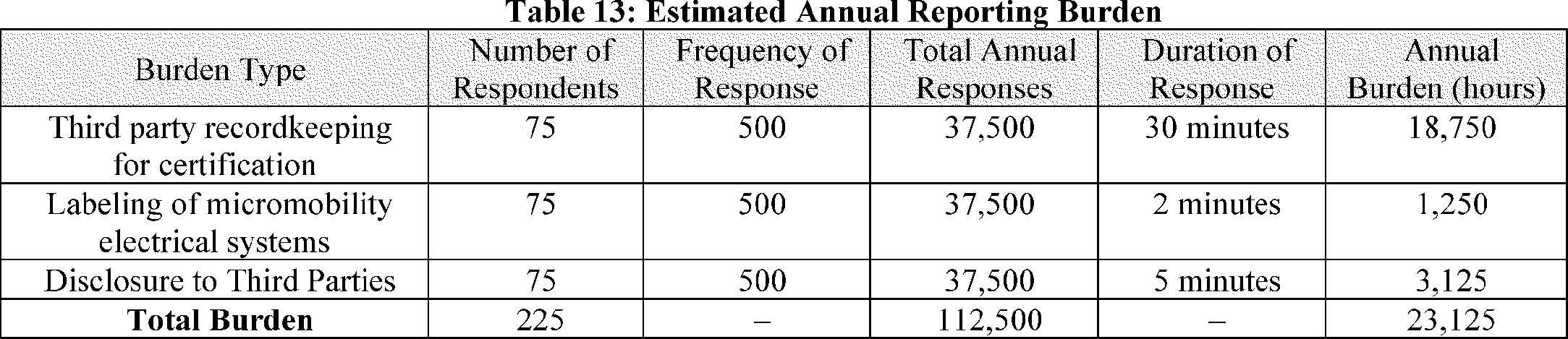
Section 14(a)(1) of the CPSA, 15 U.S.C. 2063(a)(1), requires that suppliers of regulated products test and certify that their products conform to CPSC's mandatory standards. CPSC assumes the collection of information would impose third party recordkeeping burden for the certification of children's micromobility products and batteries within the scope of the rule. Approximately 75 respondents, producers/importers who supply micromobility products, including those intended for children, or batteries would respond to the collection annually, and on average each respondent would respond 500 times per year. 115 CPSC assumes that on average respondents will spend 30 minutes per response on recordkeeping for the certification process. 116 Therefore, the estimated annual burden for third party recordkeeping certification is 18,750 hours (37,500 responses × 30 minutes per response = 1,125,000 minutes or 18,750 hours).
115 Some respondents are expected to respond less than 500 times per year, and therefore CPSC has likely overestimated the total annual response burden (Number of Responses × Frequency of Response = Total Annual Responses).
116 A small percentage of lithium-ion batteries sold annually are intended for use in children's products and would be subject to additional third party testing. The estimates in table 13 account for this additional certification burden.
Section 14 of the CPSA and 16 CFR part 1110 require that micromobility products and batteries be tested and certified to demonstrate the products are compliant with the rule. CPSC assumes approximately 75 respondents would respond to the collection annually, and on average each respondent would respond 500 times per year. On average, respondents will spend two minutes per response on labeling. Therefore, the estimated annual burden for labeling of micromobility electrical systems is 1,250 hours (37,500 responses × 2 minutes per response = 75,000 minutes or 1,250 hours).
Finally, suppliers of micromobility products and aftermarket batteries would be required to disclose product records to third parties to conform to the proposed rule, and CPSC assumes the collection of information would impose third party disclosure burdens on suppliers of micromobility products and aftermarket batteries. Accordingly, CPSC assumes approximately 75 respondents would respond to the collection annually, and on average each respondent would respond 500 times per year. On average, respondents will spend 5 minutes per third party disclosure response. Therefore, the estimated annual burden for third party disclosure is 3,125 hours (37,500 responses × 5 minutes per response = 187,500 minutes or 3,125 hours).
Based on this analysis, the proposed standard, if finalized, would impose a total paperwork burden to industry of 23,125 hours annually (18,750 hours recordkeeping + 1,250 hours labeling + 3,125 hours disclosure).
Labor Cost of Respondent Burden. According to the U.S. Bureau of Labor Statistics (BLS), Employer Costs for Employee Compensation, the total compensation cost per hour worked for all private industry workers in goods-producing industries was $45.31 (March 2024, https://www.bls.gov/news.release/archives/ecec_06182024.pdf ). Based on this analysis, CPSC staff estimate that labor cost of respondent burden would impose a cost to industry of approximately $1,047,794 annually (23,125 hours × $45.31 per hour = $1,047,793.75).
Cost to the Federal Government. The estimated annual cost of the information collection requirements to the federal government is approximately $4,774, which includes 60 staff hours to examine and evaluate the information as needed for Compliance activities. This is based on a GS-12, step 5 level salaried employee. The average hourly wage rate for a mid-level salaried GS-12 employee in the Washington, DC metropolitan area (effective as of January 2024) is $53.87 (GS-12, step 5). This represents 67.7 percent of total compensation (U.S. Bureau of Labor Statistics, “Employer Costs for Employee Compensation,” March 2024, percentage of wages and salaries for all civilian management, professional, and related employees: https://www.bls.gov/news.release/archives/ecec_06182024.pdf ). Adding an additional 32.3 percent for benefits brings average annual compensation for a mid-level salaried GS-12 employee to $79.57 per hour. Assuming that approximately 60 hours will be required annually, this results in an annual cost of $4,774 ($79.57 per hour × 60 hours = $ 4,774.20).
CPSC has submitted the information collection requirements of this proposed rule to OMB for review in accordance with PRA requirements. 44 U.S.C. 3507(d). Pursuant to 44 U.S.C. 3506(c)(2)(A), the Commission invites comments on:
• whether the proposed collection of information is necessary for the proper performance of CPSC's functions, including whether the information will have practical utility;
• the accuracy of CPSC's estimate of the burden of the proposed collection of information, including the validity of the methodology and assumptions used;
• ways to enhance the quality, utility, and clarity of the information the Commission proposes to collect;
• ways to reduce the burden of the collection of information on respondents, including the use of automated collection techniques, when appropriate, and other forms of information technology;
• the estimated burden hours associated with labels, including any alternative estimates; and
• the estimated respondent cost other than burden hour cost.
X. Preemption
Executive Order (E.O.) 12988, Civil Justice Reform (Feb. 5, 1996), directs agencies to specify the preemptive effect of a rule in the regulation. 61 FR 4729 (Feb. 7, 1996). The proposed regulation for lithium-ion batteries used in micromobility products is issued under authority of the CPSA. 15 U.S.C. 2051-2089. Section 26 of the CPSA provides that whenever a consumer product safety standard is in effect and applies to a risk of injury associated with a consumer product, no State or political subdivision of a State shall have any authority either to establish or to continue in effect any provision of a safety standard or regulation which prescribes any requirements as to the performance, composition, contents, design, finish, construction, packaging or labeling of such product which are designed to deal with the same risk of injury, unless such requirements are identical to the requirements of the Federal consumer product safety rule. 15 U.S.C. 2075(a).
The Federal Government, or a State or local government, may establish or continue in effect a non-identical requirement for its own use that is designed to protect against the same risk of injury as the CPSC standard if the Federal, State, or local requirement provides a higher degree of protection than the CPSA requirement. Id. 2075(b). In addition, States or political subdivisions of a State may apply for an exemption from preemption regarding a consumer product safety standard, and the Commission may issue a rule granting the exemption if it finds that the State or local standard: (1) provides a significantly higher degree of protection from the risk of injury or illness than the CPSA standard, and (2) does not unduly burden interstate commerce. Id. 2075(c).
Thus, the proposed rule for lithium-ion batteries used in micromobility products and electrical systems of micromobility products containing such batteries could, if finalized, preempt non-identical State or local requirements for products within the scope of this rule that are designed to protect against the same risk of injury and prescribing performance or labeling requirements for such products addressed in this rule.
XI. Testing, Certification, and Notice of Requirements
Section 14(a) of the CPSA includes requirements for certifying that children's and non-children's products comply with applicable mandatory standards. 15 U.S.C. 2063(a). Section 14(a)(1) addresses required certifications for non-children's products, and sections 14(a)(2) and (a)(3) address certification requirements specific to children's products.
A “children's product” is a consumer product that is “designed or intended primarily for children 12 years of age or younger.” Id. 2052(a)(2). The following factors are relevant when determining whether a product is a children's product:
• manufacturer statements about the intended use of the product, including a label on the product if such statement is reasonable;
• whether the product is represented in its packaging, display, promotion, or advertising as appropriate for use by children 12 years of age or younger;
• whether the product is commonly recognized by consumers as being intended for use by a child 12 years of age or younger; and
• the Age Determination Guidelines issued by CPSC staff in September 2002, and any successor to such guidelines.
Id. “For use” by children 12 years and younger generally means that children will interact physically with the product based on reasonably foreseeable use. 16 CFR 1200.2(a)(2). Children's products may be decorated or embellished with a childish theme, be sized for children, or be marketed to appeal primarily to children. Id. § 1200.2(d)(1).
Aftermarket batteries are unlikely to be children's products, but CPSC is aware that some micromobility products are specifically designed for children, and based on the factors listed above, fall within the definition of a “children's product.” If the Commission issues a final rule for micromobility products that use lithium-ion batteries, such a rule would require micromobility products that are children's products to meet the third party testing and certification requirements in section 14(a) of the CPSA. The Commission's requirements for certificates of compliance are codified at 16 CFR part 1110.
Non-Children's Products. Section 14(a)(1) of the CPSA requires every manufacturer (which includes importers 117 ) of a non-children's product that is subject to a consumer product safety rule under the CPSA or a similar rule, ban, standard, or regulation under any other law enforced by the Commission to test such products, using a reasonable testing program, and to certify based on that testing that the product complies with all applicable CSPSC-enforced requirements. 15 U.S.C. 2063(a)(1).
117 The CPSA defines a “manufacturer” as “any person who manufactures or imports a consumer product.” 15 U.S.C. 2052(a)(11).
Children's Products. Section 14(a)(2) of the CPSA requires the manufacturer or private labeler of a children's product that is subject to a children's product safety rule to certify that, based on a third party conformity assessment body's testing, the product complies with the applicable children's product safety rule. Id. 2063(a)(2). Section 14(a) also requires the Commission to publish a notice of requirements (NOR) for a third party conformity assessment body ( i.e., testing laboratory) to obtain accreditation to assess conformity with a children's product safety rule. Id. 2063(a)(3)(A). Because some micromobility products within the scope of this proposed rule are children's products, the proposed rule is a children's product safety rule, as applied to those products. Accordingly, if the Commission issues a final rule, it will also issue an NOR.
The Commission published a final rule, codified at 16 CFR part 1112, entitled Requirements Pertaining to Third Party Conformity Assessment Bodies, which established requirements and criteria concerning testing laboratories. 78 FR 15836 (Mar. 12, 2013). Part 1112 includes procedures for CPSC to accept a testing laboratory's accreditation and lists the children's product safety rules for which CPSC has published NORs. When CPSC issues a new NOR, it must amend part 1112 to include that NOR. Accordingly, as part of this NPR, the Commission proposes to amend part 1112 to add the “Safety Standard for Lithium-Ion Batteries Used in Micromobility Products and Electrical Systems of Micromobility Products Containing Such Batteries” to the list of children's product safety rules for which CPSC has issued an NOR.
Testing laboratories that apply for CPSC acceptance to test micromobility products that are children's products for compliance with the new rule would have to meet the requirements in part 1112. When a laboratory meets the requirements of a CPSC-accepted third party conformity assessment body, the laboratory can apply to CPSC to include 16 CFR part 1265, Safety Standard for Lithium-Ion Batteries Used in Micromobility Products and Electrical Systems of Micromobility Products Containing Such Batteries, in the laboratory's scope of accreditation of CPSC safety rules listed on the CPSC website at: www.cpsc.gov/labsearch .
Children's products must be tested by a CPSC-accepted third party lab, which is a laboratory accredited to ISO 17025:2017 for the specific testing scope by an ILAC-MRA recognized Accrediting Body. CPSC-accepted test labs are listed on CPSC's website by rule. To meet CPSC's requirements, children's products must be tested by a third party laboratory whose accreditation has been accepted by CPSC to test to this proposed rule and be certified by the manufacturer or importer as compliant with the regulation. Non-children's products are not required to be third party tested, but each product must be tested (either first or third party), or products must demonstrate compliance using a reasonable testing program and be certified based on passing test reports.
Accordingly, to assess test lab capacity, CPSC staff researched the availability of existing ISO-17025:2017 accredited laboratories with test capabilities for the three standards proposed to be incorporated by reference in this NPR. CPSC staff found at least 34 test laboratories that are ISO-17025:2017 accredited to test to UL 2271-23, at least 11 laboratories ISO-17025:2017 accredited to test UL 2272-24, and at least 21 laboratories ISO-17025:2017 accredited to test to UL 2849-20 at that time. Each of these labs could apply for CPSC acceptance to test children's micromobility products subject to a final rule. Test lab availability therefore is unlikely to be an issue when considering an appropriate effective date, but CPSC requests comment on this issue.
XII. Effective Date
The Administrative Procedure Act (APA) generally requires that the effective date of a rule be at least 30 days after publication of a final rule. 5 U.S.C. 553(d). Section 9(g)(1) of the CPSA states that a consumer product safety rule shall specify the date such rule is to take effect, and that the effective date must be at least 30 days after promulgation but cannot exceed 180 days from the date a rule is promulgated, unless the Commission finds, for good cause shown, that a later effective date is in the public interest and publishes its reasons for such finding.
If finalized, the Commission proposes an effective date of 180 days after publication of the final rule in the Federal Register . The rule would be applicable to products manufactured after the effective date. 15 U.S.C. 2058(g)(1). Some micromobility products are already compliant with the applicable UL standards. Moreover, as reviewed above, compliant manufacturers are already testing their products for compliance with the UL standards. For those products that do not comply, or that must update product design to meet the required testing, CPSC does not anticipate a lengthy time for redesign. Importantly, manufacturers can likely source a different battery to meet the requirements of this proposed rule.
XIII. Incorporation by Reference
As explained in section I.A, and described in detail in sections IV and V of this preamble, the Commission proposes to incorporate by reference three UL voluntary standards, with modifications:
• ANSI/CAN/UL 2849:2020, Standard for Safety for Electrical Systems for eBikes (UL 2849-20) (eBikes);
• ANSI/CAN/UL 2272:2024, Standard for Safety for Electrical Systems for Personal E-Mobility Devices (UL 2272-24) (eScooters, eSBscooters, eSkateboards, eUnicycles, and hybrid products); and
• ANSI/CAN/UL 2271:2023, Standard for Safety for Batteries for Use in Light Electric Vehicle (LEV) Applications (UL 2271-23) (user replaceable battery packs).
The OFR has regulations concerning incorporation by reference. 1 CFR part 51. For a proposed rule, agencies must discuss in the preamble of the NPR ways that the materials the agency proposes to incorporate by reference are reasonably available to interested persons or how the agency worked to make the materials reasonably available. In addition, the preamble of the proposed rule must summarize the material. 1 CFR 51.5(a).
In accordance with the OFR's requirements, sections IV.A and IV.B of this preamble summarize the requirements of the three UL standards the Commission proposes to incorporate by reference and section V of this preamble summarizes the proposed requirements in this NPR. UL 2849-20, UL 2272-24, and UL 2271-23 are copyrighted. During the comment period, you may view a read-only copy of these voluntary UL standards free of charge at on UL's website at https://www.ulstandards.com/IBR/logon.aspx. Alternatively, interested parties may inspect a copy of these standards free of charge by contacting Alberta E. Mills, Office of the Secretary, U.S. Consumer Product Safety Commission, 4330 East West Highway, Bethesda, MD 20814; telephone: 301-504-7479; email: cpsc-os@cpsc.gov. To download or print the standards, interested persons may purchase a copy of each standard through Underwriters Laboratories, Inc. (UL), 333 Pfingsten Road, Northbrook, IL 60062 or through UL's website at www.UL.com.
XIV. Proposed Findings
The CPSA requires the Commission to make certain findings when issuing a consumer product safety standard. Specifically, the CPSA requires the Commission to consider and make findings about the following:
• the degree and nature of the risk of injury the rule is designed to eliminate or reduce;
• the approximate number of consumer products subject to the rule;
• the need of the public for the products subject to the rule and the probable effect the rule will have on the cost, availability, and utility of such products;
• any means to achieve the objective of the rule while minimizing adverse effects on competition, manufacturing, and commercial practices;
• that the rule, including the effective date, is reasonably necessary to eliminate or reduce an unreasonable risk of injury associated with the product;
• that issuing the rule is in the public interest;
• if a voluntary standard addressing the risk of injury has been adopted and implemented, that either compliance with the voluntary standard is not likely to result in the elimination or adequate reduction of the risk or injury, or it is unlikely to be substantial compliance with the voluntary standard;
• that the benefits expected from the rule bear a reasonable relationship to its costs; and
• that the rule imposes the least burdensome requirement that prevents or adequately reduces the risk of injury.
15 U.S.C. 2058(f)(1), (f)(3). At the NPR stage, the Commission makes these findings on a preliminary basis to allow the public to submit comments. Appendix A of the proposed regulation text contains the Commission's proposed findings.
XV. Request for Comments
The Commission invites interested persons to submit their comments to the Commission on any aspect of the proposed rule as provided in the instructions in the ADDRESSES section at the beginning of this NPR. Additionally, the Commission seeks comment on whether the rule should address or require the following:
A. Marking and Labeling Requirements
• Whether, pursuant to the Commission's authority in section 14(c)(4) of the CPSA, 15 U.S.C. 2063(c)(4), the rule should require that each micromobility product subject to the rule have a visible and legible label on the product indicating compliance with the rule, such as “Meets CPSC Safety Requirements for Lithium-Ion Batteries”;
• Whether additional on-product marking or instructions should be required to advise consumers on how to safely operate the micromobility product ( e.g., not riding immediately after charging);
• Whether fire resistant manufacturer labeling/marking on the battery pack should be required for post fire identification;
• Whether CPSC's rule should align the marking required in UL 2849-20 and UL 2272-24 about using a specific charger with the NPR proposal to allow the use of aftermarket chargers as long as they comply with the applicable sections of UL 2849-20 and UL 2272-24 and the proposed requirement that aftermarket chargers be provided with a marking to indicate the specific micromobility product for which they are intended to be used.
B. Performance Requirements
• As proposed, the BMS does not monitor the charger's input voltage and current to the battery. The Commission requests comments on whether BMS should be required to communicate with the charger to verify basic compatibility (voltage, current and power ratings of the charger) with the battery and to prevent out of specification charging voltage or current applied to the battery;
• Whether fire resistant enclosures that use flame retardant chemicals should be prohibited in micromobility devices;
C. Effective Date
• The reasonableness of the proposed 180-day effective date and recommendations for a different effective date, if justified;
D. Regulatory Analysis
• The reasonableness of the estimated compliance rates with current voluntary standards used in the regulatory analysis and recommendations for different compliance rates, if justified;
• Whether the compliance costs for this proposed rule as estimated in the regulatory analysis are reasonable; if not, commenters should provide sources or rationale for any alternate data/estimates on costs of compliance.
E. Stockpiling
• Whether setting the anti-stockpiling provision rate at 120 percent of the base period, and setting the base period as the average monthly manufacturing or import volume of the 13 months immediately preceding the month of promulgation of the final rule, is reasonable.
XVI. Notice of Opportunity for Oral Presentation
Section 9 of the CPSA requires the Commission to provide interested parties “an opportunity for oral presentation of data, views, or arguments.” 15 U.S.C. 2058(d)(2). The Commission must keep a transcript of such oral presentations. Id. Any person interested in making an oral presentation regarding this NPR must contact the Commission, as described under the DATES and ADDRESSES section of this document.
XVII. Promulgation of a Final Rule
Section 9(d)(1) of the CPSA requires the Commission to promulgate a final consumer product safety rule within 60 days of publishing a proposed rule. 15 U.S.C. 2058(d)(1). Otherwise, the Commission must withdraw the proposed rule if it determines that the rule is not reasonably necessary to eliminate or reduce an unreasonable risk of injury associated with the product or is not in the public interest. Id. However, the Commission can extend the 60-day period, for good cause shown, if it publishes the reasons for doing so in the Federal Register . Id.
The Commission finds that there is good cause to extend the 60-day period for this rulemaking. Under both the Administrative Procedure Act and the CPSA, the Commission must provide an opportunity for interested parties to submit written comments on a proposed rule. 5 U.S.C. 553; 15 U.S.C. 2058(d)(2). The Commission typically provides 60 days for interested parties to submit written comments. In this case, a shorter comment period may limit the quality and utility of information CPSC receives in comments, particularly for areas where it seeks data and other detailed information that may take time for commenters to compile. Additionally, the CPSA requires the Commission to provide interested parties with an opportunity to make oral presentations of data, views, or arguments. 15 U.S.C. 2058. After receiving written and oral comments, CPSC staff must have time to review and evaluate those comments.
These factors make it impractical for the Commission to issue a final rule within 60 days of this proposed rule. Moreover, issuing a final rule within 60 days of the NPR may limit commenters' ability to provide useful input on the rule, and CPSC's ability to evaluate and take that information into consideration in developing a final rule. Accordingly, the Commission finds that there is good cause to extend the 60-day period.
XVIII. Executive Order 12866, Regulatory Planning and Review, and Executive Order 13563, Improving Regulation and Regulatory Review
Executive Order 12866 states that OMB's Office of Information and Regulatory Affairs (OIRA) determines whether a regulatory action is significant and subject to the requirements of the Executive Order and OMB review. Regulatory Planning and Review, 58 FR 51735 (Oct. 4, 1993). Section 3(f) of Executive Order 12866 defines a “significant regulatory action” as a regulatory action that is likely to result in a rule that may: (1) have an annual effect on the economy of $100 million or more; or adversely affect in a material way the economy, a sector of the economy, productivity, competition, jobs, the environment, public health or safety, or state, local, territorial, or Tribal governments or communities; (2) create a serious inconsistency or otherwise interfere with an action taken or planned by another agency; (3) materially alter the budgetary impact of entitlements, grants, user fees or loan programs or the rights and obligations of recipients thereof; or (4) raise novel legal or policy issues arising out of legal mandates, the President's priorities, or the principles set forth in the Executive order. OIRA has determined that this proposed rule is a “significant regulatory action” under Section 3(f)(1) of Executive Order 12866.
Executive Order 13563 directs agencies to, among other things, propose or adopt a regulation only upon a reasoned determination that its benefits justify its costs; that it is tailored to impose the least burden on society, consistent with obtaining the regulatory objectives; and that, in choosing among alternative regulatory approaches, the agency has selected those approaches that maximize net benefits. Improving Regulation and Regulatory Review, 76 FR 3821, 3821 (Jan. 21, 2011). Executive Order 13563 recognizes that some costs and benefits are difficult to quantify and provides that, when appropriate and permitted by law, agencies may consider and discuss qualitatively values that are difficult or impossible to quantify, including equity, human dignity, fairness, and distributive impacts. Id. The Commission's analysis outlines the impacts that may result from this proposed rule. OIRA has determined that this proposed rule, if finalized as proposed, is expected to be an Executive Order 14192 regulatory action.
List of Subjects
16 CFR Part 1112
Administrative practice and procedure, Audit, Consumer protection, Reporting and recordkeeping requirements, Third party conformity assessment body.
16 CFR Part 1265
Administrative practice and procedure, Bicycles, Chargers, Consumer protection, Electronic mobility, Imports, Incorporation by reference, Infants and children, Lithium-ion batteries, Micromobility products, Personal eMobility products, Scooters, Self-balancing scooters, Skateboards, Unicycles.
For the reasons discussed in the preamble, the Commission proposes to amend title 16 of the Code of Federal Regulations as follows:
PART 1112—REQUIREMENTS PERTAINING TO THIRD PARTY CONFORMITY ASSESSMENT BODIES
1. The authority citation for part 1112 continues to read as follows:
Authority:
15 U.S.C. 2063.
2. Amend § 1112.15 by adding paragraph (b)(58) to read as follows:
§ 1112.15 When can a third party conformity assessment body apply for CPSC acceptance for a particular CPSC rule or test method?
* * * * *
(b) * * *
(58) 16 CFR part 1265, Safety Standard for Lithium-Ion Batteries Used in Micromobility Products and Electrical Systems of Micromobility Products Containing Such Batteries.
* * * * *
3. Add part 1265 to read as follows:
PART 1265—SAFETY STANDARD FOR LITHIUM-ION BATTERIES USED IN MICROMOBILITY PRODUCTS AND ELECTRICAL SYSTEMS OF MICROMOBILITY PRODUCTS CONTAINING SUCH BATTERIES
Sec. 1265.1 Purpose and scope, definitions, and effective date. 1265.2 Requirements for eBikes. 1265.3 Requirements for personal eMobility products. 1265.4 Requirements for user replaceable battery packs. 1265.5 Requirements for eBike conversion kits. 1265.6 Requirements for aftermarket battery chargers. 1265.7 Standards incorporated by reference. 1265.8 Prohibited stockpiling. 1265.9 Severability. Appendix A to Part 1265—Findings Required by the Consumer Product Safety Act
Authority:
15 U.S.C. 2056, 15 U.S.C. 2058.
§ 1265.1 Purpose and scope, definitions, and effective date.
(a) Purpose and scope. The purpose of this part is to establish a consumer product safety rule for lithium-ion batteries used in micromobility products, as defined in this part, and the electrical systems of micromobility products containing such batteries, including battery management systems (BMS), chargers, and any other electrical component of the BMS, to address the unreasonable risks of injury and death associated with such products due to electric shock, fires, explosions, expulsion of gas or flames, burns, overheating, and smoke inhalation, including from thermal runaway of lithium-ion cells. The scope of this part also includes lithium-ion batteries provided or sold separately from the micromobility product (user replaceable battery packs), which includes batteries intended for use in micromobility products that are included in modification kits and eBike electrical system conversion kits, as well as aftermarket battery chargers provided or sold separately from a micromobility product.
(b) Definitions. The definitions of section 3 of the Consumer Product Safety Act (CPSA), 15 U.S.C. 2052, and the following additional definitions apply to this part.
Aftermarket battery charger means a battery charger provided or sold separately from a micromobility product. An aftermarket battery charger may be provided or sold by an original equipment manufacturer (OEM) of micromobility products, or by a third party manufacturer, to replace or supplement the originally supplied battery charger.
Battery management system means an electronic circuit that monitors critical parameters of cells within a battery pack during charging and discharging to ensure that the cells stay within their safe area of operation so that they are not stressed and become damaged, fail, overheat and ignite. Critical parameters include the cell current, voltage, and surface temperature. The BMS disconnects the battery from the external circuit to protect the cells when specifications are exceeded. The BMS can be an integral part of a battery pack or external to the battery and part of the mobility product controls.
Charger means an electronic circuit that converts external alternating current (AC) power, such as from a residential receptacle outlet, to direct current (DC) for connection to the battery to recharge it. A charger may be a discrete component that is completely separable from the mobility product, or an integral part of the mobility product.
eBike conversion kit means components provided with an eBike conversion kit or sold separately from an eBike to enable a user to convert a non-powered bicycle to an eBike. A conversion kit includes typically the following components: drive motor, motor controller, operator interface, wiring and cable assemblies, battery pack, and battery charger. The scope of this part includes any type of conversion kit, including mid-drive systems, which integrate the motor into the pedal gear/crankshaft assembly, and hub drives that have an electric motor integrated into a bicycle wheel hub.
Electric bicycle or eBike means a bicycle that is propelled by an electric motor or motors powered by a rechargeable lithium-ion battery. An eBike has functional pedals, i.e., the foot pedals drive the wheel to propel the bicycle. An eBike includes electric pedal assist cycles (EPAC) and non-EPAC eBikes. An EPAC requires the user to pedal for the electric motor to engage. A non-EPAC bike may be propelled without pedaling. Non-EPAC eBikes may also operate in an EPAC mode.
Enclosure means a housing that reduces consumer accessibility to a part of the micromobility product that involves a risk of fire, electric shock, or injury to persons, or that reduces the risk of propagation of flame, sparks, and molten metal initiated by an electrical disturbance occurring within, as defined in section 5.5 of ANSI/CAN/UL 2849-20.
Micromobility product means a consumer product used for personal mobility that relies on an electric motor powered by a lithium-ion rechargeable battery. Micromobility products include electric bicycles (eBikes), electric scooters, both stand-up and seated (eScooters), electric self-balancing scooters (eSBscooters), electric skateboards (eSkateboards), electric unicycles (eUnicycles), and hybrids of these products.
Personal eMobility product means a non-eBike personal transportation device for a single rider, propelled by a wheel or wheels driven by electrical motor(s) powered by a rechargeable lithium-ion battery. Personal eMobility products may also be referred to as other micromobility products (OMPs) in this part. Personal eMobility products include all micromobility products within the scope of this part that are not an eBike, which includes eScooters, eSBscooters, eSkateboards, eUnicycles, and hybrids of these products.
User replaceable battery pack means a battery pack intended to be removed by the consumer for charging separately from the micromobility product or as a replacement battery pack. A battery pack intended for use with an eBike conversion kit is considered a consumer replaceable battery pack.
(c) Effective date. To address the unreasonable risk of death and injury associated with lithium-ion batteries used in micromobility product electrical systems, all products within the scope of this part that are manufactured after [DATE 180 DAYS AFTER DATE OF PUBLICATION OF FINAL RULE], must comply with this part.
§ 1265.2 Requirements for eBikes.
(a) Except as provided in paragraph (b) of this section, each eBike must comply with all provisions of ANSI/CAN/UL 2849:2020, Standard for Safety for Electrical Systems for eBikes (UL 2849-20) (approved on January 20, 2020), incorporated by reference in § 1265.7, that apply to the product.
(b) eBikes shall comply with UL 2849-20 with the following additions and exclusions:
(1) Insert a new section 11.1A of UL 2849-20 as follows: 11.1A For both consumer replaceable and non-consumer replaceable battery packs that provide power to the motor(s), to prevent a consumer from opening the battery pack outer enclosure or the eBike enclosure that serves as the outer enclosure of the battery compartment and attempting to modify the battery, such outer enclosure must not be capable of being opened using common household tools, such as a flat blade or Philips head screwdriver. The enclosure must be ultrasonically welded or secured by equivalent means. Equivalent means includes adhesives complying with the adhesive requirements of UL 746C, Standard for Polymeric Materials—Use in Electrical Equipment Evaluations, or single use or tamper-proof screws.
(2) Replace the first sentence in section 28.5 of UL 2849-20 with the following: “Immediately following the discharge cycle, initiate another charge. The BMS shall not permit charging if the surface temperature of a cell within the battery pack is higher than the manufacturer's specified maximum cell surface temperature during charging. Complete the full charge followed by a full discharge. Repeat a charge and discharge cycle.”
(3) Insert a new section 32.11 to UL 2849-20:
(i) 32.11 Aftermarket (Non-specified) Charger—Reverse Polarity Test.
(ii) 32.11.1 This test evaluates the ability of the system or battery pack to withstand connection of a charger to the battery or eBike with an output connector that is the opposite polarity of the recommended charger. This testing is waived for battery systems already evaluated to section 32A of UL 2271-23 as required in § 1265.4.
(iii) 32.11.2 With a fully charged representative battery pack, a programmable DC supply power set to a current limit of 8A and at 125% of the maximum charge voltage is to be connected in the reverse polarity as intended for normal charging.
(iv) 32.11.3 Protective devices that have been determined reliable may remain in the circuit.
(v) 32.11.4 The reverse voltage is to be applied for 4 hours or until a fire or explosion occurs. Temperatures shall be measured on the cell/module where temperatures may be highest for monitoring purposes.
(vi) 32.11.5 At no time during the 4-hour test period shall the reverse voltage be imposed on the cells.
(vii) 32.11.6 If the electrical system of the eBike is operational after the test, it shall be subjected to a minimum of one charge/discharge cycle at the manufacturer's maximum specified values. The test shall be followed by a 1-hour observation time and temperatures are to be monitored prior to concluding the test.
(viii) 32.11.7 At the conclusion of the test and after cooling to near ambient temperature, representative battery packs that contain a hazardous operating voltage shall be subjected to the test in section 30a of UL 2849-20, Dielectric Voltage Withstand Test, or the test in section 29 of UL 2849-20, Isolation Resistance Test (without humidity conditioning).
(4) Exclude sections 40 and 41 of UL 2849-20.
(5) Instead of complying with section 44.1 of UL 2849-20, comply with the following: The words, “CAUTION,” “WARNING,” OR “DANGER” in a cautionary marking shall be in letters not less than 5 mm (0.2 inch) high. The remaining letters in a cautionary marking shall not be less than 2.5 mm (0.1 inch) high except as specified. The words, “WARNING” or “DANGER” are alternatives for the word, “CAUTION.”
(6) Insert new sections 44.4 through 44.9 to UL 2849-20 as follows:
(i) 44.4 Warning statements (message panel) must be in contrasting color to the background onto which the warning statement is printed. The safety alert symbol and signal word must be in black letters on an orange background if subject materials already use printed color processing, otherwise the use of black and white or contrasting colors is acceptable. Warning statements must be in contrasting color to the background onto which the warning statement is printed. The safety alert symbol (exclamation mark in a triangle), when used with the signal word ( e.g., WARNING), must precede the signal word. The base of the safety alert symbol must be on the same horizontal line as the base of the letters of the signal word. The height of the safety alert symbol must equal or exceed the signal word letter height. The signal word “WARNING” must be used for all cautionary markings specified in section 44.1 in UL 2849. The signal word must appear in sans serif letters in upper case only.
(ii) 44.5 The following warning shall be provided on the eBike on a part that is not removable. The warning text must include the safety alert symbol, signal word, and text. Manufacturers must insert the specific type of the micromobility product into the warning. The use of color is required when the subject materials already use printed color processing, otherwise the use of black and white or contrasting colors is acceptable. Figure 1 to this paragraph (b)(6)(ii) provides an example warning of the format required in this paragraph (b)(6)(ii).
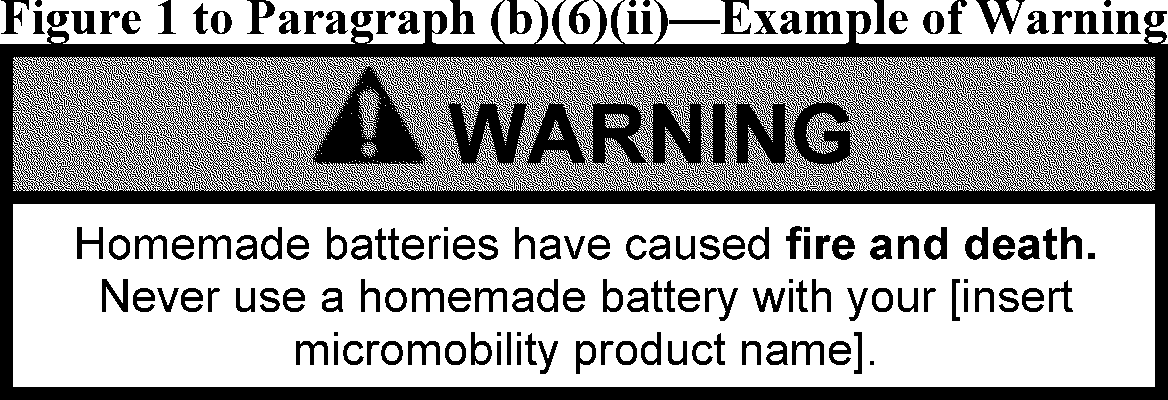
(iii) 44.6 Add the following warning statement or equivalent “To prevent risk of fire, ensure that battery is fully charged at every [manufacturer to insert recommended frequency]” or “To prevent the risk of fire, discard the battery if not used for [manufacturer to insert recommended duration].” The style, location and color requirements shall be the same as homemade battery warning specified in paragraph (b)(6)(ii) of this section.
(iv) 44.7 eBikes that contain hazardous voltage circuits shall be marked “Warning: Hazardous Voltage Circuits” or be marked with the electric shock hazard symbol from ISO 3864, No. 5036 (lightning bolt within a triangle) and shall contain the text “Do not open the enclosure.”
(v) 44.8 The following or equivalent marking shall be provided on the battery enclosure and/or device enclosure that serves as the outer enclosure of the battery: “WARNING—Risk of Fire and Electric Shock—Battery and/or battery components are not user replaceable. Do not attempt to open, disassemble or repair.”
(vi) 44.9 Each eBike shall be marked advising consumers to allow the eBike to cool down after each use and before plugging in the eBike or battery to charge. For eBikes with limited physical space, markings may be displayed within a software application that is used to operate or maintain the eBike.
(7) Insert the following sentence at the end of section 45.1 of UL 2849-20: “Instructions shall include all cautionary markings included in section 44, Cautionary Markings.”
(8) Exclude section 48.4 of UL 2849-20.
(9) Insert new sections 51 and 52 to UL 2849-20 as follows:
(i) 51. A user removable battery pack intended for removal and charging outside of the eBike shall be provided with instructions for safe handling including removal and insertion into the eBike and during charging, and instructions for storage outside of the eBike.
(ii) 52. Each eBike shall be provided with instructions warning against immersing or submerging the eBike, the battery, or any of the electrical components in water and shall also include steps for consumers to take to address a potential fire hazard in the event that the eBike, battery, or any electrical component is exposed to water.
§ 1265.3 Requirements for personal eMobility products.
(a) Except as provided in paragraph (b) of this section, each personal eMobility product must comply with all applicable provisions of ANSI/CAN/UL 2272:2024, Standard for Safety for Electrical Systems for Personal E-Mobility Devices (UL 2272-24) (approved on April 19, 2024), incorporated by reference in § 1265.7.
(b) Personal eMobility products shall comply with UL 2272-24 with the following additions and exclusions:
(1) Instead of complying with the exception in 9.2.3 of UL 2272-24, comply with the following: An easily detectable means for a new opening, for example a tamper-evident seal, is allowed but cannot be a substitute for the requirement. The manufacturer shall remind users not to use a product with broken seals and shall be immediately forwarded for appropriate recycling.
(2) Insert a new section 33A in UL 2272-24 as follows:
(i) 33A Aftermarket (Non-specified) Charger—Reverse Polarity Test.
(ii) 33A.1. This test evaluates the ability of the electrical system or battery pack to withstand the connection of a charger to the battery or personal eMobility product with an output connector that is the opposite polarity of the recommended charger. Use one personal eMobility product sample for this test.
(iii) 3A.1.1 This testing may be waived for battery systems evaluated to and compliant with UL 2271-23.
(iv) 33A.1.2 Unless noted otherwise, conduct all tests in a room with an ambient temperature of 25 ± 5 °C (77 ± 9 °F).
(v) 33A.1.3 Measure temperature using thermocouples consisting of wires not larger than 0.21 mm 2 (24 AWG), not smaller than 0.05 mm 2 (30 AWG), and that are connected to a potentiometer-type instrument. Make temperature measurements with the measuring junction of the thermocouple held tightly against the component/location being measured. For those tests that require the sample to reach thermal equilibrium (also referred to as steady state conditions), consider thermal equilibrium achieved if no change in temperature greater than ±2 °C (±3.6 °F) is indicated after three consecutive temperature measurements taken at intervals of 10% of the previously elapsed duration of the test, but not less than 15 min.
(vi) 33A.2 With a fully charged representative battery pack, connect in the reverse polarity intended for normal charging a programmable DC supply power set to a current limit of 8A and at 125% of the maximum charge voltage.
(vii) 33A.3 Protective devices that have been determined reliable may remain in the circuit.
(viii) 33A.4 Apply the reverse voltage for 4 hours or until a fire or explosion occurs. Measure temperatures on the cell/module where temperatures may be highest for monitoring purposes.
(ix) 33A.5 At no time during the 4-hour test period shall the reverse voltage be imposed on the cells.
(x) 33A.6 If the electrical system of the personal eMobility product is operational after the test, subject the product to a minimum of one charge/discharge cycle at the manufacturer's maximum specified values. The test shall be followed by a 1-hour observation time prior to concluding the test and temperatures shall be monitored.
(xi) 33A.7 At the conclusion of the test and after cooling to near ambient temperature, subject representative battery packs that contain a hazardous operating voltage to the Dielectric Voltage Withstand Test in section 30 of UL 2272-24 or to the Isolation Resistance Test (without humidity conditioning) in section 31 of UL 2272-24.
(3) Instead of complying with section 47.6 of UL 2272-24, comply with the following: 47.6 For personal eMobility products with separable battery packs that are intended to be user removable, the separable battery pack shall be marked “Use only with (__) personal eMobility product.” The information to be filled in must, at a minimum, include the name of the personal eMobility product manufacturer and the model number for each product with which the battery pack is intended for use, so that users can identify personal eMobility products in which the battery pack is safe for use.
(4) Instead of complying with section 47.8 of UL 2272-24, comply with the following: 47.8 Personal eMobility products that contain hazardous voltage circuits shall be marked “Warning: Hazardous Voltage Circuits” or be marked with the electric shock hazard symbol ISO 3864, No. 5036 (lightning bolt within a triangle) and contain the text “Do not open the enclosure.”
(5) Instead of complying with section 47.12 of UL 2272-24, comply with the following: 47.12 The following or equivalent marking shall be provided on the battery enclosure and/or product enclosure that serves as the outer enclosure of the battery: “WARNING—Risk of Fire and Electric Shock—Battery and/or battery components are not user replaceable. Do not attempt to open, disassemble or repair.”
(6) Insert new sections 47.13 through 47.19 to UL 2272-24 as follows:
(i) 47.13. Text size of signal words such as WARNING must be at least 0.2 inch (5 mm) in height and the message panel text letters must be no less than 0.1 inch (2.5 mm) high except as specified.
(ii) 47.14. Warning statements (message panel) must be in contrasting color to the background onto which the warning statement is printed. The safety alert symbol and signal word must be in black letters on an orange background if subject materials already use printed color processing, otherwise the use of black and white or contrasting colors is acceptable. Warning statements must be in contrasting color to the background onto which the warning statement is printed. The safety alert symbol (exclamation mark in a triangle), when used with the signal word ( e.g., WARNING) must precede the signal word. The base of the safety alert symbol must be on the same horizontal line as the base of the letters of the signal word. The height of the safety alert symbol must equal or exceed the signal word letter height. The signal word must appear in sans serif letters in upper case only.
(iii) 47.15. The following warning shall be provided on the personal eMobility product on a part that is not removable. The warning text must include the safety alert symbol, signal word, and text. The manufacturer must insert the specific type of personal eMobility product into the warning. Figure 1 to this paragraph (b)(6)(iii) provides an example warning in the format required in this paragraph (b)(6)(iii).
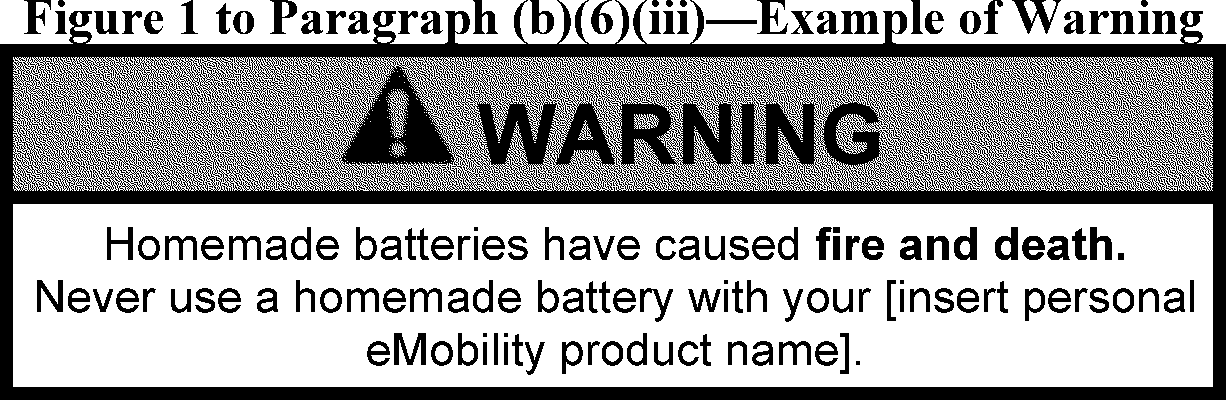
(iv) 47.16. Each personal eMobility product must contain the following warning or equivalent: “To prevent risk of fire, ensure that battery is fully charged at every [manufacturer to insert recommended frequency]” or “To prevent risk of fire, discard the battery if not used for [manufacturer to insert recommended duration].” The style, location and color requirements shall be the same as the homemade battery warning required in paragraph (b)(6)(iii) of this section.
(v) 47.17. Each personal eMobility product shall be marked to warn consumers to allow their product to cool down after use and before plugging the product in to charge. For personal eMobility products with limited physical space, markings may be displayed within a software application that is used to operate or maintain the personal eMobility product.
(vi) 47.18. If a manufacturer produces or assembles personal eMobility products at more than one factory location, each product shall have a distinctive marking—which may be in code—to identify the product of a particular factory.
(vii) 47.19. Each cautionary marking shall be located on a part of the personal eMobility product that is not removable or, if removable, on a part that impairs the operation of the unit when removed.
(7) Insert new sections 48.7 through 48.11 to UL 2272-24 as follows:
(i) 48.7. Meet instructional requirements in sections 45 through 50 of UL 2849-20 and where applicable, the requirement shall read “personal eMobility product” instead of “eBike.”
(ii) 48.8. Specific safety instructions shall be in separate manuals or, if combined, be visually distinguishable from the remainder of the text.
(iii) 48.9. While illustrations may accompany text, they cannot replace written instructions.
(iv) 48.10. Instructions shall include all warnings.
(v) 48.11 Each personal eMobility product shall contain warnings against immersing or submerging the product, the battery, or any of the components in water and include steps for consumers to take in the event that it occurs, to address a potential fire hazard.
§ 1265.4 Requirements for user replaceable battery packs.
(a) Except as provided in paragraph (b) of this section, each user replaceable battery pack that is not sold with a micromobility product must comply with all applicable provisions of ANSI/CAN/UL/ULC 2271:2023, Standard for Safety for Batteries for Use in Light Electric Vehicle (LEV) Applications (UL 2271-23) (approved on September 14, 2023), incorporated by reference in § 1265.7.
(b) User replaceable battery packs that are not sold with a micromobility product shall comply with UL 2271-23 with the following additions and exclusions:
(1) Insert new section 16.9 into UL 2271-23 as follows: 16.9 To reduce the likelihood of users accessing battery cells on a user replaceable battery pack intended to provide power to the motor(s) of an eBike or personal eMobility product, the battery pack outer enclosure shall be constructed such that it is not capable of being opened using common household tools, such as a flat blade or Philips head screwdriver. The enclosure shall be ultrasonically welded or secured by equivalent means. Equivalent means include adhesives complying with the adhesive requirements of UL 746C, Standard for Polymeric Materials—Use in Electrical Equipment Evaluations, or single use or tamper-proof screws.
(2) Instead of complying with section 28.5 of UL 2271-23, complying with the following: 28.5 Immediately following the discharge cycle, another charge shall be initiated. The BMS shall not permit charging if the surface temperature of a cell within the battery pack is higher than the manufacturer's specified maximum cell surface temperature during charging. A full charge shall be completed followed by a full discharge.
(3) Insert new section 32A into UL 2271-23 as follows:
(i) 32A Aftermarket (Non-specified) Charger—Reverse Polarity Test.
(ii) 32A.1 This test evaluates the ability of the battery pack to withstand connection of a charger with an output connector that is configured in the opposite polarity of the recommended charger.
(iii) 32A.1.1 Conduct all tests, unless noted otherwise, in a room with an ambient temperature of 25 ± 5 °C (77 ± 9 °F).
(iv) 32A.1.2 Measure temperature using thermocouples consisting of wires not larger than 0.21 mm 2 (24 AWG) and not smaller than 0.05 mm 2 (30 AWG) connected to a potentiometer-type instrument. Make temperature measurements with the measuring junction of the thermocouple held tightly against the component/location being measured. For those tests that require the sample to reach thermal equilibrium (also referred to as steady state conditions), consider thermal equilibrium achieved if no change in temperature greater than ±2 °C (±3.6 °F) is indicated after three consecutive temperature measurements taken at intervals of 10% of the previously elapsed duration of the test, but not less than 15 min.
(v) 32A.2 With a fully charged representative battery pack, connect in the reverse polarity intended for normal charging a programmable DC supply power set to a current limit of 8A and at 125% of the maximum charge voltage.
(vi) 32A.3 Protective devices that have been determined reliable may remain in the circuit.
(vii) 32A.4 Apply the reverse voltage for 4 hours or until a fire or explosion occurs. Measure temperatures on the cell/module where temperatures may be highest for monitoring purposes.
(viii) 32A.5 At no time during the 4-hour test period shall the reverse voltage be imposed on the cells.
(ix) 32A.6 If the battery is operational after the test, subject the battery to a minimum of one charge/discharge cycle at the manufacturer's maximum specified values. The test shall be followed by a 1-hour observation time prior to concluding the test and temperatures are to be monitored.
(x) 32A.7 At the conclusion of the test and after cooling to near ambient temperature, subject representative battery packs that contain a hazardous operating voltage to the Dielectric Voltage Withstand Test in section 30 of UL 2272-24 or to the Isolation Resistance Test (without humidity conditioning) in section 31 of UL 2272-24.
(4) Insert new sections 46.12 to 46.16 into UL 2271-23 as follows:
(i) 46.12. Text size of signal words such as WARNING must be at least 0.2 inch (5 mm) in height and the message panel text letters must be no less than 0.1 inch (2.5 mm) high except as specified.
(ii) 46.13. Warning statements (message panel) must be in contrasting color to the background onto which the warning statement is printed. The safety alert symbol and signal word must be in black letters on an orange background if the subject materials already use printed color processing, otherwise the use of black and white or contrasting colors is acceptable. Warning statements must be in contrasting color to the background onto which the warning statement is printed. The safety alert symbol (exclamation mark in a triangle), when used with the signal word ( e.g., WARNING) must precede the signal word. The base of the safety alert symbol must be on the same horizontal line as the base of the letters of the signal word. The height of the safety alert symbol must equal or exceed the signal word letter height. The signal word must appear in sans serif letters in upper case only.
(iii) 46.14. Each battery pack must be marked with the following language or equivalent: “To prevent risk of fire, ensure that battery is fully charged at every [manufacturer to insert recommended frequency]” or “To prevent the risk of fire, discard the battery if not used for [manufacturer to insert recommended duration].” The warning text must include the safety alert symbol, signal word “WARNING” and text.
(iv) 46.15. Each battery pack must be marked with the following statement: “Use only with [manufacturer to insert appropriate micromobility product name and model].” The warning text must include the safety alert symbol, signal word “WARNING” and text.
(v) 46.16. Each battery pack must be marked to identify the particular factory that assembled the battery pack, if more than one factory manufactures the same product.
(5) Insert new section 47.6 into UL 2271-23 as follows: 47.6 Instructions must be legible and include all warnings.
§ 1265.5 Requirements for eBike conversion kits.
(a) Components marketed, intended, or designed as part of an eBike conversion kit must comply with the specified sections of UL 2849-20, incorporated by reference in § 1265.7, as described in paragraph (b) of this section.
(b) Components marketed, intended, or designed as part of an eBike conversion kit shall comply with the following:
(1) If provided, the battery pack of an eBike conversion kit for powering the drive motor shall comply with sections 9 ( Combination of Battery, Battery Management System, and Charger ) and 12 ( Battery Packs ), and all referenced sections therein, of UL 2849-20.
(2) To prevent a user from accessing battery cells within a battery pack, the outer enclosure of the battery pack shall not be capable of being opened using common household tools, such as a flat blade or Philips head screwdriver. The enclosure shall be ultrasonically welded or secured by equivalent means. Equivalent means includes adhesives complying with the adhesive requirements of UL 746C, or single use or tamper-proof screws.
(3) If provided, the battery charger of each eBike conversion kit shall comply with sections 7 ( General ), 8 ( Power Levels ), 9 ( Combination of Battery, Battery Management System, and Charger ), 10 ( User Protection While Charging ), and 23 ( Chargers ), and all referenced sections therein, of UL 2849-20. The connector provided with the charger for connecting to the battery terminal for charging shall prevent misalignment, reverse polarity, or electrical mismatch. Compliance with this paragraph (b)(3) must be observable or, if necessary, meet the Protective Circuits and Safety Analysis requirements in section 12 of UL 2849-20.
(4) If provided, the operator interface of each eBike conversion kit shall comply with sections 7 ( General ), 8 ( Power Levels ), and 21 ( Operator Interface ), and all referenced sections therein, of UL 2849-20.
(5) If provided, the motors and motor controllers in eBike conversion kits shall comply with sections 7 ( General ), 8 ( Power Levels ), and 20 ( Motors and Motor Controllers ), and all referenced sections therein, of UL 2849-20.
(6) If provided, a user replaceable battery pack must comply with sections 46 ( Markings ) and 47 ( Instructions ) of UL 2271-23, including all referenced sections within those sections, as well as the additional markings and instructions for user replaceable battery packs required in § 1265.4(b)(4) and (5).
(7) If provided, each battery charger must comply with the marking and instructions for aftermarket battery chargers in § 1265.6(a) and (c).
§ 1265.6 Requirements for aftermarket battery chargers.
(a) Aftermarket battery chargers, if marketed, intended, or designed to charge an eBike battery, shall comply with section 23 of UL 2849-20, incorporated by reference in § 1265.7, and the requirements in § 1265.2(b)(2).
(b) Aftermarket battery chargers, if marketed, intended, or designed to charge a personal eMobility product battery, shall comply with section 11 of UL 2272-24, incorporated by reference in § 1265.7.
(c) Aftermarket battery chargers shall be provided with the following statement: “Use only with [manufacturer to insert appropriate micromobility product name and model].” The warning text must include the safety alert symbol, signal word “WARNING” and text.
§ 1265.7 Standards incorporated by reference.
(a) The standards required in this part, as stated in paragraph (b) of this section, are incorporated by reference into this part with the approval of the Director of the Federal Register under 5 U.S.C. 552(a) and 1 CFR part 51. This material is available for inspection at the U.S. Consumer Product Safety Commission and at the National Archives and Records Administration (NARA). Contact the U.S. Consumer Product Safety Commission at: the Office of the Secretary, U.S. Consumer Product Safety Commission, 4330 East West Highway, Bethesda, MD 20814, telephone (301) 504-7479, email: cpsc-os@cpsc.gov. For information on the availability of this material at NARA, visit https://www.archives.gov/federal-register/cfr/ibr-locations or email fr.inspection@nara.gov.
(b) A free, read-only copy of the standards incorporated by reference are available for viewing on UL's website at https://www.ulstandards.com/IBR/logon.aspx. You may also obtain a copy of each standard through Underwriters Laboratories, Inc (UL), 333 Pfingsten Road, Northbrook, IL 60062 or through UL's website at www.UL.com.
(1) ANSI/CAN/UL 2849:2020, Standard for Safety for Electrical Systems for eBikes (UL 2849-20) (approved on January 20, 2020), incorporation by reference approved for §§ 1265.2, 1265.5, and 1265.6.
(2) ANSI/CAN/UL 2272:2024, Standard for Safety for Electrical Systems for Personal E-Mobility Devices (UL 2272-24) (approved on April 19, 2024), incorporation by reference approved for §§ 1265.3 and 1265.6.
(3) ANSI/CAN/UL/ULC 2271:2023, Standard for Safety for Batteries for Use in Light Electric Vehicle (LEV) Applications (UL 2271-23) (approved on September 14, 2023), incorporation by reference approved for §§ 1265.4 and 1265.5.
§ 1265.8 Prohibited stockpiling.
(a) Prohibited acts. Manufacturers and importers of noncompliant micromobility products, including the components addressed in this part (user replaceable battery packs, aftermarket battery chargers, and components of eBike conversion kits), shall not manufacture or import such products that do not comply with the requirements of this part in any 180-day period between [date of publication of the final rule], and [effective date of the final rule], at a rate that is greater than 120 percent of the rate at which they manufactured or imported noncompliant micromobility products during the base period for the manufacturer.
(b) Base period. The base period for lithium-ion batteries used in micromobility products is the 13-month period immediately preceding [date of publication of the final rule].
§ 1265.9 Severability.
The provisions of this part are separate and severable from one another. If any provision is stayed or determined to be invalid, it is the Commission's intention that the remaining provisions shall continue in effect.
Appendix A to Part 1265—Findings Required by the Consumer Product Safety Act
Section 9(f) of the Consumer Product Safety Act (15 U.S.C. 2058(f)) requires the Commission to make findings concerning the following topics and to include the findings in the rule. Because the findings are required to be published in the rule, they reflect the information that was available to the Consumer Product Safety Commission (Commission, CPSC) when the rule was issued.
A. Degree and nature of the risk of injury. (1) Lithium-ion batteries used in micromobility products and the electrical systems of micromobility products, including components of eBike conversion kits, user replaceable battery packs, and aftermarket chargers, present an unreasonable risk of death and injury to consumers from electric shock, fires, explosions, expulsion of gas or flames, burns, overheating, and smoke inhalation. The primary risk of injury is associated with thermal runaway of micromobility electrical systems. In a multicell battery pack, the heat produced by the failure of one cell may propagate to other cells in the pack, expanding the release of extreme heat and fire due to thermal runaway induced in other cells, with temperatures that can exceed 1000 °C (1832 °F).
(2) Once ignited, flaming lithium-ion battery contents and gases build internal pressure and can be explosively ejected from the cell enclosure. The flaming materials may ignite nearby combustibles. Because micromobility products are often left to charge in a garage, house, or multifamily dwelling, fires can spread to combustible materials stored in those locations, such as gas or kerosene in a garage, and carpets, furniture, drapes, decorative items, and other electronic equipment in the house. Fires can also spread to the structure itself. Smoke produced by combustion is a colloid consisting of airborne solids, liquid particles, and gases ( e.g., CO 2 , CO) mixed with air. Harmful gases and fire may result in injuries and deaths to anyone inside the house or building.
(3) CPSC identified 227 unique incidents involving 357 victims that are related to micromobility products' lithium-ion batteries from January 1, 2019, through December 31, 2023. CPSC is aware of 39 fatalities, 181 injuries, and 137 non-injury incidents. Thirty-nine incidents involved multiple victims with fatalities and injuries. Of the 37 fatalities with age information, four (11 percent) were under 5 years old and nine (24 percent) were 65 and older. These fatality rates for young children and seniors are disproportionately higher compared to their corresponding proportions in the general U.S. population.
(4) Consumers are exposed to the unreasonable risks of injury during foreseeable use of micromobility products, such as during charging and discharging of lithium-ion batteries. Twenty-one out of the 39 incidents involving multiple-victim incidents (54 percent) occurred while the product was plugged in charging, including 15 out of 32 fatalities (47 percent) and 79 out of 137 injuries (58 percent). Seven multi-victim incidents were reported while the products were being stored or resting in open space and unexpectedly caught fire, causing four deaths and 33 injuries. Two incidents with five injuries were associated with products during use, shortly after use, or after unplugging a charger from the product. Users removing or replacing the battery and using a user replaceable battery or aftermarket charger were associated with four incidents, two deaths, and nine injuries. An incident was reported in which the victim was manufacturing, repairing, and charging homemade lithium-ion batteries, resulting in one death and two injuries. The remaining four multiple-victim incidents did not provide specific hazard description but accounted for 10 deaths and nine injuries.
B. Number of consumer products subject to the rule. (1) The Commission is aware of 179 firms that manufacture or supply eBikes to the U.S. market. In 2021, 898,100 eBikes were sold in the United States. Staff estimate a high growth rate for this market, estimating that in 2024 about 1.4 million eBikes were sold in the United States.
(2) The Commission is aware of 81 firms supplying 704 eScooter models/variants to the U.S. market. In 2021, 177,500 eScooters for commercial and private use were sold in the United States. CPSC staff estimate that in 2024, 257,500 eScooters were sold in the United States.
(3) The Commission is aware of 67 firms that manufacture or supply OMPs, meaning eSBscooters, eSkateboards, and eUnicycles, to the U.S. market. In 2021, about 1.3 million eSBscooters, and 124,100 eSkateboards and eUnicycles, were sold in the United States. In 2024, staff estimate about 1.4 million eSBscooters and 182,900 eSkateboards and eUnicycles were sold in the United States.
C. The public need for lithium-ion batteries in micromobility products and the effects of the rule on their utility, cost, and availability. (1) Micromobility products are marketed, intended, and designed for recreational off-road use, and for transportation in urban and suburban areas, typically for short distances. Products are sold to consumers for personal recreation and business use as well as to businesses for commercial purposes, such as rideshares and rentals for consumer use.
(2) eBikes are open frame bicycles with an electric motor and battery installed to assist the rider. eBikes are sold for use by children and adults; children's products can be purchased for as little as $200, while cargo models intended to carry additional passengers and/or cargo can sell for more than $10,000. Premium eBikes start at $2,500 and have more powerful motors that can reach speeds exceeding 28 miles per hour (mph) with pedal assist, hydraulic brakes, and lighter frames. The average price across all eBikes is approximately $3,150.
(3) Conversion kits for eBikes are battery products that convert a traditional bicycle to an eBike. Prices for conversion kits range from $100 to $400 not including a battery.
(4) eScooters are two-wheeled products comprised of a platform (with or without seating) supported by wheels in a longitudinal placement and without pedals. eScooters also use handlebars that enable users to steer and brake. Child and youth models range from $79 to $333, with the average at $188. Adult model prices average $780 and range from $499 to $7,299. Commercial eScooters are eScooters purchased for business operations instead of personal use and are mostly purchased by ridesharing companies to add to their fleet in urban areas. For all categories, the average eScooter model price was about $510.
(5) OMPs, such as eSBscooters (examples include segways and hoverboards), eSkateboards, and eUnicycles, are used primarily for recreation and are considered more difficult to operate than eBikes and eScooters. One type of eSBscooters, segways, are battery-powered mobility products that have two parallel wheels connected by a platform on which the user stands, and a steering bar. The original Segway sold for approximately $5,000, while other versions sell for $300 to $1,000. Segway-type eSBscooters specific to the children's market range in price from $299 to $499. Another type of eSBscooter consists of battery-powered mobility products, such as hoverboards, that have two parallel wheels connected by a platform on which the user stands. The market price for children's models ranges from $89 to $370 and adult models range from $150 to $399 in price.
(6) eSkateboards are board platforms supported by four wheels that are powered by electric motors, typically either a hub motor or a belt drive and gear system. eUnicycles are platforms supported by a single wheel, powered by an electric motor. eSkateboard and eUnicycle products for the adult market are split between entry-level at prices between $200 and $650, and higher-performance varieties at more than double these prices. eUnicycles start at around $1,000.
(7) The Commission finds that the rule, if adopted, would not have a substantial effect on the utility or availability of micromobility products, and the impact on cost depends on the product type. The Commission expects no loss of function or utility to these products from the rule because the construction and performance requirements would not affect riding ability, steering, or top speed for these products. CPSC estimates the incremental cost to manufacturers to produce a compliant product to be an average of $230 for a noncompliant eBike, $114.86 for a noncompliant eScooter, and $162.79 for remaining OMPs. These compliance costs are per unit estimates for the first year of the rule and the Commission expects these costs to decrease throughout the years due to economies of scale. While these costs are not insignificant, the Commission does not expect a significant change in the market that would affect the availability of these products.
D. Other means to achieve the objective of the rule, while minimizing adverse effects on competition and manufacturing. (1) The Commission considered six alternatives to achieving the rule's objective of reducing the unreasonable risks of death and injury associated with lithium-ion batteries used in micromobility products and their electrical systems.
(2) Limiting the Scope of the Rule to OMPs. The Commission considered removing eBikes from the rule. With this alternative, estimated benefits of the rule would be highly likely to exceed its estimated costs. However, this alternative would not address the unreasonable risks of death and injury associated with eBikes and thus would expose consumers, including vulnerable young children and seniors, to those hazards. eBikes have the least mature market with the highest growth potential, leading to uncertainty about what the future of the product, market, and safety record will be going forward. The Commission determines that the risk of death and injury to consumers associated with eBikes weighs against removing eBikes from the rule.
(3) Conduct Marketing Campaigns Instead of Promulgating a Final Rule. Rather than promulgating a rule, the Commission considered issuing news releases and utilizing other information and marketing techniques to warn consumers about the unreasonable risks of death and injury to consumers. CPSC already conducts education campaigns yet deaths and injuries associated with lithium-ion batteries in micromobility products continue to occur. Therefore, much of the societal costs would continue to be incurred by consumers in the form of deaths, injuries, and property damage. For this reason, the risk of death and injury to consumers associated with micromobility products weigh against relying primarily on consumer education campaigns to address the hazards.
(4) Conduct Recalls Instead of Promulgating a Final Rule. CPSC has already announced 29 consumer-level recalls and incidents continue to occur, so this option would merely maintain the status quo and not otherwise advance the safety of micromobility products. Furthermore, unlike a rule that applies to newly manufactured micromobility products, recalls only apply to specific products, and occur only after consumers have purchased and used such products and have been exposed to and potentially injured or killed by the hazard. Recalls do not prevent unsafe products from entering the market. If the Commission adopted this alternative, much of the societal costs would continue to be incurred by consumers in the form of deaths, injuries, and property damage. For these reasons, the Commission finds that recalls would not adequately eliminate or reduce the unreasonable risk of injury associated with micromobility products in the absence of rulemaking.
(5) Rely on Voluntary Standard Development. This alternative would allow firms and other stakeholders to collectively determine the degree, manner, and timing of hazard mitigation, which could delay or reduce the effectiveness of standards intended to address the hazard. In addition, firms may choose not to comply with voluntary standards and therefore incur no associated costs. CPSC staff already participate in the UL process for all three of the UL standards incorporated by reference into this part, so this alternative, like recalls, maintains the status quo. Accordingly, the Commission finds that relying on voluntary standards development in lieu of rulemaking would not eliminate or adequately reduce an unreasonable risk of injury.
(6) Set a Later Effective Date. A later effective date would allow manufacturers more time to redesign micromobility products, modify production lines, or spread research and development costs over a greater period, and mitigate supply chain issues. However, costs associated with these manufacturing activities are unlikely to be significant. The costs of the rule instead come primarily from sourcing compliant components that are currently available and can be incorporated into finished products within 180 days, and changes to warnings that would not require more than 180 days. Additionally, laboratories are already available to test products and lab capacity should not be an issue. Based on the foregoing, the Commission finds that addressing the unreasonable risk of injury within 180 days outweighs any argument that firms require more than 180 days to comply.
(7) Take No Regulatory Action. As the relevant UL voluntary standards, particularly the UL 2272-24 revision, are relatively new, compliance rates may improve in the future. State and local regulations mandating compliance with voluntary standards for micromobility products, such as a recent regulation in New York City, insurance availability, and other forces may accelerate compliance with the voluntary standards. However, without a Federal mandatory regulation, firms could choose to continue to produce non-compliant micromobility products. Given persistent deaths and injuries associated with these products, the Commission finds that maintaining the status quo will not eliminate or adequately reduce the unreasonable risk of death and injury associated with micromobility products.
E. The rule (including its effective date) is reasonably necessary to eliminate or reduce an unreasonable risk of injury. (1) As summarized in this appendix, consumers are exposed to an unreasonable risk of injury associated with these products. Vulnerable populations, children and the elderly, are disproportionately represented in the incident data. Despite the existence of voluntary standards, CPSC's work on the voluntary standards—and recalls, deaths, and injuries—continue.
(2) The Commission does not expect the adoption of this part to have a substantial effect on the utility or availability of products, as stated in paragraph C of this appendix. Weighing the possibility of increased costs for micromobility products within the scope of the rule with the continuing deaths and injuries to consumers, the Commission concludes that micromobility products pose an unreasonable risk of injury and death and that the rule is reasonably necessary to reduce that unreasonable risk of injury and death.
(3) The Commission also finds that an effective date of 180 days after publication of a final rule is reasonably necessary to address the unreasonable risks of death and injury associated with lithium-ion batteries used in micromobility products. When balancing the risk of death and injury to consumers against the possibility that some products may be less available during a transition period in the market, the Commission finds that the public interest is better served by protecting the safety of consumers.
F. Public interest. Adherence to the requirements of the rule will significantly reduce or eliminate hazards associated with micromobility products within the scope of the rule without major disruption to industry or consumers; thus, the Commission finds that promulgation of the rule is in the public interest.
G. Voluntary standards. (1) The rule incorporates by reference three voluntary standards applicable to micromobility products: UL 2849-20 (applicable to eBikes, eBike conversion kits, and related battery chargers); UL 2272-24 (applicable to OMPs and related battery chargers); and UL 2271-23 (applicable to user replaceable battery packs), with modifications to fully address the associated risks of injury. Although many requirements in the UL standards adequately address the hazards, overall, the requirements in the UL standards do not address all identified hazards associated with lithium-ion batteries used in micromobility products and their electrical systems. Accordingly, the rule includes several modifications to the standard's performance, marking, and labeling requirements. The Commission finds that without these modifications, UL 2849-20, UL 2272-24, and UL 2271-23 are inadequate to eliminate or adequately reduce the unreasonable risks of injury associated with these products.
(2) CPSC obtained estimated compliance rates from a 2023 survey of “brick and mortar” retail stores and found that weighted compliance rate across all micromobility product types in use (including eBikes) is approximately 45 percent. Together with the substantial number of incidents involving death and injury associated with noncompliant micromobility products, the survey data show that product compliance with the UL voluntary standards has not reached the level where the risk to consumers from these products is adequately mitigated. Accordingly, the Commission determines that it is unlikely that there will be substantial compliance with UL 2849-20, UL 2272-24, or UL 2271-23.
H. Relationship of benefits to costs. (1) CPSC conducted a benefits and costs analysis which accounts for mitigated deaths, injuries, and property damage by monetizing deaths using the value of statistical life (VSL), injuries using CPCS's Injury Cost Model (ICM), and property damage based on historical damage assessments.
(2) The micromobility product market includes emerging products, some of which have only been introduced in the last decade and are rapidly growing in popularity and consumer acceptance. The relative novelty of these products poses challenges in the incident data. For example, fire incident data that CPSC staff use to identify addressable fire incidents do not have a product category for lithium-ion batteries, which may cause lithium-ion battery fires from micromobility products to be mislabeled or not identified if a micromobility product is not mentioned in the incident narrative. eBike data especially have a high degree of uncertainty because eBikes are the least mature segment of the micromobility product marketplace, with substantial uncertainties related to product safety, consumer demand, producer behavior in the absence of a CPSC regulation addressing battery safety, and a growing presence of other regulations—particularly at the state and local levels.
(3) Given these uncertainties, the Commission presents the results of the benefits and costs analyses under two framings: (a) an estimate that uses the incident data collected despite likely underestimation of incidents, and (b) an upper-bound estimate that addresses the uncertainty in incidents by aligning eBike fatality rate with the rate of eScooters—which is the most developed micromobility product market.
(4) Over a 30-year study period, the estimate of the total annualized benefits, discounted at 3 percent, is $61.17 million from mitigated death and injuries associated with lithium-ion batteries used in micromobility products and their electrical systems. The upper-bound estimate identifies total annualized benefits of $472.97 million, also discounted at 3 percent.
(5) The safety improvements in this part involve two main costs: (a) a compliance cost to upgrade micromobility products to meet performance requirements; and (b) deadweight losses or market impacts caused by the increased price associated with compliance with the regulation and the subsequent decline in demand. The Commission estimates the total annualized costs from the proposed rule, discounted at 3 percent, to be $146.52 million.
(6) When costs are compared to the estimate of benefits, the estimated costs of the rule exceed benefits. Estimated annualized net benefits (benefits less costs) are −$85.35 million, discounted at 3 percent. Based on this estimate the rule would have a benefit-cost ratio of 0.42 for all micromobility products, meaning it returns $0.42 of benefits for every $1 in costs.
(7) The upper-bound estimate of benefits yields annualized net benefits of $472.97 million and a benefit-cost ratio of 3.23, meaning the rule returns $3.23 of benefits for every $1 in costs.
(8) There are both unquantified benefits and unquantified costs. The unquantified benefits stem from avoided property damage, legal costs, and insurance premium increases. Because the available data on fire incidents do not have a product category for lithium-ion batteries, CPSC's analysis could be underestimating the number of incidents and the magnitude of loss from fires from these batteries. Additionally, fires in multi-dwelling units have the potential to impose significant negative externalities, such as a fire that results in property loss for a neighbor. CPSC could not quantify these impacts due to a lack of robust data in the various data sources reviewed. Fire spreading to nearby structures also could result in additional legal costs; the potentially large magnitude of these losses could make some legal fees significant.
(9) Based on this analysis, the Commission finds that the benefits expected from the rule bear a reasonable relationship to the anticipated costs of the rule.
I. Least burdensome requirement that would adequately reduce the risk of injury. (1) The Commission considered less burdensome alternatives to the final rule, detailed in paragraph D of this appendix, but finds that none of these alternatives would eliminate or adequately reduce the risk of injury.
(2) For example, the Commission considered relying on voluntary recalls, compliance with the voluntary standard, and education campaigns, rather than issuing a mandatory standard. These alternatives would have minimal costs but would be unlikely to reduce the associated risks of injury.
(3) The Commission considered issuing a standard that only applies to OMPs and removes eBikes. This approach would impose lower costs on manufacturers but is unlikely to adequately reduce the risk of injury because it would not address the unreasonable risks of injury associated with eBikes.
(4) Based on the analysis of the alternatives to rulemaking in paragraph D of this appendix, the Commission finds that the rule is the least burdensome requirement that would adequately eliminate or reduce the unreasonable risk of death and injury associated with lithium-ion batteries used in micromobility products and their electrical systems.
Alberta E. Mills,
Secretary, Consumer Product Safety Commission.
[FR Doc. 2026-12749 Filed 6-23-26; 8:45 am]
BILLING CODE 6355-01-P