U.S. Dep’t of Justice, "ADA Business Brief: Communicating with Guests who are Deaf or Hard of Hearing in Hotels, Motels, and Other Places of Transient Lodging" (2003)
ADA Business Brief: Communicating with Guests who are Deaf or Hard of Hearing in Hotels, Motels, and Other Places of Transient Lodging
Published Oct 1, 2003Department of Justice, Civil Rights Division
People who are deaf or hard of hearing use a variety of ways to communicate. Some rely on sign language interpreters or assistive listening devices; some rely primarily on written messages. Many can speak but are not able to hear words spoken by others. The method of communication and the services or aids hotel staff must provide will vary depending upon the abilities of the guest and on the complexity and nature of the communications that are required.
Under the Americans with Disabilities Act (ADA), hotels and motels must provide effective means of communications for persons who are deaf or hard of hearing to ensure that they have an equal opportunity to enjoy the goods, services, accommodations, and amenities offered.
Illustration 1 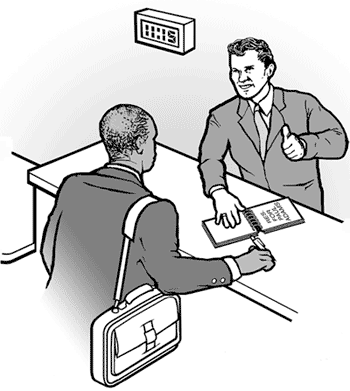
A hotel guest who is deaf communicates using written notes with the desk clerk at check-in.
- For short and relatively simple in-person conversations, such as inquiries about room rates and availability, or questions about restaurant menu items, an exchange of written notes may be effective.
- For telephone communications, many people who are deaf or hard of hearing use a teletypewriter (TTY, also known as a TDD) rather than standard telephones. These devices have a keyboard and a visual display for exchanging written messages over the telephone.
- To allow guests with hearing disabilities access to hotel telephone services, the hotel must provide a TTY, on request, for use in guest rooms. The hotel also will need to have a TTY at the front desk, and perhaps at other telephone stations, for handling billing inquiries, taking room service orders, or responding to other guest calls. Hotel desk staff should be trained in handling TTY equipment.
- The ADA established a free nationwide relay network to handle voice-to-TTY and TTY-to-voice calls. Individuals may use this network to call the hotel from a TTY. The relay consists of an operator with a TTY who receives the call from a TTY user and then places the call to the hotel. The caller types the message into the TTY and the operator relays the message by voice to the hotel staff person, listens to the staff person’s response, and types the response back to the caller using the TTY. The hotel must be prepared to take and respond to relay system calls, which may take a little longer than voice calls. For outgoing calls to a TTY user, simply dial 7-1-1 to reach a relay operator.
Illustration 2 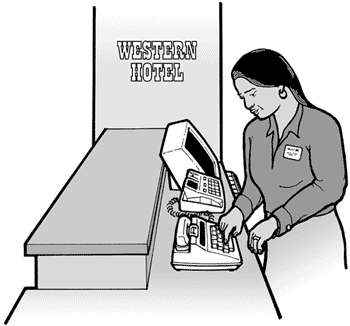
Front desk staff use a TTY to take a call for room service from a hotel guest who is deaf.
- Where televisions are provided in guest rooms, closed caption decoders must be provided upon request. New televisions at least 13 inches or larger have such devices built in.
- Some people with hearing disabilities use service animals — often “Hearing Ear Dogs” — to assist them with safety and way-finding. The hotel must permit guests to bring such animals into areas of the hotel where guests are normally allowed to go, even if it otherwise prohibits animals in the facility. For further information on the ADA’s requirements for service animals, please see the ADA Business Brief: Service Animals, which is available from the ADA Business Connection or the ADA Information Line.
- If communication with guests is lengthy or complex, it may be necessary to provide a sign language interpreter, or oral interpreter, or computer-assisted, real-time captioning in order to ensure effective communication with persons with hearing disabilities.
- A hotel or other place of lodging need not provide any of the communication aids or services described above if doing so would fundamentally alter the nature of the goods or services offered or would result in an undue burden.
Hotels and motels must also provide built-in communication features in a certain percentage of guest rooms.
These features include:
- Visual alarms in guest rooms that are connected to the building’s emergency alarm system.
- Visual notification devices in guest rooms to alert persons with hearing impairments to incoming telephone calls and door knocks or bells.
- Electrical outlets to facilitate the use of text telephones.
These communication features are required in hotel facilities built or altered after the effective date of the ADA. They are also required in hotel facilities built before the effective date of the ADA to meet the ongoing obligation to remove physical and communication barriers to the extent possible without much difficulty or expense. Hotels and motels may also use portable visual alarms and communication devices to satisfy these requirements. Check the ADA Standards for Accessible Design.
Portable communication kits that include text telephones, visual alarms and visual notification devices are available on the market at relatively modest cost.
If you have specific questions concerning the ADA, call the Department of Justice’s ADA Information Line.
800-514-0301 (voice) 833-610-1264 (TTY)
The Americans with Disabilities Act authorizes the Department of Justice (the Department) to provide technical assistance to individuals and entities that have rights or responsibilities under the Act. This document provides informal guidance to assist you in understanding the ADA and the Department’s regulations.
Guidance documents posted to this website are not intended to be a final agency action, have no legally binding effect, and have no force or effect of law. The documents may be rescinded or modified in the Departments’ complete discretion, in accordance with applicable laws. The Departments’ guidance documents, including this guidance, do not establish legally enforceable responsibilities beyond what is required by the terms of the applicable statutes, regulations, or binding judicial precedent. For more information, see 1-19.000 – Principles for Issuance and Use of Guidance Documents, https://www.justice.gov/jm/1-19000-limitation-issuance-guidance-documents-1.